New Tech Industries Your Guide to the AI Revolution
The AI economy isn’t creeping forward. It’s jumping. The AI sector is projected to reach $407 billion in 2025, up from $142 billion in 2023, and enterprise AI adoption among Fortune 500 companies rose from 23% to 67% in 18 months according to Research and Metric’s industry growth outlook.
That kind of shift changes how people work, how businesses compete, and how beginners should think about technology. New tech industries aren’t just for engineers building chips or researchers training giant models. They affect the software you use, the products you buy, the jobs being created, and the skills that matter more every year.
A good way to think about this moment is simple. Past industrial revolutions gave people stronger machines. This one gives people stronger digital decision-making. Computers aren’t only storing information anymore. They’re helping write, summarize, classify, predict, generate, and act.
If you’re still getting your bearings, start with a plain-language primer on AI basics at https://yourai2day.com/what-is-artificial-intelligence/. And if you’re curious how simple prompts can turn into working tools, this guide on Prompt to App gives a practical look at how ideas move from words to software.
Welcome to the Next Digital Frontier
The phrase new tech industries can sound broad and fuzzy. It isn’t. It describes a cluster of fast-moving fields built around software, data, automation, computing power, and connected systems.
What makes this era different is the speed of convergence. AI needs data. Data needs cloud systems. Cloud systems need chips, networks, storage, and security. Businesses then wrap those layers into products people can use.
That’s why AI feels like it’s everywhere all at once. It isn’t replacing every industry. It’s rewiring them.
Why this feels bigger than a normal tech trend
A lot of people hear terms like machine learning, generative AI, biotech, robotics, and edge devices and assume they’re separate stories. In practice, they overlap.
Your phone assistant, a hospital imaging tool, a fraud detection system, and a warehouse robot may look unrelated on the surface. Underneath, they often depend on the same building blocks:
- Data: the raw material
- Models: the pattern-finding engine
- Infrastructure: the compute, cloud, and storage layer
- Interfaces: the apps and tools people use
Practical rule: If a technology can learn from data, improve a decision, or automate a repeated task, it’s probably part of this new wave.
For beginners, the key isn’t memorizing every buzzword. It’s learning how the pieces connect. Once you see that, the field gets much less intimidating.
What Are New Tech Industries Really
New tech industries are the parts of the economy growing around advanced digital capabilities. Think AI, cloud platforms, cybersecurity, biotech tools, robotics, clean energy software, smart devices, and the hardware that powers them.
A simple analogy helps. Old industrial revolutions scaled human muscle with engines and factories. Today’s new tech industries scale human judgment with data and software.

The fuel behind the shift
These industries aren’t growing in a vacuum. They’re being pushed by huge investment and huge data creation.
Worldwide IT spending is forecasted to hit $5.75 trillion in 2025, and global data creation is projected to reach 182 zettabytes, according to CompTIA’s IT Industry Outlook 2025. In plain language, businesses are spending heavily on digital systems while creating more information than people can handle manually.
That’s why AI matters so much. It helps turn overwhelming amounts of data into something usable.
The main pillars beginners should know
Not every new tech industry works the same way, but most fit into a few familiar buckets.
AI and machine learning
This is the pattern-recognition layer. It helps software classify, predict, generate content, and support decisions.
Examples include spam filters, recommendation engines, chatbots, coding assistants, and image analysis tools.
Cloud and data infrastructure
This is the storage-and-compute backbone. It lets companies run heavy workloads without owning every server themselves.
If AI is the brain, cloud infrastructure is the nervous system and power supply.
Advanced hardware
AI doesn’t run on magic. It runs on chips, memory, networking equipment, and specialized devices built for demanding workloads.
This layer often gets less attention from beginners, but it’s one of the most important parts of the stack.
Biotech and health tech
Computation meets biology and medicine. AI can help with diagnosis support, drug research, patient monitoring, and operational planning.
For many people, this is the easiest place to see technology’s practical value.
Automation and smart systems
These tools don’t just analyze. They also act. That includes robotics, logistics software, autonomous features, industrial sensors, and digital agents.
New tech industries are best understood as a connected system, not a pile of separate inventions.
Why people get confused
One reason beginners get stuck is that companies market every feature as a revolution. A chatbot, a robot vacuum, a cloud dashboard, and a medical imaging model may all get labeled “AI,” even though they do very different things.
A better question is this: What job is the technology doing?
If it creates content, it may be generative AI.
If it spots patterns in records, it may be machine learning.
If it runs locally on a device, it may be edge AI.
If it helps move goods or machines, it may be automation.
That shift in thinking makes new tech industries much easier to follow.
Exploring the Hottest AI-Driven Sectors
Some AI sectors matter because they’re flashy. Others matter because they gradually become infrastructure. The most important ones usually do both.
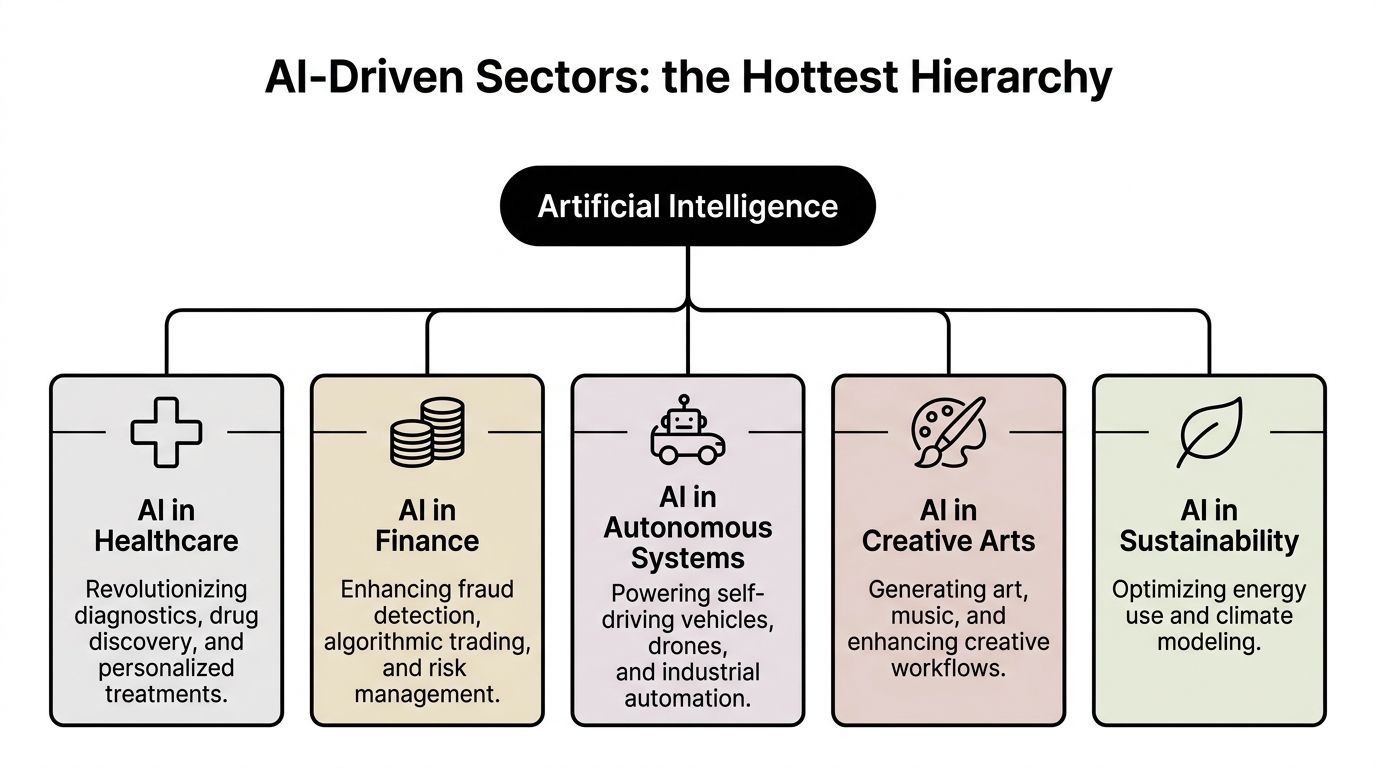
A quick snapshot
| AI Sector | What It Does (In Simple Terms) | Everyday Example |
|---|---|---|
| Generative AI | Creates text, images, audio, or code | ChatGPT drafting an email |
| Edge AI | Runs AI on a device instead of faraway servers | A phone improving photos instantly |
| AI hardware | Powers demanding AI workloads | Specialized chips training large models |
| Autonomous systems | Helps software or machines act with less human control | A warehouse robot routing items |
| AI in biotech | Uses computation to support health and biology work | Software helping analyze scans |
| AI for climate and energy | Optimizes energy use and forecasting | Smart systems balancing power demand |
Generative AI
This is often the first sector encountered. Generative AI creates new content from patterns it has learned.
If you’ve asked ChatGPT to write a message, summarize notes, brainstorm ideas, or explain a topic, you’ve already used it. Tools like Midjourney and Adobe Firefly do something similar for images. Coding assistants help with software tasks in the same general way.
For beginners, the easiest analogy is this: generative AI is like a creative assistant that responds at computer speed. It still needs supervision, but it removes a lot of blank-page work.
In healthcare, this category also overlaps with practical use cases such as summarizing medical documentation and supporting patient communication. For a more focused look, this guide to https://yourai2day.com/generative-ai-use-cases-in-healthcare/ is useful for seeing where content generation meets clinical workflows.
Edge AI
People often assume AI always lives in giant data centers. A lot of it does. But some AI runs directly on devices like phones, cars, cameras, appliances, and sensors.
That’s edge AI.
Why does that matter? Because local processing can be faster, more private, and more reliable when internet access is weak or delay matters. A smart camera spotting unusual movement or a phone transcribing speech in real time are easy examples.
The device is still using AI. It’s just not sending every task somewhere else first.
AI hardware
This sector sits underneath the apps everyone talks about. Without specialized hardware, many modern AI systems would be too slow, too expensive, or too power-hungry to use at scale.
A major trend here is agentic AI, where autonomous software agents can handle more complex tasks with less hand-holding. According to McKinsey’s top trends in tech, this shift is being enabled by specialized hardware such as NVIDIA’s H200 GPUs, which reduce processing latency by 2 to 3 times compared with earlier models.
That may sound technical, but the practical meaning is simple. Faster hardware makes AI feel more responsive. It helps tools answer quicker, process larger workloads, and support more demanding use cases.
Better AI experiences often start far below the app layer, inside the hardware and infrastructure most users never see.
Autonomous systems
Autonomous systems combine sensing, decision-making, and action. Sometimes that means robots. Sometimes it means software agents handling multistep tasks.
A warehouse machine moving goods is one version. A digital system that reviews requests, checks rules, and routes work to the right team is another.
This category is one reason people are hearing more about AI “agents.” Instead of answering a single prompt, the system can carry out a sequence. It may gather information, compare options, produce an output, and trigger the next step.
For businesses, that’s where AI starts moving from assistant to coworker.
AI in biotech and healthcare
This is one of the most meaningful areas because the impact is easy to understand. People want earlier detection, better planning, smoother administration, and more personalized care.
AI can support image analysis, documentation, triage, research workflows, and patient monitoring. It doesn’t remove the need for doctors, nurses, or researchers. It helps those professionals work with more context and less routine friction.
That’s also why this sector draws so much attention from people outside tech. The benefit feels human, not abstract.
AI for climate and energy
This sector gets less consumer attention, but it matters a lot. AI can help organizations monitor equipment, forecast demand, manage grids, improve energy efficiency, and model environmental conditions.
In simple terms, it helps people run complex systems with fewer blind spots.
This overlaps with another growing area too. Teams building decentralized digital systems are also exploring new ways data, automation, and ownership can work together. If you want to see how adjacent technology ecosystems are being built, this overview of developing Web3 Apps is a helpful companion because it shows how new platforms often emerge in layers rather than isolation.
How New Tech is Changing Daily Life and Business
New tech industries become easier to understand when you stop looking at categories and start looking at routines.

At home
A person wakes up and checks a phone that has already filtered spam, organized photos, suggested a route, and drafted a reply. None of that feels like a science-fiction breakthrough. It feels normal.
That’s how technology adoption usually works. The hard engineering disappears behind convenience.
A smart speaker transcribes speech. A streaming app recommends what to watch. A banking app flags an unusual transaction. A fitness wearable notices patterns in sleep or activity. These aren’t separate stories. They’re examples of software making decisions or recommendations from data.
At work
Now think about a small online store.
The owner uses ChatGPT to draft product descriptions, rewrite ad copy, and answer common customer questions faster. Their design team uses Canva or Adobe tools to create campaign variations. Their inventory software predicts what might run low. Their shipping system suggests efficient routing. None of these tools has to be perfect to be useful.
The pattern is what matters. Small gains stack up.
One practical business example
A local services company might use AI in a very ordinary way:
- Marketing support: generate first drafts for blog posts, emails, and ad ideas
- Customer service: summarize support tickets before a human replies
- Operations help: sort incoming requests by urgency
- Knowledge access: search company documents with natural language
That doesn’t require a research lab. It requires a clear problem and some testing.
The best early AI use cases are usually boring on the surface. They save time, reduce repetition, and help people focus on judgment-heavy work.
In physical spaces
AI also shows up where software meets machines. Stores use computer vision for inventory checks. Warehouses use robots for movement and sorting. Buildings use sensors to adjust heating, lighting, or maintenance schedules.
Even kitchens and appliances are becoming part of the story. Devices can increasingly respond to routines, learn preferences, and connect to wider digital systems.
For a quick visual example of how consumer-facing AI is framed in everyday products, this video is a useful reference:
Why this matters to non-technical people
A lot of readers worry that they need to code before they can benefit from this shift. Usually, they don’t.
Users will experience new tech industries through interfaces, not through model training. They’ll ask better questions, compare tools, automate tasks, and decide where human review still matters.
That’s a very different skill set from building AI from scratch. And for many careers, it’s the more relevant one.
Finding Your Place in the New Tech Economy
The biggest mistake beginners make is thinking they’re either “technical enough” for this era or they’re not. That’s the wrong test.
The better question is: Where can you add judgment in a workflow that now includes AI?

For individuals
You don’t have to become a machine learning researcher to benefit from new tech industries. Plenty of valuable roles sit around implementation, operations, analysis, governance, training, product design, and domain expertise.
For example, a marketer who learns prompt design and content review becomes more effective. A project manager who understands AI tool limits can lead smarter pilots. A healthcare worker who knows how AI fits into documentation or triage can contribute far beyond “basic user” status.
If you want to understand one highly specialized path, this role guide at https://yourai2day.com/machine-learning-scientist/ helps show what deeper technical careers involve.
For employers and entrepreneurs
Businesses often overcomplicate adoption. They start by asking, “How do we become an AI company?” A better opening question is, “Where are our teams losing time on repetitive work?”
Then test one workflow.
A simple adoption playbook
Pick one narrow task
Start with something repetitive like support summaries, first-draft content, internal search, or scheduling assistance.Keep a human in the loop
Early wins come from assistance, not blind automation.Set a review standard
Decide what accuracy, tone, compliance, or safety checks are required before output is used.Train the people doing the work
Adoption stalls when leadership buys tools but teams don’t learn how to use them.
Why training matters more than hype
A lot of coverage around new tech industries focuses on elite engineers. That misses a huge part of the story. Many organizations need practical upskilling for people who aren’t technical specialists.
According to LA County’s High Road Training Partnerships, programs like HRTPs have placed thousands of jobseekers in paid apprenticeships, and the model shows an 80% retention rate for upskilling non-technical workforces, as described by LA County’s HRTP initiative.
That matters because many businesses don’t need more theory. They need people who can learn tools in context and apply them on the job.
Skill-building works best when people learn on real tasks, not just in abstract tutorials.
The part many articles skip
Opportunity in new tech industries isn’t distributed evenly. Some founders have easier access to funding, mentors, technical networks, and early customers than others.
That means talent alone doesn’t guarantee momentum. Underserved founders, rural startups, and non-traditional entrants can still face harder paths even in fast-growing sectors.
For readers, that’s a reminder to think practically. Build visible projects. Learn tools by solving real problems. Join communities where people share workflows, not just opinions. The economy is changing fast, but access still matters.
The Important Questions About Our Tech Future
It’s easy to talk about AI as if progress automatically equals improvement. It doesn’t. Tools only help when people build and use them responsibly.
Privacy and trust
Most AI systems depend on data. That raises immediate questions.
What data is being collected? Who can use it? How long is it stored? Can people opt out? Those aren’t side issues. They shape whether users trust a product at all.
For beginners, a useful habit is checking whether a tool explains its data practices in plain language. If the answer is vague, that’s not a small detail.
Bias and uneven outcomes
AI can help people make decisions faster. It can also repeat bad patterns faster if the data or design is flawed.
That matters in hiring, lending, healthcare, customer support, education, and public services. The issue isn’t that AI is uniquely dangerous by itself. The issue is that scale amplifies mistakes.
A biased judgment made once is a problem. A biased judgment repeated across thousands of decisions is a system problem.
Work and displacement
People often frame this as a simple battle between humans and machines. Real life is messier.
Some tasks will shrink. Some jobs will change shape. Some roles will gain value because humans are needed to review, interpret, reassure, negotiate, and make final calls.
The practical challenge is transition. Workers need support, training, and realistic paths into new workflows. Businesses need to redesign jobs carefully instead of assuming software will solve everything on its own.
Energy and infrastructure
There’s also a physical side to AI that many people overlook. AI systems need electricity, cooling, data centers, and hardware supply chains.
As noted earlier in the broader industry discussion, AI’s energy demands are becoming a serious concern. In some regions, data centers consume over 20% of local electricity, which has pushed major tech firms to explore new power options, including nuclear revival efforts.
Responsible innovation means asking not only “Can we build this?” but also “What does it cost society to run it well?”
These questions don’t slow progress down. They make progress worth keeping.
How to Start Your New Tech Journey Today
The best way to learn new tech industries is to interact with them. Reading helps, but hands-on use makes the concepts stick.
If you’re curious
Start with consumer tools you can test in minutes.
- ChatGPT: Use it for summaries, brainstorming, and rewriting.
- Claude or Gemini: Compare how different assistants explain the same topic.
- Canva AI tools: Try simple image or presentation workflows.
- Notebook-style AI tools: Upload notes or documents and ask questions about them.
Keep one small habit. Test the same task across two or three tools and compare the output.
If you’re changing careers
Focus on practical literacy before deep specialization.
Learn these foundations
- Prompting: ask clear, specific questions
- Evaluation: spot errors, weak reasoning, and made-up claims
- Workflow design: know when AI should assist and when humans should decide
- Data basics: understand inputs, outputs, and context
- Tool familiarity: use common products regularly
Build a small portfolio. That could be a document showing prompts you refined, a process you improved, or a comparison of tools for one business task.
If you run a business
Don’t start with a giant transformation plan. Start with a bottleneck.
A good first month looks like this
- List repetitive tasks: support replies, meeting notes, internal search, draft content
- Choose one use case: pick a task with low risk and clear review steps
- Test one tool: keep the scope tight
- Measure usefulness qualitatively: did it save time, improve consistency, or reduce backlog
- Document lessons: what worked, what failed, what still needs human review
A beginner mindset that actually works
You don’t need to know everything. You need to stay curious, test tools carefully, and learn how they fit real work.
The people who benefit most from new tech industries usually aren’t the loudest. They’re the ones who keep experimenting, keep documenting what they learn, and keep connecting technology to practical problems.
YourAI2Day is a strong next stop if you want that kind of practical learning. Visit YourAI2Day for approachable AI news, tool guides, and beginner-friendly insights that help you turn curiosity into useful skill.