What Is a Data Governance Consultant & Do You Need One?
You've got an AI idea you're excited about. Maybe it's a support chatbot, a recommendation engine, a reporting assistant, or an internal copilot for your team. The demo works. The vendor pitch sounds great. Everyone's ready to move.
Then the project hits the same wall that stops a lot of AI work. Customer records don't match across systems. Product names are inconsistent. Nobody agrees which dashboard is “right.” Legal has questions about what data the model can use. The data team says the CRM export is incomplete, and operations says the spreadsheet from finance has different numbers again.
That's usually the moment people realize the problem isn't the AI tool. The problem is the condition of the data feeding it.
If that feels familiar, you're not dealing with a rare failure. You're dealing with a normal stage of AI maturity. A lot of leaders only start caring about governance when an AI project exposes the cracks. If you want a practical view of what those cracks cost, Ollo's data governance strategy for IT leaders is a useful companion read. For a beginner-friendly foundation, this guide to data governance best practices also helps frame the basics before you bring in outside help.
The AI Dream and the Data Nightmare
A founder wants to launch an AI feature that summarizes customer conversations and suggests next actions. On paper, it's a smart move. The company already has transcripts, CRM data, support history, and sales notes.
But the transcripts sit in one tool, CRM fields are full of free-text shortcuts, support tags mean different things in different regions, and nobody can explain where some of the account-level data came from. The AI model doesn't know that “SMB,” “small biz,” and “small business” all mean the same segment. It treats them as different values. The outputs start looking strange.
That's the data nightmare. Not dramatic. Just expensive, confusing, and slow.
Organizations don't need more hype at this point. They need order. They need someone who can look across systems, teams, and business rules and say, “Here's what data you have, here's what's broken, here's what can be trusted, and here's how to fix it without freezing the business.”
Good AI doesn't start with prompts. It starts with data people can actually trust.
That person is often a data governance consultant. They don't make your AI flashy. They make it usable, reliable, and safe enough to scale.
What Is a Data Governance Consultant Anyway
A data governance consultant is the person you hire when your business has plenty of data, but not enough clarity around how that data should be defined, controlled, shared, protected, and used.
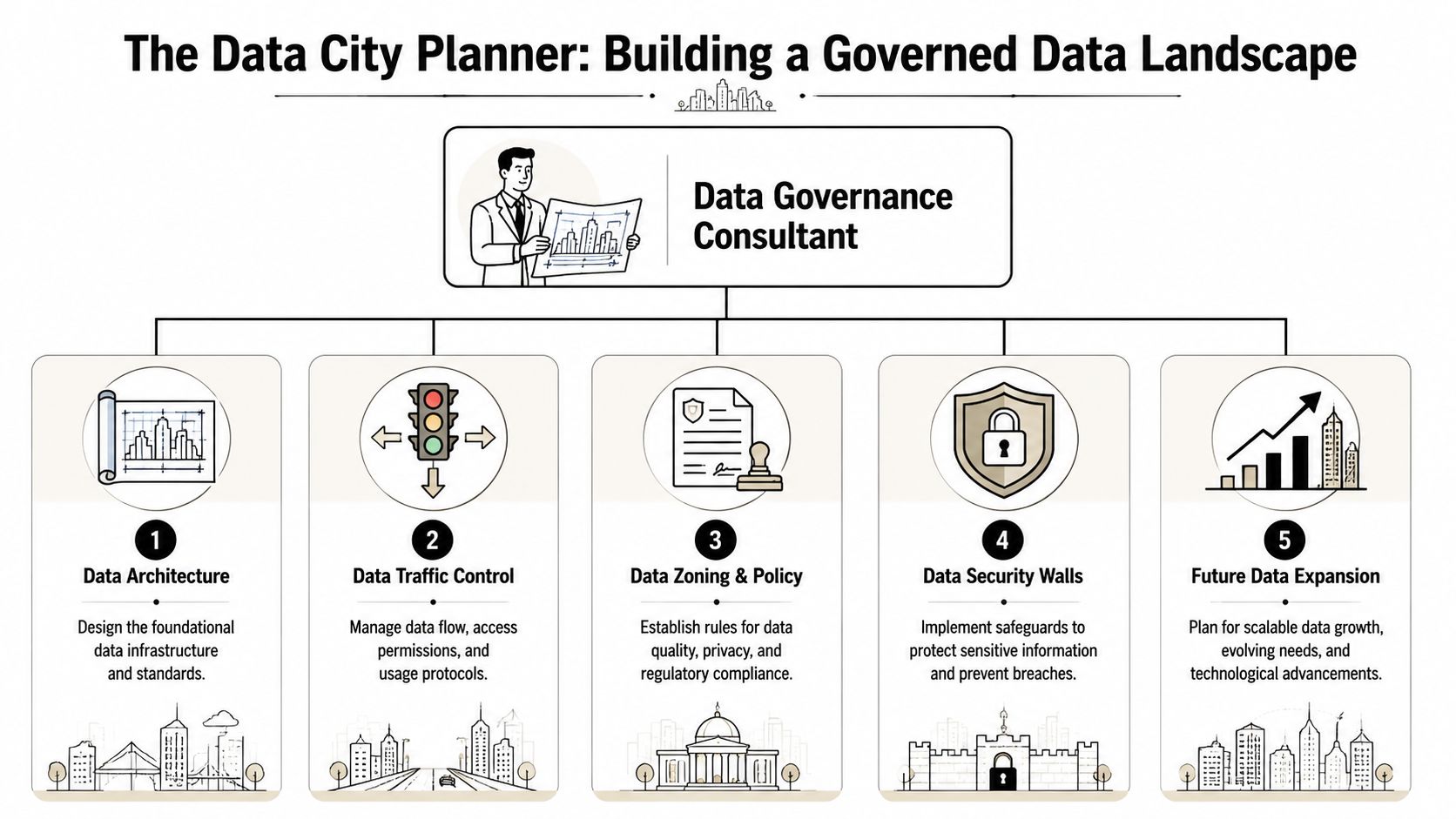
The easiest analogy is this. A data governance consultant is like a city planner for your data.
A city planner doesn't build every apartment, office, or road personally. They create the rules, map the zones, define how traffic moves, and make sure the city can grow without collapsing into chaos. A data governance consultant does the same thing for information inside a business.
The role in plain English
They help answer questions like:
- What does this data field mean
- Who owns it
- Who's allowed to change it
- Which source is the official one
- How do we spot bad data before it breaks a report or model
- How do we use AI without creating privacy or compliance problems
That sounds administrative until you connect it to real work. If your sales team, product team, and finance team all define “active customer” differently, your AI forecasting tool will inherit that confusion. If your support data includes duplicate users or inconsistent labels, your chatbot training set will be messy from day one.
Why this role matters more now
The role has become more important because businesses are trying to build AI on top of sprawling, fast-growing datasets. According to Electro IQ's data governance market overview, the data governance market was valued at US$1.81 billion in 2020 and is projected to reach US$5.28 billion by 2026, with a 20.83% CAGR. The same source says 62% of organizations identify data governance as the primary barrier to AI advancement.
That statistic matches what many teams already feel. AI isn't usually blocked by a lack of model options. It's blocked by missing lineage, poor quality, unclear permissions, and conflicting definitions.
What they are not
A lot of beginners confuse this role with a data engineer, analyst, security consultant, or compliance officer. A data governance consultant may work with all of them, but the role is different.
Here's the simplest distinction:
| Role | Main focus |
|---|---|
| Data engineer | Builds and moves data pipelines |
| Data analyst | Interprets data for decisions |
| Security specialist | Protects systems and access |
| Compliance lead | Interprets legal and regulatory requirements |
| Data governance consultant | Creates the rules, ownership, standards, and operating model that connect all of the above |
The practical value
A good consultant turns vague frustration into a working system. They help a founder stop asking, “Why are all these numbers different?” and start asking, “Which metric should the team act on?”
Practical rule: If your AI project depends on data from multiple tools, teams, or regions, governance isn't optional. It's infrastructure.
For entrepreneurs and AI enthusiasts, that's the key mindset shift. Data governance isn't the boring thing you do after innovation. It's the groundwork that lets innovation survive contact with reality.
What a Data Governance Consultant Actually Does
When people hear “governance,” they often imagine policy documents nobody reads. In practice, the job is much more hands-on. A data governance consultant usually comes in to diagnose confusion, design order, and help the business adopt new habits that stick.
One common way they work is through a five-phase process: Assessment, Design, Implementation, Monitoring, and Improvement. According to Project Manager Template's guide to data governance consultants, consultants often use this structure, and it can improve data quality metrics by up to 40% within the first year.
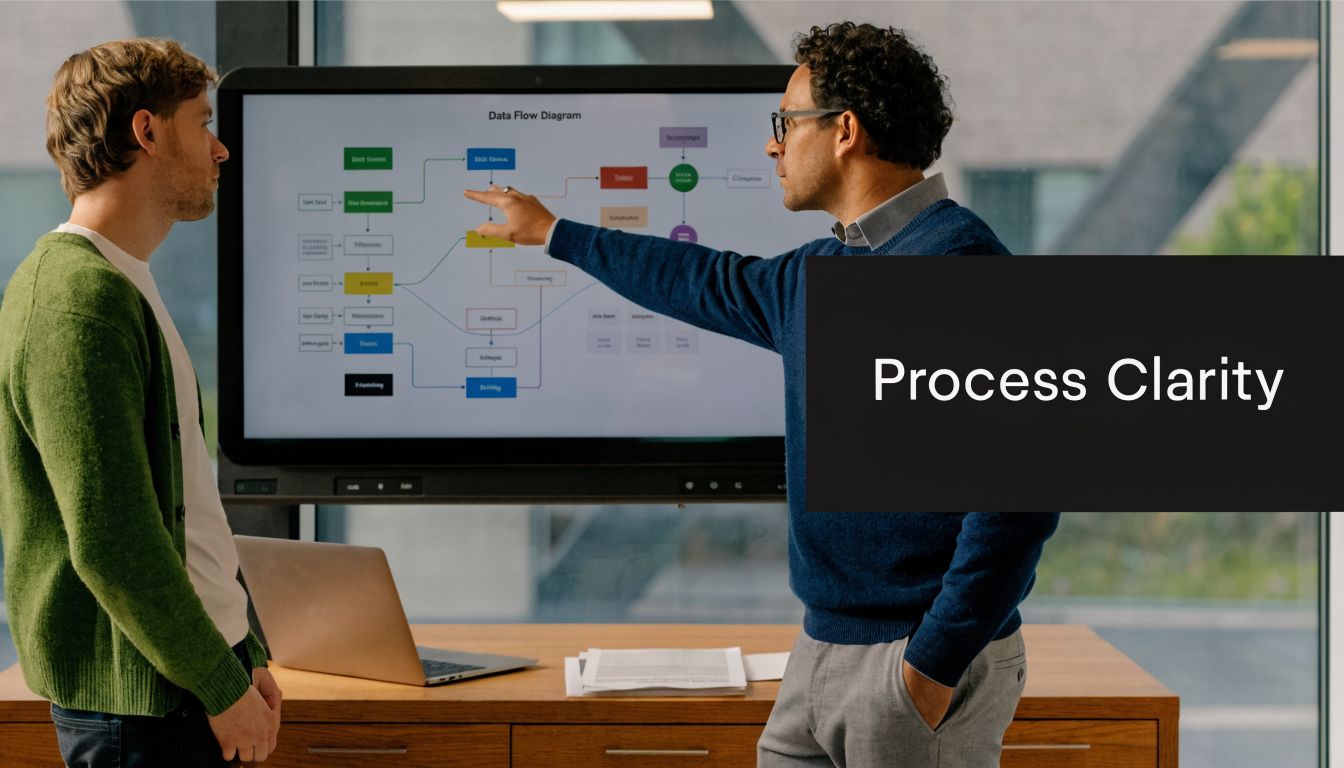
Assessment
This is the reality check.
The consultant looks at your systems, reports, workflows, ownership gaps, and risk areas. They might review your CRM, warehouse, analytics stack, data entry habits, and access controls. Tools like Collibra, Informatica, or even a well-structured spreadsheet inventory can help map what exists.
Typical findings include duplicate records, unclear source systems, broken field definitions, and datasets that nobody feels responsible for.
A founder might say, “We have customer data.” The consultant usually replies with more useful questions:
- Which system is the system of record?
- Are IDs consistent across platforms?
- Who approves schema changes?
- What happens when a value is missing or overwritten?
Design
Once the mess is visible, the consultant designs a governance model people can follow.
That may include:
- A data dictionary that defines key terms like customer, lead, order, or churn
- Ownership rules that assign data owners and stewards
- Quality standards for completeness, consistency, and validity
- Access policies for sensitive information
- Decision paths for resolving disputes when teams disagree about definitions
Governance stops being abstract at this stage. The consultant writes down how your organization will make data decisions.
If two teams can change the same field but nobody owns the definition, the problem isn't technical. It's governance.
Implementation
This is the part many businesses underestimate. Rules only matter if they show up in daily work.
The consultant may help configure workflows in tools like Talend, Informatica, or catalog platforms. They may help build approval processes for new fields, standardize naming conventions, or set automated quality checks before data enters downstream systems.
If you're working through broader operational questions around movement, retention, and handoff, this primer on data lifecycle management pairs well with governance thinking.
Monitoring
A governance program needs visible feedback. Otherwise, teams assume everything is fine until a dashboard breaks or an AI output looks wrong.
Consultants often define a small set of measures to monitor, such as:
- Completeness for required fields
- Timeliness for data freshness
- Duplicate rates in core records
- Access exceptions for sensitive datasets
- Policy adherence across business units
They also help decide who reviews these signals and how often.
Improvement
Governance isn't a one-time clean-up. New tools arrive. Teams merge. AI projects create new data flows. Customer expectations change.
So the consultant builds a repeatable loop. Review issues. Update rules. Fix root causes. Train teams. Adjust for new products and markets.
That's why the best deliverables are not just documents. They're operating habits.
What you actually receive
By the end of an engagement, you usually don't just get advice. You get practical assets:
- A governance roadmap
- A business glossary
- Role definitions
- Data quality rules
- Escalation processes
- Tool recommendations
- A rollout plan for adoption
For non-specialists, that's the easiest way to judge value. A good data governance consultant leaves your business more understandable than they found it.
The Must-Have Skills of a Great Data Consultant
Some consultants are good at writing policies. Some are good at tools. The rare ones can connect systems, business priorities, and human behavior without turning the project into bureaucracy theater.
That mix matters because governance fails for two very different reasons. Sometimes the consultant lacks technical depth. Other times they know the tools but can't get anyone to change how they work.

Technical chops
A strong data governance consultant should understand the plumbing well enough to make sensible decisions.
One especially important area is master data management and metadata management. According to People Managing People's review of data governance consultants, expert consultants use these capabilities with AI-driven tools to achieve a 25 to 35% reduction in data breach risks, 50% faster compliance audits, and resolve up to 90% of entity duplicates.
If those terms feel dense, here's the plain-language version.
Master data management, or MDM, helps a company maintain one trusted version of core business entities such as customers, products, suppliers, or locations. If one system says “Acme Inc.” and another says “ACME Incorporated,” MDM helps decide whether those are the same entity and which record should win.
Metadata management is about context. It tells you what a field means, where it came from, who changed it, and where it flows next. For AI, that matters a lot. If you can't trace where training data came from, you can't confidently explain or defend the output.
Examples of tools and concepts a strong consultant should be comfortable discussing include:
- Collibra or Alation for catalogs and governance workflows
- Apache Atlas for lineage and metadata
- IBM InfoSphere or SAP MDG for MDM
- Informatica or Talend for quality and integration
- Data quality rules for duplicates, null values, and format checks
For readers exploring the structure behind these decisions, this guide to data modelling techniques helps explain how definitions and relationships shape downstream AI use.
Human skills
Now the harder part. Governance is a people problem before it becomes a tooling problem.
A great consultant needs to:
- Translate jargon for non-technical leaders
- Negotiate ownership when teams protect “their” data
- Facilitate decisions when legal, product, analytics, and engineering disagree
- Teach without preaching so frontline teams don't reject the process
- Push for adoption without creating paperwork nobody follows
Mediocre consultants struggle with this transition. They can describe a framework beautifully, but they cannot get sales, operations, and engineering to use the same language on Monday morning.
What to look for: Ask whether the consultant has handled disagreement between teams, not just whether they've configured tools.
The best consultants are translators
The strongest data governance consultant is rarely the most academic person in the room. It's the person who can tell a founder, “Your AI assistant keeps giving shaky answers because the source data has conflicting business definitions,” then walk into a technical meeting and help map the fix.
That translator role is what makes them valuable. They don't just know data. They know how organizations behave around data.
How to Hire Your First Data Governance Consultant
Most companies don't wake up one day and casually decide to hire a data governance consultant. They do it after friction piles up.
The warning signs are usually practical. Reports conflict. An AI pilot stalls because nobody trusts the source data. A privacy review uncovers gaps in access control. Teams keep arguing over definitions that should already be settled.
There's also a wider implementation gap in the market. Precisely's 2025 planning insights on data governance adoption reports that 71% of organizations have a data governance program, but only 43% have deployed dedicated software. The same source says 90% of organizations with a Chief Data & Analytics Officer have formal frameworks in place. In other words, many businesses know governance matters, but they still need help turning intent into execution.

Start with the problem, not the title
Before you post a job or contact a consultancy, write down what is hurting the business.
That list might include:
- Conflicting metrics across dashboards
- Duplicate customer or product records
- Unclear data ownership
- AI outputs that can't be trusted
- Regulatory anxiety around sensitive information
- A stalled migration because source data is inconsistent
A vague brief attracts vague candidates. A sharp brief attracts people who can solve the right problem.
Decide what kind of help you need
Not every engagement should look the same.
A startup rolling out its first serious AI workflow might need a short diagnostic and governance blueprint. A larger company may need someone to define ownership, help select tooling, and coach internal stewards over a longer period. A regulated business might care most about lineage, auditability, and controlled access.
You're not only hiring for experience. You're hiring for fit.
What to look for in interviews
Ask candidates to explain their work in normal language. If they can't explain governance to a product manager or founder, they'll struggle to build alignment inside your company.
Look for signs that they can do all of these:
- Prioritize instead of boiling the ocean
- Balance rigor and speed so governance supports delivery
- Handle messy politics around ownership and standards
- Work across tools without becoming tool-obsessed
- Create artifacts your team can maintain after they leave
A consultant who starts with a giant framework before understanding your business usually creates paperwork, not progress.
Sample Interview Questions for a Data Governance Consultant
| Question Category | Sample Question |
|---|---|
| Business alignment | How do you connect governance work to a specific AI or business outcome? |
| Current-state assessment | When you enter a new organization, how do you identify the biggest governance risks first? |
| Data quality | How have you approached duplicate records, inconsistent definitions, or missing fields in past projects? |
| Ownership | How do you assign data owners and stewards when multiple teams claim the same dataset? |
| Tooling | When would you recommend a catalog, MDM platform, or quality tool, and when would you avoid adding more software? |
| Change management | How do you get non-technical teams to follow new rules without overwhelming them? |
| AI readiness | What governance checks do you put in place before data is used in model training or AI automation? |
| Measurement | How do you know whether a governance program is working after launch? |
| Conflict resolution | Tell me about a time two teams disagreed on a key metric or definition. How did you resolve it? |
| Handover | What do you leave behind so an internal team can keep the program running? |
Red flags to notice
Some warning signs show up fast:
- Everything sounds theoretical
- They over-focus on policy language
- They can't describe tradeoffs
- They promise a perfect enterprise-wide fix immediately
- They don't ask about your AI use cases, risk level, or operating model
A good first hire usually feels practical. They ask smart questions, reduce confusion quickly, and make governance feel like a support system rather than a compliance tax.
Understanding Pricing and Engagement Models
Pricing is where many first-time buyers get stuck, mostly because they expect one standard model. There isn't one.
Some data governance consultants work as solo advisors. Others come through specialist firms. Some deliver a tightly scoped assessment. Others stay on as strategic partners while the business rolls out new processes and tools.
Common ways consultants structure the work
A project-based engagement works well when you have a defined goal. For example, you may want a governance assessment, a glossary, ownership model, and roadmap for one business domain such as customer data. This setup is usually easier to budget because the scope is clearer.
An hourly or daily advisory model fits businesses that need flexible support. Maybe your team already has capable data staff, but they need expert help making decisions, reviewing policies, or unblocking an AI initiative. This model is useful when the work is unpredictable.
A monthly retainer makes sense when governance needs to become an ongoing operating habit. That often happens when a company is growing fast, adding tools, entering new markets, or expanding AI use cases. In that setup, the consultant acts more like a fractional leader or advisor.
What affects cost
Even without quoting exact fee ranges, you can expect price to move based on a few factors:
- Scope complexity. One domain is simpler than an enterprise-wide model.
- Industry sensitivity. Healthcare, finance, and regulated sectors usually require more rigor.
- Tooling environment. A business running multiple platforms, legacy systems, and custom pipelines takes longer to untangle.
- Change burden. If the consultant must train teams and support rollout, the engagement usually becomes broader.
- Seniority level. Strategic advisors with deep governance and AI experience will usually command higher fees than implementation-focused generalists.
How to choose the right model
If you're early, start small. A short assessment or blueprint can reveal whether you need a larger program.
If your business already knows the issues and needs execution, a defined project is often better. If your company is changing constantly, ongoing advisory support may be the better fit because governance decisions will keep surfacing.
Buy the smallest engagement that can produce a usable operating model. Don't buy a giant transformation before you know where the real friction is.
The best financial question isn't “What does a consultant cost?” It's “What's the cheapest way to stop bad data from slowing every important decision?”
The Payoff Real-World Results and AI Wins
The payoff from good governance rarely looks glamorous at first. It looks like fewer arguments, faster decisions, cleaner records, and more confidence in what your systems are saying. That's exactly why it matters for AI.
When a business gets governance right, teams stop wasting energy on basic trust problems. Product can launch features using shared definitions. Marketing can segment customers without guessing. Legal can review data use with clearer lineage. Engineering can feed models with less uncertainty.
The AI benefit is direct. Better-governed data gives models cleaner training inputs, more consistent labels, and fewer hidden surprises. That doesn't make the model magical. It makes it dependable.
What success looks like in practice
A retail team might finally unify product attributes so recommendation systems stop treating near-identical items as unrelated products.
A SaaS company might define one official customer record, which helps sales automation, support routing, and churn prediction use the same underlying truth.
A startup working with forms, emails, PDFs, and uploaded documents might clean and structure those inputs before they ever reach an AI workflow. In that context, resources on automating unstructured data parsing are useful because many AI projects fail at the exact point where messy raw documents enter the system.
Why entrepreneurs should care
Founders sometimes assume governance is for large enterprises with slow committees. That's backwards.
Smaller companies often feel bad data more sharply because they have fewer buffers. One inconsistent CRM setup, one broken integration, or one sloppy customer taxonomy can ripple through every dashboard and every AI feature. Good governance gives a smaller team an advantage. It helps them move faster without rebuilding trust from scratch every week.
The real win
Operational success isn't a prettier policy manual. It's operational confidence.
You know which data is reliable. You know who owns it. You know what your AI systems are allowed to use. You know how to trace outputs back to inputs. And when something breaks, you know where to look.
That's what a data governance consultant is really hired to create. Not bureaucracy. Not delay. A foundation solid enough to support the AI ambitions you already have.
If you're trying to make sense of AI tools, workflows, and the data foundations behind them, YourAI2Day is a smart place to keep learning. Explore practical guides, AI news, and beginner-friendly explainers that help you move from experimentation to real implementation.