Your AI Life Coach: A Beginner’s Guide for 2026
You open your laptop to “get your life together” for 20 minutes. Then you bounce between your calendar, a half-finished to-do list, notes app chaos, and three tabs about productivity systems. By the end, you know you want change, but you’re not much closer to making it happen.
That’s where an ai life coach starts to make sense.
Not as a sci-fi replacement for human wisdom. Not as a magical fix. More like a practical co-pilot that helps you think clearly, set better goals, and keep going when motivation fades. For beginners, that matters. The average person does not need more information. They need a steady system that turns intention into action.
Your New Partner in Personal Growth
A lot of personal growth stalls for one simple reason. The gap between “I should work on this” and “I know exactly what to do next” feels too wide.
An AI life coach aims to bridge that divide. It provides a dedicated space to discuss goals, habits, decisions, and obstacles in plain language, whenever the need arises. While a human coach resembles meeting a skilled guide for a scheduled session, an AI coach functions more as a thoughtful partner available at the precise moment your day gets messy.
That idea is moving fast from niche curiosity to mainstream tool use. The AI coaching market was valued at $1.2 billion in 2023 and is projected to reach $5.8 billion by 2030, with an approximate 25% CAGR, according to Paperbell’s life coaching industry statistics. That kind of growth tells you something important. People aren’t just experimenting with AI coaching. They’re finding real-world uses for it.
Why this matters to regular people
Traditional coaching can be powerful, but it also has friction. You need to find the right person, fit the sessions into your schedule, and feel ready to open up. An ai life coach removes a lot of that friction.
It can help when you’re trying to:
- Build better habits and want daily accountability
- Sort out career decisions without waiting for your next session
- Prepare for tough conversations by practicing what to say
- Reduce overwhelm by breaking big goals into small next steps
Practical rule: If you often know what you want but struggle to follow through consistently, an ai life coach can be useful even before you feel “fully ready.”
The shift is really about access
The most interesting part isn’t that AI can talk. It’s that it can make structured personal support easier to reach. For a long time, coaching was mostly something people sought out if they had the budget, the time, and the confidence to ask for help.
Now the entry point is much lower. You can test the experience, see if the style works for you, and use it in small ways before making any big commitment. That makes personal growth feel less like a formal event and more like a tool you can use on an ordinary Tuesday.
What Is an AI Life Coach Really
An ai life coach is best understood as a smart journal that talks back.
You write what’s on your mind. It responds with questions, reflections, prompts, and next steps designed to help you think better and act more deliberately. Sometimes it feels like a personal trainer for your mind. It doesn’t do the push-ups for you, but it helps you keep proper form and finish the set.

It’s not the same as a general chatbot
Here, people often get confused.
A general AI assistant can answer broad questions, summarize articles, brainstorm ideas, or draft emails. An ai life coach is narrower and more purposeful. It’s built around growth conversations such as reflection, goal-setting, habit tracking, mindset patterns, and accountability.
That means the interaction usually sounds less like:
“Tell me the best morning routine.”
And more like:
“What happens right before you skip the routine?”
“What version of this habit would still work on a busy day?”
“What are you avoiding when you reorganize your plan instead of starting?”
That difference matters. Coaching is less about handing you facts and more about helping you notice patterns.
What good AI coaching feels like
A solid ai life coach usually does a few things well:
- It asks better questions: Instead of rushing to advice, it helps you clarify what is wrong.
- It keeps context: It remembers your goals, habits, and earlier conversations.
- It encourages action: It nudges you toward the next realistic step, not the perfect one.
- It stays focused: It does not wander into random trivia unless you ask.
If you want a broader sense of how consumer AI tools are evolving, BuddyPro AI insights gives useful context on how these systems are being applied beyond simple chat.
Why the tech can feel personal
The “coach” aspect stems from conversation design, memory, and language understanding. If you’re curious about the engine underneath, a simple primer on large language models helps explain why these tools can sound surprisingly natural without being human.
A helpful test is this. If the app mostly spits out generic motivation, it’s closer to a quote machine than a coach.
The best ai life coach tools don’t just tell you what sounds good. They help you uncover what’s realistic for your life, your schedule, and your habits.
How an AI Life Coach Works Its Magic
At first glance, an ai life coach can feel mysterious. You type a messy thought like “I’m overwhelmed and procrastinating again,” and it responds with a calm, useful question that somehow cuts right to the issue.
That “magic” usually comes from three simple pieces working together.
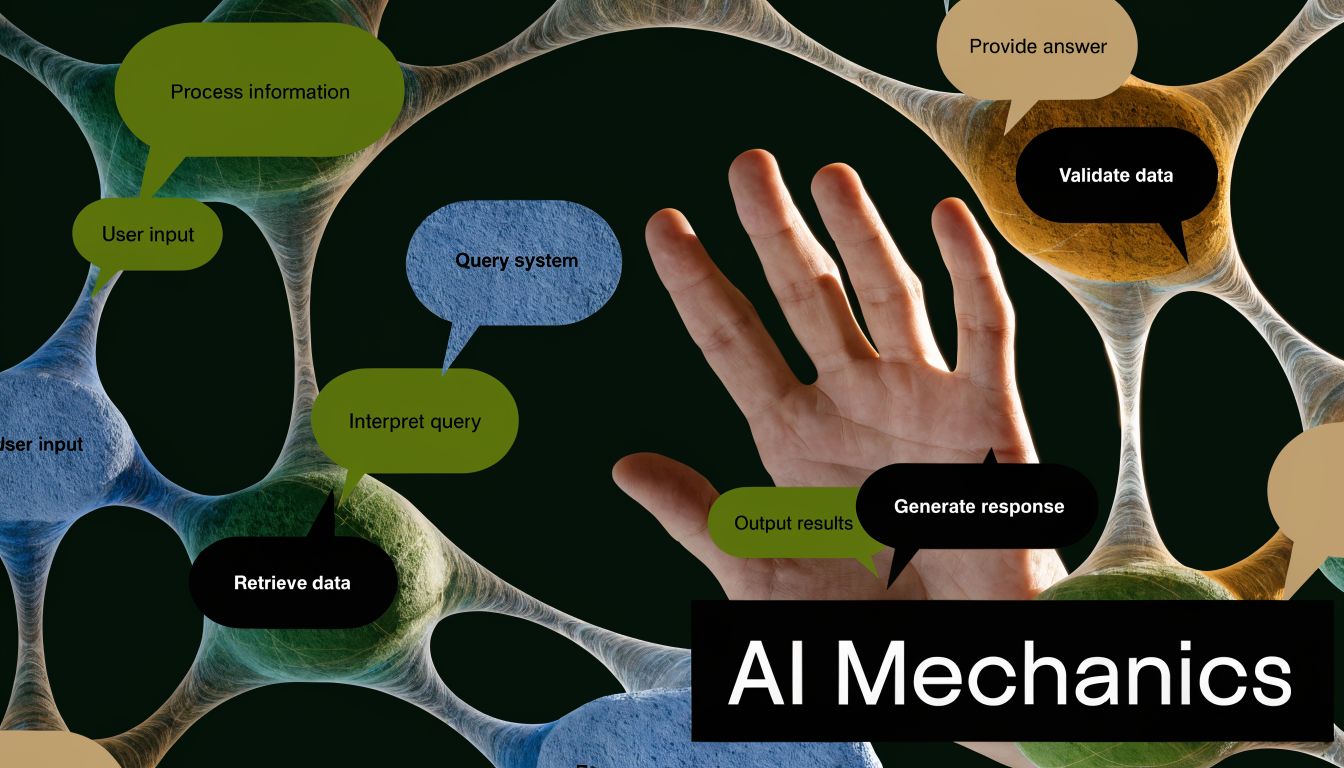
The ears
First, the system has to understand what you mean. That’s the language part.
If you say, “I keep putting off my presentation because I’m worried I’ll look unprepared,” a good AI coach doesn’t just see words. It picks up the likely issue underneath. Fear, avoidance, self-protection, maybe perfectionism. It treats your message less like a command and more like a clue.
That’s why an ai life coach can feel more useful than a search bar. A search engine gives you information about procrastination. A coaching app tries to understand your version of procrastination.
The brain
The second piece is personalization.
This is what lets the tool remember that your big goal is changing careers, that you tend to stall when tasks feel vague, or that mornings work better for you than late evenings. Over time, the app builds a working picture of how you operate.
Picture a gym coach who remembers you always skip leg day when the workout looks too complicated. The next time, they won’t give you a huge plan. They’ll give you a smaller one you’re more likely to complete.
According to The Conference Board’s overview of AI in career coaching, AI can handle up to 90% of day-to-day career coaching functions, including administrative matching, real-time question suggestions, behavioral pattern analysis, and post-session accountability reinforcement. That explains why these tools can be especially strong at routine support.
The voice
The third piece is strategic prompting. This is the part users feel.
An ai life coach works best when it asks thoughtful follow-up questions such as:
- Clarifying prompts: “What outcome are you aiming for here?”
- Pattern prompts: “When does this usually start happening?”
- Action prompts: “What’s the smallest next step you’d still be willing to do today?”
- Reflection prompts: “What story are you telling yourself about this setback?”
Those prompts create structure. Instead of spinning in your head, you move through a guided conversation.
A quick explainer can make that process easier to visualize:
Why it feels different from advice
Advice says, “You should do this.”
Coaching asks, “What keeps getting in the way when you try?”
That’s a huge shift. One gives you a recipe. The other helps you understand why you don’t use the recipe.
Good AI coaching doesn’t pretend to know your whole life. It creates a more useful conversation around the part you’re trying to change.
That’s the trick. Not intelligence in the dramatic movie sense. Structured listening, remembered context, and well-timed questions.
Putting Your AI Coach to Work
The easiest way to understand an ai life coach is to see it in everyday situations. Not abstract self-improvement. Real moments when you’re stuck, nervous, or tempted to avoid the thing you said mattered.
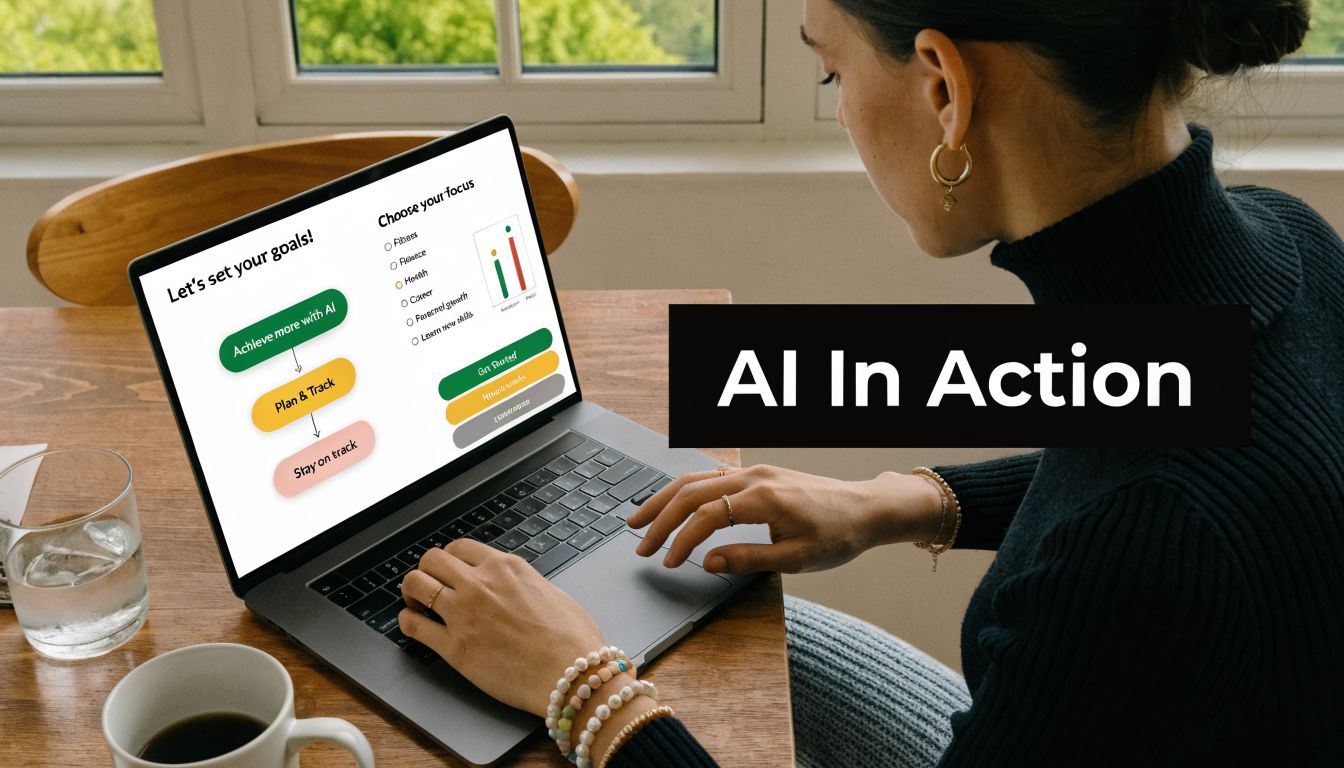
Sarah and the first team meeting
Sarah has just become a manager. She’s not clueless, but she feels a little shaky leading her first team meeting. She opens her AI coach and types, “I’m worried I’ll sound unsure and people won’t trust me.”
The coach might reply with something like:
“What part are you most worried about. Explaining the plan, handling questions, or speaking with authority?”
That one question is useful because it narrows the fear. Sarah realizes she’s mostly worried about questions she can’t answer on the spot. So the conversation shifts into preparation. The AI helps her draft a meeting outline, practice answers, and even develop a calm fallback line like, “That’s a good question. I want to verify the details and follow up clearly.”
The value isn’t motivation. It’s rehearsal.
David and the giant project
David keeps delaying a side project he cares about. Every weekend he plans to work on it, and every weekend he reorganizes his notes instead.
His ai life coach doesn’t say “believe in yourself.” It asks what the first shippable version looks like. Then it helps him break the project into small actions:
- Define the outcome: one completed draft
- Shrink the task: work for 25 minutes
- Set a trigger: start right after breakfast on Saturday
- Add accountability: report back to the app afterward
If you want better results from these interactions, learning the basics of writing AI prompts clearly can make a noticeable difference.
Nina and the stress spiral
Nina isn’t chasing a promotion or launching anything. She just feels mentally cluttered. Her ai life coach becomes a place to unload thoughts before bed and sort them into categories: urgent, emotional, practical, and not important.
Here’s how that might look:
| Situation | What Nina types | What the AI coach helps her do |
|---|---|---|
| Overloaded day | “Everything feels important” | Separate true priorities from noise |
| Hard conversation | “I’m replaying what I should have said” | Draft a calmer follow-up message |
| Low-energy week | “I’m slipping on everything” | Reduce goals to a minimum viable routine |
What people often use it for
Some use cases are especially natural:
- Career growth: practicing interviews, preparing difficult conversations, clarifying next moves
- Habit change: creating realistic routines for sleep, exercise, study, or focus
- Confidence building: rehearsing how to speak up, negotiate, or say no
- Personal reflection: spotting repeated patterns in relationships, work, and self-talk
Small shift, big payoff: Use your ai life coach when you’re slightly stuck, not only when things feel dramatic. It’s often most useful in those everyday friction points.
That’s when it starts acting like a co-pilot. Not steering your whole life, but helping you make cleaner decisions in the moments that shape it.
The Real Benefits and Honest Limitations
AI coaching gets interesting when you stop treating it like a novelty and start judging it like a tool. What does it do well. Where does it fall short. When should you use it, and when should you absolutely look for a human instead.
Where AI coaching shines
An ai life coach is especially good at consistency.
It doesn’t get tired of repeated questions. It doesn’t mind if you need to rethink the same goal five times. It can help you process a problem at 7 a.m. before work or 11 p.m. when your brain won’t turn off. That makes it unusually practical for everyday personal growth.
There’s also evidence that AI can perform strongly in structured coaching scenarios. In a controlled comparison, the AI coach 1440 was the highest overall performer against human coaches and GPT-4, with AIs excelling in problem-solving, competence, and communication, according to the Brookes study on AI coach performance.
That doesn’t mean “AI beats humans” in every sense. It means AI can be very effective in parts of coaching that benefit from consistency, structure, and fast pattern recognition.
Where it doesn’t replace people
Now for the honest part.
AI can simulate support. It cannot care about you in the human sense. It doesn’t feel concern, notice the subtle tension in your face, or catch the silence that tells a skilled coach something deeper is happening. That’s a real limitation, not a small footnote.
It also shouldn’t be treated as therapy. If you’re dealing with trauma, crisis, severe distress, or anything that needs clinical care, an ai life coach is the wrong tool.
A good rule of thumb:
- Use AI for structure: goals, habits, reflection, planning, rehearsal
- Use humans for depth: grief, identity conflict, trauma, mental health crises, emotionally loaded decisions
Accuracy matters too
Another limitation is output quality. AI can sound confident even when it’s oversimplifying, making assumptions, or steering too quickly toward neat answers. That’s why it helps to understand the basics of checking responses and spotting made-up claims. SupportGPT's guide on AI accuracy is a practical reference if you want to get better at that.
You should also think about privacy before sharing sensitive details. If the app handles personal conversations, AI safety basics for everyday users is a useful place to start.
The strongest way to use an ai life coach is to treat it like a smart tool, not an all-knowing authority.
That mindset keeps expectations healthy. You get the speed, structure, and convenience without pretending the machine offers the full range of human understanding.
How to Choose Your Digital Mentor
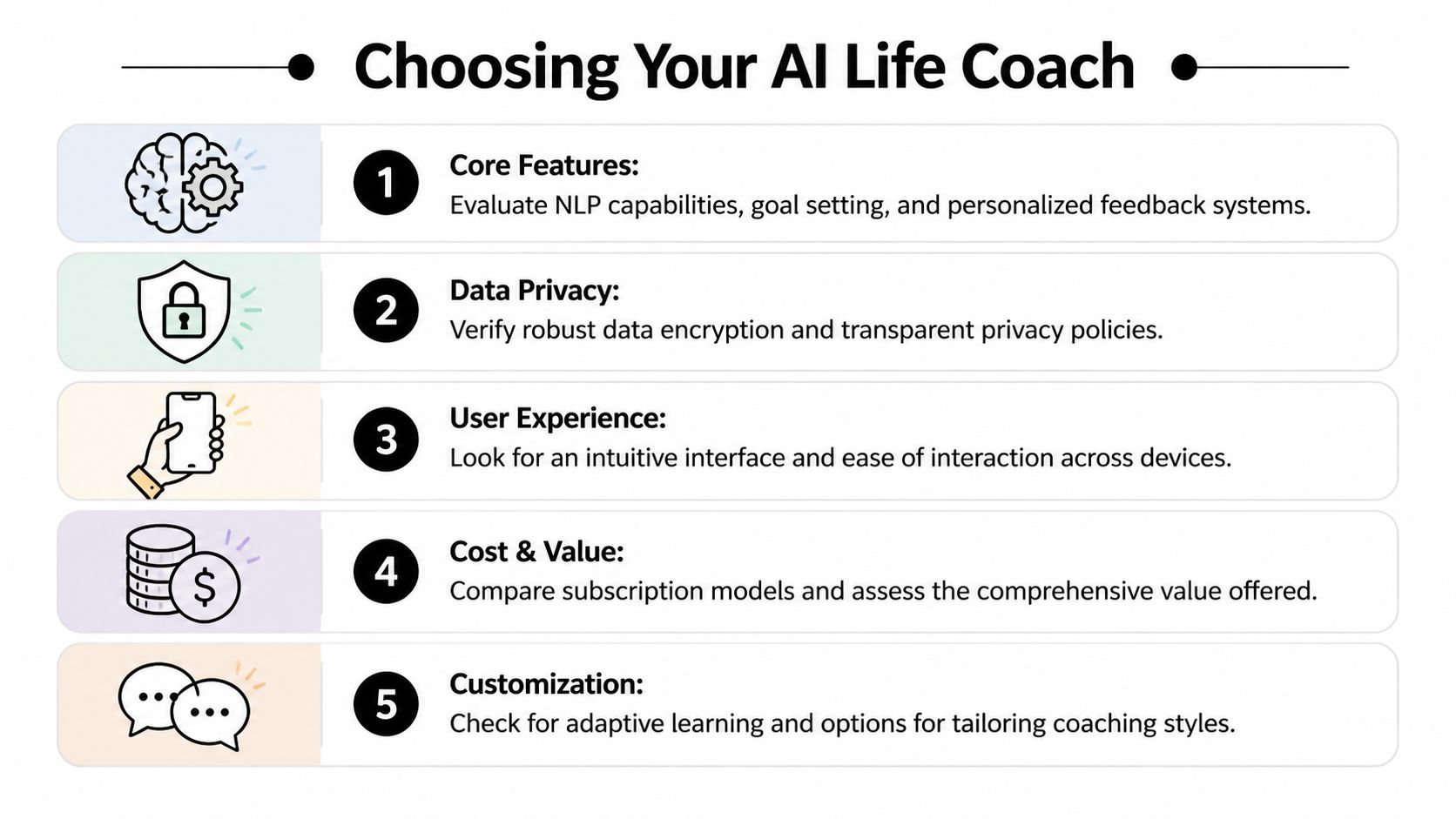
Choosing an ai life coach is less like picking a search engine and more like picking a workout partner. The basics matter, but fit matters too. A tool can be technically capable and still feel wrong for how you think, write, or process decisions.
Start with the boring stuff
Privacy deserves your attention first. If an app invites you to share your fears, habits, relationship patterns, or work stress, you should know how that data is handled. Read the privacy policy before you get emotionally comfortable with the product.
Then look at onboarding. A good ai life coach should ask enough questions to personalize the experience. If it jumps straight into generic pep talks without understanding your goals or routines, that’s a weak sign.
Use this checklist before you commit
- Core coaching behavior: Does it ask thoughtful follow-up questions, or does it mainly hand out surface-level advice?
- Memory and continuity: Can it remember your goals and refer back to prior conversations in a useful way?
- Customization options: Can you shape tone, coaching style, and focus areas so it feels workable for you?
- Interface quality: If the app is annoying to open or clunky to use, you probably won’t stick with it.
- Long-term value: Look for signs it supports ongoing change, not just day-one excitement.
That last point is easy to miss. A lot of tools feel impressive in the first week.
A 2025 study on digital health interventions found that 12% of users maintained engagement with AI coaches beyond 6 months, compared with 45% for human-led programs, as discussed in Noomii’s article on AI life coaching in 2025. That doesn’t mean AI coaching can’t help. It means retention and long-term fit should be part of your decision.
Questions worth asking yourself
Sometimes the best filter is your own reaction after a few days of use.
Ask yourself:
- Do I feel understood enough to keep talking?
- Am I getting clearer, or just entertained?
- Does this app help me act, or mostly reflect forever?
- Would I trust it with my real problems, not just light journaling?
- Can I imagine using this next month, not just tonight?
If an ai life coach makes you think more clearly and act more simply, it’s doing its job.
The best choice usually isn’t the most hyped app. It’s the one you’ll return to when life gets busy.
Top AI Coach Apps and Your Next Step
By 2026, a few AI coaching tools stand out for different reasons.
Rocky.AI is a solid fit for people who want structured growth conversations around goals, habits, and professional development. The caveat is that highly structured coaching can feel a bit rigid if you prefer a freer, more emotional conversation style.
Pi by Inflection works well for reflective, natural-feeling conversation. If you want something that feels less like a dashboard and more like a calm thought partner, it’s appealing. The tradeoff is that conversational ease doesn’t always equal strong action planning.
1440 is especially interesting because of its strong performance in controlled evaluation, discussed earlier. It looks promising for users who want coaching that is disciplined and outcome-focused. The caveat is simple. Strong study results don’t automatically guarantee the perfect fit for your personality.
If you want to compare broader options in the self-improvement space, this roundup of top personal development apps for 2026 is a useful companion read.
The big takeaway is simple. An ai life coach works best when you treat it as a practical support tool. Not a miracle. Not a fake therapist. Not a replacement for every kind of human help.
It’s more like a smart co-pilot for personal growth. It can help you notice patterns faster, turn vague goals into clear steps, and keep moving when your own thinking gets noisy. For a lot of people, that’s more than enough to make it worth trying.
If you want practical, beginner-friendly AI guides like this one, explore YourAI2Day for clear explainers, tool reviews, and everyday advice that helps you use AI with more confidence.