
AI in Japan: Your Practical Guide for 2026
Japan's AI story gets a lot more interesting when you start with one number. The country’s artificial intelligence market is projected to grow from USD 19.8 billion in 2025 to USD 194.7 billion by 2033, a projected 32% CAGR according to Grand View Research’s Japan AI market outlook.
That sounds like a simple growth story. It isn’t.
If you only look at headlines, ai in japan can seem contradictory. Big companies are investing. Policymakers are pushing an AI-friendly framework. Researchers and manufacturers are building serious tools. Yet many workers, consumers, and smaller firms are still early in adoption. That gap is exactly what makes Japan so important to understand.
For beginners, the easiest way to think about Japan is this. The country isn’t trying to copy Silicon Valley, and it isn’t trying to regulate AI like Europe either. It’s building a model that fits Japanese business culture, industrial strengths, and social priorities. That means robotics matters more. Trust matters more. Practical deployment often matters more than flashy demos.
This makes Japan especially relevant for three groups of readers. Business owners looking for market openings. Professionals deciding where to build skills. And international companies trying to figure out how to enter a major economy without misreading the local context.
Welcome to Japan's AI Revolution
Japan’s AI market projection is eye-catching, but the bigger point is what sits underneath it. Japan is treating AI as infrastructure for its next phase of economic and industrial development, not just as a consumer app trend.

That helps explain why ai in japan feels different from AI conversations in the United States. In the U.S., discussion often centers on foundation models, startup valuations, and consumer tools. In Japan, the conversation often starts with a different question. How can AI help real industries work better, more safely, and with less strain on people?
You can see that mindset in the sectors where Japan already has deep expertise. Manufacturing. Robotics. Healthcare. Mobility. These are areas where precision matters, reliability matters, and mistakes are expensive. AI fits naturally when it helps people make better decisions, automate repetitive work, or improve consistency.
Japan’s AI path makes more sense when you view it as an industrial upgrade, not just a software trend.
For new readers, one confusion comes up quickly. If Japan is so strong in technology, why doesn’t it always dominate the public AI conversation? Part of the answer is style. Japan often moves with less noise and more operational focus. A factory optimization system or a drug research platform won’t attract the same social media buzz as a chatbot. But for businesses, those quieter deployments can matter much more.
Three ideas make the Japanese AI environment easier to read:
- Policy support matters: The government has created conditions that encourage development and deployment.
- Industrial depth matters: AI is being applied where Japan already has strong capabilities.
- Adoption gaps matter: The biggest opportunities may sit where awareness and readiness are still catching up.
Japan's National AI Strategy Explained
Japan’s AI policy is easier to understand if you start with its purpose. The government is trying to speed up useful AI adoption while setting boundaries for misuse. For businesses, that creates a practical middle path. You are expected to act responsibly, but you are not immediately buried in the kind of penalty-first system that can slow early adoption.
Japan's AI policy acts more like a supportive coach than a strict referee. It sets expectations, publishes guidance, and reserves intervention for harmful behavior. That distinction matters for any company deciding whether Japan is a difficult market to enter or a realistic place to test and deploy AI products.
The AI Act in plain English
Japan’s AI Act, effective in September 2025, uses non-punitive, guideline-based risk management rather than fines. It also allows authorities to investigate malicious AI use and then provide advisory guidance, with the stated aim of supporting a trustworthy AI ecosystem, as described in Araki International IP&Law’s analysis of Japan’s AI Act.
For someone new to policy, here is the simple version. Japan is not saying companies can do whatever they want. Japan is saying responsible use should be built through guidance, oversight, and risk controls, especially in areas where mistakes affect people's lives.
For an SME, that changes the first question. Instead of asking, "How much paperwork do we need before we can try this?", the better question is, "Can we explain what the system does, where it could fail, and what guardrails we put around it?" That is a much more practical starting point for a manufacturer, logistics firm, clinic, or software company testing AI in daily operations.
What trustworthy AI means on the ground
“Trustworthy AI” can sound vague, so it helps to translate it into ordinary business decisions. A good comparison is food safety rules in a restaurant. Customers may never see the kitchen checklist, but they care that someone has thought through hygiene, storage, and handling before the meal reaches the table. AI governance works in a similar way. Good systems are usually the result of visible process, not just good intentions.
In Japan, a company deploying AI should be ready to address questions like:
- Transparency: Can users and partners understand what the system is for and where it is being used?
- Safety: Have you added technical or human checks in high-stakes settings?
- Stakeholder impact: Have you considered how data use and automated decisions affect customers, workers, or suppliers?
These points matter most in sectors such as healthcare, mobility, finance, and industrial operations. In those settings, AI is closer to a braking system or quality-control sensor than a novelty app. If it works well, it improves consistency and reduces strain on staff. If it fails, the cost is much higher than a bad customer experience.
That is why AI in Japan often feels more deployment-focused than headline-focused. The government is trying to reduce friction for companies acting in good faith while keeping pressure on reckless or malicious uses. For international founders, that can make Japan attractive as a market where governance expectations are real but still workable. For local SMEs, it means AI adoption is less about copying the latest global trend and more about solving a specific operational problem safely.
If you want a wider regional comparison, this guide to artificial intelligence in Asia shows how Japan’s policy style differs from other major markets.
Practical rule: If your AI system affects health, safety, mobility, finance, or other sensitive outcomes, build explainability and safeguards into the product from the start.
Why this strategy fits Japan
This approach makes sense in the Japanese market because many firms already value reliability, steady improvement, and long-term trust. A guidance-led model fits companies that want clear expectations and room to test use cases carefully before scaling.
It also matches the "so what?" reality on the ground. A small exporter, factory supplier, or overseas SaaS company entering Japan does not just need abstract national ambition. They need to know whether they can launch, pilot, and build customer trust without facing immediate regulatory paralysis. Japan’s strategy gives a qualified yes. It supports innovation, but it expects companies to show their work.
That balance is one reason AI in Japan matters beyond government strategy documents. It shapes how quickly pilots become real deployments, how comfortably SMEs experiment, and how confidently international entrepreneurs can enter the market with products designed for serious business use.
The Key Players Shaping Japanese AI
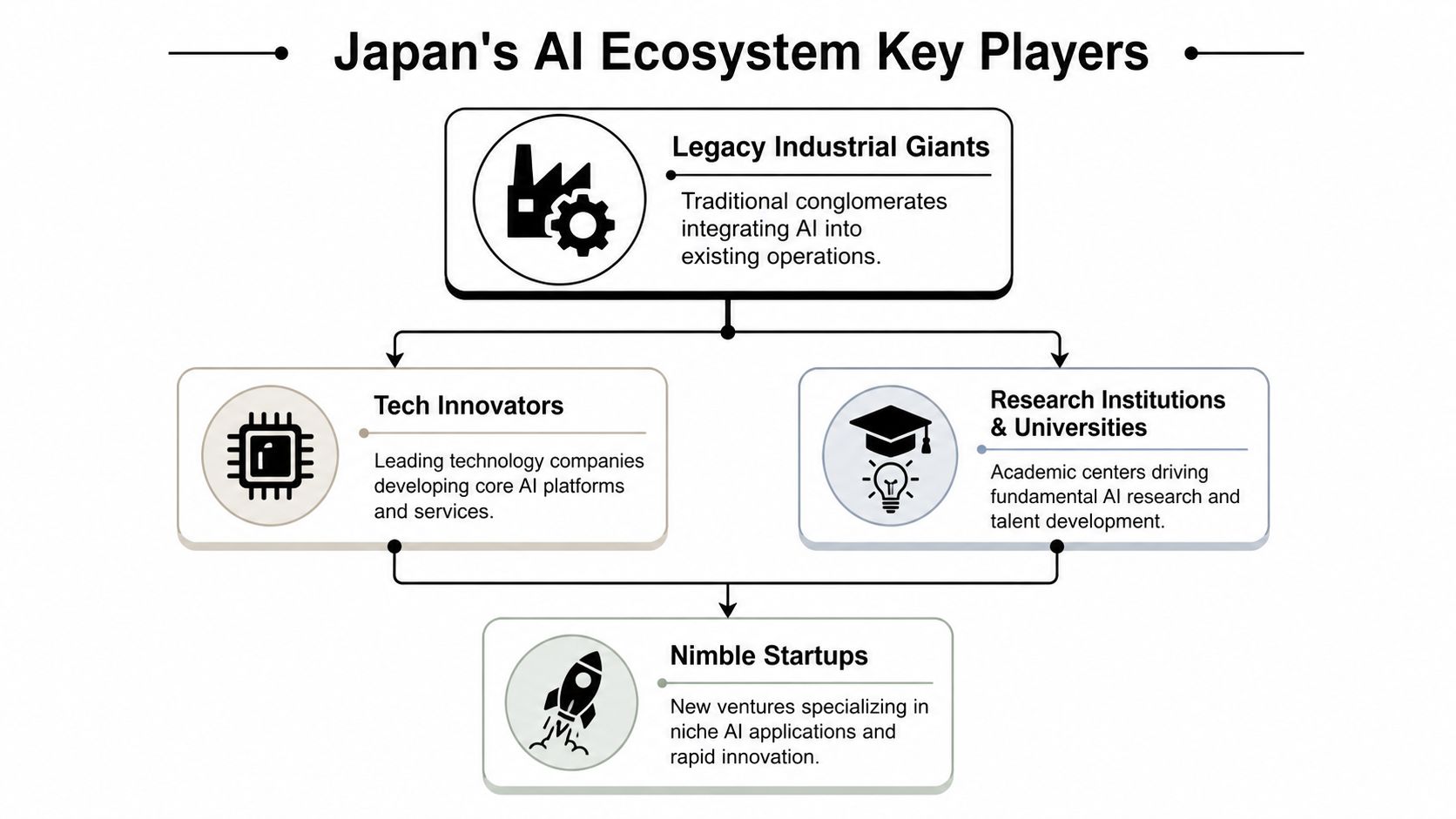
A national strategy can set direction. Actual progress depends on who can turn that direction into tools people will pay for and use. In AI in Japan, the most important players are the groups that can connect research, software, and real operations inside factories, offices, hospitals, and logistics networks.
Legacy industrial giants
Japan’s large industrial companies matter because they already own the hard part. They have production lines, supplier relationships, service networks, and customers who trust them with important work.
That changes the business equation. An AI model on its own is like an engine sitting on a workshop floor. It becomes useful only after someone installs it in a vehicle people can drive. Companies such as Toyota, Fanuc, and Sony are good at that installation step.
Toyota shows how AI connects to mobility, driver assistance, and vehicle data. Fanuc shows what practical AI looks like in robotics and factory automation. Sony brings strength in sensors, imaging, and digital systems, which matter because many AI systems are only as good as the data they receive.
For SMEs and overseas founders, this has a clear implication. Selling into Japan often means fitting into an existing industrial system rather than trying to replace it all at once. Tools that improve inspection, forecasting, scheduling, or operator support usually have an easier path than products that ask customers to rebuild their workflows from zero.
Tech innovators and domestic model builders
A second group is building the software layer. Fujitsu, CyberAgent, and Preferred Networks are often discussed because they are working on applied AI, language models, and enterprise-ready systems designed with Japanese users in mind.
Language matters here more than many newcomers expect. A model can perform well in English benchmarks and still struggle with Japanese business writing, industry terminology, or the indirect phrasing common in customer communication. Domestic model builders are trying to close that gap.
The practical takeaway is simple. If your product relies on search, summarization, chat, document handling, or workflow automation in Japanese, local model quality can matter as much as raw model size. Businesses comparing vendors should look past general AI branding and ask a more grounded question: does the system perform well on Japanese-language tasks that employees handle every day?
If you want a broader sense of where AI delivers value in day-to-day operations, these AI use cases by industry help show why sector fit matters so much in Japan.
Research institutions and universities
Research institutions and universities supply the long-term capacity behind the commercial headlines. They train engineers, support joint projects with industry, and help Japan keep developing its own technical base.
For someone new to the topic, it helps to view these institutions as part laboratory and part talent pipeline. A startup may build the product. A large company may deploy it. Universities and research centers often help produce the people, methods, and partnerships that make both possible.
This matters for businesses because strong research ties tend to create better pilot opportunities, more specialized talent, and a steadier flow of practical innovation over time.
Nimble startups
Startups often spot the most usable opportunities first. In Japan, that usually means solving a narrow problem extremely well.
Many young companies focus on places where labor is tight, workflows are specialized, or legacy systems make manual work expensive. That can include factory programming, document processing, vertical SaaS, inspection tools, and AI software adapted to Japanese operational habits.
For international entrepreneurs, this is one of the clearest lessons in AI in Japan. The opportunity is often hidden in a specific bottleneck. A startup that reduces quoting time for a supplier, improves call center summaries for a midsize service firm, or helps a manufacturer preserve expert know-how may create more immediate value than a broad “all-purpose AI platform.”
Here’s a simple map of the field:
| Company | Category | Primary AI Focus |
|---|---|---|
| Toyota | Legacy industrial giant | Mobility and autonomous systems |
| Fanuc | Legacy industrial giant | Robotics and factory automation |
| Sony | Tech innovator | Sensing and digital AI-enabled technologies |
| Fujitsu | Tech innovator | Domestic AI models and enterprise AI |
| CyberAgent | Tech innovator | Language models and applied AI development |
| Preferred Networks | Nimble startup | Advanced applied AI and industrial use cases |
A useful way to read the Japanese AI field is to ask who can turn AI into dependable business results, not who gets the most global attention.
AI in Action Across Japanese Industries
Japan becomes easiest to understand when you stop looking at strategy documents and look at workflows. The strongest examples of ai in japan are not abstract. They change how work gets done.

Manufacturing and robotics
Manufacturing is one of the clearest fits for AI in Japan. The logic is simple. Japanese industry already values repeatability, quality control, and process optimization. AI slots into those goals by helping systems detect patterns, generate machine instructions, and support operators dealing with complex tasks.
A good example is ARUM Inc. Its cloud-based AI software generates complex machining programs for precision manufacturing. If that sounds technical, think of it this way. Instead of relying only on a highly specialized technician to write detailed instructions for a machine, the software helps produce those instructions automatically. In a country dealing with labor pressure and specialized skill shortages, that’s a practical advantage.
What changes in real life? The factory doesn’t become “fully autonomous” overnight. Instead, bottlenecks start to shrink. Skilled workers spend less time on repetitive setup work and more time on judgment-heavy tasks. Smaller firms can access capabilities that used to depend on a handful of experts.
If you want a broader feel for how companies apply AI in sectors like manufacturing, retail, and services, this collection of AI use cases by industry is a useful companion.
Healthcare and drug discovery
Healthcare is where Japan’s AI story becomes especially compelling because the value is easy to grasp. Faster research can mean faster progress toward new treatments.
One standout example is Astellas Pharma’s Mahol-A-Ba platform. According to ULPA’s guide to the rise of AI in Japan, the platform combines AI and robotics to cut cell testing time from one month to 90 minutes.
That result matters because drug discovery often stalls on slow, repetitive, data-heavy experimentation. AI helps analyze likely outcomes. Robotics handles execution. Together, they compress the feedback loop between hypothesis and result.
For beginners: This is what AI looks like when it’s useful. It doesn’t replace scientists. It helps scientists test ideas much faster.
Later in the pipeline, that kind of acceleration can influence how teams prioritize research, allocate lab time, and evaluate candidate compounds.
A short explainer helps show the broader pattern in motion:
Why Japan excels in these use cases
Japan’s strongest AI applications often appear where three ingredients already exist:
- Deep domain knowledge: Companies understand manufacturing, healthcare, mobility, and robotics at a detailed level.
- Operational discipline: Teams are good at integrating new tools into repeatable workflows.
- High-value problems: Labor shortages, aging infrastructure, and precision requirements create clear reasons to adopt AI.
This is why ai in japan often looks more grounded than many consumer-facing AI stories elsewhere. A lot of the value comes from systems that reduce manual effort, improve reliability, or speed up expert work behind the scenes.
That doesn’t make the technology less important. It often makes it more durable.
Japan's AI Challenges and How It's Tackling Them
Japan’s AI strengths are real, but so are its bottlenecks. The biggest mistake is to assume a strong national strategy automatically means broad everyday adoption. It doesn’t.

The workplace adoption gap
Despite major enterprise ambition, only 8.4% of employees in Japan use AI at work, and only 6.4% use generative AI, according to Dimension Market Research’s report on Japan’s AI market. For a country with advanced industrial capabilities, that’s a striking gap.
This confuses many outside observers. If large companies are investing, why are worker-level usage rates still low? Usually because adoption isn’t just about buying software. People need training, trust, workflow redesign, internal guidance, and management support. Without those pieces, AI stays stuck in pilots or executive presentations.
Large firms and SMEs are not in the same place
Another key challenge is the distance between big corporations and smaller businesses. Large firms typically have more resources, stronger internal IT teams, and more room to experiment. Smaller firms often don’t.
That matters a lot in Japan because so much of the economy runs through SMEs. Many of them are strong in craftsmanship, manufacturing, logistics, or specialized services, but they may not have clear AI roadmaps. Some aren’t rejecting AI. They do not know where to start, how to evaluate vendors, or how to connect AI projects to daily operations.
What smart companies do differently
A lot of AI projects fail for ordinary reasons. The problem isn’t the model. The problem is weak implementation.
For readers thinking seriously about execution, this guide on building AI for business value is helpful because it emphasizes a practical question many teams skip: what business outcome are you trying to improve?
That question is especially important in Japan, where cautious decision-making can slow momentum if teams can’t tie AI to a specific operational benefit.
Here are the patterns that tend to help:
- Start with one painful workflow: Customer support backlog, document handling, scheduling, forecasting, or machine setup are easier starting points than “company-wide AI transformation.”
- Build governance early: A lightweight policy for approved tools, data handling, and human review reduces confusion. This overview of an AI governance framework is useful if your team needs a starting point.
- Train managers, not just specialists: Middle managers often decide whether a pilot becomes normal practice.
- Choose tools that fit local work habits: A strong tool that ignores Japanese language, process expectations, or reporting culture may never stick.
Many adoption problems look technical at first. They usually turn out to be organizational.
Japan’s AI challenge isn’t a lack of potential. It’s the hard, slower work of making AI usable for ordinary employees and practical for smaller firms.
How to Find Your Opportunity in Japan's AI Scene
The opportunity in ai in japan isn’t just for giant corporations. In some ways, the most interesting openings sit below the headline level.
A major example is the SME market. According to Access Partnership’s report on bridging the AI gap in Japan, only 33% of small organizations feel “very aware” of AI’s benefits, compared with 74% of large firms. For entrepreneurs, consultants, software builders, and international entrants, that gap is not bad news. It’s market space.
If you run a business
The clearest play is to make AI feel usable, safe, and specific. Japanese SMEs usually don’t need broad AI rhetoric. They need help with a narrow operational problem.
Good offers in this market often have three traits:
- Low-friction onboarding: Simple setup beats grand transformation language.
- Visible business relevance: Show how the tool helps with quality control, scheduling, reporting, customer communication, or knowledge retrieval.
- Trust-first delivery: Buyers want to understand where the tool fits and what safeguards exist.
A lightweight, focused product can win where a bigger, more complex platform feels overwhelming.
If you're an international company
Japan can reward companies that localize well. That means more than translation. It means adapting workflows, support models, and decision processes to the local market.
The most promising approach is often partnership-led rather than purely top-down. Working with local integrators, distributors, or industry specialists can help you avoid a common mistake. Assuming a successful AI product in another market will transfer cleanly into Japan.
If you're building a career
For job seekers and career changers, Japan’s AI scene creates demand for people who can connect technology with business operations. Pure model research matters, but so do implementation skills, data work, workflow design, governance, and bilingual communication.
If you're exploring roles in this space, curated AI job search tools can help you identify openings and tailor your search around AI-focused positions.
Career shortcut: Learn to explain AI in business language. Teams need people who can translate between technical tools and everyday work.
A simple way to evaluate your fit
Ask yourself which of these sounds most like you:
- Problem solver: You know an industry pain point and can build or package an AI solution around it.
- Market bridge: You understand both international AI products and Japanese customer expectations.
- Implementation specialist: You can help organizations adopt tools, train teams, and manage rollout.
- Domain expert: You bring deep knowledge in healthcare, manufacturing, logistics, finance, or operations.
If you fit one of those profiles, Japan’s AI market is more accessible than it may first appear.
The Future of AI in Japan and Your Next Steps
Japan’s AI future will likely be shaped less by hype cycles and more by steady integration. The most durable gains should come from combining AI with areas where Japan already has unusual strength, especially robotics, manufacturing systems, and specialized enterprise workflows.
That’s why ai in japan is worth watching closely. It offers a different model from the consumer-first story many readers know best. Japan is showing what happens when AI is treated as a tool for industrial capability, operational resilience, and trust-based deployment.
For your next steps, keep it practical:
- Follow official policy direction: Review materials from Japan’s AI Strategy Headquarters and related government updates.
- Watch research institutions: Groups such as RIKEN help signal where long-term scientific and technical priorities are heading.
- Track industry events: Conferences in robotics, healthcare technology, and enterprise software often reveal more than general AI panels do.
- Study real deployment data: Look for examples where AI changes a workflow, not just marketing language around innovation.
- Build your own monitoring system: If you’re researching this market at scale, tools such as #1 Web Scraping API for LLMs can help technical teams collect and organize large volumes of public web data for analysis.
The core takeaway is simple. Japan’s AI market is growing fast, but the best opportunities often sit where strategy meets execution. That includes practical tools for SMEs, local-language enterprise systems, safer high-stakes deployments, and products that fit Japan’s work culture instead of fighting it.
If you want more plain-English AI analysis, practical guides, and tool breakdowns for both beginners and professionals, visit YourAI2Day. It’s a useful place to keep learning as the AI field keeps changing.