

A Practical Guide to Contact Center AI in 2026
We’ve all been there—stuck in a customer service maze, repeating our problem to one person after another. It’s frustrating, right? Well, Contact Center AI is the technology designed to end that painful cycle for good. Think of it as a collection of smart tools that understand, route, and even resolve customer issues with a speed and accuracy that’s changing the support game entirely.
What Is Contact Center AI and How Does It Work

Forget the old image of a chaotic call center switchboard. Imagine your customer support as a highly coordinated intelligence hub. In this setup, contact center AI takes on the predictable, repetitive work, which frees up your human agents to focus on what they do best: solving complex problems with empathy and a human touch.
This isn't just a simple chatbot popping up with a few pre-written answers. It's a fully integrated system built to make every customer interaction smooth and productive. The technology listens to conversations, understands the customer's intent, and can even predict what they might need next. For example, if a customer calls about a late package, the AI can not only provide the tracking info but also check if similar shipments are delayed, giving the agent a heads-up on a wider issue.
Key Technologies Powering Contact Center AI
So how does the magic happen? It's all about a team of technologies working together. Let's break down the essential AI components that give modern contact centers their superpowers.
| AI Component | What It Does | A Simple Example |
|---|---|---|
| Natural Language Processing (NLP) | Understands the nuances of human language, both spoken and written. | An AI listens to a customer say, "My bill is bonkers this month!" It gets the sentiment (frustration) and the topic (billing), then routes them to a specialist. |
| Machine Learning (ML) | Learns from every interaction to improve its performance and predictions over time. | After handling thousands of "password reset" chats, the AI learns to solve the issue in two steps instead of five, making it faster and smarter. |
| Predictive Routing | Analyzes customer data and past interactions to send them to the best-suited agent. | A customer who previously called about a complex billing issue is automatically sent to a senior agent with a high success rate in billing resolution. |
| Automation | Executes tasks without human intervention. | A virtual agent processes a return request, updates the customer's account, and sends a confirmation email, all without needing a person to click a single button. |
Each of these technologies plays a critical role, but their real power comes from working in harmony to create a smarter, more responsive support system.
The Human-AI Partnership
It's tempting to see this as a battle of human agents versus AI chatbots, but that's the wrong way to look at it. This is a powerful collaboration. The goal isn't to replace people, but to give them superpowers. AI handles the volume and the data-crunching, while humans provide the judgment, creativity, and connection that machines can't replicate.
Expert Opinion: "The most effective contact center AI doesn’t just deflect calls," says customer experience strategist, Dr. Elena Vance. "It enriches every interaction, making both the customer and the agent feel more capable and understood. It's about augmentation, not replacement."
This blend of machine efficiency and human skill is why adoption is skyrocketing. The global market for call center AI was valued at USD 1.99 billion in 2024 and is on track to hit USD 7.08 billion by 2030, growing at an impressive 23.8% compound annual growth rate. This explosive growth isn't just a fleeting trend; it’s a direct response to sky-high customer expectations and the urgent need to solve chronic issues like agent burnout. You can explore these market dynamics in the full industry analysis.
The Core Components of an AI-Powered Contact Center
When we talk about contact center AI, it’s easy to imagine a single, all-knowing computer. The reality is more like a skilled pit crew, with each member performing a specialized task to get the car back on the track faster. These components work together, each one playing a distinct but critical role. Let’s pop the hood and see what’s inside.
Your customer’s first interaction is usually with Conversational AI. These are the friendly chatbots and voicebots that serve as the first point of contact, ready to help 24/7. They're built to handle the high-volume, straightforward requests that make up a huge chunk of any contact center's workload—things like "What's my order status?", "How do I reset my password?", or "What's my account balance?"
Forget the frustrating, rigid bots of the past. Today's conversational AI uses sophisticated Natural Language Processing (NLP) to understand how people actually talk, complete with slang, typos, and regional accents. This provides instant resolutions for common problems and frees up your human agents for the tougher, more emotionally charged issues that truly require a human touch.
Intelligent Routing and Analytics
But what happens when a bot can't solve the problem? That's where AI-Powered Routing comes in, acting as an expert matchmaker. Instead of dumping every customer into a generic queue, the system instantly analyzes the inquiry, looks at the customer's history, and understands what they need.
For example, it can see that you're a long-time customer calling from a specific phone number about a product you just bought. It then routes you to the best available agent—not just the next one. This could be an agent with specific technical skills, language fluency, or a strong track record with similar issues. The result is a dramatic increase in first-contact resolution and a sharp drop in those dreaded, frustrating transfers.
Working silently in the background are Speech and Text Analytics. Think of these as the quality control inspectors of your contact center, constantly reviewing calls and chat transcripts. They do more than just log words; they identify customer sentiment, detect rising frustration, and pinpoint the true intent behind the conversation.
Expert Opinion: "Analytics turns customer conversations from a sea of noise into a treasure map of insights," notes an expert in customer experience. "It tells you not just what customers are saying, but how they feel and what they truly need. It's the voice of the customer, amplified."
This is incredibly powerful in practice. Analytics can alert a supervisor to a call that’s going south, allowing them to step in before the customer hangs up. It can also identify widespread problems—like a bug in a recent software update—giving your product teams real-time feedback to act on.
The Agent's Secret Weapon
Perhaps the most direct support for your team comes from Agent Assist. This tool is a real-time co-pilot for your human agents. While an agent is on a call or chat, Agent Assist is right there on their screen, automatically surfacing relevant knowledge base articles, providing checklists for complex processes, and even suggesting pre-written responses for common questions.
This fundamentally changes the agent experience for the better. It takes the pressure off, reduces the time spent fumbling for information, and empowers them to solve problems with confidence and consistency.
- For the customer: It means getting the right answer, faster.
- For the agent: It means feeling supported and more capable in their role.
The industry is clearly betting big on these tools. The global conversational AI market alone is expected to hit $82.46 billion by 2034. Yet, while 88% of contact centers report using AI in some form, a deeper look reveals that only 25% have a truly unified strategy where all these components work together. As this breakdown of conversational AI statistics shows, this gap between adoption and true integration represents a massive opportunity. Of course, the effectiveness of all these systems hinges on the quality of the information they learn from; understanding what training data is is foundational to success.
The Business Case for Investing in Contact Center AI
So, we've geeked out on the technology. But what's the real reason to bring contact center AI into your operations? It’s not about chasing the latest tech trend. It's about a concrete business case built on three powerful outcomes: slashing operational costs, creating fiercely loyal customers, and making your agents’ jobs better.
Let's start with the most obvious win: cost savings. Think about the sheer volume of repetitive tasks your agents handle daily—password resets, checking on an order, answering the same five questions a thousand times. Contact center AI automates this high-volume, low-effort work.
Practical Example: A healthcare system that automated 40-60% of its routine patient inquiries (like appointment scheduling and prescription refills) saw savings between $4-5.7 million a year in labor costs. This isn't just about trimming the budget; it's about reallocating your most valuable resource—your people—to work that truly matters, like providing empathetic care to a worried patient.
Driving Customer Loyalty Through Better Experiences
While saving money gets AI in the door, its real, long-term power is in how it transforms the customer experience. In 2026, customers don't just want speed and personalization; they expect it. AI is how you deliver it consistently.
You’re instantly able to offer 24/7 support through virtual agents, ending frustrating hold music for common issues. And when a customer does need a human, AI-powered routing gets them to the perfect agent on the first try. Say goodbye to the dreaded, “I’m sorry, I’ll have to transfer you.”
- Faster Resolutions: AI can analyze a customer's problem in real-time, feeding your agent the exact solution they need to resolve the issue quickly.
- Personalized Support: By pulling up a customer's entire history, AI gives agents the context they need for a truly helpful and empathetic conversation.
- Proactive Engagement: Good AI can even spot potential problems before they escalate, letting you reach out proactively and turn a likely complaint into a moment of delight.
Expert Opinion: As one industry expert put it, "AI doesn't replace great agents; it gives them superpowers. It allows them to deliver a level of service that was previously unimaginable and turns a support call from a transaction into a relationship-building moment."
This leap in service quality has a direct line to higher customer satisfaction scores (CSAT), stronger loyalty, and glowing public reviews—all essential for lasting growth.
This workflow illustrates how AI becomes the central nervous system of a modern contact center, intelligently managing interactions from start to finish.
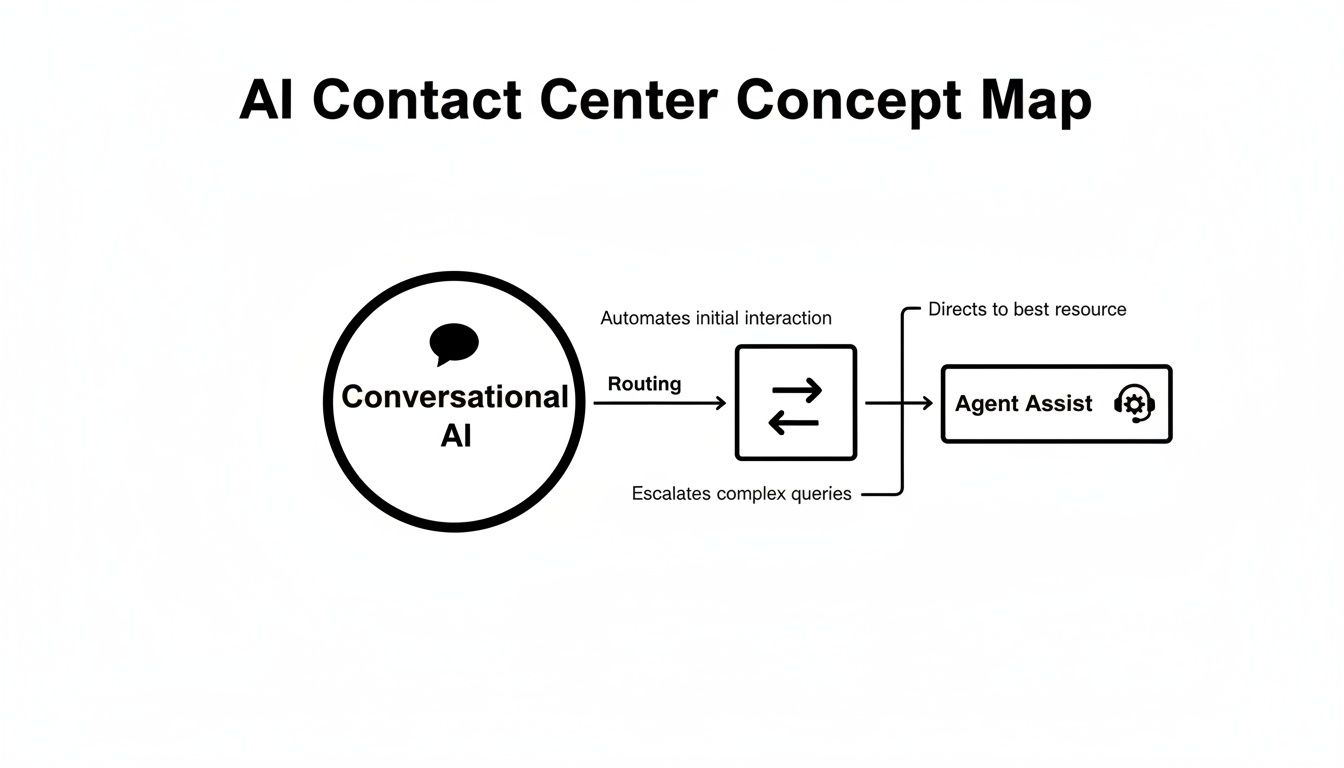
As you can see, the process starts with Conversational AI, which then routes the interaction to the right place—be it self-service or a human—before finally equipping the agent with real-time assistance.
To really grasp the shift, it helps to see a side-by-side comparison of the old way versus the new.
Before and After Implementing Contact Center AI
| Metric | Traditional Contact Center | AI-Powered Contact Center |
|---|---|---|
| Average Wait Time | 5-15 minutes (or more) | Under 60 seconds for many queries |
| First Contact Resolution | 60-70% | 85% or higher |
| Agent Turnover | 30-45% annually | Reduced by 25% or more |
| Cost Per Interaction | $8-15 | $2-5 (with significant self-service) |
| Customer Satisfaction | Inconsistent; often dips during peaks | Consistently higher, less volatility |
The numbers speak for themselves. AI doesn't just incrementally improve things; it fundamentally changes the performance and potential of the entire contact center.
Empowering Agents and Reducing Burnout
The final, and perhaps most overlooked, benefit is the profound impact AI has on your team. Agent burnout is a chronic plague in this industry, fueled by crushing repetition and high-stress calls. AI is the antidote.
When you automate the mundane, you free your agents to be problem-solvers, not script-monkeys. They get to tackle the complex, interesting cases where their empathy and critical thinking can truly make a difference. With tools like Agent Assist providing real-time guidance, they feel more supported and effective than ever.
This transition elevates the job from a temporary gig to a fulfilling career path, which is absolutely critical for reducing turnover and holding onto your best people.
This isn't a niche movement. The market is screaming for this change. The global AI cloud contact centers market is projected to explode from USD 4.3 billion in 2026 to a massive USD 23.0 billion by 2036. That incredible growth, driven by an 18.2% compound annual growth rate, shows a clear industry-wide migration from legacy systems to flexible, intelligent AI solutions. Businesses are voting with their wallets, prioritizing generative AI and cloud platforms that both slash costs and delight customers. You can read the full research on this market boom to see why enterprises are making these investments now.
Contact Center AI Examples from the Real World

The theory behind contact center AI is interesting, but the real "aha!" moment happens when you see it solving actual business problems. This isn't just about abstract tech; it's about fixing the frustrating, everyday friction that both customers and agents experience. Let's look at a few stories of how this plays out in the real world.
Think about a popular online retailer during the holiday rush. The contact center gets absolutely buried under one question: "Where is my order?" Before AI, agents spent their entire day looking up tracking numbers, which led to painful wait times and burned-out staff.
So, the retailer rolled out an AI-powered chatbot on their site and mobile app. Now, when a customer asks about an order, the bot verifies their identity, fetches the tracking details from the shipping system, and gives them a real-time update in seconds. This one move automated over 60% of their inbound questions. Suddenly, their human agents were free to tackle complex issues—like tricky returns, exchanges, or giving personal shopping advice.
- The Pain Point: An overwhelming volume of repetitive "Where is my order?" (WISMO) calls was tying up all the agents.
- The AI Fix: A chatbot was integrated directly with the order management system to deliver instant, automated updates.
- The Result: Agent workload dropped dramatically, customers got faster answers, and the team could finally focus on the high-value problems that actually require a human touch.
This is a bread-and-butter example, but the possibilities go way beyond simple Q&A. You can get a broader sense of what's possible by exploring the many conversational AI use cases businesses are putting into practice.
Improving Experiences in Finance and Travel
Let's switch gears to a large bank. Customers calling about their accounts are often stressed, and you can hear it in their voice. This bank started using a contact center AI platform with advanced voice analysis to get a read on customer sentiment during live calls.
If the AI picks up on rising frustration or distress in a customer's voice, it quietly alerts a supervisor. Even better, it can intelligently escalate the call. For example, if a customer sounds extremely agitated about a potential fraud case, the system can skip the standard queue and route them straight to a senior agent in the fraud department.
Expert Opinion: An expert in customer journey mapping puts it this way: "AI's ability to 'hear' emotion and intent is a game-changer. It allows businesses to be proactive in de-escalating issues, turning potential brand detractors into loyal advocates by showing them you're truly listening."
This kind of proactive support stops a bad experience from getting worse. It gets the customer to the right expert right away, which is critical for building trust and keeping them long-term.
Finally, imagine a major travel agency that wants to create a more personal booking process. They connected their website analytics to their contact center AI. Now, when a customer who was just browsing Hawaiian vacation packages calls in, the AI recognizes their phone number and their recent activity.
Instead of the generic "How can I help you?", the AI-driven IVR (Interactive Voice Response) might ask, "I see you were looking at trips to Maui. Would you like to speak with one of our Hawaii specialists?" The call is then sent to an agent who already has the customer's browsing history pulled up, ready to offer specific recommendations for flights and hotels.
- The Pain Point: The call experience was totally disconnected from what the customer was doing on the website.
- The AI Fix: Predictive intent analysis was used to link the customer's online behavior to their live call.
- The Result: A highly personalized service that feels almost like mind-reading. It speeds up the booking process and gives conversion rates a serious boost.
Getting Started: A Simple Checklist for Contact Center AI
Alright, you're convinced that contact center AI has serious potential. But when you think about actually bringing it into your operations, the whole project can feel overwhelming. Where do you even start?
The good news is, a smart rollout isn't about flipping a giant switch overnight. It’s a measured journey you can navigate one step at a time. This checklist is your friendly guide, focusing just as much on your people and existing workflows as it does on the new tech.
First Things First: Define Your "Why"
Before you look at a single piece of software, you need to get crystal clear on what problem you're trying to solve. What's the specific pain point you want to eliminate?
Are you drowning in simple, repetitive calls and need to free up your agents? Is the main goal to give your team the tools to resolve complex issues faster? Or maybe you're chasing a higher Customer Satisfaction (CSAT) score.
Get specific. "We want to be more efficient" is a fuzzy wish. A real goal sounds like this: "We will use AI to cut our average handle time by 15% within six months."
- Slash Operational Costs: Automate the easy stuff—password resets, order status lookups, and basic FAQs.
- Elevate the Customer Experience: Offer instant, 24/7 support and kill the dreaded hold music.
- Supercharge Agent Productivity: Feed your team real-time guidance and instant access to information.
- Drive More Revenue: Let AI spot opportunities for relevant upsells or cross-sells during conversations.
Without a solid "why," you're just buying technology for technology's sake. Your goals are the compass that will point you to the right tools and tell you what success actually looks like.
Get an Honest Look at Your Current Setup
Before you can plan your future, you have to know where you stand today. It's time for a candid assessment of your contact center's current state. What are your biggest bottlenecks? Is your tech stack a solid foundation or a tangled mess of systems that barely talk to each other?
This is also where your data comes into play. AI feeds on data, so its quality and accessibility are non-negotiable. Do you have clean, structured records of customer interactions? Or is everything scattered across a dozen different spreadsheets and platforms? Knowing what you're working with is half the battle.
Expert Opinion: A seasoned digital transformation expert once told me, "Don't buy AI to fix a broken process. Fix the process first, then use AI to make it sing. Applying a great tool to a chaotic system just gives you faster chaos."
Pick the Right Partner and Start Small
Once your goals are set and you know your starting point, it's time to talk to vendors. But don't get blinded by flashy feature lists. Look for a partner who genuinely understands your industry and has solved the exact problems you're facing. Ask for case studies from businesses that look like yours.
And here's the most important piece of advice you'll get: don’t try to boil the ocean. Forget about a massive, big-bang launch. Instead, kick things off with a small, focused pilot program. Pick one specific, high-volume problem—like automating all "Where is my order?" inquiries—and test the AI solution in a controlled environment.
This approach is a game-changer. It lets you:
- Test the tech without risking your entire operation.
- Gather real data on how it performs in your world.
- Get honest feedback from the agents and customers who use it.
- Iron out all the wrinkles before you even think about a full rollout.
A successful pilot creates incredible momentum. It gives you the hard evidence needed to get buy-in from leadership and the rest of the company. For a deeper look at this strategy, our complete guide on building an AI implementation roadmap breaks down these steps in greater detail.
Finally, remember your team. A successful contact center AI project is a team sport. Invest in thorough training, be transparent about how the tools will help them (not replace them), and bring them into the process early. When your agents feel like part of the solution, your chances of success skyrocket.
The Future of Customer Interactions
If you think contact center AI is impressive now, you’re looking at the warm-up act. The technology is evolving so fast that we’re moving beyond just reacting to customer problems. The next frontier is proactive, predictive service that solves issues before customers even know they have them.
So, what does this actually look like? It all starts with a move toward true hyper-personalization. This isn't just about slotting a customer's name into an email. We're talking about an AI that understands the full context of a customer—their purchase history, recent browsing activity, past support tickets, and even what they're likely to need next.
Practical Example: Imagine a customer’s laptop warranty is a week away from expiring. Instead of leaving it to chance, the AI could proactively send them a personalized offer to extend it, complete with a one-click purchase option. That’s not just good service; it's anticipating a need and making the solution effortless.
The Rise of Autonomous Agentic AI
The real game-changer on the horizon is agentic AI. These aren't the chatbots we're used to. They are fully autonomous systems that don't just answer questions—they take action. An agentic AI can perform complex, multi-step tasks across different platforms entirely on its own.
Think about a customer calling to report a damaged delivery. A future agentic AI could handle the entire resolution in a single, fluid interaction. It would instantly verify the order, file the damage claim with the shipping company, process a refund to the customer's card, and trigger a replacement order, all while logging the incident in the CRM.
There's no "Let me put you on hold while I check that." The AI just gets it done. It’s a profound shift from merely providing information to delivering a complete outcome.
Expert Opinion: "Agentic AI is the difference between a helpful concierge who can give you directions and a personal assistant who has already booked the car for you," says industry analyst Ben Carter. "It's about taking action, not just providing answers. That's the leap."
Ethical AI and Smart Governance
Of course, as AI becomes this powerful and autonomous, the conversation around ethics and responsible governance is more critical than ever. We can't build this future without putting up some serious guardrails. This is where new regulations like the EU AI Act come into play, creating a clear framework for fairness, transparency, and accountability.
This new regulatory focus isn't an obstacle; it's a blueprint for building customer trust. Projections show that by 2029, agentic AI will handle 80% of routine customer service tasks without any human input, pushing companies to integrate large language models and advanced reasoning into their operations. In step with this, the EU AI Act now requires strict explainability, bias detection, and human oversight for AI in customer-facing roles, a standard that's already influencing policies worldwide. You can discover more insights on these AI market trends and their regulatory impact.
The future of the contact center isn't just about being faster or cheaper. It's about creating smarter, more intuitive, and genuinely helpful experiences. A proactive, predictive, and ethically governed approach to service isn't some distant dream—it's the new standard we are building right now.
Answering Your Top Questions About Contact Center AI
It's understandable to have questions about contact center AI. This is a big shift, and it’s smart to be curious about how it all works, what it costs, and what it means for your team. Let's get straight to the answers for the questions we hear most often.
Will AI Completely Replace Human Agents?
This is always the first question, and for good reason. The short answer is a definite no. The real goal of AI in a contact center isn't to replace your people—it's to make them better at their jobs.
Think of AI as a new, incredibly efficient team member. It's brilliant at handling the repetitive, predictable tasks that clog up your queue, like order status lookups or password resets. By automating that workload, you free up your human agents to tackle the complicated, sensitive issues where a human touch is non-negotiable.
Expert Opinion: In the words of one customer experience leader, "We don't hire people to be robots. We hire them for their humanity. AI just takes the robotic work off their plate so they can be more human."
AI becomes a powerful assistant, feeding agents the right information at the right time and handling the busywork. This empowers them to be true brand ambassadors and expert problem-solvers—roles a machine simply can't fill.
How Much Does Contact Center AI Cost to Implement?
That’s a bit like asking, "How much does a car cost?" The answer really depends on the model you choose and the features you need. A simple chatbot for a small website will have a very different price tag than a comprehensive AI platform for a global enterprise.
Several key factors will influence the cost:
- Solution Complexity: Automating a basic FAQ list is far simpler (and cheaper) than building an AI that can process complex, multi-step transactions like insurance claims.
- Number of Channels: An AI that works across voice, chat, email, and social media will naturally cost more to implement than a single-channel solution.
- Integration Depth: Connecting the AI to your core business systems like a CRM or ERP adds to the initial cost, but it's also where you unlock most of its value.
The good news is that many vendors now operate on a subscription (SaaS) model. This eliminates the need for a massive upfront capital investment and makes this technology much more accessible for businesses of all sizes.
Can a Small Business Realistically Benefit?
Absolutely. In fact, for a small business, AI can be a game-changer. When you don't have a massive support team or a huge budget, you need every resource to work as efficiently as possible.
A well-chosen contact center AI solution acts like a digital employee who works 24/7, never calls in sick, and can handle a sudden flood of customer questions without breaking a sweat. It ensures you never miss a lead or an urgent customer request, even outside of business hours. Ultimately, it allows a small business to punch far above its weight and deliver a customer experience that can compete with much larger companies.
Ready to see how AI can elevate your customer support and drive real business results? At YourAI2Day, we provide the latest news, tools, and insights to help you make smart decisions about artificial intelligence. Explore our resources today!