What Is Prompt Engineering? A Beginner’s Friendly Guide
Ever feel like you’re not getting the magic out of AI that everyone else is? You ask a simple question and get a bland, unhelpful answer. The secret isn't some complex technical trick—it's learning how to ask in the right way. At its core, prompt engineering is simply the art and science of crafting specific instructions—or prompts—to get a generative AI model to give you exactly what you want. Think of it as learning the secret language of AI.
Learning the Secret Language of AI

So, how do some people pull perfectly worded emails, stunning images, or brilliant ideas from AI tools, while your own results just seem to fall flat? The answer is prompt engineering.
Imagine an AI model as an incredibly powerful but very literal intern. Give it vague instructions, and you'll get vague, unhelpful results back. But if you learn how to ask correctly, you can unlock its true potential. This is precisely why understanding what is prompt engineering is so important, especially for beginners who are just getting started with consumer AI tools.
Why Your Words Matter So Much
Let's use an analogy. Imagine you're instructing a world-class chef. If you just say, "Make me some food," you might get anything from a piece of toast to a five-course meal you had no interest in. It's a total gamble.
But what if you hand that same chef a detailed recipe? One that specifies the ingredients, the cooking methods, and even how you want the dish plated. Now, you're pretty much guaranteed to get the exact meal you were craving.
Expert Opinion: "What will always matter is the quality of ideas and the understanding of what you want." – Sam Altman, CEO of OpenAI. His point reinforces that no matter how smart AI gets, effective communication—the heart of prompt engineering—will always be the key. You still have to know what you want.
Prompt engineering works exactly the same way. It's the huge difference between asking an AI to "write about dogs" and asking it to "write a 100-word blog post intro about the loyalty of golden retrievers, using a friendly and heartwarming tone." That second, detailed prompt is the recipe for a successful result.
This skill isn’t just for developers or tech gurus anymore. It’s for anyone who wants to get real value from AI in their daily work. It really comes down to three things:
- Clarity: Being crystal clear and specific about what you need.
- Context: Giving the AI enough background information to understand the why behind your request.
- Creativity: Being willing to experiment with different phrasing and instructions to see what works best.
The Anatomy of an Effective Prompt
To help you get started right away, let’s break down the basic building blocks of a great prompt. Getting these components right is your first real step toward mastering the conversation with AI.
The Anatomy of an Effective Prompt
| Component | What It Does | Simple Example |
|---|---|---|
| Role/Persona | Tells the AI who to be, which sets the tone and level of expertise. | "Act as a professional copywriter…" |
| Task | Clearly states the specific action you want the AI to perform. | "…draft three headlines for a new coffee brand." |
| Context | Gives the necessary background for a much more relevant response. | "The brand is eco-friendly and targets young professionals." |
| Constraints | Sets the rules and boundaries, like word count, style, or format. | "Keep each headline under 10 words." |
Once you start thinking in terms of these four components, you'll find your prompts become exponentially more effective, and the AI's responses will start looking a lot more like what you had in your head.
How We Learned to Talk to Machines

While the term "prompt engineering" feels like it appeared out of nowhere, the basic idea of giving machines precise instructions is anything but new. It's a story that’s been unfolding for decades, tracking our journey from typing rigid commands to having something that feels a lot like a real conversation.
This journey didn’t kick off with the AI chatbots we use today. The real roots of prompt engineering stretch all the way back to the early days of artificial intelligence in the 1970s. One of the pioneering examples was Terry Winograd’s SHRDLU project, a system that could follow commands about a simple world of blocks, but only if you used carefully crafted prompts to give it context.
Back then, "talking" to a computer meant using a strict, unforgiving language. A single misplaced comma or an extra space could bring everything grinding to a halt. It was a one-way street; we had to learn the machine's language, not the other way around.
The Shift to Natural Language
The game completely changed in the 2010s with the rise of neural networks and deep learning. For the first time, AI models could be trained on massive datasets—basically, huge chunks of the internet. This allowed them to finally start picking up on the subtle patterns, nuances, and context of human language.
It was a monumental leap. Instead of us having to learn the machine's syntax, the machine was finally learning ours. AI could now understand requests that were far more flexible, creative, and conversational. You can dive deeper into the mechanics of this by understanding AI technology in our guide.
This evolution flipped the script entirely. The challenge shifted from writing perfect code to asking the right questions in just the right way.
Expert Insight: "AI's ability to process natural language created a new communication bridge," explains AI researcher Dr. Alistair Finch. "The focus shifted from programming syntax to the art of clear instruction, making human language the new programming language. The better the instruction, the better the output."
Suddenly, almost anyone could have a direct conversation with an incredibly powerful AI. This newfound access created a demand for a brand-new skill: the ability to guide these conversations effectively. We all had to figure out how to phrase our requests to coax the most accurate, creative, and useful answers out of these systems.
This is the point where prompt engineering as we know it was truly born. It became the essential skill for anyone looking to steer the AI and get reliable, high-quality results. It's the final step in a long journey, moving us from being rigid operators to becoming creative collaborators with technology.
Core Prompting Techniques You Can Use Today
Alright, let's get our hands dirty and move from the "what" to the "how." The techniques I'm about to show you are the bread and butter of prompt engineering. Once you get the hang of these, you’ll see a massive leap in the quality of what you get out of an AI. And the best part? They’re surprisingly intuitive.
Think of it like teaching a new skill. You wouldn't just state the rules of a game and walk away, right? You’d show a few moves, maybe play a quick round to demonstrate. Large language models learn in a very similar way. The more context and guidance you provide, the better they perform.
The whole process is really a loop: you write a prompt, check the output, and tweak your instruction until it’s just right.
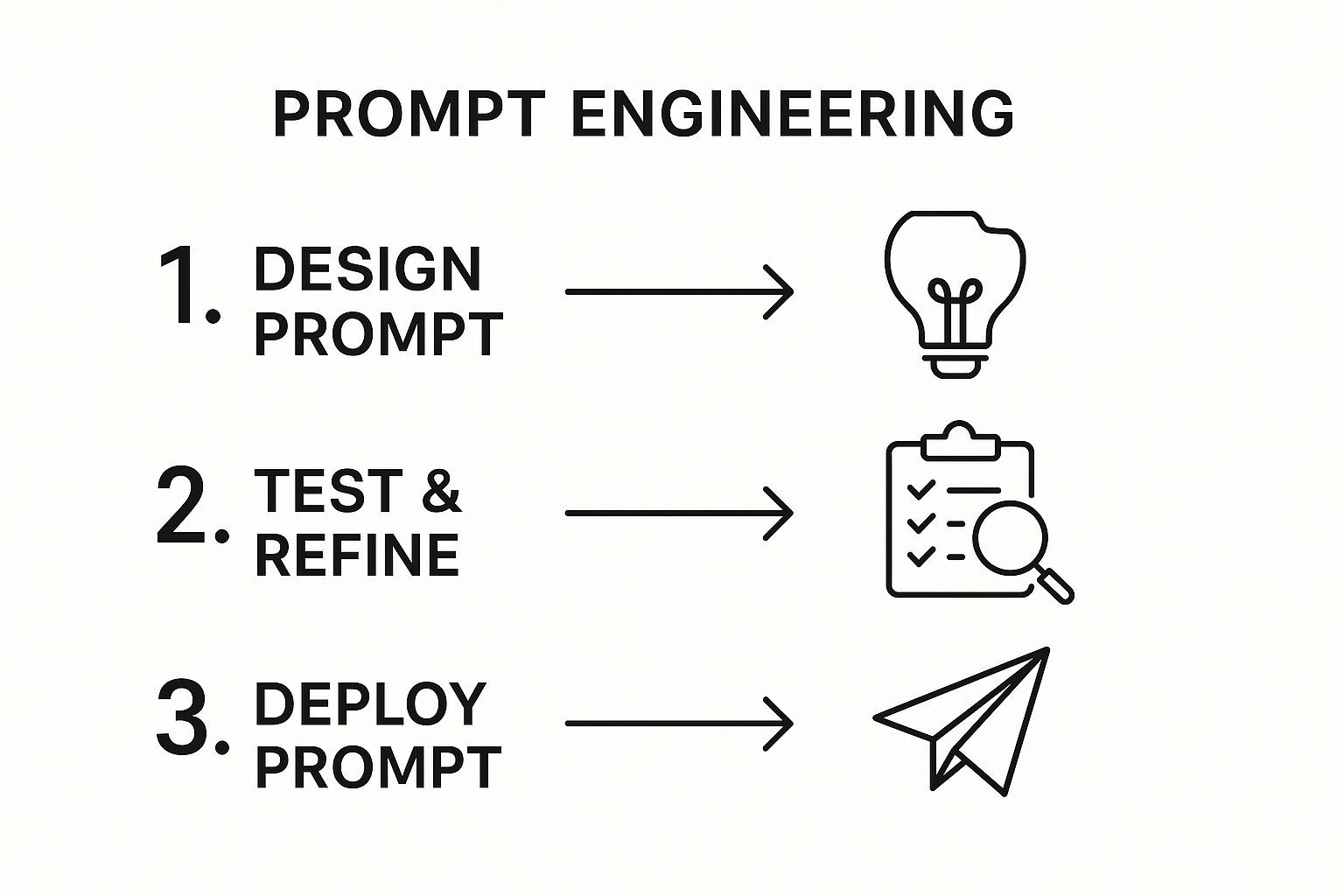
This back-and-forth is key. Good prompt engineering isn't about getting it perfect on the first try. It’s about refining your approach to get predictable, high-quality results every time.
Zero-Shot, One-Shot, and Few-Shot Prompting
One of the first things you'll learn is that the number of examples you give the AI in your prompt completely changes the game. Each approach gives the model a different level of context to work with.
-
Zero-Shot Prompting: This is where you give the AI a task with zero examples. You're banking entirely on the model's built-in knowledge. It’s quick and easy, but sometimes the AI guesses wrong.
- Okay:
Classify this email's sentiment: "I'm very unhappy with the product." - Better:
Classify the sentiment of the following email as Positive, Negative, or Neutral. Email: "I'm very unhappy with the product."
- Okay:
-
One-Shot Prompting: Here, you provide one single example to steer the AI in the right direction. This little nudge helps it understand the format and tone you're looking for.
- Example:
Email: "The new update is fantastic!" Sentiment: Positive. Now, classify this: "I'm very unhappy with the product."
- Example:
-
Few-Shot Prompting: This is your go-to for more complex or specific tasks. You give the model several examples, which establishes a clear pattern for it to follow.
- Example:
Email: "The new update is fantastic!" Sentiment: Positive. Email: "The delivery was late." Sentiment: Negative. Email: "The webinar is scheduled for Tuesday." Sentiment: Neutral. Now, classify this: "I'm very unhappy with the product."
- Example:
My Take: Giving the AI examples is like tuning an instrument for a specific song. While a good model can often play the tune with zero guidance, feeding it even one or two examples sharpens the output dramatically, especially if you need structured data back. It’s one of the easiest ways for a beginner to get better results fast.
Chain-of-Thought Prompting
Ever notice how an AI can sometimes jump to the wrong conclusion on a problem that requires a few steps? That's because it's trying to get to the answer in one leap. Chain-of-Thought (CoT) prompting is a brilliantly simple fix for this.
All you have to do is tell the AI to "think step-by-step."
This simple phrase forces the model to slow down, break the problem into smaller pieces, and show its work. This process of reasoning almost always leads to a more accurate final answer.
Before (Simple Prompt):Q: Roger has 5 tennis balls. He buys 2 more cans of tennis balls. Each can has 3 tennis balls. How many tennis balls does he have now?
Potential AI Answer: He has 10 tennis balls. (Wrong.)
After (Chain-of-Thought Prompt):Q: Roger has 5 tennis balls. He buys 2 more cans of tennis balls. Each can has 3 tennis balls. How many tennis balls does he have now? Let's think step by step.
AI Answer: First, I need to calculate the new balls. Roger bought 2 cans, and each has 3 balls, so 2 * 3 = 6 new balls. Then, I add the new balls to the ones he already had: 5 + 6 = 11 balls. So, Roger now has 11 tennis balls. (Correct!)
These are just a couple of the foundational methods, but you can see how powerful they are. You can apply them across all kinds of AI tools for content creation, whether you're drafting an email, analyzing data, or even solving a word problem.
Prompt Engineering in Your Daily Life

This is where the theory hits the road. It’s one thing to talk about prompt engineering, but it’s another to see how it can genuinely make your day-to-day life a whole lot easier. This isn't just for developers or data scientists; it's about getting better, more useful answers from the AI tools you’re already using for work, hobbies, or just for fun.
The best part? You can start using these skills right away. Once you get the hang of a few core principles, you can fire up tools like ChatGPT, Gemini, or Midjourney and see a noticeable difference in the quality of what you get back.
Let's walk through a few real-world situations.
For the Small Business Owner
Say you run a cozy, eco-friendly coffee shop and need some fresh social media content. You could ask for a simple post, but a thoughtfully crafted prompt can produce something that actually sounds like you.
-
Vague Prompt:
Write a social media post about our new latte. -
Engineered Prompt:
Act as the social media manager for a small, community-focused coffee shop that prides itself on sustainability. Write three distinct Instagram captions for our new "Sunrise Citrus Latte." The tone needs to be warm, friendly, and a bit playful. Be sure to mention the fresh orange zest and our locally sourced espresso beans. End each caption with a question to get people talking and include these hashtags: #EcoCoffee #LocalBeans #CitrusLatte.
See the difference? The engineered prompt gives the AI a role, plenty of context, a clear task, and specific constraints. The result is content that feels authentic, not generic. This is how you start using AI for marketing effectively.
For the Busy Professional
You’ve just been handed a dense, 20-page report, and you have a meeting in an hour to discuss it. Prompt engineering can turn your AI into a hyper-efficient assistant.
-
Vague Prompt:
Summarize this report for me. -
Engineered Prompt:
I'm a project manager prepping for an important client meeting. Scan the attached report and pull out only the key findings, action items, and the proposed project timeline. Format the output as a numbered list with concise, easy-to-scan points.
By clearly defining your role and exactly what you need, you get a summary that’s immediately useful, not just a wall of text. It's a game-changer for getting up to speed quickly.
Pro Tip: Specificity is your superpower. Instead of asking for a "summary," ask for a "five-bullet-point summary for a busy executive." The more detail you feed the model, the less it has to guess.
Prompt Makeovers From Vague to Valuable
To really drive the point home, let's look at a few more side-by-side comparisons. This table shows how a little bit of thoughtful engineering transforms a basic request into a powerful instruction, leading to dramatically better outputs.
| Goal | Basic Prompt | Engineered Prompt | Why It's Better |
|---|---|---|---|
| Drafting an Email | Write an email to a client. |
Draft a polite but firm follow-up email to a client named John at Acme Corp. Remind him that invoice #1234 is 15 days past due. Maintain a professional and helpful tone. Offer to answer any questions he might have. |
Provides a specific scenario, tone, and key details (invoice number, recipient), ensuring the email is actionable and appropriate. |
| Generating Ideas | Give me some blog post ideas. |
I run a blog for beginner gardeners in urban areas. Brainstorm 10 blog post titles that are SEO-friendly and focus on low-maintenance plants for small apartment balconies. Target keywords like "balcony garden" and "container plants." |
Narrows the focus by defining the audience, niche, and SEO goals, leading to relevant and strategic ideas. |
| Explaining a Concept | Explain quantum computing. |
Explain the concept of quantum computing to a 12-year-old using a simple analogy. Avoid technical jargon and focus on the core ideas of superposition and entanglement. Keep it under 200 words. |
Sets a clear target audience and constraints (analogy, word count, jargon), making the explanation accessible and easy to understand. |
As you can see, the "engineered" column isn't about being overly complex—it's about being clear and intentional. A few extra sentences of context can make all the difference between a frustrating, generic response and a genuinely helpful one.
Why This Is a Skill Worth Learning
So, beyond just getting a better answer from a chatbot, why should you spend your time getting good at prompt engineering? The short answer is that it’s quickly moving from a niche "trick" to a core skill for getting things done in today's world.
Think of it as your new superpower, one that makes you more effective at just about anything. It turns you into a better creative partner with AI, helping you spark ideas you might never have stumbled upon otherwise. Instead of just taking whatever generic first draft the AI spits out, you can guide it to build, refine, and perfect your concepts. It’s a massive boost for any creative process.
Supercharge Your Productivity and Career
On a purely practical level, good prompting can have a huge impact on your productivity. Imagine automating those mind-numbing tasks like summarizing long reports into crisp bullet points, drafting personalized emails for a dozen contacts, or generating a week's worth of social media posts. This isn't just about saving a few minutes here and there; it’s about freeing up huge chunks of your day for work that actually requires your brain.
Expert Insight: "This shift reframes prompt engineering not as a technical chore, but as a form of digital literacy," notes technology analyst Sarah Jenkins. "It’s the key to unlocking a more efficient and creative partnership between human ingenuity and artificial intelligence."
From a career perspective, this skill is already becoming a serious advantage in the job market. As more businesses weave AI into their daily operations, they're desperate for people who know how to talk to these tools effectively. This isn’t a fleeting trend—it has real money behind it.
The job market for prompt engineering has exploded, showing just how important this skill has become worldwide. In 2023-2024, some prompt engineering roles were pulling in salaries as high as $335,000 a year. That number reflects the serious expertise it takes to guide these complex language models. You can find more stats on the value of prompt engineering skills at AIStratagems.com.
This makes one thing clear: mastering the art of the prompt is more than a hobby. It's a smart investment in your future, opening up new opportunities and making you a more valuable person in any industry. Learning this skill puts you in the driver's seat, letting you direct the technology instead of just being a passive user.
Simple Rules for Writing Better Prompts
Want to get better results from AI, starting now? Keep these simple rules in your back pocket. They're easy to remember and will make a huge difference in the quality of what you get back, turning frustrating conversations into productive ones.
Be Specific, Not Vague
Think about it this way: you’d never ask a friend to just "get some groceries" and expect them to read your mind. You’d give them a list. The same principle applies to AI. Vague requests get you generic, unhelpful responses.
- Vague: "Write about my company."
- Specific: "Write a 100-word paragraph about 'EcoBloom,' a startup that sells sustainable gardening kits. Make sure to mention our commitment to using recycled materials and our mission to make gardening accessible for people in cities."
Give the AI a Role to Play
One of the best tricks in the book is to tell the AI who it should be. Giving it a persona instantly frames the entire conversation, setting the tone, style, and level of expertise for the response.
- Practical Example: Asking for marketing ideas is fine. But asking for marketing ideas
as if you're a top brand strategist who specializes in reaching Gen Z on TikTokwill give you completely different—and far more valuable—results.
Expert Insight: An AI's persona acts like a lens. Telling it to be a 'skeptical editor' or an 'enthusiastic startup founder' focuses its knowledge and shapes its voice. You're basically turning a general tool into a specialist assistant on demand.
Provide Context and Set Boundaries
The AI doesn't have your background knowledge, so you need to fill in the gaps. Give it the "why" behind your request and then set clear rules for the task, like word count, a specific format, or things it absolutely should not mention. Giving the model context and constraints is fundamental to getting it to understand the job.
As you get more advanced, you can even explore ways to get algorithms to fine-tune prompts for you. You can read more about how this works by exploring the evolution of AI communication on PromptEngineering.org.
Don't Be Afraid to Iterate
Your first prompt is almost never your last. Treat it like a real conversation. If the AI's first attempt isn't quite right, don't just scrap it and start over.
Build on what it gave you. Add a new detail, clarify a point, or ask it to try again from a different angle. This back-and-forth process is where the real magic of prompt engineering happens.
Common Questions About Prompt Engineering
As you get your feet wet with prompt engineering, you’re bound to have a few questions. It’s a new field, after all. Let's clear up some of the most common things people wonder about when they're just starting out.
Do I Need to Be a Programmer to Do This?
Absolutely not. At its heart, prompt engineering is about clear communication, logic, and creativity, not slinging code. It’s a skill built on using natural language to give great instructions.
While a technical background can certainly help with more advanced, specialized applications, anyone who can write a clear sentence has the foundation they need to start learning. It’s more about being a good communicator than a good coder.
Will AI Get So Smart We Won’t Need Prompt Engineering?
It's far more likely to evolve than to vanish completely. As AI models get better at understanding us, they'll need less hand-holding for simple, everyday tasks. That part is true.
But for complex, creative, or highly specific goals, the need for precise, well-crafted guidance will always be there. Think of it this way: the skill will shift from just giving basic instructions to providing high-level strategic direction.
As one expert put it, "What will always matter is the quality of ideas and the understanding of what you want." This really gets to the core of it—effective communication with these powerful tools will always be valuable.
What’s the Best Way to Start Practicing?
Honestly? Just jump in and start experimenting. There's no substitute for hands-on experience.
Fire up a free AI tool like ChatGPT, Google Gemini, or Microsoft Copilot. Pick a simple task that sounds fun to you—maybe plan a weekend trip, write a silly short story, or invent a new recipe. Then, just play. Try phrasing your request in different ways and see what happens. You'll quickly see how small tweaks to your words can lead to dramatically different results.
Ready to dive deeper and stay ahead of the curve? YourAI2Day is your go-to source for the latest AI news, tools, and insights. Explore more guides and join our community at https://www.yourai2day.com.