What Is Neo4j and How Does It Power Modern AI?
Have you ever felt trapped by the rigid rows and columns of a traditional database? If so, you've stumbled upon the exact problem that graph databases were built to solve. At its core, Neo4j is a graph database, but that definition barely scratches the surface. It's a system designed from the ground up to treat the relationships between your data points as just as important as the data itself.
Instead of tables, Neo4j uses a friendly network of nodes and relationships, which makes it incredibly fast at navigating complex, interconnected information. Think of it less like a stuffy filing cabinet and more like a dynamic mind map of your data.
Beyond Spreadsheets: Understanding Neo4j and Graph Databases
Think about any spreadsheet or relational database you've ever worked with. They're like a perfectly organized digital phone book. If you know someone’s name, finding their number is simple and fast. But what if you wanted to find out which people in that phone book know each other, or who their friends-of-friends are? The phone book model falls apart instantly.
This is precisely where Neo4j shines. It’s built to answer those "how is everything connected?" questions. Instead of a static phone book, picture Neo4j as a living, breathing social map. Every person is a dot (a node), and a line (a relationship) instantly shows you who knows whom.
For those who want a quick summary, here's a simple breakdown of what Neo4j is all about.
Neo4j at a Glance
| Concept | Simple Explanation |
|---|---|
| Graph Database | A database that uses a graph structure (nodes, relationships) to store and query data, just like drawing on a whiteboard. |
| Nodes | The primary data entities. Think of them as the "dots" in a network, like Customers or Products. |
| Relationships | The connections between nodes. They are the "lines" that give the data context, like PURCHASED or FRIENDS_WITH. |
| Cypher | The query language used to "ask questions" of the graph, designed to be intuitive and almost like plain English. |
This table gives you the basics, but the real "aha!" moment comes when you see how this structure fundamentally changes how you work with data.
Expert Opinion: “The true power of a graph database isn't just storing data; it's about making the connections between data points as important as the data itself. This shift from static entries to a living network of relationships is what enables a deeper level of insight.”
Shifting from Tables to Networks
In a traditional database, finding those friends-of-friends requires running complex JOIN operations that stitch different tables together. As your dataset grows and the connections multiply, these queries get exponentially slower. It’s a huge performance bottleneck.
Neo4j completely sidesteps this problem. It stores relationships as physical pointers, so hopping from one data point to the next is a near-instant operation, no matter how many millions of connections you have.
- Traditional Databases (like a phone book): Great for looking up specific records but painfully slow at exploring the web of connections between them.
- Graph Databases (like a social map): Purpose-built to navigate and analyze the relationships that tie your data together with incredible speed.
This is a fundamental paradigm shift. To fully grasp why this is so different, it’s helpful to know how traditional databases are designed. Resources like this guide on What Is An ER Diagram can show you the old way of modeling data, which makes the advantages of the graph model even more obvious.
Why Does This Matter Today?
In a world powered by AI and incredibly complex systems, context is king. Understanding the "how" and "why" behind data connections is no longer a luxury—it’s a necessity.
This is why Neo4j has become the leader in the graph database market, reaching an impressive $200 million in annual recurring revenue as of November 2024. Its adoption by 84% of Fortune 100 companies, including household names like Walmart, NASA, and IBM, speaks volumes about its role in the modern data stack.
From powering real-time recommendation engines that suggest what you should buy next to uncovering sophisticated fraud rings hidden deep within financial data, Neo4j allows organizations to ask questions they simply couldn't before. It’s not just about what the data is; it's about how it's all connected.
The Building Blocks of Neo4j: Nodes, Relationships, and Properties
To get a handle on what Neo4j is all about, you need to grasp its three core components. If you’re coming from a world of relational databases, you’re used to tables, rows, and columns. Neo4j scraps that for a model that’s much more intuitive: Nodes, Relationships, and Properties.
Don't let the new terms intimidate you. If you’ve ever sketched a family tree or a mind map on a whiteboard, you've already been thinking in graphs. We can even use the tangled web of Game of Thrones to make these ideas click.

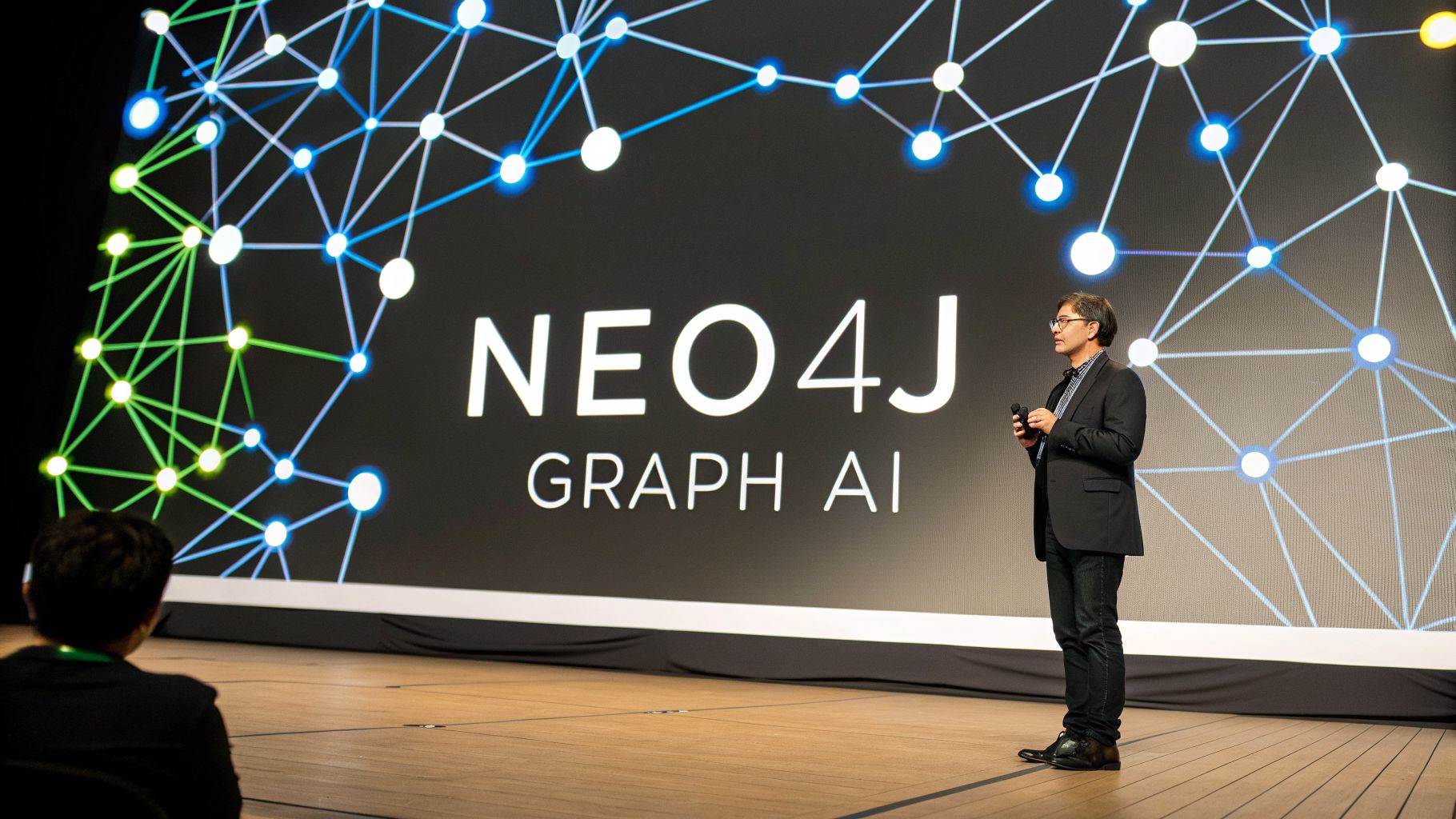
This visual shows how Neo4j moves past rigid tables to focus on the dynamic connections that give data its real-world meaning.
Nodes: The Dots in Your Data Universe
Everything in a graph starts with Nodes. Think of them as the primary subjects or entities in your dataset. They represent the nouns—the people, products, places, or events you want to track. In our Game of Thrones world, 'Jon Snow', 'Winterfell', and the 'Iron Throne' would each be represented as a node.
Nodes are typically grouped using Labels. A label is just a tag, like :Person or :Location. For instance, we could apply the :Person label to the 'Jon Snow' and 'Daenerys Targaryen' nodes, and a :Location label to 'Winterfell'. This simple act of organization makes your graph much easier to query and manage down the line.
Key Concept: Nodes
Nodes are the fundamental data records in a graph, representing any given entity. They are the graph equivalent of a 'row' in a SQL table or a 'document' in a document DB.
Relationships: The Lines That Connect Everything
Here’s where a graph database really shows its strength. Relationships are the direct, meaningful connections between your nodes. They are the verbs that describe how two nodes are related, giving your data its structure and context. In Neo4j, these connections are just as important as the data points themselves.
So, instead of just having a 'Jon Snow' node and a 'Daenerys Targaryen' node floating in space, we can draw a directed line between them: (Jon Snow)-[:ALLIED_WITH]->(Daenerys Targaryen).
The possibilities are endless.
(Robb Stark)-[:SIBLING_OF]->(Sansa Stark)(Jaime Lannister)-[:MEMBER_OF]->(Kingsguard)(Daenerys Targaryen)-[:RULES]->(Meereen)
These rich, descriptive connections tell a story that a relational table with foreign keys just can't match. The power to traverse these paths is what makes Neo4j so fast for finding connections, like the shortest route between two points—a classic graph problem you can learn more about in our guide on implementing depth-first search in Python.
Properties: The Details That Matter
Finally, what about the specific details? That's where Properties come in. These are simple key-value pairs that you can attach to both nodes and relationships to store extra information. Think of them as the adjectives that add crucial detail and color to your graph.
For example, on our :Person node for 'Jon Snow', we could store properties like:
name: 'Jon Snow'title: 'King in the North'status: 'Alive'
What's really powerful is that relationships can have properties, too. The [:ALLIED_WITH] relationship could hold a property like duration: '2 years' to record how long that alliance held. This ability to add detail to both the entities and their connections lets you build incredibly nuanced and realistic data models.
Learning to Speak Graph with the Cypher Query Language
So, you've modeled your data as a beautiful web of nodes and relationships. How do you actually talk to it? That’s where a query language comes in. For Neo4j, that language is Cypher, and it’s so intuitive that people often call it "ASCII art for data."
What they mean is that Cypher's syntax visually mirrors the patterns you want to find in your graph. You literally draw what you're looking for with keyboard characters. This makes it incredibly readable and—most importantly—easy for newcomers to learn, especially when asking questions about connections.
Let's walk through a few examples using our Game of Thrones dataset to see just how straightforward it is.
Finding a Single Character
First up, the simplest task: finding one specific person in our database. Let's find the node for 'Jon Snow'.
Here’s the Cypher for that:
MATCH (p:Person {name: 'Jon Snow'})
RETURN p
It might look a little strange at first, but it’s completely logical. Let's break it down:
MATCH: This is your "find" command. It tells Neo4j to look for a specific pattern in the graph.(p:Person {name: 'Jon Snow'}): This is the pattern itself. The parentheses()represent a node. Inside,pis just a variable name we're giving the node we find,:Personis its label, and{name: 'Jon Snow'}is the property we need it to have.RETURN p: This tells Neo4j what to give you back. Here, we're asking for the entire node we found and namedp.
Running this query returns the single node for Jon Snow, properties and all. See? Not so bad.
Finding Connected Characters
Now for the fun part. Let's ask a relationship-based question: who is 'Sansa Stark' a sibling of? This is where Cypher's visual style really clicks.
We need to find a Person node ('Sansa Stark'), follow a SIBLING_OF relationship, and see which Person node is on the other end.
This is what that looks like in Cypher:
MATCH (sansa:Person {name: 'Sansa Stark'})-[:SIBLING_OF]->(sibling)
RETURN sansa.name, sibling.name
Here’s what’s going on in that query:
(sansa:Person {name: 'Sansa Stark'}): We start by finding Sansa's node and assigning it to the variablesansa.-[:SIBLING_OF]->: This is the relationship part. The square brackets[]always represent a relationship, and the arrow->shows its direction. We're looking for an outgoingSIBLING_OFconnection.(sibling): This represents whatever node is at the other end of that relationship. We've given it the variable namesibling.RETURN sansa.name, sibling.name: Instead of returning the whole nodes, we’re just asking for thenameproperty from Sansa and the sibling(s) we found.
The result would be a neat table showing 'Sansa Stark' next to the names of her siblings, like 'Robb Stark' and 'Arya Stark'.
Uncovering Deeper Connections
Ready to go deeper? Let's find the allies of 'Daenerys Targaryen's' allies. This "friend-of-a-friend" type of query is where graph databases truly outshine their relational counterparts.
MATCH (dany:Person {name: 'Daenerys Targaryen'})-[:ALLIED_WITH]->(ally)-[:ALLIED_WITH]->(ally_of_ally)
RETURN dany.name, ally.name, ally_of_ally.name
This query might look longer, but we're just extending the same simple pattern we've already learned.
- Start at Daenerys:
MATCH (dany:Person {name: 'Daenerys Targaryen'}) - Find her direct allies:
-[:ALLIED_WITH]->(ally) - Find their allies:
-[:ALLIED_WITH]->(ally_of_ally) - Return the names:
RETURN dany.name, ally.name, ally_of_ally.name
This single, readable line of Cypher accomplishes something that would require multiple, often slow, JOIN operations in a SQL database. The difference is night and day.
Comparing SQL Joins to a Cypher Query
Imagine a social network where users are friends. Finding friends of your friends is a common task, but the way you ask the database for this information reveals the core philosophical difference between relational and graph models.
| Query Goal | SQL (Relational) | Cypher (Graph) |
|---|---|---|
| Find friends of 'John's' friends | SELECT p3.nameFROM People p1JOIN Friends f1 ON p1.id = f1.person_idJOIN People p2 ON f1.friend_id = p2.idJOIN Friends f2 ON p2.id = f2.person_idJOIN People p3 ON f2.friend_id = p3.idWHERE p1.name = 'John'; |
MATCH (p1:Person {name:'John'})-[:FRIENDS_WITH]->(p2)-[:FRIENDS_WITH]->(p3)RETURN p3.name; |
The SQL version requires multiple JOINs across two tables (People and Friends), which can become complex and slow as you look for connections that are three, four, or more "hops" away. The Cypher query, on the other hand, is a simple, visual representation of the path you're searching for. It's not just shorter—it's more intuitive and directly reflects how we think about relationships.
Why Graph Technology Is Fueling the AI Revolution

It’s no secret that artificial intelligence is changing everything, but there's a powerful combination brewing behind the scenes: AI and graph technology. While large language models (LLMs) are brilliant at processing text, they have a fundamental weakness—they don't truly grasp context or how different facts connect. This is where a graph database like Neo4j comes in, providing a structured, long-term memory for AI.
We're pushing past basic chatbots toward AI that can genuinely reason, recall past information, and deliver answers you can actually trust. This leap forward is happening thanks to two ideas that put Neo4j right in the middle of modern AI development: Knowledge Graphs and GraphRAG.
Giving AI a Brain with Knowledge Graphs
Try asking a standard AI, "Who directed the movie that starred the actor from The Matrix?" An LLM might get it right, but it might also guess or "hallucinate" an answer. That's because it’s just processing a sequence of words, not the underlying relationships between people, places, and things.
A Knowledge Graph, built inside Neo4j, fixes this by explicitly mapping out those real-world connections.
(Keanu Reeves)-[:ACTED_IN]->(The Matrix)(The Matrix)-[:DIRECTED_BY]->(The Wachowskis)
Suddenly, the AI has a reliable source of truth it can navigate. Instead of guessing, it can follow these connections to find a factually correct answer. It’s the difference between memorizing flashcards and actually understanding the story.
Expert Opinion: “For enterprise-grade AI, you can't afford hallucinations. Knowledge Graphs provide the critical contextual backbone, grounding generative AI in factual, interconnected data. It's the missing piece for building AI systems that are not just intelligent, but also reliable and explainable.”
By creating this web of structured context, Knowledge Graphs massively cut down the risk of an AI inventing facts—a non-negotiable for any business that relies on accuracy.
Making Generative AI Smarter with GraphRAG
One of the most practical and exciting developments in this area is GraphRAG, which is short for Graph-based Retrieval-Augmented Generation. This is Neo4j’s method for making generative AI models far more accurate, relevant, and insightful.
Standard RAG systems work by finding relevant documents to give an LLM some context before it generates an answer. GraphRAG takes this concept to a whole new level by retrieving a map of interconnected data points directly from a Knowledge Graph. Instead of just a wall of text, the AI gets a rich picture of related concepts, entities, and events.
For instance, if you ask about a supply chain disruption, GraphRAG can pull the incident report, the specific suppliers involved, the customers who will be affected, and even data on similar past events—all connected in the graph. This allows the AI to generate a response with incredible depth and nuance. To get a better handle on these systems, it's helpful to explore related concepts like the different vector database use cases that often work alongside them.
Neo4j isn't just dabbling in AI; it's a central part of their mission. After creating the graph database category, the company is now leading the charge in combining knowledge graphs with RAG. In March 2024, Neo4j reinforced its leadership by announcing a collaboration with Microsoft to deliver integrated data and AI products, signaling a deep commitment to this GenAI-driven graph technology acceleration.
This fusion of graph technology and AI is creating entirely new possibilities. For a closer look at how these pieces fit together, it’s worth reading about leveraging Knowledge Graphs for Advanced RAG Systems to see how this turns a simple Q&A bot into a real analytical partner.
Real-World Neo4j Use Cases You Interact with Daily

Theory is great, but where does the rubber meet the road with Neo4j? You might be surprised to find you're already using systems built on graph databases every single day. Let's pull back the curtain on a couple of common scenarios to show how Neo4j’s knack for understanding relationships solves real-world business problems.
And this isn't just a niche technology; the whole industry is catching on. In fact, Gartner predicts that graph technologies will be used in 80% of data and analytics innovations by 2025. That's a staggering leap from just 10% in 2021. This sharp uptake shows how businesses are completely rethinking data to build their most critical applications.
Powering E-commerce Recommendations
Ever been on a shopping site and seen that "Customers who bought this also bought…" carousel? That’s a classic graph problem, and it's a perfect fit for Neo4j.
The Business Problem: An e-commerce store wants to lift sales by showing shoppers products they'll actually want, and they need to do it in real time. A traditional database would have to grind through massive sales history tables with slow, complicated queries. By the time it found an answer, the shopper would be long gone.
The Neo4j Solution: A graph model makes these connections intuitively obvious and lightning-fast.
- Every
Customeris a node. - Every
Productis a node. - When a customer buys an item, a
PURCHASEDrelationship connects theCustomerandProductnodes.
Finding recommendations now becomes as simple as taking a walk through the graph. To suggest products for someone looking at a new laptop, Neo4j can instantly find other customers who PURCHASED that same laptop and then see what other products they also PURCHASED. Because Neo4j was born to traverse these connections at high speed, it delivers spot-on recommendations that feel personal and drive sales.
Expert Opinion: “Recommendation engines built on graphs are more powerful because they uncover hidden patterns. They can recommend a product not just because it’s popular, but because it’s frequently bought by people with similar purchase histories, revealing subtle connections that drive sales.”
Uncovering Complex Financial Fraud Rings
Financial fraud is a multi-billion dollar headache, and criminals are always cooking up new schemes to fly under the radar. They weave intricate webs of shell companies, fake IDs, and money laundering to cover their tracks.
The Business Problem: A bank needs to spot sophisticated fraud rings that stretch across dozens of accounts, devices, and transactions. A relational database might flag a simple stolen credit card transaction, but it hits a wall trying to connect the dots of a coordinated attack—where different people use different phones to access multiple accounts that are all quietly linked.
The Neo4j Solution: This is where a graph database really shines. Financial institutions can map their entire data landscape into a huge, connected network:
AccountnodesCustomernodesDevicenodes (like a specific phone or laptop)Transactionnodes
Relationships like HAS_ACCOUNT, USED_DEVICE, and SENT_MONEY_TO tie everything together. A fraud analyst can then run a query looking for suspicious patterns, like several "unrelated" accounts all being accessed from the same device, or a circular money flow that starts and ends in the same place. These elaborate networks, which are nearly invisible in rows and columns, practically jump off the screen in a graph.
For those curious about how AI uses context to find meaning in data, take a look at our guide on what retrieval-augmented generation is.
Your First Steps with a Neo4j Project
Alright, enough theory. The best way to really 'get' Neo4j is to fire it up and see it work. This is where the concepts click into place.
Getting started is surprisingly painless. The community provides some fantastic free tools, so you can dive in without needing a credit card or a complex server setup. Let's walk through the quickest path to get you from zero to your first functioning graph project.
An Action-Oriented Checklist
Follow these steps to get your first graph up and running. The goal here isn't to build a massive, production-ready application. It's to have that "aha!" moment when you see your data as a living, breathing network of connections.
Download Neo4j Desktop (Free): Your first port of call is the Neo4j Desktop application. This is a free, local development hub for Windows, Mac, and Linux that lets you manage different database projects right on your machine. Think of it as your personal graph sandbox.
Run the Built-in Movie Database: Once Desktop is installed, the simplest way to see Neo4j in action is by launching the 'Movie Database' project that comes with it. The database is already populated with movies, actors, and directors, so you can immediately start writing Cypher queries and visualizing the graph without any data import hassles.
Explore Neo4j AuraDB (Free Tier): When you're ready to see how Neo4j works in a cloud environment, check out Neo4j AuraDB. It’s their fully managed database-as-a-service, and it has an "Always Free" tier that’s genuinely useful for small projects and prototypes. You can spin up a cloud instance in minutes.
Expert Tip: I always recommend starting with Neo4j Desktop to get comfortable with Cypher and the basics of graph modeling locally. Once you have a feel for it, migrate your project to the AuraDB free tier. This two-step process demystifies both local development and cloud deployment.
Where to Go From Here
Once you've run a few queries and seen the data connect, you'll probably have a dozen new ideas. The Neo4j community has built an incredible set of resources to guide you as you dig deeper.
Here are some of the best places to continue learning:
- Official Neo4j Tutorials: The main website is packed with solid tutorials that cover everything from fundamental concepts to specific, advanced use cases.
- Neo4j GraphAcademy: This is your best bet for free, comprehensive courses. They offer guided learning paths with hands-on exercises for Cypher, graph data modeling, and building applications on top of Neo4j.
- Community Forums: If you get stuck, the Neo4j community forum is the place to go. It’s an active and friendly space where you can get answers from other developers and the Neo4j team itself.
Frequently Asked Questions About Neo4j
If you're just getting started with Neo4j, you probably have a few questions. Let's tackle some of the most common ones we hear from people new to graph databases.
When Should I Use Neo4j Instead of a SQL Database?
The short answer is: use Neo4j when the relationships and connections between your data are the main event, not just a side detail.
A traditional SQL database is great if your primary need is to look up a customer record by its ID. It's clean and efficient for that. But what if you need to find out which customers were influenced by the same ad, share a shipping address with a known fraudster, or are likely to buy something because their friends did? That’s where Neo4j shines.
Use Neo4j when your business questions sound like, "How are these things connected?" or "What hidden patterns exist in my network?" For simpler, tabular data lookups, SQL is still a great choice.
Is Neo4j Difficult for a Beginner to Learn?
Surprisingly, no. While thinking in graphs is a shift from the rows and columns of SQL, many developers find Neo4j's query language, Cypher, incredibly intuitive.
The reason is that Cypher's syntax is designed to look like the patterns you're searching for. You're essentially drawing the connections you want to find with your code. When you combine that with excellent free tools like Neo4j Desktop and the huge library of tutorials on GraphAcademy, the learning curve feels much gentler than you might expect.
How Does Neo4j Handle Large Amounts of Data?
Neo4j was built from the ground up for performance, especially with complex, highly connected data. The secret is a concept called index-free adjacency.
In a relational database, performance drops dramatically as you add more JOINs to link tables. With Neo4j, following a relationship from one node to another is a direct, lightning-fast physical operation, no matter how massive your overall dataset grows. For enterprise-scale needs, Neo4j also has advanced clustering architectures that distribute the graph across multiple machines, ensuring it stays fast and highly available.
Is Neo4j Only for Big Companies?
Not at all. It's true that 84% of Fortune 100 companies use Neo4j, but the technology is incredibly accessible to everyone, thanks to a strong open-source community and some generous free tiers.
- Neo4j Desktop: This is a completely free app for running Neo4j on your own computer. It's the perfect sandbox for learning the ropes and kicking off your first project.
- Neo4j AuraDB: The official cloud version offers a great "Always Free" tier. It lets you build and deploy smaller applications without ever pulling out a credit card.
These options make it easy for anyone—from a solo developer with a new idea to a student learning graph theory—to explore what makes Neo4j so powerful.
At YourAI2Day, we are dedicated to providing you with the knowledge and tools to understand and apply cutting-edge technologies. Explore more insights and stay ahead of the curve by visiting https://www.yourai2day.com.