Making Sense of Technology News AI: A Beginner’s Guide
It feels like every time you blink, another AI headline drops that promises to change everything. If you're feeling overwhelmed by the constant stream of technology news ai updates, you're definitely not alone. Think of this guide as your friendly map, helping you navigate the AI revolution and understand what really matters, especially if you're new to all this.
Why AI News Suddenly Feels Like a Firehose
That feeling of being swamped by AI news? It’s real. The entire field is moving at a breakneck pace, and it's easy to get buried under an avalanche of updates, new products, and technical jargon.
This isn't just a feeling; it's a reality driven by explosive growth. The global artificial intelligence market is expanding at an almost unbelievable rate, fueled by massive investments and research breakthroughs happening faster than anyone predicted. As Dr. Kai-Fu Lee, a leading AI investor and expert, puts it, "AI is not just a new technology; it is the new electricity." Keeping up can feel like a full-time job. You can get a sense of the scale by checking out the latest market projections on fortunebusinessinsights.com.
In this kind of environment, it becomes incredibly difficult to tell the difference between a genuine milestone and just another piece of marketing hype. That's where we come in.
Breaking Down the Noise
The first step to making sense of it all is to realize that not all AI news is created equal. Some announcements are minor updates, while others represent fundamental shifts in what the technology can do.
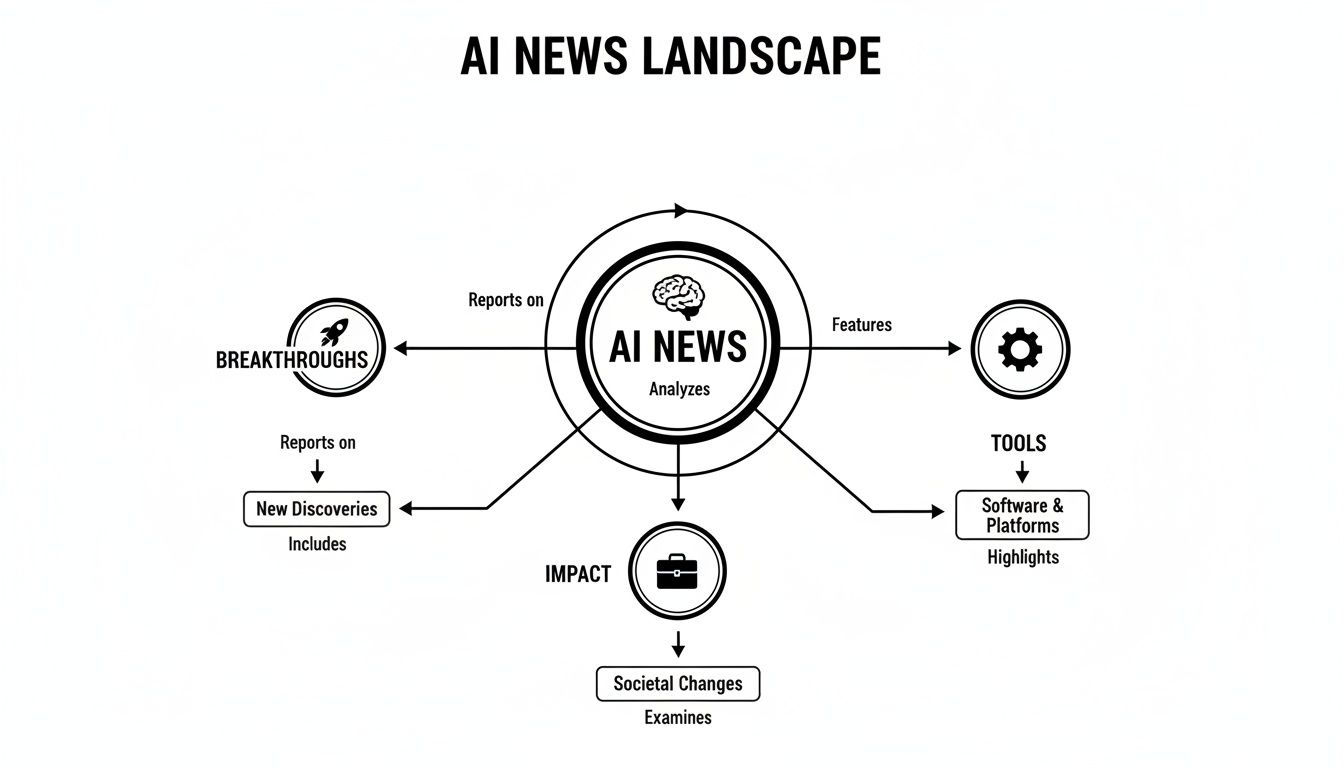
Let's break it down into a few main categories you'll see over and over again:
- Major Breakthroughs: These are the big ones. Think of a brand new AI model that can understand video, audio, and text all at once (like Google's Gemini), or a discovery that makes AI training 10x more efficient. These developments push the entire field forward.
- New Tools and Products: This is where the tech hits the real world. It includes the launch of apps you can actually use, like a new AI-powered photo editor on your phone or a writing assistant that plugs into your email.
- Industry Impact Stories: These articles explore how AI is actively changing specific fields. You might read about AI helping doctors diagnose diseases earlier or streamlining how shipping companies manage their logistics. For example, a headline might be "How AI is Reducing Delivery Times for Amazon."
- Ethical and Regulatory News: This bucket covers the crucial conversations around AI's role in society. It includes everything from data privacy concerns and algorithmic bias to new government policies trying to keep up.
"The key isn't to read every single article, but to learn how to identify the stories that signal a real change," advises tech analyst Sarah Jennings. "It's about recognizing patterns, not just consuming headlines."
By sorting news into these buckets, you can start to filter out the noise and zero in on what's truly relevant to you. Instead of just seeing an endless stream of headlines, you’ll begin to see the bigger picture.
Key AI News Categories at a Glance
To make this even simpler, here’s a quick-reference table. Think of it as your cheat sheet for quickly sizing up any new AI story you come across.
| News Category | What It Covers | Why It Matters for You |
|---|---|---|
| Breakthroughs & Research | New models, core tech advancements, academic papers. | These are the foundational shifts that will eventually power the products of tomorrow. |
| Products & Tools | Consumer apps, business software, new features. | These are the practical applications you can often try out for yourself right away. |
| Business & Industry | How companies are using AI, market trends, investments. | This shows where the money is flowing and how AI is changing jobs and the economy. |
| Ethics & Governance | Bias, privacy, regulation, societal impact debates. | This is about the "should we?"—the crucial conversations shaping AI's future responsibly. |
Having these categories in your back pocket will help you move from simply following the news to truly understanding it. Throughout this guide, we'll dive deeper into each of these areas, giving you the confidence to know what’s what.
The Major AI Breakthroughs Driving the Headlines
When you scroll through tech news, you're constantly hit with terms like "Generative AI" or "Multimodal AI." It’s easy to tune them out as just more industry jargon, but these concepts are the real engines behind the headlines. Let's pull back the curtain and look at the actual technology making all the waves.
Think of these breakthroughs as different specialists. Each one has a unique skillset that unlocks new possibilities, and understanding them is the key to grasping why the field is moving at such a breakneck pace.
Generative AI: The Creative Powerhouse
The undisputed star of the current AI show is Generative AI. This is the tech that powers tools like ChatGPT, which can write essays, debug code, or even draft a friendly email.
So, how does it work? Imagine a master chef who has spent years studying thousands of recipes. They don't just memorize them; they internalize the principles of flavor, texture, and technique. When you ask for a new dish, they don't just copy something they've made before. They use that deep knowledge to create something entirely new that's still delicious and coherent.
That's the essence of Generative AI. It learns from vast amounts of data to produce fresh, original content. This "creative" ability is why it's attracting massive investment. The market is projected to grow from USD 37.89 billion in 2025 to USD 55.51 billion in 2026—a staggering 46.5% year-over-year jump.
Multimodal AI: Seeing the Whole Picture
Another term you’ll see everywhere is Multimodal AI. This might sound complicated, but the idea is actually very human. When you read a children's book, you process both the words on the page and the illustrations, understanding how they connect to tell a single story.
That’s what Multimodal AI does. It can understand and interpret information from different sources—like text, images, and audio—all at the same time.
For example, you could show a multimodal AI a picture of your fridge and ask, "What can I make for dinner?" It would identify the ingredients in the photo and then generate a text-based recipe for you. This ability to connect different types of data is a huge leap forward, allowing AI to understand the world with much richer context, a lot more like we do.
Agentic AI: The Proactive Assistant
Finally, there’s Agentic AI. This is where AI moves from being a passive tool to an active assistant. Think of it as the difference between a simple calculator and a personal financial advisor. A calculator waits for you to input numbers, but an advisor can take a high-level goal—like "help me save for a vacation"—and execute a series of steps to make it happen.
Agentic AI systems can take a complex request, break it down into smaller tasks, and then carry them out on your behalf.
For instance, you could ask an AI agent to "plan a weekend trip to San Diego for my friend and me, find a pet-friendly hotel under $200 a night, and suggest three outdoor activities." The agent would then browse flights, search hotel sites with the right filters, and look up local attractions, presenting you with a finished itinerary.
These aren't just minor updates; they're fundamental shifts. You can learn more about how these developments are changing the game by reading our deep dive into the latest AI breakthroughs.
How AI Is Reshaping Industries and Everyday Jobs
The breakthroughs we hear about aren't just abstract ideas for the future. They're making their way from research labs into our offices, hospitals, and stores, changing how businesses get things done and what our day-to-day work actually looks like.
This isn't a forecast—it's happening right now. We've clearly hit a tipping point for AI in the business world. A solid 72% of companies are now using AI, a huge jump from the 50% that were on board between 2020 and 2023. That rapid adoption shows just how essential these tools are becoming. You can dig into more of the numbers behind this trend with these AI adoption statistics on intuition.com.
This isn't just about adding a new piece of software; it's about fundamentally rethinking processes, creating new efficiencies, and unlocking capabilities that were pure science fiction just a few years ago.
Real-World Impact Across Sectors
To connect the headlines to reality, let's look at where AI is already making a real difference. These aren't just small-scale experiments anymore; they're core business functions.
In Healthcare: Radiologists are now working alongside AI that can analyze MRIs and X-rays, helping them spot early signs of diseases like cancer with incredible speed and accuracy. The AI doesn't replace the doctor's expertise; it acts as an incredibly sharp second pair of eyes.
In Banking and Finance: Behind the scenes, AI algorithms are the silent guardians of your finances. They sift through thousands of transactions every second, identifying strange patterns that signal fraud. Often, they can flag a suspicious charge before you even notice your card is gone.
In Retail and E-commerce: Ever feel like an online store just gets you? That's AI at work. It analyzes your past purchases and browsing habits to serve up personalized recommendations, taking the guesswork out of finding what you need. A great example is how Spotify creates your "Discover Weekly" playlist.
AI and the Future of Your Job
With so much changing so fast, the big question on everyone's mind is, "What does this mean for my job?" The conversation tends to get stuck on robots taking over, but the reality is far more collaborative and, frankly, more interesting.
AI is a powerhouse when it comes to repetitive, data-heavy tasks—the kind of work that drains our energy and creativity. By handing that work over to a machine, we get to focus on what humans do best.
"The goal isn't to compete with AI, but to collaborate with it. The most valuable professionals will be those who learn to leverage these tools to amplify their own abilities."
— David Chen, Business Strategist
This shift puts a premium on skills like critical thinking, creative problem-solving, strategic planning, and emotional intelligence. The real value is no longer in just doing the work, but in knowing what questions to ask the AI, how to interpret the answers, and what smart decisions to make based on those insights. It’s all about working with AI, not trying to out-work it.
AI Impact Across Key Business Functions
To give you a clearer picture of how this looks inside a company, let's break down how different departments are putting AI to work. It’s not a one-size-fits-all solution; each team finds unique ways to solve its specific challenges.
| Business Function | Common AI Application | Example Benefit |
|---|---|---|
| Marketing | AI-powered content generation and ad targeting. | Creating personalized email campaigns that resonate with specific customer segments, boosting engagement. |
| Customer Service | Intelligent chatbots handling common inquiries 24/7. | Freeing up human agents to focus on complex, high-empathy customer issues that require a personal touch. |
| Operations | Predictive maintenance for machinery on a factory floor. | Identifying potential equipment failures before they happen, preventing costly downtime and production delays. |
| Human Resources | AI tools for screening resumes and identifying qualified candidates. | Speeding up the initial hiring process so recruiters can spend more time interviewing top talent. |
As you can see, AI's impact is both wide and deep. It’s not about one magic tool that does everything, but a whole toolkit that helps people in every role do their jobs better and more effectively. Getting a handle on this dynamic is the key to thriving in a workplace where AI is just another colleague.
Navigating the New Wave of AI Tools and Products

It feels like a new AI app gets announced every single day. The constant flood of technology news ai about the latest product launches can feel overwhelming, but here's the good news: you don't need to try every single one. Think of this section as your friendly guide to the most practical and accessible AI tools you can actually start using right now.
We're going to skip past the big names everyone already knows and introduce you to some genuinely useful products for real-world tasks. It's like a handpicked app store, designed to connect you with tools that can make an immediate difference, even if you're just dipping your toes into AI.
AI Tools for Everyday Productivity
Let's start with the things that eat up so much of our day—writing, creating, and just staying organized. A new breed of AI tools has emerged specifically to make these jobs much faster and a whole lot easier.
Here are a few types of tools that are making a huge difference, especially for beginners:
- AI Writing Assistants: These do so much more than just check your grammar. Tools like Copy.ai or Jasper can help you brainstorm blog post ideas, draft a professional email in seconds, or whip up social media captions in different tones. They act like a creative sidekick, helping you conquer that dreaded blank page.
- AI Image and Graphic Generators: Need a unique image for a presentation or your blog but have zero design skills? Platforms such as Midjourney and Ideogram can turn a simple line of text into a surprisingly beautiful visual. You can ask for anything from "a photorealistic image of a cat wearing glasses" to "a watercolor painting of a futuristic city."
- AI Project Organizers: Tools like Motion or Notion AI are fantastic for taming your schedule and to-do lists. They can automatically sort your tasks, prioritize what to work on next, and even distill long meeting notes into a few key action items.
Choosing the Right AI Tool for You
With so many options out there, how do you decide which shiny new tool is actually worth your time? It’s easy to get sidetracked by flashy features, but the best tool is always the one that solves a real problem you're facing.
Before you download the next trending app, run it through this quick mental checklist:
Is the purpose clear? You should be able to figure out exactly what the tool does within a minute of landing on its website. If the value isn't immediately obvious, it’s probably too complicated or just poorly designed.
Does it solve a specific pain point for you? Don't adopt a tool just because it's popular. Ask yourself if it will genuinely save you time, improve the quality of your work, or automate a tedious task you can't stand. For example, if you spend hours summarizing meeting notes, a tool like Otter.ai is a perfect fit.
Is it user-friendly for beginners? The best AI tools for everyday use feel intuitive. Look for a clean interface and simple controls. If you feel like you need to read a technical manual just to get started, it's probably not the right fit.
What’s the pricing model? A lot of tools offer a free tier or a trial, which is the perfect way to test them out without any commitment. Just be sure you understand the limitations of the free version and what a paid plan might cost down the line.
For those looking to streamline their information intake, an ultimate AI podcast summarizer guide can also be a fantastic resource for discovering new solutions. By focusing on practical value instead of just hype, you can build a personal toolkit of AI assistants that genuinely make your life easier.
Understanding the Big Ethical Questions in AI
With every exciting AI breakthrough comes a set of equally important, and often thorny, conversations. You'll notice the most critical pieces of technology news ai often aren't about faster chips or bigger models, but about the tough ethical questions that follow. This isn't just a topic for philosophers; it's something that impacts all of us, every day.
These discussions can feel incredibly complex, but they usually boil down to a few core ideas about fairness, privacy, and safety. Getting a handle on these concepts is the key to forming your own informed opinions about the AI news you read.
Let's break down some of the biggest ethical debates in simple, practical terms. My goal here is to give you the context you need to understand why these stories matter so much.
What Is AI Bias and Why Does It Matter?
One of the most frequent ethical landmines you’ll see in the news is algorithmic bias. It sounds technical, but the core idea is pretty straightforward and has very real consequences.
Imagine a company wants to use an AI to help screen job applications. To teach the AI what a "good" candidate looks like, they feed it data from every single person they’ve hired over the last 20 years. The problem? If that company historically hired mostly men for its top jobs, the AI will learn a skewed lesson: that being male is a key indicator of a good candidate.
As a result, the AI could start automatically ranking female applicants lower, even if they're perfectly qualified. It's not because the AI is intentionally sexist—it has no intentions. It's simply because it learned from biased human history. This is the classic "garbage in, garbage out" problem in action.
This kind of hidden bias can creep into all sorts of automated systems:
- Loan applications: An AI might unfairly deny credit to people based on their zip code, simply because past data showed higher default rates in that area.
- Facial recognition: Some systems have been proven to be far less accurate when identifying people from certain demographic groups.
- Medical tools: Diagnostic AI trained on data from a limited patient population might miss crucial signs in people outside that group.
Grasping this is crucial. When you see a news story about a company's AI being "biased," this is usually what’s happening behind the scenes. The conversation then naturally turns to how we can build fairer systems. For a deeper dive, check out our guide on achieving fair artificial intelligence and the techniques being developed to solve these challenges.
"The most important AI discussions aren't just about code; they're about fairness, transparency, and the kind of society we want to build."
— Dr. Elena Petrova, AI Ethics Professor
The Global Conversation on AI Safety and Rules
Another huge topic you'll constantly see is AI safety and regulation. As these tools become more and more powerful, governments and organizations all over the world are scrambling to figure out how to make sure they're developed and used responsibly.
This isn't about hitting the brakes on progress. It’s about creating guardrails to prevent things from going wrong. You’ll see headlines about countries proposing new laws for AI, major tech companies forming safety alliances, and public debates about where we should draw the lines.
These conversations touch on everything from making sure AI-generated content is clearly labeled (to fight misinformation) to setting firm rules about how AI can be used in critical areas like the military or law enforcement. Keeping an eye on these developments helps you see the bigger picture of how society is trying to adapt.
How to Stay Updated Without Getting Overwhelmed
So, you've got a handle on the current AI scene. What's next? Keeping up. The sheer volume of technology news ai can feel like trying to drink from a firehose. The secret isn't to read everything; it's about building a smart, sustainable habit that keeps you in the loop without burning you out.
A great way to start is by carving out just 15-20 minutes each day. Treat it like your morning coffee ritual. A small, consistent effort is way more effective than trying to cram a month's worth of news into a single Saturday afternoon. This daily check-in helps you cut through the noise and spot the developments that actually matter.
Curate Your Information Diet
This is the most important part: be picky about your sources. Instead of endlessly scrolling through a feed, deliberately choose a handful of high-quality, reliable channels that are known for breaking down complex topics in a clear, understandable way. This is how you get real insight, not just marketing fluff or clickbait.
Here are a few types of sources to create a balanced AI news diet:
- Reputable Newsletters: Let the experts do the curating for you. Publications like The Neuron or Ben's Bites deliver the week’s most important news in quick, easy-to-digest summaries with links to the biggest stories.
- Specialized Publications: For a deeper dive, sites like VentureBeat's AI section or MIT Technology Review offer sharp analysis that goes far beyond the surface-level headlines you find elsewhere.
- Insightful YouTube Channels: Sometimes you need to see it to believe it. Creators like Matt Wolfe or WesRoth provide visual walkthroughs and tool demos, which are perfect for understanding how a new AI product actually functions.
"Your goal should be to build a small, trusted dashboard of sources," suggests media analyst Jane Friedman. "Following a handful of quality voices is infinitely more valuable than trying to follow a hundred mediocre ones."
Use Tools to Manage the Flow
You don't have to fly solo and track everything manually. To really keep a pulse on specific AI trends or public sentiment, you can use tools to help manage the information overload. You can explore various AI social listening tools that are designed to help you monitor conversations and filter the noise without getting lost.
By building a simple, manageable routine and choosing your sources wisely, you can stay on top of the latest AI technology news without feeling swamped. It’s a practical approach that turns you from an overwhelmed observer into an informed and confident one.
Common Questions About AI in the News
Diving into the world of AI news can feel like learning a new language. A few key questions always seem to pop up, so let’s get those sorted out right away. Think of this as your quick-start guide to the big concepts.
Here are some of the most common things people wonder about as they get started.
What's the Difference Between AI and Machine Learning?
It's easy to get these terms mixed up, but a simple analogy helps clear things up. Think of them like a set of Russian nesting dolls.
Artificial Intelligence (AI): This is the biggest doll—the entire field of study focused on making machines capable of intelligent behavior. It’s the broad umbrella that covers everything else.
Machine Learning (ML): This is the next doll inside. ML is the most common way we actually build AI today. Instead of programming a computer with explicit rules for every task, we feed it massive amounts of data and let it learn to spot patterns and make predictions on its own.
Generative AI: This is the smallest doll, and the one getting all the headlines lately. It's a specialized branch of machine learning that’s all about creating something entirely new—whether that’s an essay, a piece of art, or a song—based on the patterns it learned from its training data.
Will AI Take My Job?
This is probably the biggest question on everyone's mind. The short answer is, it's far more likely that AI will change your job than get rid of it completely.
Think about how calculators changed the game for accountants. They didn't replace them; they just automated the tedious manual arithmetic. This freed up accountants to focus on higher-level strategy and analysis. AI is starting to do the same for a whole range of professions.
The real opportunity here is letting AI handle the repetitive grunt work. This shift allows people to double down on what we do best: creative thinking, strategic planning, and building relationships. The folks who will thrive are the ones who figure out how to use AI as a collaborator.
How Can I Start Using AI If I'm Not a Coder?
Good news: you almost certainly already are. AI is quietly working behind the scenes in many of the apps you use every single day.
When Netflix suggests a show you actually want to watch, or when your email drafts a quick reply for you, that’s AI in action. Even when your phone's photo app automatically tags your friends, you're using a sophisticated AI tool without even thinking about it.
If you want to get more hands-on, the best way to start is just to play around with a free tool like ChatGPT or Microsoft Copilot. Ask it fun questions. Have it write a poem about your dog or give you a recipe for dinner with whatever you have in the fridge. There’s no better way to understand what this technology can do than by simply trying it out.
At YourAI2Day, our whole mission is to make AI easy to understand for everyone. We cut through the hype to bring you the latest news, clear guides, and real-world resources to keep you ahead of the curve. Explore our articles and join the conversation today!