Supervised vs Unsupervised Learning: A Beginner’s Guide
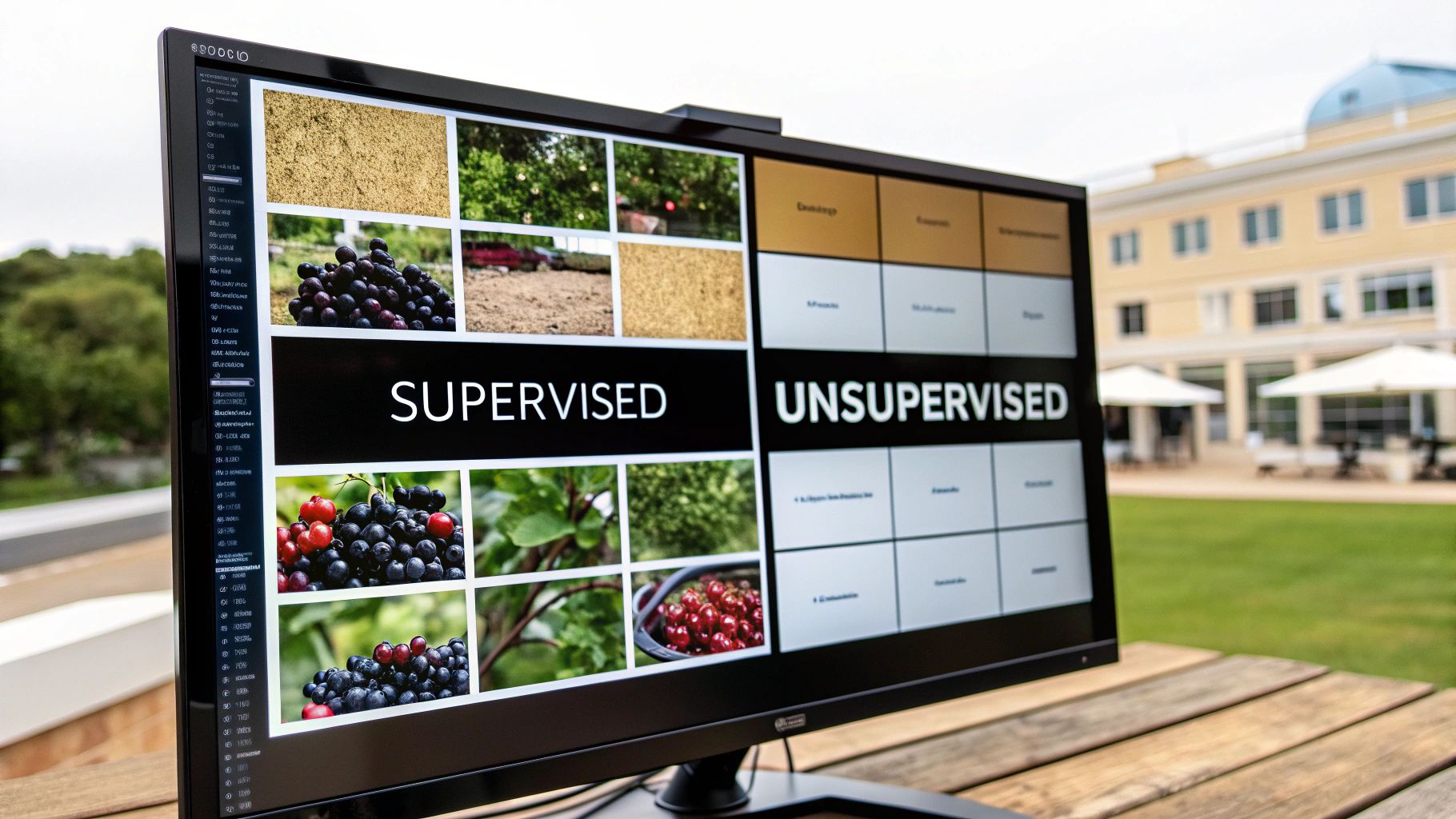
Let's cut right to the chase, shall we? The biggest difference between supervised vs. unsupervised learning is all about the data you give the machine. Supervised learning uses labeled data—think of it as studying for a test with a complete answer key. Unsupervised learning, on the other hand, gets unlabeled data and has to find hidden patterns on its own, like a detective trying to solve a case with nothing but a pile of evidence.
Unpacking Supervised and Unsupervised Learning
Imagine you're teaching a toddler to recognize different animals. If you show them a picture of a cat and say, "This is a cat," you're giving them a label for that picture. That's exactly how supervised learning works. The goal is simple: train a model so well that the next time it sees a cat, it can confidently say, "Hey, that's a cat!"
Now, what if you gave that same toddler a big box of animal photos—dogs, cats, birds—and just said, "Sort these into piles that make sense to you." They might make a pile for animals with fur and four legs, and another for animals with feathers and wings. That’s unsupervised learning in a nutshell. The algorithm has to discover the underlying structure all by itself. It's not about predicting a specific answer, but about finding natural groups in the data.
"The choice isn't about which method is 'smarter,' but which tool is right for the job," says AI consultant Jane Doe. "Supervised learning is your scalpel for precise, known tasks. Unsupervised learning is your metal detector for finding treasure you didn't even know was buried."
The Core Distinctions at a Glance
To make this even clearer, let's break down the fundamental differences in a simple table. This is your quick reference for understanding how they operate.
Supervised vs Unsupervised Learning At a Glance
| Attribute | Supervised Learning | Unsupervised Learning |
|---|---|---|
| Input Data | Requires labeled data with clear input-output pairs. | Works with unlabeled data containing only inputs. |
| Primary Goal | To predict future outcomes based on historical data. | To discover hidden patterns and natural structures in data. |
| Common Tasks | Classification (e.g., spam detection) and Regression (e.g., price forecasting). | Clustering (e.g., customer segmentation) and Association (e.g., market basket analysis). |
| Level of Guidance | High human involvement is needed to label the data accurately. | Minimal human involvement; the algorithm explores data independently. |
This contrast is one of the most important concepts in machine learning. While the two approaches are distinct, they aren't mutually exclusive. In fact, many advanced models in fields like deep learning can apply principles from both. To see how these ideas fit into the bigger picture, check out our guide on deep learning vs machine learning.
How Supervised Learning Works with Labeled Data
Let's dive a little deeper into supervised learning. At its heart, it’s all about teaching a machine with an "answer key." You're the teacher, giving the model a dataset where you already know the correct outcomes.

Think of training an AI to spot spam emails. You wouldn't just show it a bunch of random messages. Instead, you'd feed it thousands of emails, each one carefully labeled as either 'spam' or 'not spam'. The algorithm then gets to work, identifying the patterns—words like "free," "winner," or strange links—that signal "spam." After seeing enough examples, it builds a model that can make a pretty good guess when a new email lands in your inbox.
This whole process is "supervised" because a human provides the ground truth, steering the algorithm toward the right answers. It's a very direct, goal-oriented approach, making it perfect when you have a specific problem to solve and historical data to learn from.
The Two Main Flavors of Supervised Learning
Supervised learning generally splits into two categories, and the one you choose depends entirely on the type of question you're asking. Getting this right is fundamental to building a useful model.
-
Classification: This is all about assigning data to a specific category. It answers "which one?" questions. A classic example is your email's spam filter, which decides if a message is 'spam' or 'not spam'. Another is a medical app that looks at an image and classifies a mole as 'benign' or 'malignant'.
-
Regression: This is used when you need to predict a continuous value, like a number. It answers "how much?" or "how many?" questions. For instance, a real estate site like Zillow might use regression to estimate a home's price based on its square footage, location, and age.
Expert Opinion: "The real magic of supervised learning is its precision," notes data scientist Dr. Alistair Finch. "If you have clean, accurately labeled data, these models can deliver incredibly accurate results. The bottleneck is rarely the algorithm itself; it's the massive human effort needed to create that high-quality labeled dataset in the first place."
This is why supervised learning is behind so many major AI breakthroughs. Take image recognition, for example. Deep learning models trained this way have hit an error rate as low as 3.45% on some really tough image classification challenges. That level of accuracy is non-negotiable for things like self-driving cars that need to identify pedestrians and stop signs perfectly. In the business world, customer sentiment analysis models often exceed 90% accuracy, giving companies a reliable way to gauge public opinion. You can find more details on these impressive supervised learning findings.
Popular Algorithms and What They Do
You don’t have to be a data scientist to grasp what the most common supervised learning algorithms are for. They're just different tools for solving classification and regression problems.
Here are a few of the most common ones you'll run into:
-
Linear Regression: This is the workhorse for many regression tasks. It’s great for finding a simple, straight-line relationship between two variables, like predicting how many ice cream cones you’ll sell as the temperature rises.
-
Logistic Regression: Don't let the name fool you; this one is for classification. It's used to predict a binary outcome (yes/no, true/false), which is perfect for figuring out if a credit card transaction is fraudulent.
-
Support Vector Machines (SVMs): A really powerful classification algorithm that’s surprisingly versatile. An SVM works by finding the clearest line or plane to separate different groups of data, making it a solid choice for complex tasks like text categorization or facial recognition.
In the end, supervised learning is your best bet when you have a clear objective and a solid foundation of historical data. It learns from past outcomes to build a reliable model for predicting what comes next.
Discovering Patterns with Unsupervised Learning
Now, let's flip the coin and look at unsupervised learning. This is where the real adventure begins, because it's all about discovery. Here, we're working with data that has no labels or predefined answers, which forces the algorithm to find hidden structures entirely on its own.
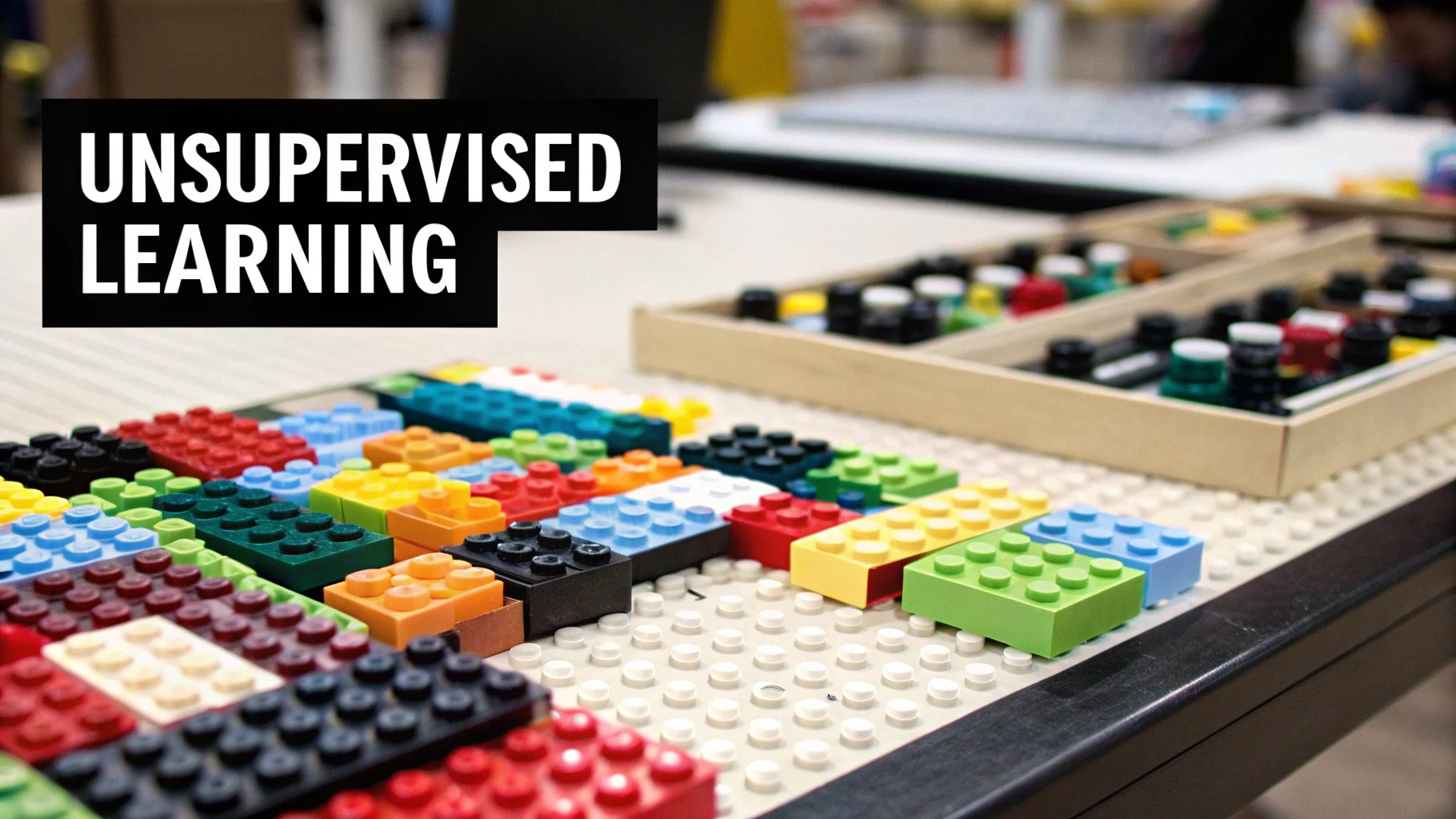
Imagine being handed a massive box of mixed LEGO bricks without any instructions. Your task is to sort them. Instinctively, you'd start creating piles based on similarities—all the red bricks here, the small square ones there, and so on. This is precisely how unsupervised learning operates. It’s an exploratory process designed to make sense of raw, messy data.
This approach is incredibly powerful when you don't even know what you're looking for. Instead of predicting a known outcome, you're essentially asking the machine, "What's interesting in this data?" The answers it finds can be both surprising and incredibly valuable.
The Main Tasks of Unsupervised Learning
Unsupervised learning primarily tackles two types of problems, each one focused on revealing a different kind of insight from your data. Understanding these helps clarify its practical applications in the business world.
-
Clustering: This is the most common unsupervised task. The goal is to group similar data points together into "clusters." Items within the same cluster share more in common with each other than with those in other clusters. A great real-world example is how Netflix might analyze your viewing history to group you with other users who have similar tastes, which helps them recommend new shows you'll probably love.
-
Association: This technique finds interesting relationships, or "association rules," between variables in a large dataset. The classic example is "market basket analysis," where a supermarket discovers that customers who buy diapers are also highly likely to buy beer. This kind of insight can directly influence product placement and promotional strategies.
"Unsupervised learning is the detective of the machine learning world," says a lead AI strategist. "It doesn't start with a suspect; it sifts through all the evidence to find connections and builds a case from the ground up. This makes it essential for any kind of exploratory data analysis."
This exploratory power is a game-changer. For instance, some companies have used unsupervised clustering to group customers by behavior, boosting retention by up to 25% through better-targeted marketing. This same method is also crucial for anomaly detection, helping banks spot unusual financial transactions that could signal fraud.
A Common Algorithm: K-Means Clustering
One of the most well-known and straightforward clustering algorithms is K-Means Clustering. Don't let the name intimidate you; the concept is actually quite simple.
You start by telling the algorithm how many clusters (the "K") you want to find. It then randomly places that many center points, called centroids, within your data. From there, it repeats a simple two-step process:
- Assign: Each data point is assigned to its nearest centroid, which forms the initial clusters.
- Update: The centroid of each new cluster is recalculated by finding the average position of all the points within it.
This assign-and-update loop continues until the centroids stop moving, meaning the clusters have stabilized. You're ultimately left with distinct groups, revealing the underlying structure you were looking for. These initial steps of organizing raw data are a core part of what is data analytics, and unsupervised learning is often the engine that drives this discovery.
Comparing Supervised and Unsupervised Learning Methods
Choosing between supervised and unsupervised learning isn't just a technical decision. It's a strategic one that comes down to your data, your goals, and the resources you have on hand. Think of it this way: one method is about getting answers to questions you already have, while the other is about discovering questions you didn't even know to ask.
The biggest dividing line is your data. Supervised learning absolutely requires labeled data, which is both its greatest strength and its biggest headache. Having a clear target for the model is fantastic, but creating that "answer key" is often the most demanding part of the entire project.
Unsupervised learning, on the other hand, works with unlabeled data. This makes it far more accessible. You can dive right into raw information without the expensive and slow process of manual labeling.
"The real trade-off is between precision and exploration," an expert might explain. "Supervised learning gives you a highly accurate, fine-tuned tool for a known task. Unsupervised learning offers a powerful lens to find patterns you never knew existed."
The Cost and Effort of Data Preparation
Let's be direct: getting data ready for supervised learning can be a major investment. Imagine you're training a model to spot different types of defects in a manufacturing line. You'd need human experts to sift through thousands of images, meticulously tagging each one. That process costs a lot of time and money.
Now, consider an unsupervised approach. It could take that exact same pile of images and automatically group them based on visual similarities. It might put all the images with cracks in one bucket and those with scratches in another, all without being told what a "crack" or "scratch" is. It's a much faster and cheaper way to get an initial analysis off the ground.
Aligning with Your Business Problem
The kind of problem you're trying to solve is the other critical piece of the puzzle. Are you trying to predict a specific, known outcome, or are you trying to understand your data at a more fundamental level?
-
For Prediction: If your goal is to forecast next quarter's sales or figure out which customers are about to leave, supervised learning is what you need. These are classic regression and classification problems with clear targets. You have historical data with known outcomes (e.g., customers who churned vs. those who didn't), which is the perfect fuel for a predictive model.
-
For Exploration: If you want to discover new customer segments or find strange activity in your network traffic, unsupervised learning is the better path. You don't have a pre-defined target. Your goal is to let the algorithm find the hidden structure in the data for you.
This is a key distinction. Using a supervised model for an exploratory task is like bringing a hammer to a job that needs a paintbrush—it’s just the wrong tool.
Interpretability and the Nature of Results
How you make sense of the results also changes dramatically. A supervised model gives you a direct, and often easy-to-digest, answer. For instance, a loan approval model might give you a straightforward prediction: "Approved" with 85% confidence. Success metrics like accuracy are clear and easy to measure.
Unsupervised learning results are more open-ended and demand human interpretation. A clustering algorithm might create five distinct customer groups, but it's up to you to figure out what those clusters mean. Group 1 might be "high-value weekend shoppers," while Group 2 could be "infrequent bargain hunters." The insights are incredibly powerful, but they aren't just handed to you.
This table really gets into the nitty-gritty of how these two approaches differ in practice.
Detailed Feature Breakdown Supervised vs Unsupervised
| Comparison Point | Supervised Learning | Unsupervised Learning |
|---|---|---|
| Data Requirement | High-quality, accurately labeled data. | Raw, unlabeled data is sufficient. |
| Core Objective | Prediction of a known outcome or target. | Discovery of hidden patterns and structures. |
| Cost & Effort | High due to the need for manual data labeling. | Low, as it works with readily available data. |
| Result Type | A specific prediction or classification. | Inherent groupings or association rules. |
| Human Role | Provides the initial "ground truth" through labels. | Interprets the patterns found by the model. |
| Example Question | "Will this customer click the ad?" | "What natural groups exist among our customers?" |
In the end, your choice is a balancing act. You have to weigh the need for specific, accurate predictions against the desire for open-ended discovery, all while keeping a close eye on your budget and data reality.
How to Choose the Right Learning Model
Deciding between supervised and unsupervised learning can feel like a major technical hurdle, but it really just comes down to two questions: What kind of data do you have, and what are you trying to accomplish? This is where theory hits the road. The best choice is entirely dependent on your specific goals.
Think of it like this. If your aim is to predict a specific, known outcome and you have historical data that already contains the "answers," then supervised learning is your best bet. It’s like using last year's sales figures to forecast next quarter's revenue. You already have the past results, so you can train a model to predict future ones.
On the other hand, if your goal is more about exploration and discovery, you'll lean into unsupervised learning. This is for when you're sitting on a mountain of raw data and asking, "What hidden patterns or groups are lurking in here?" You aren't trying to predict a known target; you're on a hunt for insights you didn't even know existed.
Matching Your Business Case to a Model
Let’s get practical with a few common business scenarios. Seeing how these models are applied in the real world makes the choice much clearer.
-
Scenario 1: Predicting Customer Churn
You want to identify which of your current subscribers are most likely to cancel their service next month. You have a rich dataset of past customers, including their usage history, support tickets, and—most importantly—a clear label marking whether they churned or not. This is a classic supervised learning problem. You are predicting a specific, binary outcome (churn vs. not churn) using labeled historical data. -
Scenario 2: Discovering Audience Personas
Your marketing team wants to understand your user base on a much deeper level. You have tons of data on user behavior—like what features they use and how often they log in—but you don't have any predefined categories. Unsupervised learning is the perfect tool here. A clustering algorithm can sift through this unlabeled data to identify distinct groups of users, effectively creating new audience personas like "power users," "weekend explorers," or "one-time visitors."
This decision tree infographic helps visualize the core logic behind picking the right model based on your data.
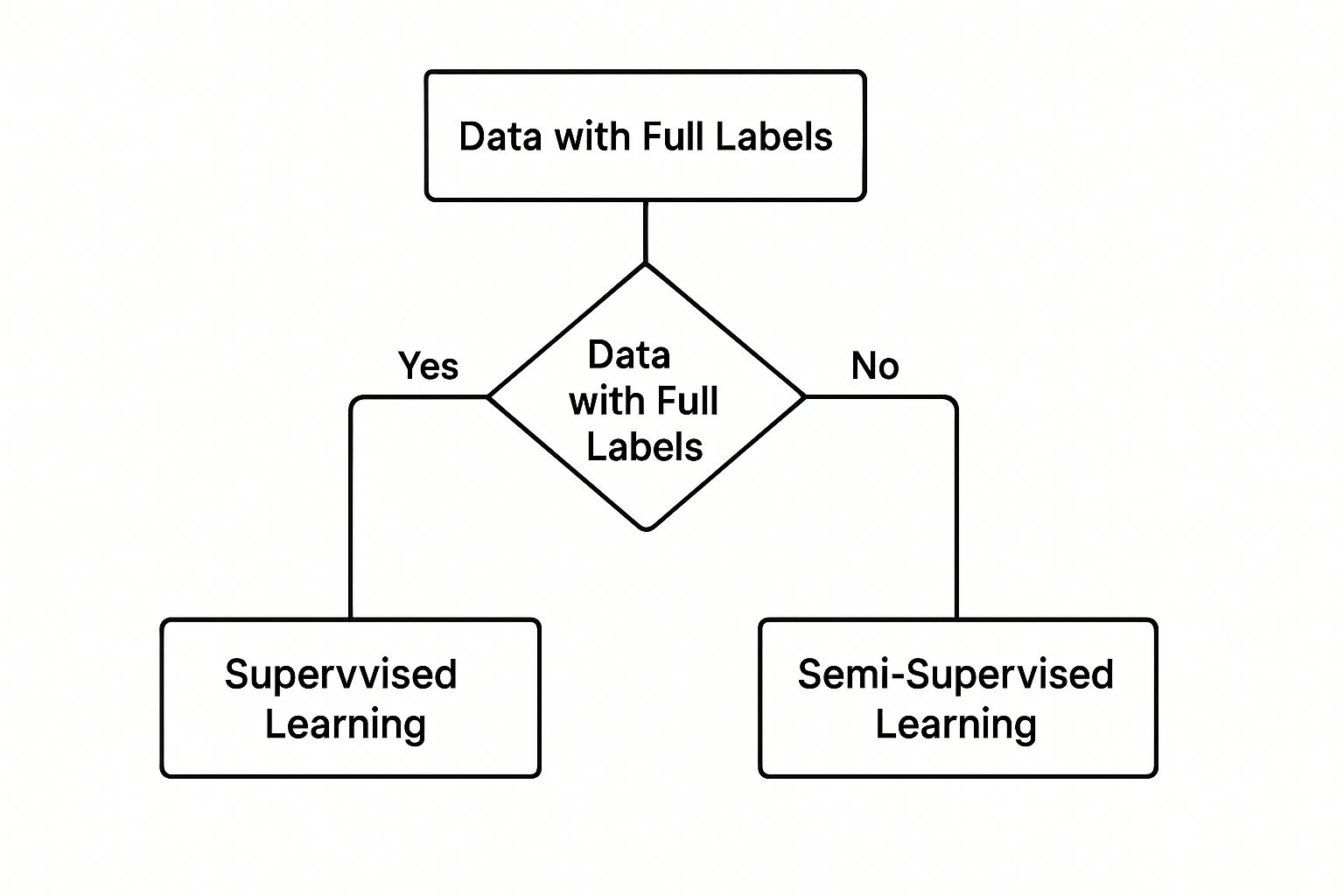
As you can see, the availability of labels is the primary fork in the road, which really highlights just how critical data preparation is for any project.
The Middle Ground: Semi-Supervised Learning
So, what happens if you're stuck in the middle? Maybe you have a massive dataset, but only a tiny fraction of it is labeled because the process is just too expensive or time-consuming. This is a common problem, and it’s exactly where semi-supervised learning shines.
This hybrid approach uses a small amount of labeled data to give the model some initial guidance, which then helps it learn the broader structure from the vast sea of unlabeled data. It’s the best of both worlds, often boosting accuracy without the need for a fully labeled dataset.
Expert Opinion: "Don't get locked into an 'either/or' mindset," a seasoned machine learning engineer might advise. "Semi-supervised learning is an incredibly practical solution for businesses that want the predictive power of supervised models but just can't afford to label all their data. It's a pragmatic compromise that delivers real results."
The choice between these models also reflects broader market trends. The global machine learning market was valued at around $1.4 billion back in 2020, with much of that value driven by supervised applications. However, as businesses collect more and more raw data, unsupervised learning is quickly gaining ground. In fields like fraud detection, for instance, semi-supervised approaches have shown remarkable success, improving detection rates by up to 30% compared to models trained only on small, labeled datasets.
Choosing the right model is a critical first step, and understanding these options is key to successfully implementing AI in your business.
Common Questions About Machine Learning Models
As you start wrapping your head around supervised and unsupervised learning, a few questions always seem to come up. It's perfectly normal. Let's walk through some of the most common ones that people ask when they're figuring out how to apply these concepts to real work.
Think of this as a quick FAQ to clear up any confusion and help you get a more solid footing.
Can I Use Both Supervised and Unsupervised Learning Together?
Absolutely. In fact, some of the most powerful machine learning solutions do exactly that. Combining the two isn't just possible; it's often how you get the most sophisticated results. You get to play to the strengths of both—discovery and prediction—all in one project.
A classic example is customer segmentation. You could kick things off with an unsupervised clustering algorithm to sift through your customer data. The goal is to let the machine find natural groupings based on things like buying habits or how often they log in. You might uncover distinct personas you didn't know existed, like "high-value loyalists," "weekend bargain hunters," or "newly signed-up users."
Once you have these clusters, you can then switch gears. For each specific group, you can build a highly-tuned supervised learning model. Imagine creating a churn prediction model just for your "high-value loyalists." That model will almost certainly be more accurate than a one-size-fits-all model trained on your entire, messy customer base. It’s a smart way to layer your approach.
Which Type of Learning Is More Advanced?
That's a bit like asking if a hammer is more advanced than a screwdriver. Neither is "smarter" than the other—they're just different tools for different jobs. The right tool depends entirely on the problem you have in front of you.
Expert Opinion: "The real measure of an 'advanced' solution isn't how complex the algorithm is, but how well it solves a real business problem," an AI strategist would tell you. "A simple supervised model that nails your sales forecast is far more valuable than a complex unsupervised model that spits out confusing insights nobody can act on."
Supervised learning shines when you know exactly what you want to predict and you have the clean, labeled data to do it. On the other hand, unsupervised learning is your go-to for exploration, especially when you're staring at a mountain of unlabeled data and trying to find the hidden patterns. The "best" approach is always the one that fits your data and your goals.
What Is the Biggest Challenge in Supervised Learning?
Hands down, the single biggest hurdle in supervised learning is the data—specifically, the acquisition and labeling of that data. The algorithms themselves are incredibly sophisticated, but they're useless without a high-quality dataset to learn from. It’s the classic "garbage in, garbage out" problem.
Putting together a large, clean, and accurately labeled dataset can be an enormously expensive and slow process. This "data bottleneck" often requires hours of manual work from subject matter experts who have to painstakingly label every single data point. For a lot of companies, the sheer cost and effort of creating that perfect "answer key" for the model is a major roadblock, and it's why they often look to unsupervised methods instead.
Is Deep Learning Supervised or Unsupervised?
This trips a lot of people up. The simple answer is: deep learning can be both.
"Deep learning" doesn't describe the learning method (supervised or unsupervised) but rather the architecture of the model itself. It refers to a class of machine learning that uses artificial neural networks with many, many layers—that's where the "deep" comes from. These powerful, multi-layered structures can be applied to either type of task.
Here’s how to think about it:
-
Supervised Deep Learning: This is what most people think of. Image recognition that can pick a cat out of a photo with near-perfect accuracy is a prime example. These models are trained on massive, labeled datasets (think millions of images explicitly tagged as "cat" or "dog").
-
Unsupervised Deep Learning: Deep learning is also a fantastic tool for discovery. For instance, sophisticated fraud detection systems can use deep neural networks to learn the normal patterns of network traffic. Then, without ever being told what "fraud" looks like, they can flag bizarre activity that deviates from that norm.
So, it's best to think of deep learning as a high-performance engine. You can put that engine into a supervised car to win a race or into an unsupervised rover to explore new territory. The term describes the engine's power, not where it's going.
Ready to dive deeper into the world of AI and stay ahead of the curve? At YourAI2Day, we provide the latest news, expert analysis, and practical guides to help you make sense of artificial intelligence. Explore our resources and join a community of enthusiasts and professionals today.