
What Is Real Time AI and How Does It Actually Work?
Hey there! Ever heard of "real time AI"? It's not just about making systems smart; it's about making them fast—really fast. We're talking about processing information and making decisions in milliseconds, allowing a system to react to live events as they unfold. It’s the split-second logic that lets a self-driving car swerve to miss a pothole or your bank decline a fraudulent charge before the transaction even completes.
This immediacy is the game-changer. It’s what separates real time AI from its more traditional, batch-processing cousins. Ready to see how it all works? Let's dive in!
Welcome to the Age of Instant Intelligence
Ever wonder how your smart speaker seems to grasp your command the moment you say it? Or how an opponent in a video game anticipates and counters your every move with uncanny speed? The secret sauce behind these experiences is real time AI. It’s a breed of artificial intelligence engineered not just to analyze, but to act on information now.
Think of it like this: a traditional AI might be like a historian, poring over last month's sales data to write a detailed report. A real time AI, on the other hand, is like a fighter pilot, constantly processing incoming sensor data to make life-or-death decisions in a fraction of a second. That gap—from hours or days to mere milliseconds—is everything.
To bring this into clearer focus, let's look at a quick comparison.
Real Time AI vs Traditional AI at a Glance
This table breaks down the fundamental differences between systems designed for instant reaction and those built for deeper, slower analysis.
| Aspect | Real Time AI | Traditional (Batch) AI |
|---|---|---|
| Processing Speed | Milliseconds to seconds | Minutes, hours, or even days |
| Data Handling | Processes continuous streams of live data | Analyzes large, static datasets (batches) |
| Decision Making | Immediate, automated responses | Delayed insights after processing is complete |
| Common Use Cases | Fraud detection, self-driving cars, online gaming | Business forecasting, scientific research, customer segmentation |
| Primary Goal | Instantaneous action and reaction | In-depth analysis and pattern discovery |
As you can see, the choice isn't about which one is "better" but which is right for the job. You wouldn't use a historian to fly a jet, and you wouldn't ask a pilot to write a comprehensive history of modern commerce.
Why Does This Matter to You?
This isn't just some far-off concept for tech giants. It’s already deeply integrated into your daily routines, making the technology you use feel seamless and responsive. It’s the intelligence that stops credit card fraud in its tracks, recommends the perfect song on your playlist, and powers the voice assistant on your phone.
Speaking of which, your phone’s assistant is one of over 8 billion AI-powered voice assistants worldwide, all designed to process your queries instantly. That number is only going up, with projections showing the user base for voice search in major markets will hit 157.1 million soon. If you're curious, you can explore the full story behind AI's rapid adoption and find more insights about this shift toward conversational technology.
What You Will Learn in This Guide
Over the next few sections, we're going to pull back the curtain on real time AI, breaking it down into simple, understandable pieces. No Ph.D. required.
We'll cover:
- The Core Technology: We’ll look at the engine behind it all, from stream processing to model optimization.
- Everyday Examples: You'll see exactly where real time AI shows up, from your commute to your evening entertainment.
- Building Your Own: A practical look at the tools and platforms developers use to create these intelligent systems.
- Best Practices: Straightforward advice for getting real time AI right and avoiding common pitfalls.
My goal is to give you a solid, practical understanding of one of the most dynamic fields in technology today. Let’s get started.
How Real-Time AI Processes Information Instantly
So, how does real-time AI manage to work so fast? It's not magic, but a clever mix of powerful techniques engineered to process information at the speed of thought. Think of it less like a computer slowly crunching numbers and more like a human reflex—instant, automatic, and precise.
To really get a feel for this, we need to look at three key pieces of the puzzle: how the data flows, how the AI model is built for speed, and where the "thinking" actually happens. Let's break down these technical ideas into something a bit more digestible.
The image below draws a clear line between traditional AI, which learns from historical data, and real-time AI, which acts on live information as it unfolds.
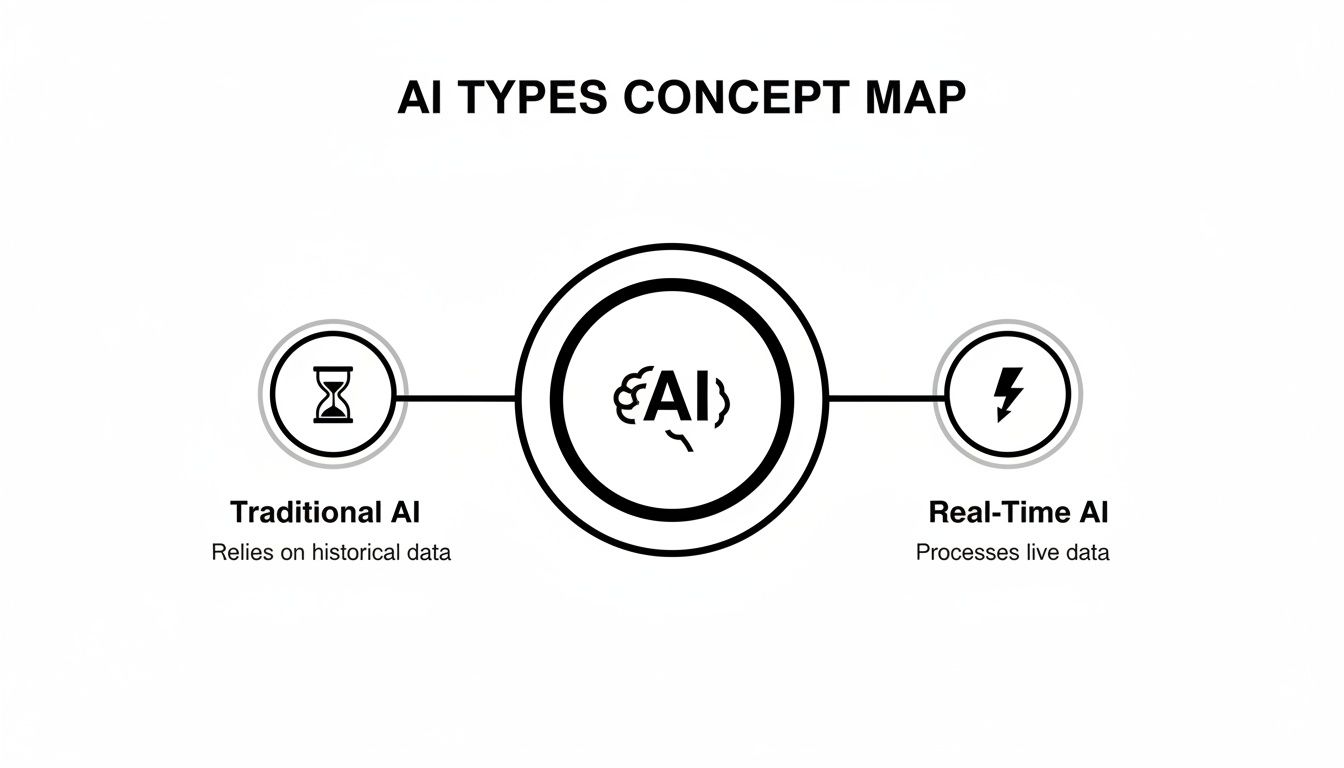
This visual shows why real-time processing is such a game-changer. It's the lightning bolt of instant decision-making, a world away from the slow-moving hourglass of traditional data analysis.
The Data Conveyor Belt: Stream Processing
Picture a factory with a conveyor belt that never stops. Parts (your data) are constantly arriving, and workers (the AI) inspect them the second they appear. That’s the core idea behind stream processing.
Instead of waiting for a huge box of parts to show up, unpacking it, and then checking everything at once—which is how traditional batch processing works—the AI handles each piece of information as it streams in.
This continuous flow is what lets a fraud detection system flag a suspicious credit card swipe the microsecond it happens, not hours later in a daily report. It's all about acting on the now. A great practical example is a live dashboard for a ride-sharing app; stream processing allows it to update driver locations on the map instantly for users.
The Fast-Food Recipe: Model Optimization
Next, let's talk about the AI model itself. A complex, heavy-duty AI model can be like a gourmet chef’s recipe with 50 intricate steps. The result might be incredible, but it's slow. For real-time AI, we need something more like a fast-food kitchen: a simple, efficient recipe that delivers a consistent result in seconds.
This is what we call model optimization. Engineers essentially trim the fat from the AI model, stripping out unnecessary complexity without losing critical accuracy. They use techniques like quantization (using simpler numbers) or pruning (cutting out less important parts of the model's neural network).
The whole point is to build a lean, lightweight model that can make decisions almost instantly. This is absolutely essential for applications where every millisecond counts, like in self-driving cars or high-frequency stock trading. If you're curious about the kinds of models that get optimized for these jobs, you can learn more by reading our guide on what is a large language model.
Expert Take: According to data engineering consultant Sarah Greene, "What’s really needed isn’t more access to raw data but instead a curated set of clean, derived data that carries real business meaning. Streaming offers a fundamentally different foundation for this."
This insight gets to the heart of the matter. The speed of real-time AI isn't just about the model; it's just as much about the quality and continuous flow of the data. A lightning-fast model fed with slow or messy data is always going to underperform.
The Brains of the Operation: Edge vs. Cloud
Finally, where does all this super-fast processing actually take place? You’ve got two main options: on the "edge" or in the "cloud."
- Edge Computing: This is like having a mini-brain right inside the device. Think of a smart security camera that identifies an intruder on its own, without having to send video footage anywhere. The processing happens locally, which makes it incredibly fast and great for privacy.
- Cloud Computing: This is like phoning a supercomputer for help. The device sends its data to powerful servers in a data center for heavy-duty analysis, and the results are sent back. This is perfect for tasks that need massive computational muscle that just won't fit on a small device.
A great real-world example is the conversational AI in modern phone answering services. These systems often use a hybrid approach, handling simple queries on the edge and routing complex ones to the cloud, all within the span of a normal conversation. This blend of stream processing, optimized models, and smart deployment is what truly makes real-time AI a reality.
Where You See Real-Time AI in Action Every Day
The idea of real-time AI might sound like something from a sci-fi movie, but it's already a quiet partner in many of your daily routines. From your morning commute to your evening entertainment, this instant intelligence is working behind the scenes to make life safer, more efficient, and more personal. Let’s pull back the curtain and see where you can find it.
This technology is no small thing. In the high-stakes world of modern business, real-time AI is the secret weapon driving massive investments. This growth is fueled by applications in finance and manufacturing, where AI can predict equipment failures milliseconds before they happen, slashing downtime by up to 50%. Major analysts forecast that AI will add 26% to local GDPs by 2030, with a staggering $6.6 trillion coming from productivity boosts—much of that tied directly to these real-time efficiencies.

On the Road with Autonomous Systems
Autonomous vehicles are one of the most powerful examples of real-time AI. A self-driving car isn’t just following a map; it's constantly building a 360-degree picture of its environment by processing a massive stream of data from cameras, LiDAR, and radar sensors.
This is where split-second decision-making is a matter of life and death. The AI has to:
- Identify Objects Instantly: Is that a pedestrian, a cyclist, or just a plastic bag blowing across the road?
- Predict Motion: Where will that other car be in two seconds? Is that person about to step off the curb?
- React in Milliseconds: Based on those predictions, the car must brake, accelerate, or steer to avoid a collision.
All of this happens far faster than any human could react. It’s a continuous loop of seeing, thinking, and acting, powered by complex models running on processors right inside the vehicle. This is a great application of a field you can explore in our article explaining https://yourai2day.com/what-is-computer-vision/.
Protecting Your Finances Instantly
Ever received a text from your bank asking if you really just made a purchase hundreds of miles away? That's real-time AI at work.
Fraud detection systems analyze thousands of data points with every single transaction. They look at your location, the purchase amount, the type of store, and your typical spending habits. If a transaction looks completely out of character—like a small coffee purchase in your hometown followed by a huge electronics purchase overseas a minute later—the AI flags it as suspicious in milliseconds. This immediate response stops fraud before the money even leaves your account.
Expert Take: According to financial tech analyst Dr. Kenji Tanaka, "These systems don't just follow simple rules. They learn and adapt, constantly updating their understanding of what 'normal' looks like for you. This allows them to catch sophisticated fraud schemes that would easily trick a human analyst."
Personalizing Your Entertainment
That "recommended for you" row on Netflix or Spotify isn't just a lucky guess. It’s a sophisticated real-time AI system personalizing your experience on the fly.
The moment you finish a movie, the platform’s AI analyzes that new piece of data. It considers the genre, actors, director, and even the time of day you watched it. It then cross-references this with the viewing habits of millions of other users who have similar tastes.
Within seconds, it generates fresh recommendations tailored just for you. This instant feedback loop is designed to keep you engaged by predicting what you’ll want to watch or listen to next, creating a far more compelling experience. To see the full scope of this technology's potential, explore these intelligent automation use cases that show how instant intelligence is changing workflows in all kinds of industries.
Choosing the Right Tools and Platforms
Diving into real-time AI can feel a bit like stepping into a massive hardware store. You’re surrounded by aisles of shiny, powerful tools, and every single one promises to be the perfect fit for your project. So, which ones do you actually need? Let's walk through the essential gear together, breaking down the key tools and platforms without getting bogged down in jargon.
Think of building a real-time AI system like designing a city's water supply. First, you need a robust network of pipes to ensure water—your data—flows constantly and reliably to every building. That’s the job of stream processing frameworks.
Next, you need treatment plants and pumping stations (cloud platforms) to process, manage, and deliver that water on demand. And finally, you need a team of engineers and advanced monitoring systems (MLOps tools) to make sure the entire system runs smoothly, 24/7.
The Central Nervous System for Your Data
To make decisions in the moment, you need a system that can handle a continuous, high-speed flood of information from countless sources. This is exactly what a stream processing framework is built for.
One of the most popular tools for the job is Apache Kafka. It’s best to think of Kafka as the central nervous system for your data. It acts as a high-throughput pipeline that ingests streams of events—like user clicks on a website, sensor readings from a factory floor, or financial transactions—and makes them available to any application that needs them, instantly. It’s built to ensure no data is lost and that everything arrives in the right order, which is absolutely critical for making accurate real-time decisions.
Without a solid foundation like Kafka, your real-time AI would be starved of the constant data it needs to function. It's the circulatory system that keeps the whole operation alive.
Finding a Home in the Cloud
Once your data is flowing, you need a powerful place to process it and run your AI models. This is where the major cloud providers step in, offering a whole suite of services built for this kind of work, each with its own unique strengths.
Choosing the right platform often comes down to your team's existing skills, your budget, and the specific scale of your project. Let's take a quick look at the big three and what they bring to the table for real-time AI.
Popular Platforms for Building Real-Time AI
Here's a high-level comparison of the top cloud platforms, focusing on their key services, ideal use cases, and pricing models for real-time AI applications.
| Platform | Key Real-Time Services | Best For |
|---|---|---|
| AWS | Kinesis, SageMaker | Teams already deep in the Amazon ecosystem or those needing a vast, highly scalable toolkit. |
| Google Cloud | Dataflow, Vertex AI | Projects demanding top-tier AI/ML capabilities and seamless integration with data analytics. |
| Azure | Stream Analytics, Azure Machine Learning | Enterprises heavily invested in Microsoft products or requiring strong hybrid cloud solutions. |
These platforms handle so much of the heavy lifting. They manage the complex infrastructure needed for real-time AI, which lets you focus your energy on actually building your application instead of just keeping the lights on.
Expert Take: According to data engineering consultant Sarah Greene, "What’s really needed isn’t more access to raw data but instead a curated set of clean, derived data that carries real business meaning. Streaming offers a fundamentally different foundation for this."
This expert take gets to the heart of the matter—your tools are only as good as the data you feed them. A great platform doesn't just process data quickly; it helps you clean, enrich, and transform it on the fly.
Keeping Your AI Healthy with MLOps
Getting a real-time AI model into production is just the beginning. These models operate in dynamic environments where data patterns can shift in an instant. This is where MLOps (Machine Learning Operations) becomes your best friend.
MLOps is a set of practices and tools designed to automate and monitor the entire lifecycle of your machine learning models. For real-time AI, this isn't just a nice-to-have; it's essential. These tools help you:
- Monitor Performance: Keep a close eye on key metrics like latency and throughput to ensure your model is responding fast enough.
- Detect Drift: Get alerted the moment a model's performance starts to degrade because live data no longer looks like the data it was trained on.
- Automate Retraining: Automatically kick off retraining and redeployment with fresh data to keep your model accurate and relevant.
Think of MLOps as the dedicated health monitoring system for your AI, constantly checking its vitals. To really get a handle on this final, crucial step, check out our guide on effective machine learning model deployment. It’s a great overview of the practices you'll need to keep your AI running in peak condition.
Best Practices for Implementing Real Time AI
Jumping into real-time AI can feel like a massive undertaking, but I've found that success usually hinges on a few practical rules. It’s less about having the most powerful technology and more about having a smart, focused plan. With the right strategy, you can sidestep common pitfalls and build a system that delivers genuine value right from the get-go.

The best advice I can give is to start small but think big. Instead of trying to boil the ocean with an AI that solves every problem, pick one clear, high-impact use case. What’s a specific bottleneck in your business that keeps you up at night? Maybe it’s spotting defective parts on an assembly line or personalizing website content the instant a visitor lands.
Focusing on a single, well-defined problem lets you score a quick win. This does more than just prove the value of real-time AI to your team; it gives you a solid foundation to build on for more ambitious projects down the road.
Prioritize Data Quality Above All Else
There’s an old saying in this field that has never been more relevant: “garbage in, garbage out.” Your real-time AI could be powered by the most sophisticated algorithm on the planet, but if you feed it inconsistent, low-quality data, you'll get garbage results. Every single time.
Clean, well-structured data is the lifeblood of any successful AI. Before you even think about which model to use, make sure your data pipelines are rock-solid. This means you need to:
- Ensure Consistency: All your data should follow a uniform format.
- Handle Missing Values: Have a clear plan for dealing with incomplete data.
- Filter Out Noise: Get rid of any irrelevant or inaccurate information that could throw your model off.
Spending time on data hygiene upfront will save you countless hours of painful troubleshooting later. It’s the single most important investment you can make.
Monitor Performance Relentlessly
Once your real-time AI is up and running, the job isn’t done—in many ways, it's just beginning. The real world is dynamic and unpredictable, and your AI’s performance can degrade over time. That’s why robust, continuous monitoring isn't just a nice-to-have; it's essential.
You need to keep a very close eye on two critical metrics:
- Latency: How quickly is your system responding? For most real-time apps, we’re talking milliseconds. A slow response can render the entire system useless.
- Throughput: How many requests or events can your system handle concurrently? This tells you if your AI can scale when demand spikes.
Tracking these metrics helps you catch issues before they affect your users, ensuring your AI stays fast, accurate, and dependable.
Keep a Human in the Loop
Especially in the early days, it’s incredibly wise to implement a human-in-the-loop system. This setup means the AI makes decisions automatically, but a person can review, correct, or override them when necessary.
Expert Take: From my experience as an AI strategist, human oversight acts as a crucial safety net. It not only prevents costly mistakes but also creates an invaluable feedback mechanism. Every time a human corrects the AI, it’s a learning opportunity that helps the model get better over time, building both accuracy and trust.
This collaborative approach ensures your real time AI learns the right lessons and allows you to deploy with confidence, knowing you have a failsafe in place. It's the perfect marriage of machine speed and human judgment.
The Future Is Instant: What's Next for Real Time AI
Looking ahead, the future of real-time AI is less about simply speeding up what we already do and more about a fundamental shift in how we experience the world. We're moving beyond AI that just reacts to our commands. The next wave is about genuine anticipation—creating experiences that aren't just personalized, but truly predictive and adaptive. The future is shaping up to be more responsive and intelligent in ways we're only just beginning to grasp.
This evolution isn't happening in a vacuum; it's backed by incredible global momentum. The artificial intelligence market is projected to explode, growing at a compound annual rate of over 40% to reach an estimated $2,503.13 billion by 2031. That isn't just a big number; it's a clear signal of the massive investment and adoption happening right now. You can explore the full market analysis on Mordor Intelligence to see the detailed breakdown of this growth.
The Rise of On-Device Intelligence
One of the most exciting frontiers is federated learning. Think of it as teamwork for your devices, letting them get smarter together without ever compromising your private data. Instead of shipping your sensitive info off to a central cloud server, the AI model itself comes down to your phone or smart speaker. It learns locally from your data, then only sends back generalized improvements—the "lessons learned"—to the mothership.
This approach brings two game-changing benefits:
- Enhanced Privacy: Your personal data stays exactly where it should be: on your device.
- Improved Speed: Processing happens right on the spot, eliminating the network lag of a round trip to the cloud for even faster responses.
Hyper-Personalized Worlds Await
The impact of this instant, on-device intelligence will be massive. Imagine an educational app that doesn't just stick to a rigid curriculum but adapts in the moment to a student's confusion. The AI could generate new examples or switch up its teaching style on the fly, essentially giving every learner a personal, one-on-one tutor.
Or think about entertainment. Gaming worlds will become truly dynamic. Instead of following predictable scripts, non-player characters (NPCs) will react intelligently to your specific playstyle, leading to unique stories that unfold differently for every single player.
Expert Take: I believe that real-time AI isn't just about making things faster. It’s about building a world that understands and responds to us in the moment, creating a more intuitive, helpful, and seamlessly connected existence.
Ultimately, the journey with real-time AI is taking us from a world of commands and clicks to one of genuine conversation and collaboration. We're on the cusp of a future where technology doesn't just serve our needs but actually anticipates them, making our lives simpler and our interactions with the world richer.
A Few Final Questions on Real-Time AI
We've covered a lot of ground, from the nuts and bolts of stream processing to deploying models on the edge. Before we wrap up, let's go over a few common questions that pop up when people first dive into real-time AI. This should help cement some of the key ideas we've discussed.
What's the Single Biggest Hurdle When Building a Real-Time AI System?
Hands down, the biggest challenge is latency. Everything hinges on speed. For a real-time AI to be more than just a novelty, it has to receive data, figure out what to do, and act on that decision within milliseconds. A fraction of a second too late, and the opportunity is gone—whether that's stopping a fraudulent transaction or helping a self-driving car avoid an obstacle.
This isn't just about tweaking a model to run faster. It’s an end-to-end infrastructure problem. You need a finely tuned data pipeline, efficient stream processing, and often a smart edge computing strategy to cut down on network lag. Making all those moving parts work together seamlessly, with near-zero delay, is what keeps engineers in this space up at night.
Is Real-Time AI Only for Big Tech Companies?
Not at all. That's a myth that's thankfully fading away. With powerful and surprisingly accessible cloud platforms from AWS, Google Cloud, and Azure, the tools are no longer reserved for companies with massive budgets.
Think about a small e-commerce shop. They could implement a real-time personalization engine that watches how a visitor clicks around the site. Based on that live behavior, it could instantly shuffle product recommendations to show them exactly what they’re likely looking for. This used to be a monumental task, but with today's managed services, it's a very achievable project for a small team.
"The powerful edge processing offered by Jetson Thor will take Digit to the next level—enhancing its real-time responsiveness and expanding its abilities to a broader, more complex set of skills." – Peggy Johnson, CEO of Agility Robotics.
This quote from Agility Robotics' CEO really drives the point home. Advances in both hardware and platforms are making sophisticated real-time systems a reality for a much wider range of companies, not just the usual giants.
How Is Real-Time AI Different from Regular Automation?
That’s a great question, as the line between them can seem blurry. The difference really comes down to the nature of the decision-making process.
-
Automation is about following a pre-written script. It’s rigid. Think of an email marketing tool that sends a welcome message when someone signs up. The rule is simple and unchanging: if a new subscriber joins, then send this specific email.
-
Real-time AI is about making dynamic, intelligent decisions on the fly. It doesn't follow a fixed script. Instead, it analyzes a continuous stream of new data, understands the context, and decides the best course of action right now. It's adaptive, while traditional automation is purely repetitive.
At YourAI2Day, our goal is to give you clear, practical guides to the world of AI. To keep learning and stay on top of what's next, be sure to visit us at YourAI2Day.com.