
Overcoming Resistance to Change Management: A Practical Guide for Leaders
Let's start with a crucial mental shift. When your team pushes back against a change, don't see it as an obstacle to be bulldozed. See it as valuable feedback.
Truly successful change happens with your people, not to them. This guide is built on that fundamental truth, and it all starts with listening to and addressing their concerns. Let's walk through how to turn that pushback into forward momentum, one step at a time.
Why So Many Change Initiatives Fizzle Out

Let’s be real for a moment. Kicking off a big change in an organization is tough, and countless well-intentioned plans die on the vine. You've probably seen it before: leadership unveils a brilliant new strategy with impressive slide decks, only for everyone to quietly slip back into their old routines a few months later. Sound familiar?
The problem is rarely the strategy itself. The real failure point is almost always a disconnect with the very people who are supposed to make the vision a reality.
This isn't just a gut feeling; the numbers are sobering. A widely-cited McKinsey & Company study found that a staggering 70% of large-scale change initiatives fail to achieve their goals. The primary reason? Employee resistance. The human element is the invisible force that can make or break any transformation.
The Psychology Behind the Pushback
So, why do people instinctively push back against change? It’s not because they’re being difficult. It's a deeply human, psychological response. We are creatures of habit, and change introduces uncertainty, which our brains register as a threat.
Imagine your team has a familiar path they walk every single day. They know every shortcut and exactly where the puddles form after it rains. Then, you announce you're building a new, more efficient highway. The end result sounds great, but the construction phase is disruptive, messy, and forces them onto unfamiliar ground.
This resistance usually stems from a few core fears:
- Fear of the Unknown: People worry about their jobs, their ability to learn new systems, or how their day-to-day work will be upended.
- Loss of Control: When change is dictated from on high, people feel like they’ve lost their autonomy, which quickly leads to resentment.
- Past Negative Experiences: If the last "big initiative" was a disaster, you can bet your team will be cynical about this one.
Expert Opinion: Dr. John Kotter, a leading expert on change management, often says, "Resistance isn't just opposition; it's a symptom. It's your team's way of telling you that their fundamental needs for security, control, and competence feel threatened. Listening to it is the first step toward a solution."
Recognizing the Different Faces of Resistance
Resistance isn't always a megaphone and a picket line. More often, it's subtle, showing up in ways that can be hard to pinpoint if you don't know what you're looking for.
Part of leading change is learning to "read the room" and understand what the behavior is really saying. To help you out, here are some of the most common forms of resistance I've seen over the years.
Common Types of Resistance and Their Hidden Meanings
| Type of Resistance | What It Looks Like | What It Often Really Means |
|---|---|---|
| Active Resistance | Openly criticizing the change, arguing in meetings, being confrontational. | "I don't understand the 'why' behind this," or "I feel this change is a mistake and I need to be heard." |
| Passive Resistance | Publicly agreeing but privately not complying, missing deadlines, "forgetting" new procedures. | "I feel powerless and this is the only way I can retain some control," or "I'm overwhelmed and don't have the bandwidth for this." |
| Disengagement | Showing up but being quiet, withdrawn, or apathetic. A noticeable drop in voluntary effort. | "I don't see how this benefits me, so I'm checking out," or "I've been burned by change before, so I'm not getting invested." |
| Spreading Negativity | Complaining to colleagues, gossiping, and focusing only on the downsides. | "I'm anxious about the future and I'm seeking validation for my fears from my peers." |
Recognizing these signs early is your chance to intervene before a small pocket of concern snowballs into a major roadblock. Each type requires a different response, but all of them start with listening.
Find the Real Reasons Your Team Is Pushing Back
When you're trying to steer a team through a big change, that pushback you feel can easily be mistaken for stubbornness. But let's be clear: resistance is rarely about being difficult just for the sake of it. It's a symptom, a flashing warning light that something deeper is at play. To get a handle on the situation, you have to put on your detective hat and find the real story.
This isn't about calling a big, formal meeting to demand answers. The truth usually comes out in the quieter moments—the informal coffee chats, the casual questions you ask in the hallway, or by simply paying close attention to the side conversations happening at the edges of a meeting.
Beyond Surface-Level Complaints
What you hear first is almost always just the tip of the iceberg. A complaint about a new software’s clunky interface might actually be masking a much deeper fear about job security.
Practical Example: I once worked with a manager who was completely baffled by her team's fierce resistance to a new analytics dashboard. The feedback was all about how it was "too complicated" and "a waste of time." She was ready to write them off as just being stuck in their ways.
Instead, she started having one-on-one chats. It didn't take long to discover their real fear had nothing to do with the software's design. They were terrified the tool would automate key parts of their jobs, eventually making their roles obsolete. The software wasn't the problem at all; the unspoken fear of being replaced was.
Once she understood the true issue, she could address it head-on. She showed them exactly how the tool would free them up for more strategic, high-value work—actually securing their roles, not eliminating them. The resistance practically vanished.
The resistance you see is rarely the real problem. It's a smoke screen for underlying anxieties about job security, loss of control, or the competence to adapt. Address the anxiety, and the resistance often melts away.
Practical Tools for Uncovering the Truth
You don't need a massive budget or complicated tools to figure out what's really going on. Simple, consistent methods almost always work best.
- Anonymous Pulse Surveys: These are quick, easy, and incredibly powerful. Ask just 2-3 pointed questions like, "What is your biggest concern about the upcoming change?" or "On a scale of 1-10, how clear is the reason for this change?" Anonymity is your best friend here; it encourages raw honesty.
- Active Listening in Meetings: Pay attention to more than just what is said. Listen to how it's said. Notice the recurring questions, the tone of voice, and the body language. These are all valuable clues.
- 'Ask Me Anything' Sessions: Host informal, no-agenda Q&A sessions. The goal is to create a safe space where people feel comfortable asking the "stupid" questions they're afraid to raise in a more formal setting.
The scale of this challenge is massive. Data from Gartner suggests that while nearly 73% of organizations expect to roll out major transformations each year, a staggering 70% of these efforts struggle because of employee resistance. But here's the good news: organizations that use analytics and feedback to pinpoint employee concerns see a 27% higher success rate in their change initiatives. Listening isn't just a nice-to-have; it's a genuine strategic advantage.
Common Triggers to Watch For
As you start listening, you'll begin to notice patterns. Resistance to change often boils down to a handful of fundamental human fears. For instance, when implementing new processes, some team members may worry about learning new skills, especially if it involves technology like AI. You can check out our guide on implementing AI in business for more on navigating those kinds of transitions.
Be on the lookout for these common emotional triggers:
- Fear of Job Loss: This is the most potent fear of them all. Is the change perceived as a direct path to layoffs?
- Anxiety About Competence: Will I be able to learn this new system? Will I look foolish trying?
- Frustration from Past Failures: Is the team cynical because the last three "big changes" were abandoned halfway through?
- Loss of Status or Autonomy: Does the new way of doing things reduce someone's influence or their control over their own work?
By digging beneath the surface complaints, you move from fighting symptoms to curing the actual disease. This kind of empathetic investigation is the foundational step in turning your biggest critics into your most engaged advocates for change.
Craft a Communication Plan That Builds Trust

Once you’ve figured out the real reasons for the pushback, it's time to stop broadcasting and start communicating. Forget those dense, jargon-filled corporate emails sent from a "no-reply" address. Real progress happens when you build a communication strategy that fosters genuine trust, especially when uncertainty is running high.
This isn't just about relaying facts. It’s about crafting a clear, compelling, and consistent story. Your mission is to answer the one question on every single employee’s mind: “What does this mean for me?”
Build a Narrative, Not Just a Message
People don't rally behind spreadsheets; they rally behind a vision. Your first job is to frame the change in a way that connects to a larger purpose. Don't lead with what is changing—lead with why it matters.
Practical Example: A company introducing https://yourai2day.com/ai-automation-for-businesses/ shouldn't just say they're "deploying new efficiency software." That's a recipe for fear. A much better story is, "We're bringing in tools to handle repetitive tasks so we can free you up to focus on the creative, strategic work you were hired to do." One message sparks anxiety; the other creates opportunity.
Expert Opinion: Brené Brown, a researcher on vulnerability and leadership, puts it this way: "Clear is kind. Unclear is unkind." Authentic communication is the bedrock of successful change. If your team senses even a hint of corporate spin, you've lost them. Transparency, even when the news isn't perfect, builds far more trust than polished but empty messaging.
This narrative has to be consistent from the top down. When an employee hears the same core story from their direct manager and the CEO, it reinforces the message and builds confidence that everyone is heading in the same direction.
Establish a Communication Rhythm
During times of change, silence is deafening and quickly gets filled with rumors. To counter this, you need to set up a predictable rhythm for communication. This isn't about spamming inboxes; it's about creating reliable touchpoints people can count on.
A single all-hands meeting will never cut it. You need a multi-channel approach that meets people where they are.
- Weekly Team Huddles: These are perfect for managers to translate the big-picture vision into team-specific actions and tackle immediate questions.
- Monthly 'Ask Me Anything' Sessions: Get senior leaders in a room (or on a call) for informal Q&As. Nothing should be off-limits. This shows you have nothing to hide.
- Regular Email/Slack Updates: Use these for tactical news, celebrating small wins, and sharing progress reports. Showing tangible momentum is huge for morale.
The key here is consistency. Even if the update is just, "we're still working through the details," the simple act of communicating shows respect and keeps everyone in the loop.
Tailor the Message for Different Audiences
A big change will affect your engineers and your sales team in completely different ways, and your communication has to reflect that. A one-size-fits-all message lands with a thud because it feels impersonal.
Practical Example: Imagine you're rolling out a new CRM system.
- The sales team needs to hear how it will help them close deals faster and manage their pipeline better. They care about commissions and efficiency.
- The IT department needs to understand the technical roadmap, security protocols, and support plan. They care about stability and integration.
- The marketing team needs to know how the new data will fuel more targeted campaigns. They care about lead quality and analytics.
By segmenting your audience and tailoring the "What's in it for me?" message, you show that you've actually thought about how the change impacts everyone. This simple step makes people feel seen and valued, which is absolutely critical for getting buy-in.
Finally, remember that communication has to be a two-way street. Create real feedback loops—like anonymous surveys or dedicated Slack channels—where people can voice concerns without fear. When you actively listen and visibly act on that feedback, you shift the dynamic from a top-down mandate to a collaborative journey. You stop talking at your team and start solving problems with them.
Turn Your Team into Active Partners in Change
Here’s the biggest secret I've learned about successful change: stop doing it to people and start doing it with them. The most effective way to handle resistance isn't about pushing harder against the opposition; it's about making the wall disappear entirely by inviting people to help you build whatever comes next.
This is your playbook for turning employees from passive observers—or even active resistors—into genuine co-creators. When people have a hand in shaping their future, they feel a real sense of ownership. The initiative is no longer "management's project"—it becomes "our project."
Cultivate a Network of Change Champions
In every company, there are informal leaders. They might not have the fanciest titles, but they're the ones everyone listens to, respects, and trusts. Identifying these individuals and bringing them into the fold early is one of the most powerful moves you can make.
These people become your change champions. Think of them as a vital bridge between leadership and the front lines. They translate the high-level vision into relatable terms for their peers and, just as importantly, provide you with honest, unfiltered feedback.
To build this network, you need to:
- Look for Enthusiasm: Who's asking curious questions or showing early signs of support? Start there.
- Empower Them: Give them a real role, not just a label. Ask for their input on communication plans or let them pilot new tools first.
- Provide Information: Equip them with the "why" behind the change and exclusive updates. This way, they can confidently answer their peers' questions.
Co-Design the Future Together
Nothing dissolves resistance faster than giving people a bit of control. Instead of presenting a perfectly polished, finished plan, bring your teams into the process. Ask for their help in designing the new workflows. This co-creation approach transforms the dynamic from a top-down mandate to a shared mission.
Practical Example: A logistics company planning to introduce a new inventory management system did this brilliantly. Instead of just training staff on the finished product, they ran workshops. Warehouse teams used sticky notes and whiteboards to map out their ideal daily workflow. This process uncovered critical insights the IT team had completely missed. More importantly, it made the warehouse staff advocates for the very system they helped design.
The infographic below shows how collaborative workshops can give teams ownership from the very start.
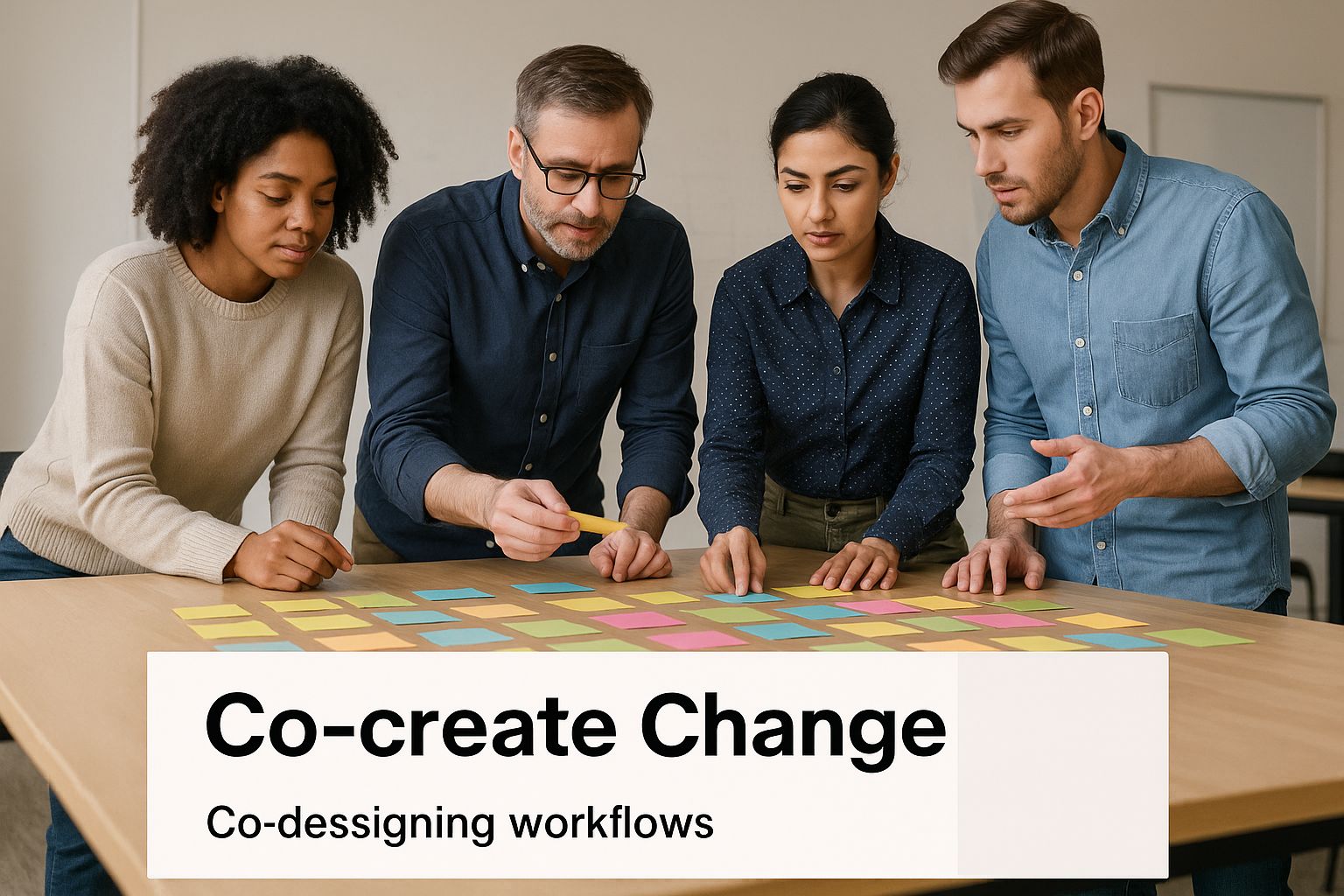
When you involve employees directly, you build investment and dramatically reduce their fear of the unknown.
Leadership Engagement Is Non-Negotiable
While bottom-up involvement is absolutely critical, it can’t succeed in a vacuum. It needs visible, active support from the very top. When employees see senior leaders championing the change, it sends a powerful message that the initiative is a real priority with long-term backing.
This isn't just theory. In a landmark 2020 report from Prosci, a staggering 75% of organizations cited employee resistance as their number one barrier. The study also revealed a direct link between leadership and that resistance, finding that companies with visibly engaged senior leaders experienced 40% less pushback from their teams.
Expert Opinion: Simon Sinek captures this perfectly: "Leadership is not about being in charge. It is about taking care of those in your charge." The most powerful signal leaders can send during a change is their consistent, visible, and unwavering support. When your team sees you're all-in, it gives them the confidence to follow.
Visible support means more than just a kickoff announcement. It means leaders showing up at workshops, participating in Q&A sessions, and actively using the new tools or processes themselves.
Choosing the right engagement methods is key to turning theory into practice. Some tactics are quick and easy, while others require more planning but yield far greater returns.
Engagement Tactics Comparison High vs Low Impact
| Engagement Tactic | Potential Impact on Resistance | Resource Level | Best For |
|---|---|---|---|
| Co-Design Workshops | High | Medium-High | Complex process changes where frontline input is critical for success. |
| Change Champion Network | High | Medium | Large-scale changes needing sustained, peer-to-peer communication and feedback. |
| Town Halls/Q&A Sessions | Medium | Low-Medium | Sharing major announcements and getting a broad pulse on employee sentiment. |
| Email Updates/Newsletters | Low | Low | Keeping everyone informed on progress, but not effective for deep engagement. |
| Suggestion Box (Digital/Physical) | Low | Low | Gathering passive feedback, but often lacks the context for meaningful action. |
Ultimately, a mix of high-impact strategies like co-design and champion networks, supported by consistent communication, will deliver the best results. By turning your team into true partners and backing them with strong leadership, you're not just managing resistance—you're creating a culture where change can truly thrive.
Keep the Momentum Going When Things Get Hard
The kick-off for a big change is always exciting. There's a buzz in the air, a sense of new beginnings. But the real test isn't the launch; it’s what happens weeks or months down the road. That’s the messy middle—when the initial energy fades, old habits resurface, and motivation starts to dip.
Let's be honest, you can't just set a change in motion and hope everyone stays on board. You have to intentionally build resilience into your plan to get through the inevitable rough patches. Without a strategy for this phase, even the best-laid plans can fall apart.
Celebrate the Small Wins
When the finish line feels miles away, people get discouraged. It's human nature. That's why celebrating small, concrete wins is one of the most powerful things you can do. These little victories are tangible proof that the effort is worth it and that progress is actually happening.
Don't wait until the project is over to hand out praise. Be on the lookout for those moments of incremental progress and make a big deal out of them.
Practical Examples:
- Did a team figure out a new software feature on their own? Give them a shout-out in the next team meeting.
- Did a department hit their first small target with the new process? Send a company-wide email highlighting their success.
- Did someone share a great tip for using the new system? Acknowledge them and share that tip with everyone.
These aren't just feel-good moments; they create a powerful feedback loop. Morale gets a boost, the new behaviors are reinforced, and the journey starts to feel less like a marathon and more like a series of achievable sprints.
Track Progress with Data and Stories
To keep people invested, you need to show them where you've been and where you're headed. The best way to do this is by combining hard data with real human stories. Numbers are great for proving a point, but it's the personal experiences that make the change feel real.
Practical Example: Imagine a medical clinic rolling out a new digital check-in system. They could show progress by tracking:
- Data: Monitoring the average patient check-in time, with a goal to cut it by 15% in the first month.
- Stories: Sharing a quote from a front-desk employee who now has more time for genuine patient interaction, or from a patient who loved how much faster the new process was.
When you pair quantitative and qualitative feedback like this, the benefits become undeniable. The data shows it’s more efficient, and the stories show it’s making life better for actual people.
"Momentum is a fragile thing. You build it by consistently showing people that their efforts are making a measurable difference. Without visible progress, even the most enthusiastic supporters will eventually burn out."
Empower Your Frontline Managers
Your managers are the linchpins for sustaining any change. They're in the trenches every single day, fielding questions, calming fears, and dealing with frustration. If they aren’t equipped to lead their teams through the dip, the whole initiative could grind to a halt.
Supporting them isn't optional; it's essential.
- Provide Clear Talking Points: Give them simple, consistent answers to common questions so they can respond with confidence.
- Give Them Autonomy: Let them make small tweaks to the plan to fit their team's unique workflow. This empowers them and shows you trust their judgment on the ground.
- Create a Support Network: Host regular check-ins just for managers. It gives them a space to share what's working, what isn't, and learn from each other. Knowing they aren't alone makes a huge difference.
When managers feel supported, they become the steady hand that guides their teams through the uncertainty. By focusing on celebrating wins, tracking progress, and empowering your managers, you're not just launching a change—you're building the endurance to see it through to the end.
Questions We Hear All the Time About Change Resistance
Even with a solid plan, the human element of change can throw you for a loop. Let's tackle some of the most common questions and roadblocks that leaders run into when they're deep in the trenches of managing change.
What’s the Single Best Way to Overcome Resistance?
If I had to pick just one strategy, it's this: get your people involved, and do it early. There's no magic wand, but this comes closest. So much resistance is really just a reaction to feeling powerless or a fear of what’s coming next. When a change is simply announced from the top, it feels like something being done to them, not with them.
The trick is to completely flip that script.
Bring employees into the conversation from the very beginning. Ask for their help in pinpointing the problems, let them brainstorm solutions, and give them a role in planning the rollout. This simple shift turns them from spectators into active players. It gives them a sense of control and a clear view of why the change is necessary in the first place.
When people feel like they have some skin in the game, their entire mindset changes. They stop defending the old way and start owning the new one. Suddenly, they're championing the very thing they might have fought against.
How Should I Deal With Someone Who Is Actively Resisting?
Handling a vocal and active resistor requires a delicate touch. You need to be direct, but also empathetic. Your first instinct might be to shut them down or just ignore them, hoping they'll go away. Both are huge mistakes. Often, these people are actually some of your most passionate and engaged employees—they just see risks you might have missed.
The first move is always to talk to them one-on-one, in private. In that meeting, your main job is to listen. Don't just wait for your turn to talk; truly hear them out.
- Start by acknowledging their perspective. You don't have to agree with it, but saying something like, "I can see why you're concerned about how this will affect our team's workflow," immediately lowers their defenses.
- Look for common ground. Is there a piece of their feedback you can actually use? Involving them in finding a solution can transform them from an opponent into an ally.
Now, if you've made a genuine effort and their resistance continues to be disruptive, it's time for a different kind of conversation. You’ll need to clearly, but respectfully, lay out the parts of the change that are not up for debate and clarify what's expected of them in their role. Always document these conversations. The goal is to bring them on board, but you also have a duty to the rest of the team and the organization's success.
How Do We Know If Our Efforts Are Actually Working?
Figuring out if you're making headway requires looking at both the numbers and the people. You can't rely on one without the other. Real success is a mix of hard data showing progress and subtle shifts in attitude and behavior. For anyone interested in the technical aspects of tracking and analyzing complex information, understanding concepts like the differences between deep learning vs machine learning can provide a deeper appreciation for how modern data analysis works.
Here’s a practical way to track your progress:
Quantitative Metrics (The Hard Data)
- Project Timelines: Are you hitting your implementation deadlines? Consistent delays are often a symptom of quiet, passive resistance.
- Productivity Metrics: Expect an initial dip in productivity—that's normal. A successful change effort will see those numbers bounce back and eventually climb higher than before.
- Adoption Rates: How many people are actually using the new software or following the new process? You need to track this trend over several weeks and months.
- Employee Turnover: Pay close attention to attrition rates, especially in the departments most impacted by the change. A sudden spike is a serious red flag.
Qualitative Indicators (The Human Element)
- Pulse Surveys: Use quick, frequent surveys to get a read on employee morale and feelings about the change.
- The Tone in the Room: Listen to the kinds of questions people ask in town halls. Are they shifting from fearful ("Why is this happening?") to constructive ("How can I get trained on the new system?")?
- Manager Check-Ins: Your frontline managers are your eyes and ears. Ask them what they're hearing in their team meetings and one-on-ones.
- Engagement in Training: Are people just showing up to training sessions, or are they asking questions and participating? Engagement is a powerful indicator.
You know you're succeeding when you feel the atmosphere slowly shift—from fear and uncertainty to cautious curiosity, and finally, to genuine engagement.
At YourAI2Day, we believe that understanding the human side of technological change is just as important as the technology itself. Our platform provides the latest news, research, and tools to help you and your business navigate the evolving world of artificial intelligence with confidence. Explore our resources and join a community dedicated to making AI accessible and practical for everyone.
Learn more at: https://www.yourai2day.com