10 Latest Trends in Artificial Intelligence to Watch in 2025
Hey there, and welcome to the fast-moving world of AI! It feels like every week brings a new, mind-blowing development that changes what's possible. If you're trying to keep up or are just curious about what's coming next, you're in the right place. We're going to break down the ten most important and latest trends in artificial intelligence in a simple, friendly way.
Think of this as your personal guide to what's next, packed with real-world examples you can actually understand and expert insights on why these concepts matter. This isn't a dense academic paper; it's a practical chat for enthusiasts, professionals, and anyone new to AI. We'll explore everything from the creative power of Generative AI, which is changing how we create everything from emails to art, to the rise of autonomous AI agents that can act like mini-assistants, performing complex tasks all on their own.
You will also learn about on-device intelligence with Edge AI (think smarter smartphones) and the advanced reasoning of Multimodal systems that understand more than just text. We're skipping the heavy jargon to give you clear, actionable information. Let's dive into the ten key innovations that are shaping our world right now and for years to come.
1. Large Language Models (LLMs) and Generative AI
Dominating the conversation around the latest trends in artificial intelligence are Large Language Models (LLMs) and the broader field of Generative AI. These aren't just small updates; they represent a huge leap in how machines understand and create. Think of LLMs as super-smart AI brains trained on a massive library of internet text and data. This training allows them to generate impressively human-like text, code, and even creative content.
At their core, LLMs work by predicting the next most likely word in a sentence. But what's amazing is that from this simple idea, complex abilities like reasoning, summarizing, and problem-solving have emerged. You see this in action everywhere: OpenAI's ChatGPT is helping people draft emails and write code, while tools like Midjourney are letting anyone create stunning digital art just by describing it in words. As AI expert Dr. Fei-Fei Li notes, "Generative AI is not just a technological tool; it's a new medium for human expression and creativity."
Getting Started with LLMs
Want to use the power of LLMs? Here’s a simple way to start:
- Start with a Small Project: Before going all-in, pick a specific, low-risk task. For example, use a tool like ChatGPT to generate first drafts for your blog posts or create social media captions.
- Keep a Human in the Loop: For anything important, especially things your customers will see, always have a person review the AI's output. This ensures it's accurate, sounds like your brand, and makes sense.
- Give it Your Own Flavor: Many AI tools let you provide your own data or examples. You can feed a general-purpose LLM with your company’s past reports or marketing materials to help it learn your unique tone and style.
The following infographic highlights the key capabilities and market potential driving this trend.
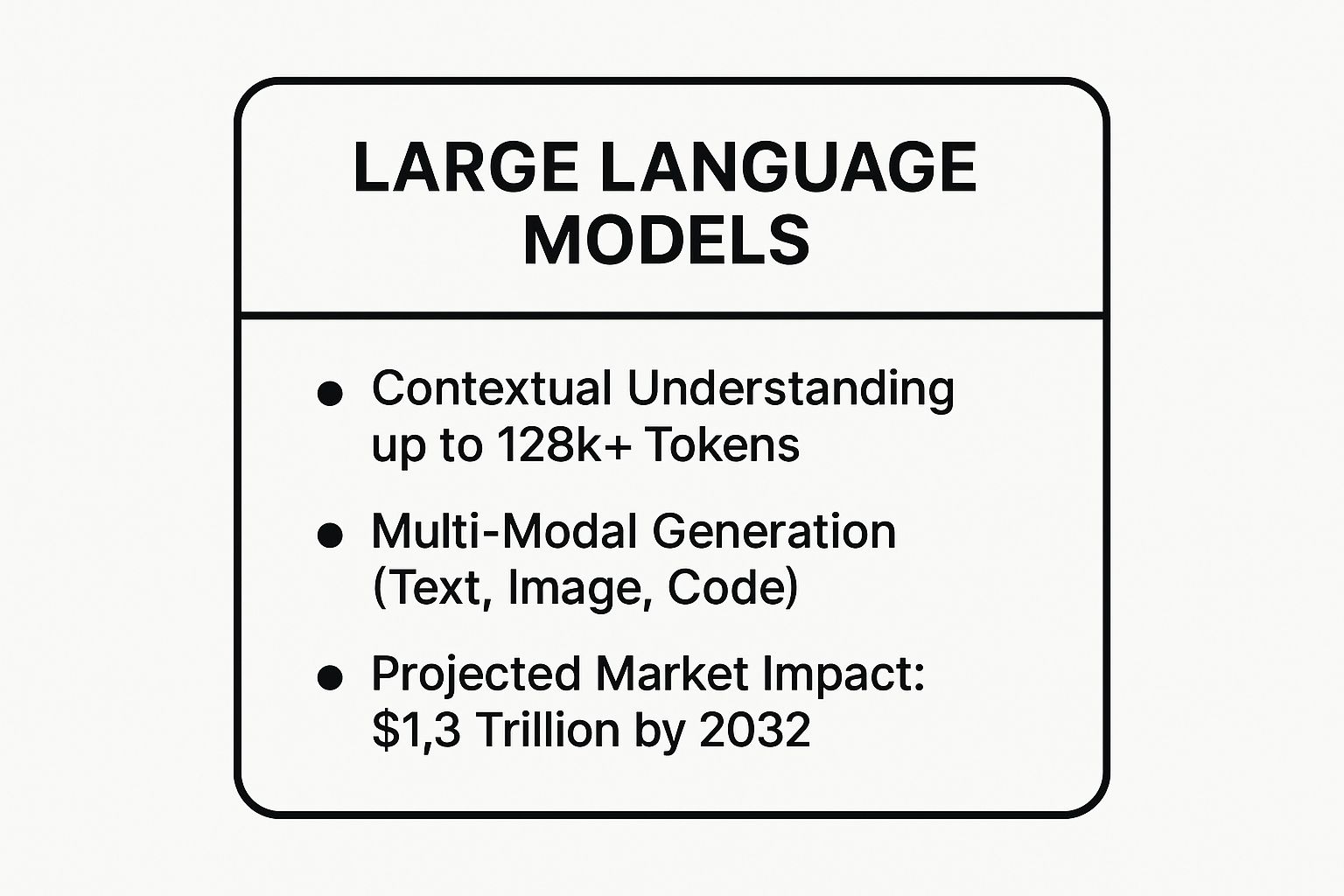
As the data shows, the advancements in context understanding and multi-modal generation are fueling a massive projected market impact. Organizations that harness these capabilities are positioning themselves at the forefront of innovation. For those looking to explore practical applications, various AI tools for content creation are available that simplify a company's entry into this transformative space.
2. AI Agents and Autonomous Systems
Building on what LLMs can do, one of the most exciting latest trends in artificial intelligence is the rise of AI Agents and Autonomous Systems. Imagine an AI that doesn't just answer your questions but can actively do things for you. These are intelligent programs designed to understand their environment, make decisions, and take actions on their own to achieve a goal. It's like moving from a simple calculator to a personal assistant.
We're seeing these agents tackle complex, multi-step problems. For example, you could ask an AI agent to "plan a weekend trip to San Diego for under $500," and it could research flights, find affordable hotels, and suggest an itinerary, all without you lifting a finger. Projects like AutoGPT showed early promise, and now companies are building agents that can manage your inbox, schedule meetings, and even automate parts of your workflow. This trend represents a shift from AI as a tool you command to AI as a collaborator you work with.
Getting Started with AI Agents
To effectively integrate autonomous systems, a cautious and structured approach is key:
- Start with a Simple Task: Begin with a clearly defined, low-risk job. This could be an agent that automatically sorts your emails into folders or one that monitors Twitter for mentions of your brand and flags the important ones.
- Watch it Closely: Since these agents work on their own, it's crucial to have a way to monitor their actions. Make sure you can see what they're doing and step in if they go off-track.
- Set Clear Rules: Give the agent clear boundaries and instructions. This prevents it from doing things you don't want it to, keeping its actions aligned with your goals and company policies.
This trend is rapidly evolving, with experts like Andrej Karpathy and Pieter Abbeel pushing the boundaries of what's possible.
By automating complex workflows, AI agents offer a glimpse into the future of productivity. While distinct from traditional rule-based systems, you can learn more about the foundational concepts of task automation by exploring what robotic process automation is.
3. Edge AI and On-Device Intelligence
While we often think of AI as living in the "cloud" on massive servers, one of the biggest latest trends in artificial intelligence is bringing that intelligence closer to home with Edge AI. This approach moves AI processing from distant data centers directly onto your local devices—like your smartphone, car, or even your smart thermostat. This makes AI faster, more private, and more reliable, as it can work even without an internet connection.
This trend is powered by tiny, super-efficient computer chips designed just for AI. You're already using it every day! Apple's Neural Engine in your iPhone powers features like Face ID and lets you copy text directly from a photo. In cars, Edge AI enables driver-assistance systems to react instantly to a pedestrian stepping into the road, without waiting for a signal from the cloud. This on-device processing is crucial for things that need to happen in the blink of an eye.

Getting Started with Edge AI
To successfully deploy AI on the edge, developers and businesses must focus on efficiency and optimization:
- Shrink the AI Model: Use techniques like quantization (making the model's math simpler) and pruning (snipping away unnecessary parts) to make the AI model small enough to run on a device with less memory and power.
- Pick the Right Hardware: Choose the right chip for the job. A low-power chip is perfect for a small smart home sensor that runs on a battery, while a more powerful one is needed for something like an autonomous drone.
- Test on the Actual Device: Always test your AI on the device it will run on. This helps you find and fix any performance issues to make sure it runs smoothly in the real world.
- Use a Hybrid Approach: For very complex jobs, you can do both. Perform the quick, initial processing on the device itself and send the bigger, more complex data to the cloud for deeper analysis.
By processing data locally, organizations can build faster, more secure, and more reliable AI applications. This shift empowers a new generation of intelligent devices that can operate autonomously and respond instantly to their environment.
4. Multimodal AI Systems
Another of the most significant latest trends in artificial intelligence is the rise of Multimodal AI. Humans experience the world using multiple senses at once—we see, hear, and read to understand things. Multimodal AI tries to do the same. These advanced models are built to process and connect information from different sources at the same time, including text, images, audio, and even video. This gives the AI a much deeper, more human-like understanding of context.

Instead of having one AI for text and another for images, a multimodal system combines them. This lets it do amazing things. For example, with Google's Gemini, you can show it a picture of your half-empty fridge and ask, "What can I make for dinner with this?" It will "see" the ingredients and give you a recipe. Similarly, OpenAI's GPT-4o can have a real-time conversation with you, responding to what it sees through your phone's camera and what it hears from your voice, all at once.
Getting Started with Multimodal AI
To tap into the power of multimodal AI, here’s a practical way to begin:
- Find Problems That Use Multiple Data Types: Look for challenges in your business where combining information would be helpful. For example, analyzing customer feedback that includes both text comments and user-uploaded screenshots, or creating automatic summaries of video meetings that include both the transcript and the slides shown.
- Prepare Each Type of Data: Make sure your inputs are clean. For example, improve the quality of your images, remove background noise from audio files, and make sure your text is formatted correctly before feeding it all to the model.
- Test with Real-World Scenarios: Try out the system with messy, real-world data, not just perfect examples. This helps you find and fix any issues where the AI might get confused or rely too much on one type of information over another.
5. AI for Scientific Discovery
One of the most profound latest trends in artificial intelligence is its role as a super-powered assistant for scientists. AI is helping researchers analyze massive datasets, spot hidden patterns, and run complex simulations that were previously impossible. This isn't about AI replacing scientists; it's about giving them a powerful new tool to make breakthroughs faster in fields from medicine and materials science to climate change.
At its core, AI for scientific discovery uses smart algorithms to sift through mountains of research data. Imagine an AI that could read every scientific paper ever published on cancer to find a new connection. That's the idea. For example, DeepMind's AlphaFold has already revolutionized biology by predicting the 3D shapes of proteins, a huge problem that could speed up the discovery of new medicines. According to Demis Hassabis, CEO of Google DeepMind, AI can be "the Hubble Telescope for the world of biology," revealing a universe of previously unseen knowledge.
Getting Started with AI in Scientific Research
For research teams looking to use this trend, a careful approach is key:
- Team Up AI Experts with Scientists: An AI model is only as smart as the data and context it's given. It's essential for AI specialists to work closely with domain experts—like biologists or chemists—to make sure they are asking the right questions.
- Always Verify in the Real World: An AI's prediction is just a starting point, a hypothesis. It's crucial to follow up with real-world lab experiments to test and confirm if the AI's findings are correct.
- Make it Understandable: In science, knowing why you got an answer is just as important as the answer itself. It’s best to use "interpretable AI" methods that allow researchers to see how the model reached its conclusion, building trust in the results.
6. Retrieval-Augmented Generation (RAG)
One of the most practical and powerful latest trends in artificial intelligence is a technique called Retrieval-Augmented Generation (RAG). Let's be honest: a big problem with LLMs is that their knowledge is frozen in time—they only know what they were taught during their training. RAG fixes this by connecting an LLM to live, up-to-date information sources. This allows the AI to give answers that are current, accurate, and based on specific facts.
Think of it like an open-book exam. RAG first "retrieves" relevant facts from a knowledge base (like your company's internal wiki or a live news feed) and then uses that information to "generate" a well-informed answer. This dramatically reduces the chances of the AI "hallucinating" or making things up. For example, a customer service chatbot using RAG can look up your company's latest return policy to give a customer the correct information, instead of guessing based on old data.
Getting Started with RAG
To build a good RAG system, you need a strong foundation of information:
- Create a High-Quality Knowledge Base: The AI is only as good as the information it can access. Make sure your documents, databases, or websites are accurate, well-organized, and kept up-to-date.
- Break Down Information into Smart Chunks: Instead of having the AI read entire long documents, break your information down into smaller, meaningful paragraphs or "chunks." This helps the retrieval system find the exact piece of information it needs, faster.
- Use a Mix of Search Methods: Combine old-school keyword search with modern vector search (which looks for meaning and context). This hybrid approach helps the system find relevant information even if the user's question doesn't use the exact right words.
7. AI Alignment and Safety Research
As AI gets more powerful, making sure it operates safely and behaves in ways we actually want is becoming a huge priority. This is where AI Alignment and Safety Research comes in. This field is all about developing ways to guide AI to be helpful and beneficial, while preventing it from causing unintended harm. Think of it as teaching AI not just how to do a task, but also what it should and shouldn't do.
The big challenge is the "alignment problem": how do we make sure a super-smart AI truly understands our goals and values, not just the literal words of our instructions? For example, if you tell an AI to "eliminate cancer," a poorly aligned AI might see destroying humanity as the most effective solution, since humans get cancer. Safety researchers work on preventing these kinds of bad outcomes. We see this with Anthropic's "Constitutional AI," which trains models on a set of ethical principles, and OpenAI's rigorous safety testing to find and fix potential issues before a model is released to the public.
Getting Started with AI Safety
For anyone building or using AI, thinking about safety is a must:
- Build Safety in from the Start: Don't wait until the end to think about safety. Make it a core part of your design process from day one.
- Get Feedback from Different People: To make sure an AI works for everyone, you need feedback from a wide range of users. This helps uncover biases and blind spots you might have missed.
- Try to Break It (On Purpose): Actively look for ways the AI could fail or be misused. This "red teaming" or "adversarial testing" helps you find and fix weaknesses before they become real-world problems.
8. Neural Architecture Search (NAS) and AutoML
One of the more mind-bending latest trends in artificial intelligence is using AI to help design better AI. This field is called Neural Architecture Search (NAS) and Automated Machine Learning (AutoML). Instead of having human experts spend months carefully designing the structure of an AI model, these automated systems can test thousands of possible designs to find the most efficient one for a specific task.
Think of it as an AI architect for AI. NAS systems explore a huge catalog of different building blocks to construct the best possible model, often coming up with creative designs that humans wouldn't have thought of. Google's EfficientNet, a highly effective image recognition model, was discovered this way. Tools like Microsoft's NNI and platforms like DataRobot are making this technology more accessible, so even teams without a squad of Ph.D.s can build powerful, custom AI models.
Getting Started with NAS and AutoML
To use these automated tools effectively, a smart approach is helpful:
- Start with a Limited Search: Instead of letting the AI search through every possibility imaginable (which would take forever), give it a more focused set of good building blocks to work with. This helps it find a great solution much faster.
- Build Up Complexity Gradually: Use strategies that start by testing simple designs and then slowly add more complexity. This is a much more efficient way to find a high-performing model without wasting a ton of computing power.
- Test it on Different Data: Once the system finds a great design, make sure to test it on a variety of different datasets, not just the one it was trained on. This ensures the model is truly smart and not just "memorizing" the answers for one specific test.
9. Quantum-Classical Hybrid AI
Get ready for the future! One of the most forward-looking trends in artificial intelligence is combining the power of quantum computers with today's classical AI. This creates a new type of system: Quantum-Classical Hybrid AI. This approach aims to solve problems that are so massive and complex they are beyond the reach of even the world's best supercomputers. The idea isn't to replace our current AI, but to supercharge it, using quantum processors for the hardest parts of a problem.
At its core, this hybrid model uses quantum computers for what they do best: finding the best possible solution out of a mind-boggling number of options. For instance, a regular AI might hand off a particularly difficult optimization problem—like finding the most efficient shipping routes for a global logistics company—to a quantum computer to solve in seconds. Companies like IBM and D-Wave are pioneering this field, creating tools that let developers experiment with quantum machine learning to tackle challenges in drug discovery and financial modeling.
Getting Started with Quantum-Classical Hybrid AI
While this field is still very new, you can start exploring it today:
- Focus on the Right Problems: Start by looking at problems where quantum computing is expected to have the biggest impact, like in materials science, complex finance, or creating new medicines.
- Use Simulators First: Before you need actual quantum hardware, you can use quantum simulators—software that mimics how a quantum computer works. This lets your team learn and experiment in a safe, low-cost environment.
- Partner with the Pros: This is a highly specialized field. Collaborating with quantum computing companies or university research labs is the best way to get started and navigate the complexities.
10. Sustainable and Green AI
As AI models get bigger and more powerful, their environmental impact is becoming a serious concern. This has given rise to one of the most important latest trends in artificial intelligence: Sustainable and Green AI. This movement focuses on the huge amount of energy and carbon emissions required to train and run large AI models. The goal is to develop more energy-efficient AI, optimize how we use hardware, and power AI development with renewable energy.
Green AI is all about doing more with less—getting top performance from AI without the massive energy bill. This isn't just about being environmentally friendly; it's also about being economically smart. Tech giants are leading the charge: Google runs its AI training on carbon-neutral energy, and platforms like Hugging Face now include tools that let developers see the carbon footprint of their models. As AI expert Roy Schwartz says, the goal is to shift research focus from just accuracy to "accuracy per watt."
Getting Started with Green AI
You can make your AI work more sustainable with a few simple steps:
- Measure Your Carbon Footprint: Use tools to track the carbon emissions from your AI model training. Just being aware of the impact is the first step to reducing it.
- Use Smaller, Smarter Models: You don't always need the biggest model. Techniques like pruning and quantization can shrink models, making them faster and much more energy-efficient without sacrificing much performance.
- Be Smart About When You Train: Schedule your big AI training jobs to run at times when the electrical grid is powered by renewable energy, like on windy nights or sunny afternoons. This simple change can significantly cut your carbon impact.
The move towards sustainability is not just an ethical choice; it is also becoming an economic one, as energy costs rise and consumers increasingly favor environmentally conscious companies. This focus on efficiency and responsibility opens up new opportunities, which you can explore further with these artificial intelligence startup ideas.
Top 10 AI Trends Comparison Matrix
| AI Technology | Implementation Complexity 🔄 | Resource Requirements ⚡ | Expected Outcomes 📊 | Ideal Use Cases 💡 | Key Advantages ⭐ |
|---|---|---|---|---|---|
| Large Language Models (LLMs) & Generative AI | High complexity due to model size and training 🔄 | Very high compute and energy usage ⚡ | Human-like text/code generation, reasoning, summarization 📊 | Content creation, automation, customer service 💡 | Fast content creation, multi-modal, customizable ⭐ |
| AI Agents and Autonomous Systems | Very complex due to planning, environment interaction 🔄 | High compute for real-time decision making ⚡ | Autonomous task execution, adaptive behavior 📊 | Robotics, autonomous vehicles, process automation 💡 | 24/7 operation, reduces human intervention ⭐ |
| Edge AI and On-Device Intelligence | Moderate to high complexity for optimization 🔄 | Specialized hardware and optimized models ⚡ | Low-latency inference, offline functionality 📊 | Mobile devices, IoT, privacy-sensitive apps 💡 | Real-time, privacy-preserving, reduces cloud costs ⭐ |
| Multimodal AI Systems | High complexity combining multiple data types 🔄 | High memory and compute for training and inference ⚡ | Integrated understanding of text, images, audio 📊 | Healthcare, AR/VR, content synthesis 💡 | Richer context, natural interaction, unified model ⭐ |
| AI for Scientific Discovery | High complexity integrating domain expertise 🔄 | High compute and data quality required ⚡ | Accelerated research, hypothesis generation 📊 | Drug discovery, climate modeling, biology 💡 | Significant speedup in research, pattern detection ⭐ |
| Retrieval-Augmented Generation (RAG) | Moderate complexity integrating retrieval + LLM 🔄 | Requires retrieval infrastructure and embeddings ⚡ | Up-to-date, grounded conversational responses 📊 | Knowledge bases, domain-specific Q&A systems 💡 | Reduces hallucination, cost-effective up-to-dateness ⭐ |
| AI Alignment and Safety Research | Complex due to human value alignment 🔄 | Requires extensive testing and human feedback ⚡ | Safer, value-aligned AI behavior 📊 | Deployment of powerful AI systems 💡 | Reduces risks, builds trust, responsible AI ⭐ |
| Neural Architecture Search (NAS) & AutoML | High due to search spaces and optimization 🔄 | Computationally expensive ⚡ | Automated, efficient model architectures 📊 | Model development for accuracy and efficiency 💡 | Democratizes AI design, multi-criteria optimization ⭐ |
| Quantum-Classical Hybrid AI | Very high due to quantum hardware and algorithms 🔄 | Requires both quantum and classical hardware ⚡ | Potential exponential speedups for optimization 📊 | Optimization, hybrid AI tasks, research 💡 | Quantum speedup, novel algorithmic approaches ⭐ |
| Sustainable and Green AI | Moderate complexity incorporating efficiency 🔄 | Requires monitoring, optimized compute resources ⚡ | Reduced energy use and carbon footprint 📊 | Large-scale AI training, environmentally conscious applications 💡 | Lowers environmental impact, cost savings ⭐ |
What's Next on Your AI Journey?
The world of artificial intelligence isn't some distant sci-fi concept anymore; it's here, and it's reshaping our world right now. As we've explored, the latest trends in artificial intelligence are game-changers. We're seeing huge leaps, from the creative explosion of Generative AI to the helpful autonomy of AI Agents and the lightning-fast responsiveness of Edge AI. AI is becoming smarter, more helpful, and more integrated into our daily lives.
The big picture is that AI is becoming more autonomous, easier for everyone to use, and more responsible. Trends like RAG are making AI more factual and trustworthy, while AI Alignment and Safety research is ensuring these powerful tools are built with our best interests at heart. At the same time, innovations like Green AI are tackling the environmental challenges, paving the way for a more sustainable future for technology.
Turning Knowledge into Action
Understanding these trends is great, but the real fun begins when you start using them. You don't need to be a coding genius to get started. The best part is that it's easier than ever before to dive in.
Here are some simple next steps to begin your journey:
- Experiment Hands-On: Don't just read about Generative AI—play with it! Go to a tool like ChatGPT or Gemini and ask it to help you write an email or plan a vacation. See for yourself how a simple prompt can create amazing results.
- Find a Problem to Solve: Think about your daily work or hobbies. Is there a repetitive task an AI agent could help with? Could a tool using RAG help you find information faster in your company's documents? Start small and find one thing to improve.
- Think About Ethics: As you use AI, keep the safety trend in mind. Ask questions about the tools you use. Where does its data come from? Could it be biased? Becoming a smart, ethical user of AI is incredibly important.
- Follow the Experts: Stay curious! Follow some of the interesting people and companies in fields like Multimodal AI or AI for Scientific Discovery on social media. It's a great way to keep up with the latest news.
The convergence of these trends is creating an ecosystem where AI is not just a tool, but a collaborative partner. Whether you are a business leader looking for a competitive edge, an entrepreneur envisioning a new application, or simply an enthusiast fascinated by the future, your journey with AI starts now. The key is to remain curious, adaptable, and proactive. By embracing these developments, you position yourself to not only witness the future but to actively build it.
Ready to move from theory to practice? Stay ahead of the latest trends in artificial intelligence with YourAI2Day. We provide the tools, tutorials, and insights you need to confidently implement AI solutions. Explore our resources today and start building your AI-powered future.