
Your Friendly Guide to the Latest Artificial Intelligence News That Matters
Feeling swamped by the endless stream of AI news? You’re definitely not alone. It feels like the entire field is moving at light speed, with amazing breakthroughs in creating text and images, new AI features popping up in the apps we use every day, and a ton of important conversations happening around how to keep it all safe.
Think of this guide as your friendly map to cut through the noise and figure out what really matters.
Your Guide to Understanding AI Headlines
It seems like every single day a new AI story drops that claims it will change everything. One minute, we're talking about an AI that writes poetry; the next, it's helping doctors spot diseases earlier. Just keeping up can feel like a full-time job.
But here’s the thing: getting the big picture is a lot easier than you might think.
Most of the truly important developments fit into just a few key categories. Think of it like sorting your mail—you have bills, personal letters, and junk. In the world of AI news, everything pretty much boils down to new models, how those models get baked into products, and the rules being written to keep it all in check. Once you get a handle on these core themes, you’ll be able to follow along with confidence.
The Big Three AI News Categories
To make things even clearer, let's pull back the curtain on what's actually happening behind the headlines. These are the main areas driving the entire conversation right now:
-
Model Breakthroughs: This is all about the "brains" of the AI getting smarter and more capable. Think of it like a software update for an app you love. Companies are constantly releasing new versions of their AI models (like OpenAI's GPT-4o or Google's Gemini family) that are faster, more creative, and can now even understand images, audio, and speech in real-time.
-
App Integrations: This is where AI stops being a lab experiment and becomes a practical tool for you. We're talking about the news of your favorite apps getting new AI-powered features, like a smart writing assistant in your email (think Gmail's "Help me write") or an AI photo editor on your phone that can magically remove unwanted objects from a picture.
-
Regulation and Ethics: This bucket covers the critical conversations about using AI responsibly. Governments and organizations around the world are scrambling to create rules to ensure AI is fair, safe, and transparent. It's a massive topic, and you’ll see it in the news constantly.
Having a basic grasp of these systems provides some great context for the headlines. For a deeper look, you can learn more about how AI works in our detailed explainer. This foundational knowledge makes it so much easier to understand why a new model or a new regulation is actually a big deal.
"The real story in AI isn't just about a single product launch," says AI strategist Dr. Alistair Finch. "It's about the compounding effect of smarter models, wider access through apps, and the guardrails we're building around the technology. That's what's truly shaping our world."
Ultimately, our goal here is to help you cut through the jargon. You don’t need a computer science degree to understand what’s important. By focusing on these key areas, you'll feel more than ready to jump into any conversation about AI.
To simplify this even further, here's a quick cheat sheet that breaks down what the major AI news trends mean for you as a person and for businesses.
Top AI News Headlines and Why They Matter
| News Category | What It Means for You (Consumer) | What It Means for Business (Impact) |
|---|---|---|
| New Model Releases | Your apps get smarter, more helpful, and can do new things like have a natural voice conversation or understand your photos. | Access to more powerful tools for automation, creativity, and data analysis, potentially creating new products and services. |
| App & Software Updates | Everyday tools like email, calendars, and photo editors become more efficient and creative, saving you time and effort. | Increased productivity and efficiency in workflows. Customer support, marketing, and software development get major upgrades. |
| Regulation & Policy | Greater protection for your data and a push for more transparency in how AI makes decisions that affect you. | New compliance requirements and a need to develop responsible AI frameworks. A clearer "rulebook" can also reduce uncertainty. |
Think of this table as your quick-scan guide. When you see a new headline, you can quickly categorize it and understand its real-world ripple effects.
Decoding the Unstoppable Growth of the AI Market
If you're following the latest artificial intelligence news, you've probably noticed that AI feels like it's suddenly everywhere. That's not just a hunch; it's the result of a massive economic engine running at full tilt. The AI market is expanding at a breakneck pace, which is making the technology cheaper, more powerful, and easier for everyone to get their hands on.
I like to think of it as a snowball rolling downhill. It starts small, but as it gains momentum, it picks up more snow, growing bigger and faster with every turn. The AI market is doing the exact same thing—more investment leads to better tech, which pulls in more users and, you guessed it, even more investment. This cycle is what's behind AI's explosive growth.
The Numbers Behind the Boom
To get a real sense of the scale here, let's look at the numbers. Recent analysis paints a pretty staggering picture. The global AI market is on track to balloon from around USD 638.23 billion in 2024 to an almost unbelievable USD 3,680.47 billion by 2034.
That’s a compound annual growth rate of roughly 19.20% over the next ten years. Right now, North America is leading the pack, but the Asia Pacific region is catching up fast, which tells you this is truly a global race. If you want to dive deeper, you can check out the full AI market projections for all the details.
This data also helps us make sense of the AI news categories we see every day. The action really boils down to three main areas:
As you can see, the headlines are almost always centered on new Models, how AI is being Integrated into the apps we use, and the ongoing conversations around Regulation.
Why This Growth Matters to You
This isn't just about big numbers and corporate profits; it has a real-world impact on all of us. The billions of dollars pouring into AI are what's funding the tools you're starting to use every day. It’s the reason your favorite apps keep getting smarter and why it feels like a new, genuinely helpful AI assistant pops up every other week.
"This isn't just another tech trend; it's a fundamental economic shift," explains market analyst Sarah Jenkins. "The sheer amount of capital flowing into AI practically guarantees that the pace of innovation isn't going to slow down. The AI of tomorrow will be leagues ahead of what we have today."
Keeping this financial engine in mind gives you the context you need to understand the headlines. It explains the fierce competition between the tech giants and why so many startups are jumping into the fray. Every new investment pushes the boundaries of what's possible.
You can learn more about the specific latest trends in artificial intelligence that are spinning out of this boom. Ultimately, the market’s incredible growth is the force turning sci-fi concepts into the practical tools we're starting to rely on.
The Powerful Chips Fueling the AI Revolution
Ever wonder what’s actually humming away inside those massive data centers training models like ChatGPT? It's not just about clever code. The real workhorses of the AI world are tiny, incredibly powerful components known as AI chips.
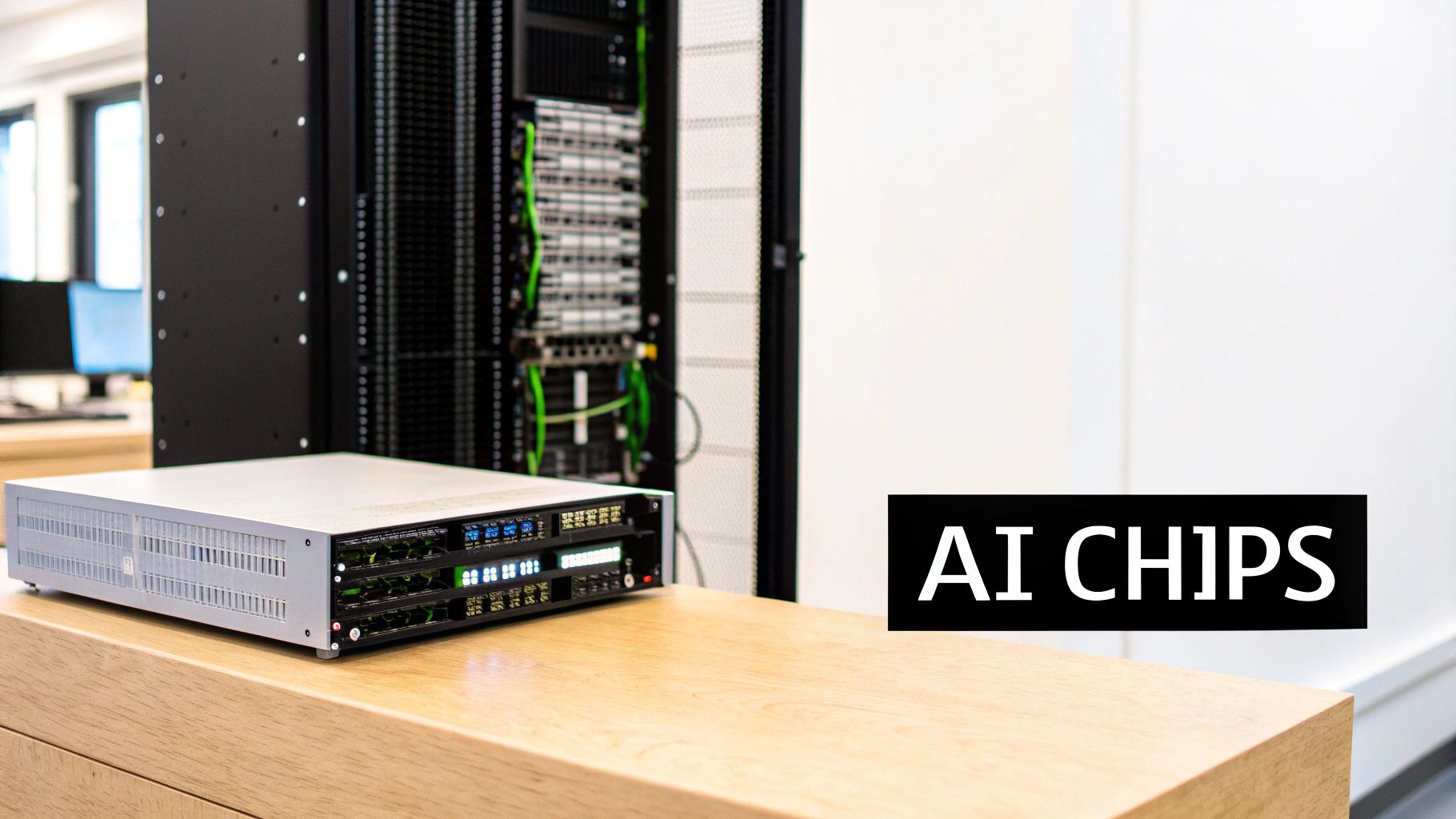
Here’s a good way to think about it. A standard computer chip is like a versatile multi-tool; it can handle a wide variety of tasks reasonably well. An AI chip, however, is a specialized instrument, like a surgeon's scalpel, engineered for one specific job: performing complex mathematical calculations at mind-boggling speeds.
These chips are the bedrock of modern AI. Without them, the AI boom we're witnessing would simply not be possible. They’re doing the heavy lifting behind the scenes for everything from training the next generation of large language models to powering the facial recognition on your smartphone.
The Mind-Boggling Growth in AI Hardware
The surge in demand for this specialized hardware has ignited an economic firestorm. Keeping an eye on the AI chip market is one of the most important trends in the latest artificial intelligence news because it tells us exactly where the investment and innovation are concentrated. After all, more powerful hardware translates directly into more capable AI.
The numbers are staggering. The market for AI chips has already quadrupled since 2021, soaring from roughly USD 10.8 billion to a projected USD 44.3 billion by 2025. And it's not slowing down. Forecasts suggest the market could reach nearly USD 127.8 billion by 2028—that’s a nearly 12-fold explosion in just seven years. You can dig into the data yourself to see the full scope of this booming AI hardware market.
As one hardware engineer from a major tech firm noted, "Software gets all the headlines, but the hardware is where the physical constraints of AI are being broken. Every leap in chip performance unlocks a new frontier of what AI can achieve."
This isn't just about big numbers on a chart. It’s a clear signal that the fundamental infrastructure for an AI-driven future is being built right now, and at a pace we've never seen before.
Why This Matters for Everyday AI
So, what does this hardware arms race mean for you and me? Simply put, a fiercely competitive chip market leads to better, faster, and more accessible AI tools for everyone.
Here’s how that plays out in the real world:
- Smarter Assistants: More efficient chips are why the voice assistant on your phone can understand complex questions and respond almost instantly, without a long awkward pause.
- Creative Tools: The hardware jump is the reason AI image generators can conjure up breathtaking artwork in seconds, not minutes or hours. For example, a new, powerful chip can reduce the time it takes to create a detailed image in Midjourney from a minute to just ten seconds.
- Future Innovations: This constant push for better silicon is what fuels the development of the latest artificial intelligence technology, making once-impossible ideas a reality.
At the end of a day, the battle for chip supremacy is fantastic news for all of us. It means the AI features that seem like magic today will quickly become the standard, reliable tools of tomorrow.
Inside the Generative AI Investment Boom

If you feel like you're seeing generative AI everywhere, you're not wrong. It's the technology that lets us create brand-new content out of thin air—whether that’s drafting an email, composing a song, or generating a photorealistic image from a few words. It's not just a cool party trick; it's a field attracting an absolutely staggering amount of investment.
For years, AI was mostly about analyzing data that already existed. Generative AI flips that on its head by creating things. That fundamental shift is exactly why investors, from venture capital firms to the biggest names in tech, are pouring billions into startups and research. Everyone is betting that this technology will redefine how we work, create, and interact with computers.
This firehose of cash is the reason we're seeing such rapid improvements in the AI tools available to everyone. More money means faster development, which leads to more powerful and accessible products hitting the market.
The Global Race for AI Supremacy
This isn't just a Silicon Valley phenomenon; it's a global sprint. The headlines are full of stories about this investment race, with countries and companies all vying to build the next great AI model. For us as users, this fierce competition is fantastic news—it’s what’s pushing innovation forward at a breakneck speed.
The numbers really put the scale of this into perspective. Generative AI has become a capital magnet, pulling in USD 33.9 billion in global private investment recently, an 18.7% jump from the previous year. While the U.S. remains a dominant force, debuting 40 major AI models in 2024 alone, other countries are closing the gap faster than ever. You can dig into more of this data by checking out the global state of AI.
"The current investment in generative AI isn't just about funding the next cool app," says a partner at a leading venture capital firm. "It's about building the foundational platforms that will support the next decade of digital innovation. It's an infrastructure play, and the stakes couldn't be higher."
What This Investment Means for You
So, what do all these billions of dollars mean for the average person? It’s simple: this money directly fuels the tools you use today and the even more amazing ones coming tomorrow. Every major funding announcement is another signal that more brainpower and resources are going into making AI genuinely useful.
Here's how this investment boom affects you directly:
- Better Free Tools: The intense competition pushes companies to offer incredibly capable free versions of their AI tools to win you over. Think about how powerful the free version of ChatGPT has become in such a short time.
- AI in Your Favorite Apps: The software you already rely on is getting smarter. Companies are either buying or building AI features to integrate directly into their existing products, like Adobe adding generative AI to Photoshop.
- New Creative Outlets: All this funding makes it possible to build entirely new kinds of tools that can help you do everything from brainstorming business ideas to creating stunning art.
Ultimately, this tidal wave of investment is what keeps the AI space so dynamic. It’s a guarantee that the tools at our fingertips will only get more powerful, more intuitive, and more integrated into our daily lives.
How AI Is Already Changing Your Daily Life

With all the headlines about massive investments and mind-bending new models, it's easy to think of AI as something far off in the future. But the truth is, it’s already here, quietly running in the background of your daily life. Most of the time, you probably don't even notice it.
Think about the last movie you watched on a streaming service. That "Recommended for You" list on Netflix wasn't just a lucky guess. An AI algorithm analyzed everything you've watched, compared your tastes to millions of other viewers, and made an educated prediction about what you’d want to see next.
This kind of silent integration is happening all over the place. It's the spam filter in your inbox, the portrait mode on your phone’s camera, and the smart assistant that understands your voice. AI is the invisible engine making your tech more helpful.
From Your Commute to Your Couch
It’s easy to overlook AI's presence because when it works best, it's completely seamless. Your devices just seem to get smarter and more intuitive on their own.
Here are a few places you probably run into AI every single day:
- Navigation Apps: When you pull up Waze or Google Maps to find the quickest way home, AI is crunching real-time traffic data, accident reports, and even construction schedules to steer you around a jam before you ever see it.
- Smart Assistants: Asking Siri or Alexa to play a specific song or answer a trivia question feels simple, but it relies on incredibly complex natural language processing—a cornerstone of modern AI that helps computers understand human speech.
- Customer Support Chatbots: More and more websites use AI-powered chatbots to answer your questions instantly, letting human agents focus on the really tricky problems.
The sheer reach of AI across different industries is staggering. It’s no longer confined to research labs; its applications are everywhere.
The Real-World Impact
These subtle helpers are the real story behind all the latest artificial intelligence news. The massive research budgets and breakthrough discoveries are what power these seemingly simple features that we quickly start to take for granted.
"For the everyday person, the best AI is the AI you don't realize you're using," comments a user experience designer at a major tech company. "It's not about complicated prompts or technical knowledge; it's about technology just working better, feeling more personal, and saving you a bit of time."
This is the tangible result of the current AI boom. It’s why a small business can now offer 24/7 customer support or why your phone can automatically organize your photo library by recognizing faces and places. The headlines might be about billion-dollar deals, but the true impact is measured in these small, daily improvements that are reshaping our relationship with technology.
What to Expect Next in the World of AI
Now that you’re caught up, let's look at what’s just over the horizon. The AI space moves at a breakneck pace, but a few key trends are already starting to define the next chapter, giving us a pretty clear picture of where this is all going.
One of the biggest shifts you’ll see is the move toward multimodal AI. Right now, most AI models are specialists—they’re great with text or images or sound. Multimodal AI brings all of that together, giving a model the ability to understand the world in a much more human-like way.
Think of an AI that can watch a video, understand the dialogue, pick up on the emotional cues in the music, and then write a detailed summary. That’s where we’re headed. This opens up some incredible possibilities, like asking an AI to edit a video clip just by describing the changes out loud or having it "watch" a live football game with you and pull up relevant stats in real-time.
Smarter, More Personal Assistants
Another huge area of focus is turning our current AI assistants into true, proactive agents. Today, they're mostly reactive; they sit and wait for a command. The next generation is being built to learn your patterns, anticipate what you need, and act on your behalf without you having to spell everything out.
Imagine an assistant that sees you have an early flight, checks the traffic, and then suggests a new wake-up time. It's a fundamental shift from a tool you command to a partner that helps you manage your day.
"The ultimate goal is to move from instruction-based AI to intention-based AI," says a lead researcher in the field. "You shouldn't have to tell it every single step; it should understand your ultimate goal and figure out the best way to get there on its own."
Staying Informed on Your AI Journey
Finally, you can expect the conversations around AI ethics and safety to get much louder and more sophisticated. As these systems become more powerful and integrated into our lives, making sure they’re fair, transparent, and secure isn't just a technical challenge—it's a societal one.
Keeping up with the latest artificial intelligence news doesn’t have to feel like a full-time job. A few simple habits can keep you in the loop:
- Follow Key Company Blogs: The teams at OpenAI, Google, and other major labs often post their biggest breakthroughs directly on their official blogs.
- Find a Good Newsletter: Plenty of great newsletters from tech journalists and AI experts break down the week’s news into plain English. They do the heavy lifting for you.
- Stay Curious: The best way to learn is by doing. Play with the new tools as they come out, ask questions, and see what they can do. Engaging with the present is the best way to prepare for the future.
Your AI News Questions, Answered
It feels like there's a new AI breakthrough every single day, and keeping up can feel like a full-time job. Let's tackle some of the most common questions people have about what’s happening in the world of artificial intelligence.
What's the Single Biggest Thing Happening in AI Right Now?
If you only pay attention to one thing, make it generative AI. This is the technology powering the tools you've seen everywhere, from ChatGPT spitting out essays to Midjourney creating stunning, photorealistic images from a simple text prompt.
The big push right now is to make these models multimodal. Think of it like teaching a person who only understands text how to also see images and hear sounds. A great practical example is Google's latest AI updates, where you can point your phone's camera at a broken bike and ask the AI how to fix it—it sees the problem and talks you through the solution. This is where all the major players are placing their bets.
How Do I Follow AI News Without Feeling Completely Lost?
The trick isn't to drink from the firehose—it's to find a good filter. Drowning in headlines is easy, so the key is to be selective.
Here's a simple strategy:
- Find a great newsletter: Many fantastic tech journalists and analysts do the hard work for you, breaking down complex topics into clear, digestible summaries.
- Follow a few key voices: Identify a handful of respected experts or commentators on platforms like X or LinkedIn. They often cut straight to what's important.
- Always ask "why it matters": Instead of getting bogged down in the technical jargon, focus on the impact. How will this change a product? What does this mean for a particular industry?
This way, you get the signal without all the noise.
Is AI a Job-Killer or a Job-Creator?
This is the billion-dollar question, and honestly, the answer is "both." It's complicated. AI is definitely automating certain repetitive tasks that were once done by people, and we can't ignore that.
But it's also creating entirely new career paths that didn't exist just a few years ago—think of roles like prompt engineering or AI ethics specialist.
"Most experts don't see this as a simple story of humans vs. machines," observes economist Dr. Lena Petrov. "Instead, AI is a powerful tool that will fundamentally change how we work, much like the spreadsheet or the internet did."
The real takeaway is that skills like critical thinking, creative problem-solving, and emotional intelligence are becoming more valuable than ever. The future belongs to those who can blend their uniquely human talents with the power of these new tools. AI literacy isn't just a buzzword anymore; it’s becoming a fundamental skill for almost everyone.
At YourAI2Day, our mission is to cut through the clutter and deliver clear, practical insights into the world of AI. Visit us to stay ahead of the curve. https://www.yourai2day.com