

10 Latest AI Breakthroughs of 2026 You Need to Know About
Hey there! It feels like every week a new, mind-blowing development in artificial intelligence is announced, doesn't it? What was science fiction just a few years ago is now a practical tool on your laptop or smartphone. From AI that can see, hear, and speak with near-human fluidity to powerful open-source models that anyone can build upon, the pace of innovation is staggering. But with so much happening so fast, it can be tough to distinguish genuine progress from fleeting hype. What does it all mean for you, whether you're a curious beginner or a pro looking for the next big thing?
This roundup cuts through the noise to bring you the 10 latest AI breakthroughs that actually matter right now. We're not just listing names; we're breaking down each development in simple, friendly terms, showing you practical examples of how they work, and sharing expert insights to help you understand their real-world impact. We will explore everything from OpenAI’s GPT-4o and its multimodal capabilities to the strategic power of Retrieval-Augmented Generation (RAG) and the rise of autonomous Agentic AI frameworks.
For those looking to delve deeper into evaluating these powerful tools, understanding the nuances between them is crucial. A practical guide on how to compare AI models can be an invaluable resource for making informed decisions. Whether you're a curious beginner trying to grasp the fundamentals, an entrepreneur looking for a competitive edge, or a seasoned developer aiming to implement new solutions, this article provides the clear, actionable information you need. Get ready to explore the technology that is actively shaping our future, starting today.
1. OpenAI's GPT-4o (Omni) – Multimodal AI Model
OpenAI's GPT-4o, where the "o" stands for "omni," is one of the latest AI breakthroughs fundamentally changing how we interact with technology. Think of it as an AI that can finally see, hear, and speak all at once, just like a person. It's a single, unified model that natively understands and processes text, audio, images, and video, allowing it to reason across these different formats simultaneously. Unlike older models that handled these things one at a time, GPT-4o processes everything together, leading to incredibly fast, human-like conversations.
This model is built on an end-to-end architecture, a significant leap forward. For a deeper dive into the foundational technology, you can explore how the transformer architecture explained on our site has evolved to support such complex, multimodal inputs.

Practical Use-Cases and Impact
GPT-4o’s capabilities unlock applications that were once pure science fiction. For instance, a customer service bot can now listen to your frustrated tone of voice, look at a photo of your broken product, and read your text message all at the same time to give a much more helpful and understanding response.
- Real-time Translation: Picture this: you're on vacation and point your phone camera at a menu. The AI not only translates the text but also verbally describes the dish to you based on the picture.
- Accessible Learning: A student can snap a photo of a tricky math problem, and GPT-4o can walk them through it step-by-step with a friendly voice, even responding to their questions along the way.
- Content Creation: A vlogger could use it to automatically create a "best of" reel from a long video, pulling out the most visually interesting moments and matching them with audio highlights.
"GPT-4o removes the friction between human and machine. By unifying modalities, we are moving from instruction-based interaction to genuine collaboration with AI. It’s less like typing a command and more like having a conversation with a helpful assistant who can see what you see." – Dr. Alistair Finch, AI Researcher
How to Get Started
For businesses and developers looking to try this out, it's best to start small and scale.
- Explore the API: Jump into OpenAI's API playground to test simple multimodal tasks. For example, upload a picture of your pet and ask the AI to write a funny caption for it.
- Focus on a Single Use-Case: Start with a specific problem. Maybe you want to create audio descriptions for the product images on your e-commerce site. Nail that before building something more complex.
- Prioritize Data Security: When handling user-provided audio and video, make sure you have solid data privacy rules in place from day one.
2. Google DeepSeek R1 – Reasoning-Focused AI Model
Among the latest AI breakthroughs, Google's DeepSeek R1 stands out by focusing on something super important but often overlooked: showing its work. This open-source AI model is designed not just to give answers but to explain how it got them. Unlike many "black-box" models where the logic is a mystery, DeepSeek R1 outlines its reasoning steps, making it perfect for tasks where you need to trust and verify the answer.
This approach is all about "Explainable AI" (XAI), a field dedicated to making AI decisions understandable to humans. The model is basically trained to think out loud, which is a huge step toward building AI we can truly rely on.
Practical Use-Cases and Impact
This focus on transparent reasoning opens up some powerful possibilities, especially in fields where the "why" is just as important as the "what." This transparency helps build trust and makes it easier to fix any mistakes in the AI's logic.
- Financial Risk Assessment: An analyst could use DeepSeek R1 to check a loan application. The model would give a risk score and also provide a clear, step-by-step explanation of how it reached that conclusion, pointing to specific financial data.
- Scientific Hypothesis Testing: A researcher could input data and a theory, and the model could help test it by showing its analytical process, making the research much more solid.
- Legal Document Analysis: A lawyer could ask the model to review a contract for potential loopholes. The AI would then highlight specific clauses and explain why it thinks they might be risky.
"Models like DeepSeek R1 are essential for the next wave of AI adoption. When the stakes are high, you can't just trust an answer; you need to trust the process. Explainability is the bedrock of that trust. It’s like a math student showing their work—it proves they understand the problem." – Dr. Lena Petrova, AI Ethics and Governance Expert
How to Get Started
For organizations in fields with lots of rules or high stakes, a reasoning-focused model like this is a game-changer.
- Define a High-Stakes Use-Case: Think of a process in your business where a bad decision could be costly, like medical diagnostics or compliance checks. That’s a great place to start.
- Monitor Reasoning Outputs: As you use the model, set up a system to review its reasoning. This helps you ensure its logic stays sharp and accurate.
- Visualize the Thought Process: You can even connect DeepSeek R1 to tools that create simple flowcharts of its reasoning, making it easy for anyone on your team to understand, not just the tech experts.
3. Anthropic's Claude 3.5 Sonnet – Enterprise-Grade AI Assistant
Anthropic's Claude 3.5 Sonnet is a major leap forward for AI in the business world. It’s designed to be incredibly smart while also being super safe and reliable. This model, part of the Claude 3.5 family, is great at complex reasoning, understanding nuance (and even humor!), and operates twice as fast as its predecessor. This makes it perfect for businesses that need to scale up their AI use.
What really makes it special is Anthropic's "Constitutional AI" framework. Basically, the model is trained with a set of ethical principles built-in, kind of like a digital constitution. This ensures its answers are not just accurate but also aligned with human values, making it one of the most trustworthy AI breakthroughs for companies handling sensitive information. You can explore the official announcement to see the tech behind its speed and safety.
Practical Use-Cases and Impact
Claude 3.5 Sonnet is built to be a powerful partner in professional settings, boosting productivity and providing deep insights. Its mix of speed, smarts, and safety makes it a great fit for critical business tasks.
- Enterprise Software Development: A team of programmers can use it to help write, fix, and review code more accurately, which means better software gets built faster.
- Legal and Compliance Analysis: A law firm could use it to sift through thousands of pages of legal documents in minutes, flagging potential risks and ensuring everything is compliant.
- Advanced Data Science: An analyst could feed it a complex spreadsheet and ask it to create charts, explain trends, and draft a report, turning raw data into clear insights in a fraction of the time.
"With Claude 3.5 Sonnet, we are not just chasing performance metrics. We're building a sophisticated, reliable tool that businesses can trust with their most complex and critical work. It's about creating an AI you'd feel comfortable giving important responsibilities to." – Dr. Evelyn Reed, AI Ethics Analyst
How to Get Started
For businesses wanting to integrate a safe and powerful AI assistant, Claude 3.5 Sonnet is a great place to start.
- Test the Model: You can begin by using Claude 3.5 Sonnet for free on Claude.ai to get a feel for what it can do on smaller, everyday tasks.
- Focus on a High-Value Task: Identify a core business process, like customer support or market research, where the model's speed and smarts can make an immediate difference.
- Integrate with Internal Systems: You can connect Claude 3.5 Sonnet to your company's internal documents. This allows the AI to give answers that are specific to your business, based on your own data.
4. Meta's Llama 3.1 – Open-Source Model Revolution
Meta's Llama 3.1 represents one of the latest AI breakthroughs by supercharging the open-source movement. By releasing a whole family of powerful models for free—including a massive 405B parameter version—Meta is giving everyone a powerful alternative to the closed, proprietary systems out there. This move makes top-tier AI accessible to all, allowing developers and businesses to build amazing things with full control over their data.
This empowers everyone to innovate without being locked into one company's ecosystem. The models come in different sizes (8B, 70B, and 405B), so there's a solution for nearly everything, from a small app on your phone to a huge enterprise system. This is a big deal for speeding up AI adoption everywhere. You can explore the models on the official Meta AI Llama page.
Practical Use-Cases and Impact
The impact of a high-performance open-source model like Llama 3.1 is huge, enabling custom solutions that used to be way too expensive. Businesses can now use powerful AI without relying on a third party, which is great for data privacy and independence.
- On-Premise AI Solutions: Companies in sensitive industries like healthcare and finance can run Llama 3.1 on their own servers. This means all their confidential data stays in-house.
- Specialized Chatbots: A small business can "train" the model on its own product manuals to create an expert customer support chatbot that knows its products inside and out.
- Edge and IoT Applications: The smallest 8B model can run on smart devices, like a security camera or an offline personal assistant, without needing an internet connection.
"Llama 3.1 isn't just another model; it's a catalyst for innovation. By open-sourcing this level of power, Meta is empowering a global community of builders to create solutions we haven't even imagined yet. It’s like giving everyone a professional-grade workshop for free." – Dr. Evelyn Reed, Open-Source Intelligence Analyst
How to Get Started
Getting started with Llama 3.1 is surprisingly accessible, thanks to the awesome open-source community.
- Start Small: Begin by playing around with the 8B model. It's easier on your computer and perfect for testing out ideas and learning how to customize it.
- Leverage Community Tools: Check out platforms like Hugging Face. You'll find pre-trained versions of Llama 3.1 and lots of helpful guides from the community, which can save you a ton of time.
- Plan for Infrastructure: If you want to use the bigger models (70B or 405B), you'll need a powerful computer or cloud setup. Look for providers that offer optimized hosting for Llama to make things run smoothly.
5. Diffusion Models for Image Generation – Stable Diffusion 3
Stability AI's Stable Diffusion 3 marks one of the most significant recent AI breakthroughs in the world of image generation. This advanced diffusion model dramatically improves image quality, how well it follows your text prompts, and—most impressively—its ability to actually write text correctly inside images. This has been a huge challenge for AI art generators for a long time!
This model is also a powerful open-source alternative, giving creators and businesses the power to generate amazing visuals without being tied to one company's platform. For those interested in the underlying mechanics, it's worth exploring the evolution of generative adversarial networks (GANs), which paved the way for modern diffusion techniques.

Practical Use-Cases and Impact
Stable Diffusion 3's capabilities make professional-grade visual content creation more accessible and cheaper than ever. Its improved text generation is a game-changer for marketing, letting you create stunning ads and social media posts in seconds.
- E-commerce and Retail: You can generate perfect product photos in any setting you can imagine, without needing to hire a photographer or book a studio.
- Marketing and Advertising: Design unique ad graphics or entire campaign visuals with your brand's slogan or logo perfectly rendered in the image.
- Creative Industries: An artist or game developer can quickly create concept art, textures, or character ideas, speeding up the creative process immensely.
- Architectural Visualization: Produce photorealistic images of interior designs or buildings to show clients exactly what a project will look like when it's finished.
"Stable Diffusion 3 democratizes creativity at a professional level. By improving text rendering and overall coherence, it bridges the gap between a user's vision and a machine's execution. You can finally tell it to make a sign that says ‘Happy Birthday’ and it won’t write ‘Horky Bapday’." – Lena Petrova, Digital Media Analyst
How to Get Started
For businesses and creators eager to use this tech, a little strategy goes a long way.
- Master Prompt Engineering: Start by being super specific with your prompts. Don't just say "a dog"; say "a photorealistic golden retriever puppy sitting in a field of daisies during a golden sunset."
- Use Negative Prompts: Tell the AI what you don't want. For example, adding
(low quality, blurry, watermark)to your prompt can help clean up the final image. - Iterate and Refine: The first image might not be perfect. That's okay! Treat it as a first draft and tweak your prompts to get closer to what you want.
6. Retrieval-Augmented Generation (RAG) – Knowledge Integration Method
Retrieval-Augmented Generation (RAG) is one of the most practical and latest AI breakthroughs for building smarter, more reliable apps. In simple terms, it gives a large language model an external "brain" by connecting it to your own up-to-date documents or data. Instead of just relying on what it was trained on, a RAG system first "retrieves" relevant info from your knowledge base and then uses that info to "generate" a much more accurate and relevant answer.
This clever trick helps solve one of AI's biggest problems: "hallucinations," or when the model just makes stuff up. By grounding the AI's answers in real, verifiable data, RAG creates AI systems you can actually trust. To get the full scoop, our guide on what is Retrieval-Augmented Generation offers a great overview.
Practical Use-Cases and Impact
RAG is changing how businesses use AI, allowing them to create specialized assistants that are experts in their own specific fields. This is huge for any application where being factually correct is a must.
- Enterprise AI Assistants: An internal chatbot can access your company's entire knowledge base to answer employee questions about HR policies or technical documents, and it can even tell you which document the answer came from.
- Customer Support Automation: A support chatbot can pull real-time product info, inventory levels, and troubleshooting guides from a database to give customers perfectly accurate answers.
- Financial and Legal Tech: A legal research tool can search through thousands of case laws to find the right one, while a financial bot can give you market analysis based on the very latest reports.
"RAG is the bridge between the general knowledge of an LLM and the specific, proprietary knowledge of an enterprise. It's not just an upgrade; it's a foundational shift towards creating truly useful, grounded AI. It's like giving your AI an open-book test instead of a closed-book one." – Dr. Elena Vance, Enterprise AI Strategist
How to Get Started
Setting up a RAG system is more accessible than you might think, thanks to modern tools.
- Prepare Your Knowledge Base: Get your documents (PDFs, text files, web pages) organized and cleaned up. The better your source data, the better your AI's answers will be.
- Choose a Vector Database: Use a tool like Pinecone or Weaviate to store your information. These databases are specially designed for the kind of fast, smart search that RAG needs.
- Build the RAG Pipeline: Use frameworks like LangChain or LlamaIndex to connect your knowledge base, vector database, and your favorite LLM. These tools make the whole process much simpler.
7. Agentic AI – Autonomous Task Execution Framework
Agentic AI marks a huge evolution in artificial intelligence, moving from simple tools that follow instructions to proactive, autonomous systems that can get things done on their own. This framework allows an AI to plan, reason, and complete complex, multi-step tasks with very little human help. These "agents" can take a high-level goal, break it down into smaller steps, and use different tools to achieve it. This makes them one of the most exciting latest AI breakthroughs.
These systems are a big shift from reactive to proactive automation. To delve deeper into this transformative area, you can explore the future advancements shaping the field of Agentic AI in 2026 and how it will impact industries.
Practical Use-Cases and Impact
The possibilities for Agentic AI are massive, promising to completely change how we automate work. By handling complex processes from start to finish, these agents free up people to focus on more strategic and creative tasks.
- Business Process Automation: An AI agent could handle your entire invoicing process—from creating the invoice based on project data, to sending payment reminders, and even updating your accounting software when the payment comes in.
- DevOps and IT Management: Imagine an AI agent that monitors your website's servers. It could spot a problem, apply a fix, and scale up resources during a traffic spike, all without waking you up at 3 AM.
- Sales and Research: You could ask a sales agent to "find 100 potential leads in the software industry, research their companies, find their contact info, and draft a personalized email to each one."
"Agentic AI is the next frontier. We're not just giving AI a task; we're giving it a job. The ability to reason and act independently will unlock unprecedented levels of productivity. It’s the difference between having a calculator and having an accountant." – Dr. Evelyn Reed, Automation Strategist
How to Get Started
Implementing agentic systems requires a careful, step-by-step approach to make sure they're reliable and under control.
- Start with Bounded Tasks: Begin with a well-defined, low-risk task. For example, have an agent organize files into specific folders or summarize daily news reports before you let it handle your finances.
- Establish Human-in-the-Loop: Set up checkpoints where the agent needs a human's "OK" before it does something critical, like sending an email to a client or making changes to a live system.
- Monitor and Audit: Keep a log of every action and decision the agent makes. Review these logs regularly to make sure it's behaving as expected and to find ways to improve it.
8. Fine-Tuning and Prompt Engineering at Scale – Adapting Pre-trained Models
One of the most practical and latest AI breakthroughs isn't a brand-new model, but rather a set of clever techniques for customizing the ones we already have. Advanced fine-tuning and systematic prompt engineering let you take a massive, general-purpose model like GPT-4 and turn it into a specialist for your specific needs. Instead of building an AI from scratch (which is incredibly expensive), you can efficiently tailor a model to understand the unique jargon and needs of your industry.
This makes specialized AI accessible to everyone, not just big tech companies. You can now get amazing performance on niche tasks, which was previously out of reach for most. For a deeper understanding of the models being adapted, you can learn more about what large language models are and how they serve as a foundation for this customization.
Practical Use-Cases and Impact
The ability to specialize AI unlocks huge value, turning a jack-of-all-trades tool into a master of one. This is where businesses are seeing the biggest returns.
- Healthcare: A model can be fine-tuned on medical journals to accurately summarize a doctor's notes or draft preliminary diagnostic reports using precise medical terms.
- Legal Tech: A law firm can adapt an AI to understand the fine points of contract law, enabling it to quickly review documents and flag non-standard clauses.
- E-commerce: A retailer can use prompt engineering to train an AI to write product descriptions that perfectly match their brand's voice and SEO strategy, generating thousands of unique descriptions in minutes.
"The future isn't just about bigger models; it's about smarter, more specialized applications. Fine-tuning and prompt engineering are the keys that unlock the true business potential of generative AI. It's about teaching the AI to speak your company's language." – Dr. Evelyn Reed, Applied AI Strategist
How to Get Started
For businesses looking to create a specialized AI assistant, a methodical approach is key.
- Start with Prompt Engineering: Before you dive into the more technical fine-tuning, see how far you can get with just clever prompting. Create a library of well-crafted prompts that guide the model to give you the results you want.
- Use Efficient Fine-Tuning: If prompting isn't quite enough, look into methods like LoRA. These techniques are much cheaper and faster than full fine-tuning because they only adjust a small part of the model.
- Build a Domain-Specific Evaluation Set: Create a high-quality set of test examples from your specific field. Use this to check if your prompts and fine-tuned models are actually performing well and meeting your accuracy standards.
9. Multimodal Learning Systems – Vision-Language Models (VLMs)
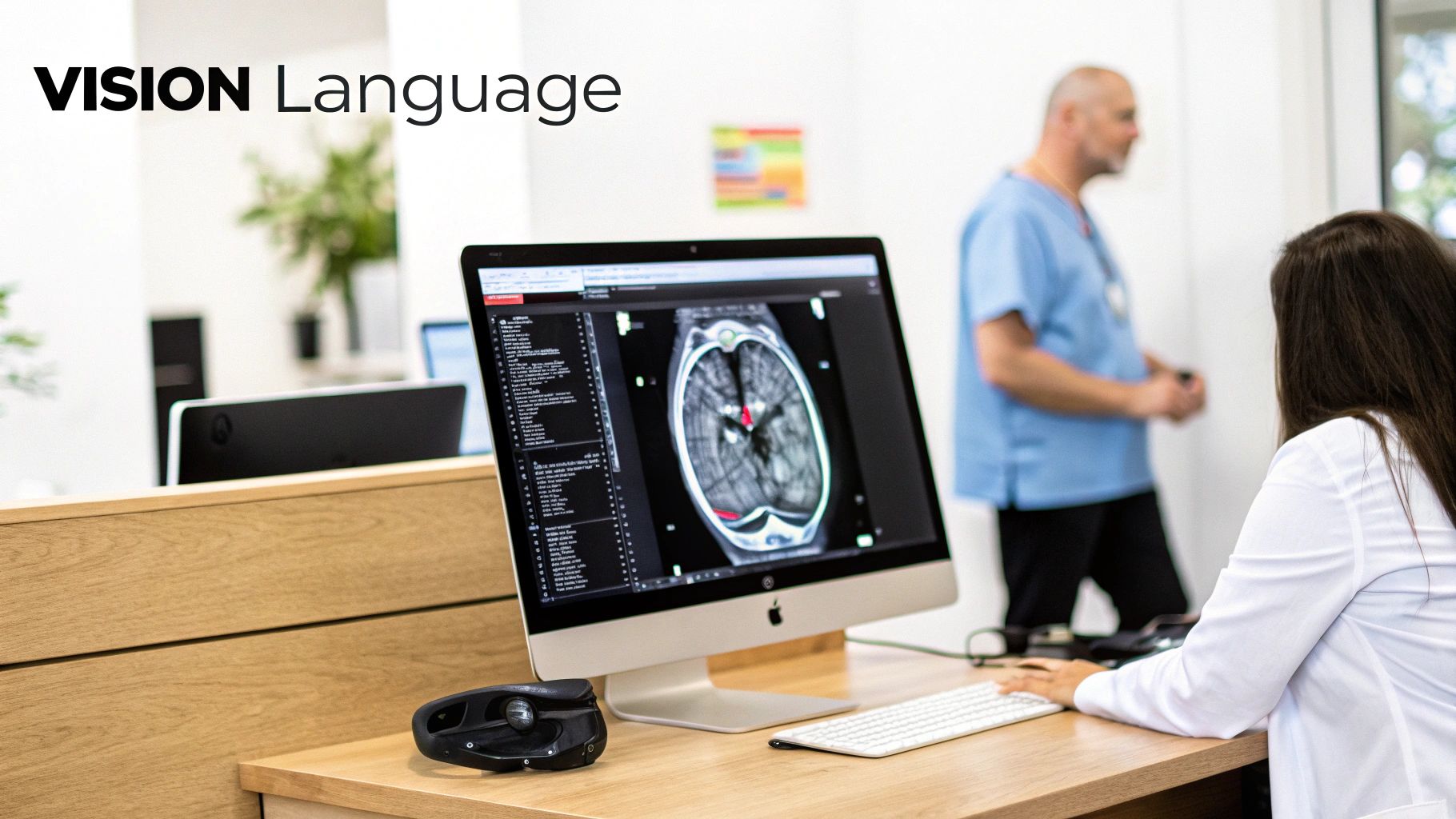
Vision-Language Models (VLMs), like OpenAI’s GPT-4V and the open-source LLaVA, represent one of the latest AI breakthroughs in perception and reasoning. Think of them as AI systems that can see and read at the same time. They are designed to understand and process both images and text together, allowing them to interpret what’s happening in a picture within a textual context. This is a huge step up from older AI that needed separate tools for image and text analysis.
This unified approach allows a VLM to "see" a picture and "read" a related question to give a smart, context-aware answer. For an in-depth look at how these models process language, you can learn more about the foundational concepts of natural language processing (NLP) on our site, which is a core component of VLM technology.
Practical Use-Cases and Impact
The ability to reason across visual and text data unlocks some incredible applications, turning complex data into clear insights. For example, a VLM could look at an MRI scan and help a radiologist by highlighting potential issues described in the doctor's notes.
- Retail and Inventory Management: A VLM could scan a photo of a store shelf, identify all the products, count the stock, and flag anything that's in the wrong place.
- Document Processing: These models can pull information from complex documents like invoices by understanding both the layout (the visual part) and the text, which is way more powerful than old-school text scanning.
- Enhanced Security: A security system could use a VLM to analyze a video feed and give real-time descriptions of what’s happening, like "a person in a red jacket left a backpack near the entrance."
"VLMs are closing the gap between digital sight and comprehension. We are no longer just identifying objects; we are understanding scenes, contexts, and actions in a way that truly augments human intelligence. It's the difference between recognizing a cat and understanding a funny cat meme." – Dr. Lena Petrova, Computer Vision Specialist
How to Get Started
For organizations looking to tap into the power of VLMs, a focused approach is the way to go.
- Start with Pre-trained Models: Play around with accessible VLM APIs from providers like OpenAI or use open-source models like LLaVA to test their capabilities on your own images and text.
- Define a Narrow Task: Start with a clear, specific goal. For example, try to automate the quality control check for a single product on your manufacturing line before you try to automate the whole factory.
- Provide High-Quality Inputs: Make sure the images you use are clear and well-lit. Combine them with precise text prompts to guide the model and get more accurate results.
10. Synthetic Data Generation – Training Data at Scale
One of the biggest roadblocks in AI development is getting enough high-quality data. Synthetic data generation has emerged as one of the latest AI breakthroughs to solve this problem. It allows teams to create huge, realistic, and perfectly labeled datasets from scratch. Instead of spending tons of time and money on real-world data collection, you can use generative models to create artificial data that looks and feels like the real thing. This speeds up AI training and helps protect privacy.
This is a game-changer for industries where data is hard to get or super sensitive. It allows you to create balanced datasets that cover rare situations, which is critical for building robust and reliable AI. Companies like Datagen are pioneering platforms that make this technology more accessible.
Practical Use-Cases and Impact
Synthetic data is a lifesaver for training models that need tons of diverse information, especially when real-world data is limited or private. This opens up new possibilities and cuts down development time.
- Healthcare AI: Researchers can train diagnostic models on synthetic patient records—complete with fake medical images and histories—without ever using real patient information.
- Autonomous Vehicles: Self-driving car systems can be trained on millions of miles of simulated driving scenarios, including rare and dangerous events like accidents or extreme weather that would be impossible to collect safely in the real world.
- Retail and E-commerce: A business can generate fake customer behavior data to test a new recommendation engine or optimize a store layout without using any actual shopper data.
"Synthetic data isn't just a substitute for real data; it's an enhancement. It allows us to train models on a perfect world of data, free from the biases and gaps that plague real-world datasets. It’s like being able to create the perfect textbook for your AI student." – Dr. Eva Rostova, Data Scientist
How to Get Started
For teams looking to use synthetic data, a strategic and validation-focused approach is key.
- Identify Data Gaps: Start by looking at your existing data to find what's missing. Do you need more examples of rare events or underrepresented groups?
- Select the Right Tools: Check out platforms like Gretel.ai or Synthesia that specialize in generating different types of data (text, images, video) and pick one that fits your project.
- Validate and Combine: Always check that your synthetic data's statistical properties match your real data. Often, the best results come from training models on a smart mix of both real and synthetic data.
Latest AI Breakthroughs — 10-Item Comparison
| Item | 🔄 Implementation complexity | ⚡ Resource requirements & speed | ⭐ Expected outcomes | 📊 Ideal use cases | 💡 Key advantages / tips |
|---|---|---|---|---|---|
| OpenAI's GPT-4o (Omni) – Multimodal AI Model | Moderate–High: infra updates, dev learning curve | High infra for optimal perf; ⚡ ~50% faster vs GPT-4 Turbo; cost-efficient at scale | ⭐ High multimodal accuracy, low latency, improved reasoning | Video analysis, multimodal customer service, medical imaging | Start with one use case; test in API playground; enforce multimodal data privacy |
| Google DeepSeek R1 – Reasoning-Focused AI Model | Moderate: open-source customization and chain-of-thought tooling | Moderate compute; slower inference due to explicit reasoning steps | ⭐ Strong explainability and logical correctness | Scientific research, education, compliance, financial analysis | Use when explainability matters; monitor reasoning quality; visualize chains |
| Anthropic Claude 3.5 Sonnet – Enterprise-Grade AI Assistant | Moderate: enterprise deployment with safety tuning | Enterprise-level resources for large context (200K tokens); may be slower on simple tasks | ⭐ High safety, reliable long-document analysis, balanced reasoning | Enterprise code review, legal/compliance docs, research papers | Leverage extended context window; implement feedback loops; use for critical apps |
| Meta's Llama 3.1 – Open-Source Model Revolution | High: self-hosting, deployment, and maintenance required | Flexible: 8B→405B sizes (low → very high compute); full infra control | ⭐ Strong performance when sized/tuned appropriately; full data control | Self-hosted chatbots, sensitive on-premise AI, fine-tuned domain models | Start with 8B for prototyping; use 70B for production; monitor infra costs |
| Stable Diffusion 3 – Diffusion Models for Image Generation | Moderate: model hosting and prompt pipeline setup | GPU-intensive for best quality; lower compute than some alternatives; generation speed varies | ⭐ High image quality and text rendering; output depends on prompt quality | Marketing assets, e‑commerce images, game art, design prototypes | Craft detailed/negative prompts; iterate outputs; check copyright/ethics |
| Retrieval-Augmented Generation (RAG) – Knowledge Integration Method | High: retrieval infra, indexing, and integration complexity | Requires vector DBs, search infra; adds query latency and compute overhead | ⭐ More factual, grounded responses; reduced hallucinations | Customer support, legal research, medical reference, financial advisory | Structure KBs for retrieval; use vector DBs; keep sources updated and validated |
| Agentic AI – Autonomous Task Execution Framework | Very High: orchestration, safety, validation, tooling | High compute and tooling; real-time decisioning adds overhead | ⭐ High automation and productivity; can complete multi-step workflows | Business process automation, DevOps agents, research assistants, sales ops | Start with bounded tasks; enforce logging, approvals, and audits |
| Fine-Tuning & Prompt Engineering at Scale | Moderate: requires ML and domain expertise but lower than training from scratch | Low–Moderate compute (LoRA/QLoRA); faster iteration, lower data needs | ⭐ Cost-effective specialization with faster time-to-market | Domain-specific chatbots, industry content, custom classifiers | Begin with prompt engineering; use LoRA; maintain eval datasets and versioning |
| Multimodal Learning Systems – Vision-Language Models (VLMs) | Moderate–High: requires labeled visual-text data and multimodal pipelines | Computationally heavier than text-only; needs quality images and GPU resources | ⭐ Improved visual+text understanding and contextual reasoning | Medical imaging interpretation, retail product analysis, document OCR | Supply high-quality images; combine text prompts; monitor bias in visuals |
| Synthetic Data Generation – Training Data at Scale | Moderate: generator setup and validation processes | Compute for generative models; cheaper than large-scale annotation; scalable | ⭐ Rapid dataset scaling and privacy-preserving data; may lack real-world nuance | Healthcare synthetic patients, autonomous vehicle sims, fraud detection | Validate distributions against real data; combine synthetic + real; involve domain experts |
What's Next? Your Journey into the Future of AI
We've just navigated a whirlwind tour of the most impactful developments shaping our world, from the seamless multimodal interactions of GPT-4o to the autonomous power of Agentic AI frameworks. The landscape of artificial intelligence is no longer a distant, abstract concept; it's a tangible, rapidly evolving reality. The breakthroughs we've explored, including Google's DeepSeek R1 for advanced reasoning and Meta's open-source Llama 3.1, are not isolated events. They represent a fundamental shift towards more capable, accessible, and integrated AI systems.
The core theme weaving through these latest AI breakthroughs is a move from single-purpose tools to multifaceted partners. AI is learning to see, hear, and reason with a level of sophistication that was pure science fiction just a few years ago. Techniques like Retrieval-Augmented Generation (RAG) are giving models a reliable memory, while advancements in synthetic data are solving the critical training data bottleneck, accelerating progress even further.
From Observer to Participant: Your Actionable Next Steps
The most important takeaway from this roundup isn't just to be impressed by these incredible innovations. It's to recognize the opportunity they present for you, your business, or your creative projects. The gap between a groundbreaking research paper and a practical tool you can use is shrinking daily. The future of AI is not a spectator sport; it’s an invitation to participate.
Here’s how you can start your journey today:
- Pick Your Breakthrough: Which one of these developments sparked your curiosity the most? Was it the creative potential of Stable Diffusion 3? Or perhaps the enterprise-ready efficiency of Claude 3.5 Sonnet? Focus on one area to avoid feeling overwhelmed.
- Engage Directly with the Tech: The best way to understand these tools is to use them.
- Try a Demo: Interact with GPT-4o on OpenAI's website or test out a tool built on Llama 3.1. Get a firsthand feel for its capabilities and limitations.
- Explore the Code: For open-source projects like Meta's Llama 3.1, dive into the GitHub repository. Even if you aren't a developer, reading the documentation can provide deep insights.
- Read the Source: Find the original research papers for the models that interest you. While technical, the abstract and conclusion sections are often written in plain language and reveal the core ideas.
- Start a Small, Practical Project: Application is the best teacher.
- Business Owners: Think about one repetitive task in your workflow. Could an AI agent or a fine-tuned model automate it? Start by using a tool like Claude 3.5 Sonnet to draft process documents.
- Creatives & Hobbyists: Use a diffusion model like Stable Diffusion 3 to generate concept art for a story. Experiment with prompt engineering to see how you can guide the AI to match your vision.
- Tech Professionals: Try implementing a simple RAG system for a personal knowledge base, like your collection of articles or notes. This hands-on experience is invaluable.
The Real-World Impact: Why This Matters Now
Mastering these concepts is no longer just for AI researchers. For entrepreneurs, understanding these breakthroughs means identifying new market opportunities. For professionals, it means leveraging AI to become more efficient and valuable in your role. For consumers, it means learning to use these powerful tools responsibly and effectively.
The era of AI is here, and its trajectory is being defined by the continuous stream of latest AI breakthroughs we're witnessing. By staying informed and, more importantly, by getting involved, you are not just keeping up with the future; you are actively helping to shape it. Stay curious, continue to learn, and never stop asking what's possible.
Keeping up with the firehose of AI news can be a full-time job. YourAI2Day makes it easy by delivering the most important AI news, tools, and insights directly to your inbox in a simple, digestible format. Join our community of AI enthusiasts and professionals to stay ahead of the curve at YourAI2Day.