I Built a Canonical GPT Engine for YourAI2Day
How I Built a Canonical GPT Engine for YourAI2Day
Most “AI‑written” blog posts are fine until you actually need to trust them. They look polished in the editor, but the moment you try to cite them, update them, or plug them into a larger strategy, they collapse like cardboard in the rain. That gap between looking good and being genuinely reliable is exactly why a dedicated publishing engine—not just another prompt—now sits behind every long‑form article on YourAI2Day.webstacks+2
Today marks an inflection point for the site: the first full production version of a custom GPT that will power every long‑form AI article going forward. This is not just another “AI writer” but a publishing architect designed to produce reference‑grade, editorially sound content at scale.animalz+3
Why generic AI posts weren’t enough
Most generic AI blog workflows suffer from the same weaknesses:
- They don’t enforce sourcing or citation discipline.
- They optimize for surface‑level readability, not long‑term reusability.
- They treat each article as a one‑off instead of part of a larger content system.webstacks+1
The result is content that feels disposable. It might rank briefly or fill a content calendar, but it rarely becomes a durable asset you want to reuse in slide decks, email sequences, or product education.storychief+1
This project started as a reaction to that pattern. The goal was never “get more posts out.” The goal was to build a publishing architect—an AI system that thinks about search intent, structure, reader psychology, and business outcomes in a single continuous workflow.animalz+1
From loose prompts to an editorial engine
The earliest versions of this GPT looked like countless others: a well‑structured prompt that could outline and draft posts on demand. It was useful, but it was still fragile; small instruction changes created big differences in quality, and there was no guarantee that critical steps wouldn’t be skipped.webstacks
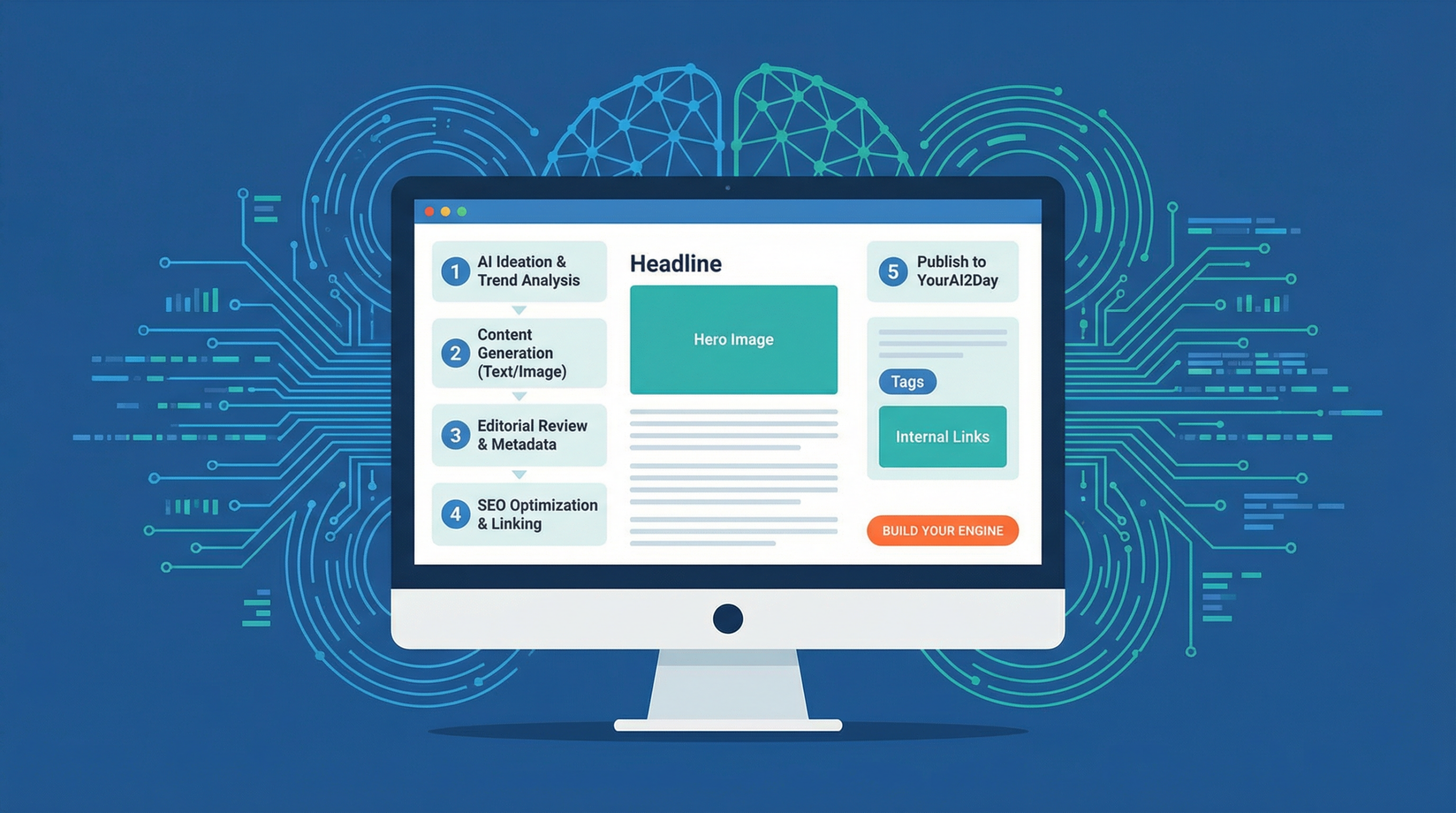
Over multiple iterations, that loose prompt evolved into a single enforceable system with clearly labeled, ordered steps. The key upgrades were:animalz+1
- One source of truth: All instructions live in one coherent block, eliminating duplicated or conflicting prompt fragments.
- Non‑skippable workflow: The GPT must move through each step—research, blueprint, drafting, post‑production—before the article is considered complete.
- Explicit roles: The system doesn’t see itself as a “writer” but as an editorial architect responsible for the entire lifecycle of the article.webstacks+1
At the core is a strong system identity: “YourAI2Day — Canonical AI Publishing Architect.” That label is more than branding; it anchors how the GPT evaluates its own work, keeping the focus on editorial quality, not just word count or keyword density.animalz+1
Upgrading the Max Organic Traffic DNA
Under the hood, the engine borrows heavily from an earlier Max Organic Traffic framework and several generations of custom GPT builds. The original logic around keyword discovery, search intent analysis, blueprinting, and article generation remains, but it has been refactored into a ten‑step editorial engine.hudareview
Those ten steps, at a high level, cover:
- Search intent and keyword alignment
- Structural blueprinting for both readers and search engines
- Drafting with psychological flow and on‑page optimization
- Post‑production layers: imagery, metadata, schema, internal links, HTML export, and social snippets.hudareview+1
Instead of thinking in terms of “prompt in, article out,” the system now behaves more like a full content operation in miniature. It designs the piece, builds it, dresses it for publishing, and prepares it to be reused across channels.webstacks+1
Learning from content that already works
Rather than inventing a voice from scratch, the GPT was tuned against content that was already performing in the wild. That meant looking closely at:
- Existing YourAI2Day articles, which lean friendly, practical, and beginner‑inclusive.
- A core Premiere‑BusinessPro article, which uses a very task‑driven, step‑by‑step style suited to implementers.yourai2day+1
YourAI2Day content offered the approachable tone that helps everyday readers get comfortable with AI concepts. The Premiere‑BusinessPro piece brought the operational rigor needed for people who don’t just want to understand ideas, but to ship projects based on them.yourai2day+1
The new GPT blends these two strengths. The goal is content that is:
- Friendly without being fluffy.
- Structured and step‑based without feeling like dry documentation.animalz+1
Hard‑wiring better behavior into the workflow
The most important changes were not cosmetic; they were behavioral. Instead of hoping the model “remembers” to be practical and action‑oriented, those traits were wired directly into the instructions and step map.
The GPT is now explicitly instructed to:
- Add action blocks after major sections, translating theory into immediate next steps.
- Use problem → outcome framing in introductions so each article opens with a real pain and a clear promise.
- Generate mini use cases that show how concepts play out in realistic scenarios.
- Tag key recommendations with time and difficulty, giving readers a sense of the effort required.webstacks+1
These patterns reshape how each article feels. Instead of being a wall of information, each piece reads more like a guided implementation plan that a solo founder, manager, or specialist can actually act on.webstacks
Making visuals and structure pull their weight
Another major upgrade is how the engine handles visuals. Rather than sprinkling in generic stock‑style prompts, the GPT now generates semantic visual prompts: diagrams, roadmaps, and process graphics that clarify specific decision chains or workflows.storychief+1
The rules guiding those visuals include:
- Every proposed diagram must map directly to a multi‑step process described in the text.
- Roadmaps should highlight progression over time or maturity, not just restate bullet points.
- Visuals are chosen to reduce cognitive load, not to decorate empty space.storychief+1
On top of visuals, the GPT also follows rules for:
- Expert‑insight hooks, where outside perspectives or advanced considerations get folded into the narrative.
- Citation‑ready definitions that can be reused across pages, glossaries, and educational materials without constant rewriting.
- Pathway navigation at the end of each article, routing different reader types—owners, managers, implementers—to the most relevant next resource.storychief+1
This turns each article from a dead‑end page into a node in a larger learning pathway.webstacks
How the ten‑step engine changes production
In practical terms, pushing every long‑form piece through this engine changes three things for YourAI2Day:
- Speed with standards: Production accelerates because the system handles structure, drafting, visuals, and metadata in one flow—without relaxing quality expectations.
- Consistency: Articles share a recognizable rhythm: clear intros, structured sections, embedded actions, smart visuals, and purposeful endings.
- Reusability: Because definitions, use cases, and action blocks are structured, it is easier to reuse pieces across emails, lead magnets, and training assets.animalz+1
For readers, the experience is simple: more articles that feel engineered, not improvised; more posts that respect their time and help them take concrete steps with AI.storychief+1
What this means for future content on YourAI2Day
If there is a single idea behind this new Canonical AI Publishing Architect, it is that automation should raise editorial standards, not quietly lower them. By forcing every long‑form piece on YourAI2Day through the same ten‑step workflow—intent, structure, drafting, visuals, metadata, and navigation—the system turns AI from a copy machine into a consistent partner in real publishing.yourai2day+1
Going forward, you will start seeing a note on major long‑form pieces indicating that they were created with the YourAI2Day Canonical AI Publishing Architect. That label is a promise: each article has passed through an editorial engine designed for search intent, reader value, and business impact, not just output volume. As you read those pieces, you can assume one thing—they were engineered, not just generated, to be useful, trustworthy, and ready to slot into the rest of your AI learning stack.yourai2day+1