How to Use AI in Business: A Beginner’s Guide
Ever feel like you're drowning in routine tasks? Using AI in business is all about giving you a life raft. It’s about applying smart software to handle repetitive work, make sense of data, and create more personal customer experiences. This saves you time and, let's be honest, a lot of headaches, helping your business grow. It's about bringing in tools for everything from marketing content creation to making daily operations smoother, putting powerful technology in everyone's hands, not just the tech giants.
Why Your Business Needs to Start Using AI

Let's be real, AI isn't some far-off concept from a sci-fi movie anymore. It’s a practical, everyday tool that businesses of all sizes are using right now to get an edge. The conversation has moved past "what if" and is now firmly on "how," because ignoring AI just isn't a sustainable option if you want to stay competitive.
The idea at its core is simple: AI helps you work smarter, not harder. It takes over the repetitive, time-sucking tasks that bog your team down, freeing them up to focus on the things that really matter—strategy, creativity, and building customer relationships. For a closer look at the basics, our guide on understanding AI technology is a fantastic starting point.
From Niche to Necessary
It wasn’t long ago that AI felt like it was only for massive corporations with bottomless budgets. Today, a flood of accessible, user-friendly tools has completely leveled the playing field. This shift is more than just a passing trend; it's a fundamental change in how business gets done.
The numbers really drive this point home. By 2025, an incredible 78% of companies are expected to be using AI in at least one business area, a huge leap from just 20% back in 2017. With the market projected to grow at a rate of 37.3% annually through 2030, it’s clear this is no flash in the pan.
This means your competitors are almost certainly already using it to:
- Automate Marketing: Churning out social media posts, email campaigns, and ad copy in a fraction of the time.
- Enhance Customer Support: Deploying chatbots to provide instant, 24/7 answers to common questions.
- Analyze Data: Finding hidden patterns in sales figures or customer feedback that a human might miss.
- Improve Operations: Making everything from employee scheduling to inventory management more efficient.
"The magic of AI for a business isn't about replacing people," says tech analyst Chloe Devereaux. "It's about giving your team superpowers—empowering them to make faster, more informed decisions and deliver a customer experience that truly stands out."
Unlocking Immediate Benefits
You don't need to completely rebuild your operations to start seeing the benefits of AI. The trick is to identify small, high-impact areas where it can make an immediate difference. Just think about getting back five or ten hours a week that used to be lost to manual admin work. What could you do with that time?
For instance, a local bakery could use an AI tool to look at sales data and predict which pastries will sell best on a rainy Saturday. This simple insight helps reduce waste and maximize profit. A freelance consultant could use it to transcribe client calls and generate instant summaries, making sure no crucial detail is ever forgotten.
These are tangible, real-world examples that directly boost your bottom line and set your business on a path toward sustainable growth.
Finding Your First AI Wins Without the Overwhelm
Jumping into artificial intelligence can feel like being asked to build a spaceship from scratch. The reality is much simpler. Forget about overhauling your entire business overnight. The real secret is to focus on finding small, high-impact wins—the low-hanging fruit.
Think of it as a treasure hunt for inefficiencies. Where are you and your team getting bogged down by repetitive, manual work? Those are your starting points. Those are your first easy wins.
Audit Your Daily Grind
Take a hard look at your typical workday. This isn't about some massive, formal audit. It's just a quick, honest check-in on where the time goes. The best way to start with AI is by solving a real, tangible problem you're facing right now.
Consider these common time-sucks that are perfect candidates for an AI assist:
- Content Creation: Ever get stuck trying to come up with fresh ideas for social media, blog posts, or email newsletters? AI can be an incredible brainstorming partner.
- Customer Inquiries: Do you find yourself answering the same five customer questions all day long? An AI chatbot can handle those instantly, freeing you up for the trickier stuff.
- Data Entry: Is your team burning hours manually punching in data from invoices or forms into a spreadsheet? AI tools can automate that with surprising accuracy.
Let's say a small marketing agency spends 10 hours a week just drafting initial social media captions for its clients. By bringing in a generative AI tool, they could slash that time to just two hours. That’s a full workday reclaimed every single week. If that sounds familiar, you can find a solid list of AI tools for content creation to get you started.
"Don't chase some futuristic AI strategy," advises business coach Mark Jennings. "Instead, target a real, present-day bottleneck. Solving a small, nagging problem builds momentum and proves the value of AI from day one."
Set Realistic, Bite-Sized Goals
Once you’ve pinpointed a pain point, set a simple, measurable goal. Big ambitions are great, but it’s the specific goals that actually get accomplished. Instead of a vague target like "improve marketing," get concrete.
Your first goal could be something like:
- "Save five hours per week on administrative tasks." This is all about efficiency, freeing up your time for more strategic work.
- "Increase our response time to customer emails by 50%." This directly targets customer satisfaction and makes a noticeable difference.
- "Generate 10 new blog post ideas in 30 minutes." This tackles a creative block with a clear, achievable outcome.
Starting small makes the whole process feel manageable and gives you clear metrics to track. As you start hitting these early targets, you'll build the confidence and hands-on experience needed to tackle bigger, more advanced AI integrations down the road.
Using AI in Your Marketing and Sales
If you're looking for the quickest win from an AI investment, marketing and sales is where you'll find it. These departments are absolutely ripe with opportunities for AI to make a real, measurable difference right away. We're not talking about needing a data scientist; we're talking about practical tools that help you find and connect with customers better.
For most small businesses, the content treadmill never stops. Tools like Jasper or Copy.ai can become your new best friend, helping you whip up engaging social media posts, brainstorm blog ideas, or draft persuasive email campaigns. Think of it as having a junior copywriter ready to go whenever you are, turning hours of work into minutes.
Supercharge Your Sales Funnel
When it comes to sales, the real magic of AI is in prioritization. Instead of your team chasing down every single lead with the same energy, AI-powered CRM systems can sift through customer data to flag who's actually ready to buy. This simple shift means your team can focus their valuable time on the hottest prospects, which has a massive impact on conversion rates.
Imagine your sales reps coming in each morning to a clean, prioritized list of people showing clear buying signals, not just a daunting alphabetized list. That’s what predictive analytics brings to the table. It stops being a guessing game and starts being a smart, data-informed strategy.
A marketing strategist I know uses generative AI to craft hyper-personalized outreach emails. By feeding the AI information from a lead's LinkedIn profile and company website, it generates an opening paragraph that resonates on a personal level, leading to a significant boost in reply rates.
The Rise of AI in Small Business Marketing
This isn't just a trend; the numbers back it up. AI adoption among small and medium-sized businesses is exploding, jumping 41% in just one year, from 39% in 2024 to 55% in 2025. Marketing is leading the charge, with a staggering 80% of SMBs claiming AI is now essential for reaching new customers. They’re using it to claw back time and keep up with what modern buyers expect: speed and personalization. You can dig deeper into the data on how small businesses are embracing AI on investor.thryv.com.
Beyond writing content and scoring leads, AI can also handle other crucial tasks:
- A/B Testing: Automatically trying out different headlines or ad images to find a clear winner.
- Customer Segmentation: Grouping your audience by their behavior to send them offers they’ll actually care about.
- Basic Graphic Design: Creating professional-looking social media graphics without needing to hire a designer.
The infographic here really drives home how cloud-based AI—which is what most of these marketing tools are—makes this technology accessible. It's faster to get started and much cheaper than trying to build something yourself.
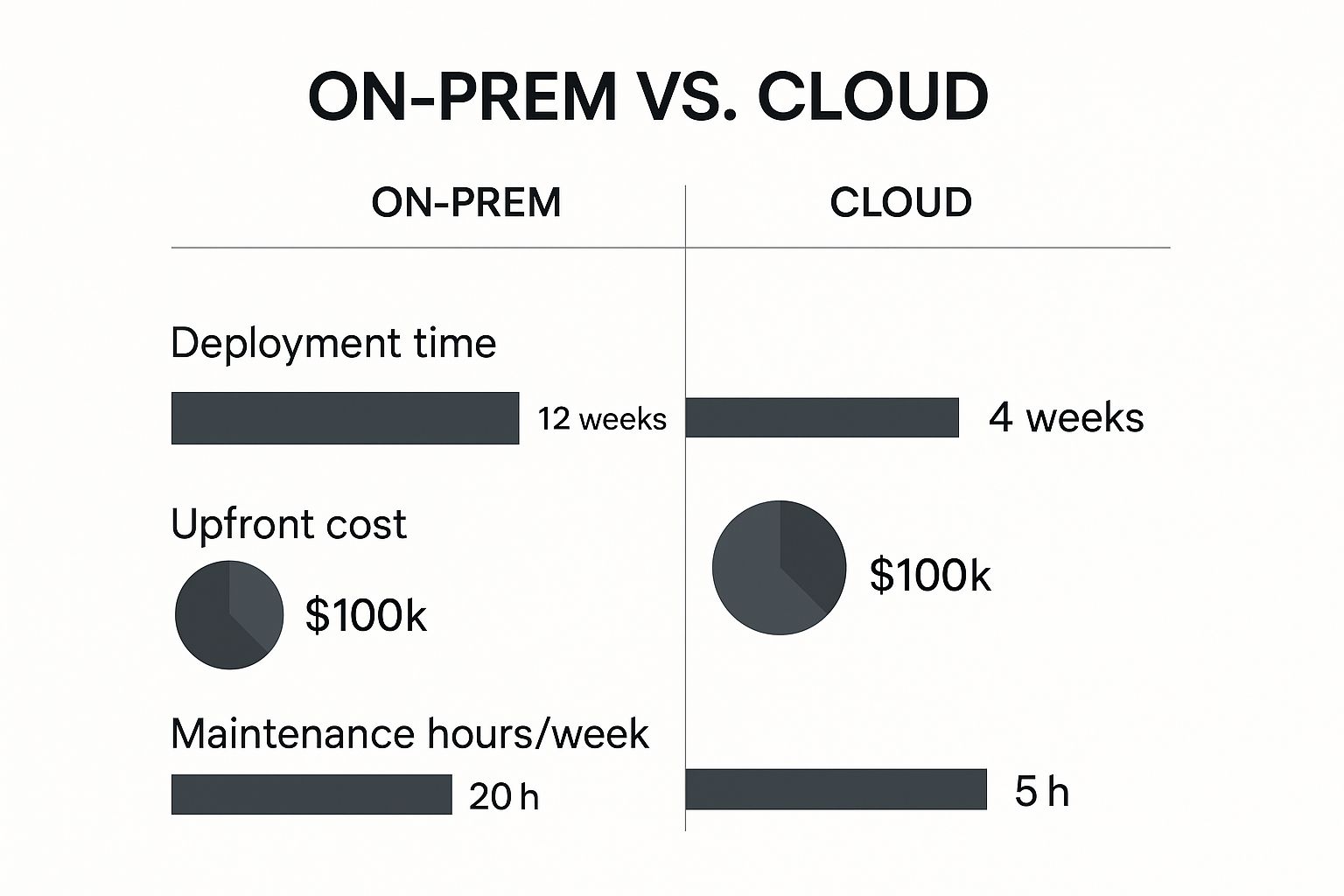
The data is pretty clear: moving to the cloud drastically cuts down the time, cost, and headache of maintenance. This is what puts powerful AI tools within reach for businesses that don't have massive IT budgets.
Choosing the Right AI Tool for Your Business Needs
With so many tools out there, it can be tough to know where to begin. The key is to match the tool to a specific problem you're trying to solve. Are you drowning in administrative work? Or is creating content your biggest bottleneck?
This table breaks down a few popular options across different business areas to give you a sense of what's possible.
| Business Area | Tool Example | Primary Use Case | Best For |
|---|---|---|---|
| Marketing | Jasper | Generating marketing copy, blog posts, and social media content. | Teams needing to scale content creation quickly without hiring more writers. |
| Sales | Salesforce Einstein | Lead scoring, sales forecasting, and activity tracking. | Businesses with an established sales process looking to improve efficiency and prioritize leads. |
| Customer Support | Zendesk AI | Automating responses to common queries with chatbots and suggesting replies. | Companies wanting to provide 24/7 support and free up human agents for complex issues. |
| Operations | ClickUp | Automating tasks, summarizing documents, and managing projects. | Teams looking to reduce manual work and streamline their internal workflows. |
Ultimately, the "best" tool is the one that solves a genuine pain point for your team. Start small with a single use case, get comfortable with the technology, and then expand from there.
Streamlining Operations and Customer Support

While marketing and sales often get the AI spotlight, some of the biggest wins happen behind the scenes. Think about all those small, repetitive tasks that chip away at your team's day. This is where AI really flexes its muscles, supercharging your internal operations and customer support.
It all comes down to getting your most valuable resource back: time. When you hand off the routine administrative grind to AI, you empower your team to focus on what they do best—strategy, creative problem-solving, and the kind of high-touch customer conversations that build real loyalty.
Automating the Administrative Grind
Every business has its share of administrative headaches. These are the necessary but monotonous jobs that keep the engine running, from scheduling meetings and transcribing calls to processing invoices. The good news is that AI tools are built to handle this kind of work with incredible speed and precision.
Imagine an AI assistant that can scan everyone's calendars and nail down the perfect meeting time from a single email, killing the endless "does this time work?" chain. Or a tool that joins your Zoom call, spits out a full transcript, and even gives you a neat summary with assigned action items. It feels like magic, but it’s a practical application of concepts you can explore by understanding what is Robotic Process Automation.
These aren't just minor conveniences; they translate into real efficiency gains that boost your bottom line.
"The real power of AI in operations isn't just about speed," notes efficiency expert Dr. Alistair Finch. "It's about completely removing tasks from your team's plate. When you eliminate that administrative friction, you create the breathing room needed for the kind of strategic thinking that actually moves the needle."
Reinventing Your Customer Service
In customer support, AI delivers a powerful one-two punch: customers get instant answers, and your team gets a lighter workload. We’ve all been stuck on hold or waited days for a simple email reply. This is exactly the problem AI chatbots were born to solve.
Forget the clunky bots from a few years ago. Today's AI can field a massive volume of common questions around the clock, handling everything from "Where's my package?" to "What's your return policy?" This means your customers get help the moment they need it, which makes a huge difference in their overall experience.
By letting AI handle the first line of defense, your human agents are free to tackle the tricky, emotionally-charged problems where empathy and critical thinking are paramount. It’s a classic win-win, leading to happier customers and more engaged employees.
Let's see how this plays out in the real world.
Case Study: A Small E-commerce Business
An online shop selling handmade jewelry was getting swamped with customer service tickets. The small team was burning out answering the same questions over and over about shipping, returns, and product details.
They decided to integrate an AI-powered help desk with a customer-facing chatbot. The impact was immediate. The bot started fielding the majority of routine questions, freeing up the team to give personalized style advice and sort out complex order issues.
The results speak for themselves. Within just three months, they slashed their support ticket volume by 40% and watched their customer satisfaction score climb by 15%. This is a perfect, tangible example of how a small business can use AI to get a serious competitive edge.
How to Measure Success and Avoid Common Pitfalls
https://www.youtube.com/embed/yDV-7VQDJKk
Getting a new AI tool up and running is the easy part. The real challenge? Figuring out if it's actually making a difference. The initial buzz of new tech wears off fast if you can’t point to real, tangible results.
Forget about getting lost in complex spreadsheets. The trick is to tie your AI initiatives directly to clear business outcomes. We're talking about focusing on numbers that matter to your bottom line, not just vanity metrics that look good on paper.
Defining Your Key Metrics
Before you even think about flipping the "on" switch, you have to decide what success actually looks like for your team. The right metrics will depend entirely on the specific problem you’re using AI to solve.
Let’s look at a few real-world examples:
- For Customer Support: If your goal is speed, track your average response time before and after bringing in an AI chatbot. If it's about making customers happier, your Customer Satisfaction (CSAT) score is your north star.
- For Marketing: Using AI to draft content? The most direct metric is the time saved per article or social media post. If you're using it to find better prospects, keep a close eye on the conversion rate of AI-qualified leads.
- For Operations: When automating routine tasks, the clearest win is hours saved per week. This number shows you exactly how much time your team is getting back to focus on more strategic work.
"I see this all the time: people get excited about an AI tool but forget to set a baseline," warns data scientist Maria Rodriguez. "Before you introduce anything new, you absolutely have to measure your current performance. Without that starting point, you have no real way to prove your ROI—you're just guessing."
Side-Stepping the Common Mistakes
Knowing what not to do is just as critical as having a solid plan. So many businesses stumble out of the gate with AI, but you can avoid the most common traps with a bit of foresight.
The biggest pitfall is thinking AI is some kind of silver bullet. The reality is, success isn't a given. For instance, AI use in U.S. firms climbed from 3.7% in late 2023 to 9.7% in mid-2025. Yet, many of these companies reported only minor gains, often with cost savings under 10%. You can dig deeper into these AI adoption trends on anthropic.com. The data shows that digitally mature industries, like the Information sector, are adopting AI much faster for a reason—they have the foundation in place.
Here are the top mistakes I've seen teams make, and how you can avoid them:
- Skipping Team Training: You can't just hand over a powerful new tool and expect everyone to become an expert overnight. Proper training is non-negotiable. It ensures your team understands the 'why' behind the tool and the 'how' to get the most out of it.
- Forgetting the Human in the Loop: AI isn't perfect. It can hallucinate facts, misinterpret nuance, or just get things plain wrong. You always need a human to review, edit, and approve AI-generated output, especially when it's going out to customers.
- Setting Unrealistic Goals: Don’t expect to triple your revenue in the first quarter. Start small with a clear, achievable goal—like saving each team member five hours a week. AI implementation is a marathon, not a sprint. You build momentum with small, consistent wins.
Got Questions About AI in Business? We've Got Answers.
Jumping into the world of AI can feel a little daunting, and it's totally normal to have questions about the practical side of things—cost, skills, and data security are usually top of mind. Let's break down some of the most common questions I hear from business owners so you can feel confident moving forward.
How Much Is This Actually Going to Cost?
This is the big one, isn't it? The good news is, the answer is "it depends," and that's actually a great thing for your budget. Getting started with AI can cost anywhere from $0 to a serious investment, all based on what you’re trying to accomplish.
For most people just starting out, many of the best tools for content, marketing, or project management run on a "freemium" model. You get to use a solid, free version to see if it actually helps your workflow. If it does, you can decide if upgrading to a paid plan for more powerful features makes sense. It’s a fantastic, no-risk way for smaller businesses to experiment.
Here’s a quick breakdown of what you can expect:
- Free or Nearly Free: Think of tools like the free version of ChatGPT or a starter plan for a marketing AI. Many powerful tools offer free tiers or low-cost subscriptions in the $20-$50 per month range.
- Mid-Tier Tools: If you're looking for something more specialized, like an AI-driven CRM or a sophisticated analytics platform, you might be looking at a few hundred dollars a month.
- Custom-Built Systems: This is the high end of the spectrum, usually reserved for larger enterprises that need a unique AI solution built from scratch.
My advice? Start small. Use the incredibly powerful and affordable tools available now to show a real return on investment. Once you see the value, you can scale up.
Do I Need to Be a Tech Whiz to Use AI?
Absolutely not. This might have been true a few years ago, but the game has completely changed. Today’s AI tools are designed for regular business people, not developers. Most have clean, intuitive interfaces that feel as familiar as any other software you use daily.
"It's no longer about your ability to code; it's about your ability to think strategically," argues former Google AI strategist, Kenji Tanaka. "The most crucial skill now is simply understanding your business problem inside and out. If you can define the goal, you can find an AI tool to help you get there."
Seriously, if you know how to write an email or manage a social media account, you have all the technical skills you need to get started with most business AI platforms.
Is My Company's Data Safe?
This is a critical question, and you're right to ask it. When you're using any third-party tool, you have to be smart about what information you feed into it. The key here is to stick with reputable AI providers who are upfront about their data policies.
Before you go all-in, take a few minutes to read the terms of service, especially if you're looking at an enterprise-level platform. As a common-sense rule, never paste highly sensitive customer data, financial records, or internal secrets into a public AI model. The good news is that many business-grade AI tools now offer private, secure instances and beefed-up security protocols to keep your information confidential.
Ready to explore AI with confidence? YourAI2Day provides the latest news, expert insights, and practical guides to help you make smart decisions. Discover the right tools and strategies at our homepage.