
How to Implement AI in Business
Feeling a bit lost in all the AI noise? You're not the only one. Many business leaders see the potential but freeze up when it comes to the first step. A lot of the buzz is around consumer AI, like creating cool images, but how does it actually make a difference in your day-to-day business?
The good news? You don't need a PhD in computer science to make this work. The trick is to stop chasing every new, flashy AI tool and instead zero in on solving real, nagging business problems.
Think of it this way: you wouldn't hire a new team member without a clear job description. Adopting AI is no different. You need to know exactly what you want it to do before you bring it on board. Successful AI projects are always less about the tech and more about the problem you're solving.
If you're looking for a solid foundation on the different types of AI and what they do, our guide on understanding AI technology is a fantastic starting point.
The Four Pillars of AI Implementation
To bring this idea to life, I've broken down the process into four core stages. This simple framework keeps you focused on creating real business value, not just adopting technology because it's trendy.
Think of these pillars as your roadmap from idea to impact.
| Pillar | What It Means | Key Action |
|---|---|---|
| Problem Identification | Finding a specific pain point or opportunity in your business. | Pinpoint a repetitive task, a customer friction point, or a gap in your data analysis. |
| Solution Selection | Choosing the right AI tool or approach to solve that specific problem. | Research and vet tools that directly address the need you just identified. |
| Pilot Project | Testing your chosen AI solution on a small, controlled scale. | Launch a limited-scope test to measure performance and gather real-world data. |
| Measure & Scale | Analyzing the results of the pilot and planning for a wider rollout. | Define what success looks like (KPIs) and use that data to justify expansion. |
This isn't just theory; it's a practical way to turn what feels like a massive undertaking into a series of manageable steps. It's about building momentum and proving AI's worth, one win at a time.
The data backs this up, too. Businesses are quickly moving past the initial hype and finding genuine uses for AI. By 2025, an estimated 78% of companies globally will be using AI in at least one business function. That's a huge leap from just 20% back in 2017. You can dig into more of the numbers in this report on companies using AI.
Finding Where AI Can Truly Make a Difference

Before we even touch the technology, let's talk about something far more important: problems. The most successful AI projects I've seen almost never start with a flashy new tool. They start with a frustrating bottleneck, a tedious process that drains the team's energy, or a golden opportunity you just can't seem to grab.
Think of yourself as an "opportunity detective" inside your own company. Your mission is to find the high-impact areas where AI can deliver real, measurable value. This isn’t about chasing trends; it’s about getting your hands dirty and finding the specific friction points holding your business back.
Start with the Repetitive, Low-Value Grind
The easiest place to start your detective work is with tasks that are repetitive, rule-based, and frankly, a bit soul-crushing. These are the low-hanging fruit for automation because they chew up valuable human hours that could be redirected to creative, strategic work.
For instance, a local accounting firm could use AI to automatically extract data from thousands of invoices, saving their team from mind-numbing data entry. It’s a simple application, but it saves dozens of hours every single week. An e-commerce shop could do something similar by deploying an AI chatbot to handle the 70% of customer queries that are routine, like "Where's my order?" or "What's your return policy?"
This immediately frees up your support team to handle the complex, high-touch issues that actually build customer loyalty. These small wins are the bedrock of a smart AI strategy. They are often perfect candidates for a technology known as robotic process automation, which you can learn more about in our guide on what is Robotic Process Automation.
Map Your Customer Journey to Find the Snags
Where do your customers get stuck? Where do they get frustrated? Mapping out every single touchpoint a customer has with your business—from their first website visit to post-purchase support—is an incredibly powerful exercise.
Once you have that map, look for the areas where the experience is slow, confusing, or impersonal.
- Initial Discovery: Can customers find what they need on your site, or do they give up? An AI-powered search function can deliver far more relevant results.
- Sales Process: Are your reps bogged down qualifying leads? AI can score leads based on behavior, letting the team focus on the hottest prospects. A practical example is a CRM that automatically flags leads who visited your pricing page three times in a week.
- Onboarding: Is getting a new client set up a manual, time-consuming slog? AI can automate welcome emails, training materials, and follow-up check-ins.
- Customer Support: Are people waiting on hold forever? As mentioned, AI chatbots can give them instant answers, 24/7.
Each of these snags is a blinking sign—a clear opportunity to implement AI to make life better for your customers and your team.
Expert Takeaway: As AI consultant Sarah Jennings puts it, "Don't ask, 'What can I do with AI?' Instead, ask, 'What's the most annoying, time-consuming, or inefficient part of my business?' The answer to that second question is your AI starting point."
Use Data to Uncover Hidden Opportunities
Your business data is a goldmine of insights just waiting to be dug up. You don't need to be a data scientist to find valuable patterns, either. Modern AI tools can chew through sales data, customer feedback, and website analytics to reveal trends you might have missed completely.
Imagine an online retailer using AI to analyze purchasing patterns. The system might notice that customers who buy a specific camera are highly likely to purchase a certain tripod within two weeks. Boom. Armed with that insight, the retailer can create a targeted, automated email campaign suggesting the tripod to new camera owners, boosting sales without any extra manual effort.
This isn't just a hypothetical; it's a real-world application of predictive analytics. And the economic impact is massive. The manufacturing sector alone is projected to gain $3.78 trillion from AI by 2035. In retail, a staggering 80% of executives expect to be using AI automation by 2025, which makes sense when you consider that 19 out of 20 customer interactions will soon be AI-assisted.
Choosing The Right AI Tools Without The Headache
Once you’ve nailed down a specific problem you want to solve, the next question hits you like a ton of bricks: which AI tool is the right one? The market is absolutely flooded with options, and trying to pick one can feel like finding a needle in a haystack. It’s easy to get analysis paralysis.
The trick is to simplify your thinking. When you cut through all the marketing noise, you'll find there are really only three ways to bring AI into your business. Getting a handle on these paths is the first real step toward making a smart, confident decision instead of just taking a wild guess.
The Three Main Paths For AI Adoption
Your choice here will really boil down to three things: your budget, your team's tech skills, and just how unique your problem is. Let's walk through the options, from the simplest to the most hands-on.
-
Buy Off-the-Shelf: This is the most common and straightforward route. You’re essentially buying a ready-made software product (SaaS) that has AI features already built in. Think of your CRM suggesting which leads to call next, or an email platform using AI to write killer subject lines. It's designed to work right out of the box.
-
Customize an Existing Platform: This is the happy medium. You take a powerful, existing AI platform—like Google AI Platform or Amazon SageMaker—and train it using your own company's data. This takes a bit more technical skill but delivers a solution that's much more tuned into your specific business needs than a generic tool ever could be.
-
Build a Bespoke Solution: This is the most complex and expensive path. Here, you're either hiring a team of developers or using your own in-house experts to build a custom AI model from the ground up. Honestly, you should only go down this road if you have a truly unique problem that no existing software on the market can solve well.
My Pro Tip: No matter which path you're leaning toward, always start with a small, low-risk pilot project. Pick a single team or a single process and test the tool in a controlled environment. This lets you see how it actually performs and builds a rock-solid business case for a bigger rollout, all without betting the farm on a massive upfront investment.
Vetting Vendors And Asking The Right Questions
Picking a vendor is a lot like hiring a key employee—you have to do your homework. A flashy demo can be impressive, but you need to dig much deeper to make sure their solution is secure, reliable, and won’t be a nightmare to integrate with your current systems.
Here are a few questions I always tell people to ask any potential AI vendor:
- Data Security & Privacy: How, specifically, will you protect our business and customer data? Are you compliant with major regulations like GDPR or CCPA? Where will our data be stored?
- Integration Capabilities: How does your tool talk to the software we already rely on, like our CRM or ERP? Do you have a well-documented API we can use?
- Training & Support: What does your onboarding process actually look like? If we hit a snag at 3 PM on a Friday, what kind of support can we expect?
- The "Black Box" Problem: Can you explain how your AI model makes its decisions, or is it a "black box"? Transparency is a huge deal for building trust, especially if you're in a regulated industry.
This is where you need to decide what matters most to your business. The chart below shows how different factors play out depending on the path you choose.
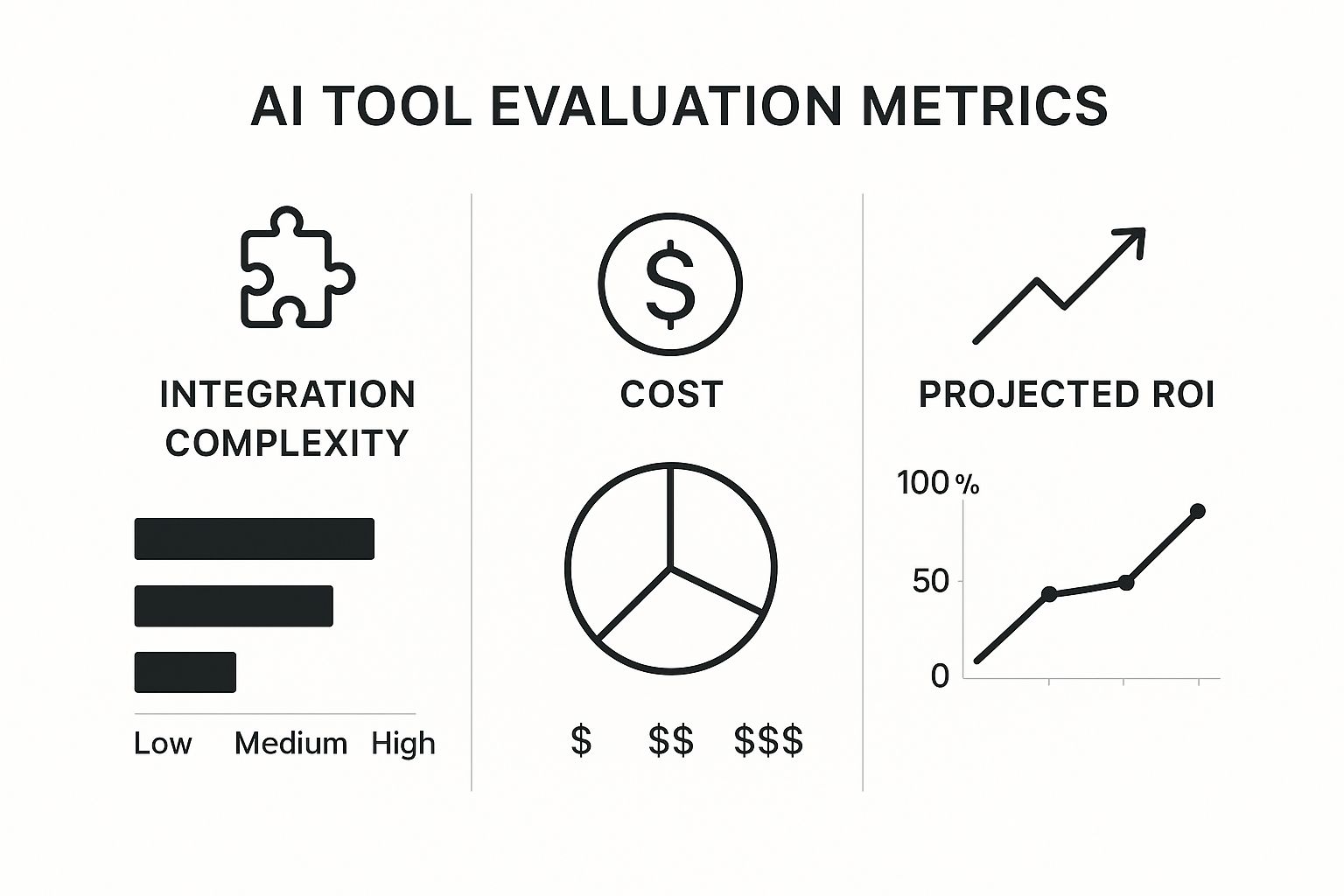
As you can see, off-the-shelf tools are cheaper and simpler to get going, but you might not get the highest possible ROI. On the flip side, a custom build is the exact opposite across the board.
Finding the right approach means weighing these trade-offs carefully. A pre-built SaaS tool might be perfect for one business, while another might find that a custom solution is the only way to gain a real competitive edge. The table below breaks down the pros and cons to help you decide.
AI Implementation Paths Compared
| Approach | Best For | Pros | Cons |
|---|---|---|---|
| Buy (Off-the-Shelf) | Businesses needing a quick, cost-effective solution for a common problem. | Fast deployment, low upfront cost, no technical expertise needed. | Limited customization, potential data lock-in, may not solve unique problems. |
| Customize (Platform) | Companies with some technical resources who need a tailored solution. | More control than "Buy", better alignment with business needs, leverages powerful platforms. | Requires data science skills, longer implementation time, higher cost than SaaS. |
| Build (Bespoke) | Large enterprises with highly specific needs and deep technical teams. | Complete control and ownership, creates a unique competitive advantage. | Very high cost, long development cycle, requires specialized talent. |
Ultimately, there's no single "best" path—only the one that's best for your specific situation, budget, and team.
A Practical Example In Action
Let's make this real. Imagine you run a content marketing agency, and the big bottleneck is how long it takes your team to write first drafts for blog posts.
-
Path 1 (Buy): You could subscribe to a dedicated AI writing assistant. These tools are fast, affordable, and get you started immediately. To see what's out there, check out our guide on AI tools for content creation.
-
Path 2 (Customize): If your agency has a very distinct brand voice, you could use an AI platform and train a model on your best-performing articles. The AI's output would then sound much more like you. For instance, you could feed it 50 of your top blog posts, and the new drafts it generates would adopt that tone and style.
-
Path 3 (Build): For this particular problem, this is massive overkill. Building a language model from scratch would be incredibly expensive and time-consuming, especially when so many fantastic tools already exist.
For most small and mid-sized businesses, the "Buy" or "Customize" options provide the best mix of power, cost, and speed. The key is to match the scale of the solution to the scale of the problem.
Crafting Your Practical AI Implementation Roadmap
An idea without a solid plan is just a wish. Now that you’ve zeroed in on a problem and explored some tools, it’s time to get practical and build a roadmap. I’m not talking about a stuffy, 100-page document no one will ever read. This is about creating a clear, simple action plan that gets everyone on the same page.
Think of this plan as your guide, outlining the steps, resources, and timelines needed to go from concept to launch. It’s the bridge between a great idea and a real-world result that actually adds value. Without this structure, even the most promising AI projects can drift off course and fail to deliver.
Your Data Is Your Foundation
Let’s be crystal clear: AI is only as good as the data it learns from. If you feed an AI messy, incomplete, or biased data, you'll get messy, unreliable, or biased results. It’s the classic "garbage in, garbage out" principle, and it’s non-negotiable in the world of AI.
Getting your data ready isn't the most exciting part of the process, but skipping it is a recipe for disaster. It’s like building a house—you wouldn’t start putting up walls on a shaky foundation, would you? Data preparation is pouring that solid concrete base.
Here’s what this typically involves:
- Gathering Data: Pull all the relevant information from different places—your CRM, sales records, customer support tickets, or website analytics.
- Cleaning Data: This is a big one. You’ll need to fix errors, remove duplicate entries, and figure out how to handle missing information.
- Organizing Data: Structure everything in a consistent format that an AI model can actually understand. This might mean labeling customer feedback as "positive" or "negative."
This groundwork ensures your AI has the best possible starting point, which directly impacts the quality of its output and its value to your business.
Assemble Your AI Dream Team
You don't need a whole department of data scientists, especially when you're just starting. Your "AI team" might just be a small, dedicated group of people who are genuinely passionate about the project. The key is having the right mix of skills and perspectives.
For many small businesses, this team ends up being a blend of internal and external talent.
- The In-House Champion: This is someone inside your company who deeply understands the business problem you’re trying to solve. They’re the project owner, the one who will drive it forward and keep it aligned with your goals.
- The Technical Lead: This person handles the tech side. It could be someone from your IT department, a tech-savvy employee, or an external consultant who specializes in how to implement AI in business solutions.
- The End-Users: Don’t forget the people who will actually use the tool every day! Involve a couple of them from the department where the AI will be deployed. Their feedback is pure gold.
This combination ensures you have both the business context and the technical know-how to make the project a success.
As tech leader Marcus Thorne says, "You're not just installing software; you're changing a workflow. Getting buy-in from the team isn't just a nice-to-have, it's a non-negotiable for successful adoption. Empower your people from day one."
Communicate the ‘Why,’ Not Just the ‘What’
One of the biggest mistakes I see businesses make is rolling out new technology without properly explaining why they’re doing it. They focus on the "what" (we’re getting a new AI tool) but completely ignore the "why" (to eliminate boring data entry so you can spend more time with clients).
This lack of communication breeds fear and resistance. Employees might worry that AI is there to replace them, leading to pushback and a failed project. The investment in AI can be significant, and its success is reflected in the market. In early 2023, for example, market capitalization linked to generative AI surged by $1.4 trillion, while related corporate profits jumped 45% in just four months. To see these kinds of returns, you need your team on board. You can find more insights on the financial impact of AI implementation.
To build excitement instead of fear, be transparent. Hold a kickoff meeting, explain the benefits clearly, and provide thorough training. Show your team how this new tool will make their jobs easier, not obsolete.
Launching and Scaling Your AI Strategy

So, you’ve done the hard work, navigated the options, and your pilot project is live. Now what? The journey doesn’t end at deployment. In many ways, this is where the real work—and the real value—truly begins.
Your role now shifts from that of a builder to more of a gardener. You have to monitor, measure, and nurture your new AI initiative, making sure it grows strong and actually delivers on its promise. This phase is all about turning that initial proof-of-concept into a durable, competitive advantage.
Measuring What Truly Matters
Let's get one thing straight: forget vanity metrics. Success isn't about how many tasks your AI completes; it’s about the tangible, bottom-line impact it has on your business. You absolutely need to define Key Performance Indicators (KPIs) that connect directly back to the original problem you set out to solve.
Imagine you rolled out an AI chatbot to handle customer support inquiries. The wrong KPI would be something generic like "number of chats handled." Instead, you need to get granular and focus on metrics that reflect genuine business outcomes.
Here are a few examples of KPIs that actually mean something:
- Customer Satisfaction (CSAT) Score: Are customers happier after interacting with the bot, or is it just causing frustration?
- First-Contact Resolution Rate: How often did the bot completely solve the issue without a human handoff? A high rate here is a direct signal of efficiency gains.
- Average Handle Time Reduction: By how much did the bot reduce the time human agents spend on common issues, freeing them up for more complex problems?
- Employee Adoption Rate: This one is huge. Is your team actually using the new tool? Low adoption is a massive red flag that something is off, either with the tool or the training.
Tracking specific, outcome-driven metrics like these is the only way to know if your AI is actually moving the needle. It's the difference between saying "the AI is busy" and proving "the AI is creating value."
The Cycle of Improvement: Feedback and Refinement
AI models are not a "set it and forget it" technology. They need to learn and evolve. The most powerful way to fuel that evolution is by creating a tight feedback loop with the people who use the tool every single day. Their on-the-ground experience is gold for refining the model's performance.
Think of it as continuous on-the-job training. Your team's feedback is what helps you spot where the AI excels and, more importantly, where it stumbles. This iterative cycle of "measure, learn, improve" is the secret sauce for getting long-term value from your investment.
Expert Opinion: "The goal of a pilot isn't just to see if the AI works; it's to find out how it breaks," advises Elena Petrova, an AI strategist for SMBs. "Every error, every piece of user feedback is a gift. It's a data point that shows you exactly what you need to fix to make the tool indispensable."
For instance, if your sales team is using an AI to predict which leads are most likely to convert, you need a dead-simple way for them to give feedback. When the AI gets a prediction wrong, the salesperson should be able to flag it with a click. That input teaches the model to learn from its mistakes, making it more accurate over time.
Knowing When and How to Scale
Once your pilot has proven its worth with hard data, it’s time to think bigger. But scaling isn't about just flipping a switch and rolling the AI out to the entire company. That's a recipe for disaster. It should be a strategic process of taking the lessons you’ve learned and applying them thoughtfully to other parts of the business.
A successful pilot gives you so much more than just a working tool; it gives you a blueprint. You now have a proven business case, a much deeper understanding of the technology, and a core group of internal champions who can vouch for the new solution. That momentum is priceless for driving wider adoption.
So, how do you scale the right way?
- Find Adjacent Problems: Look for similar pain points in other departments. If you successfully automated invoice processing in accounting, could the same core technology be used to automate purchase order processing in operations?
- Document Your Playbook: Create a simple, clear guide that breaks down what worked. This should cover everything from the data prep and team training to the specific KPIs you used to prove success.
- Expand Incrementally: Don't go from one team to the whole organization overnight. Roll the solution out to a second, related team. Measure the results, refine your playbook, and then move on to the next.
This methodical approach minimizes risk and helps build a culture where AI is seen not as a threat, but as a powerful partner for growth. You’re essentially teaching your organization how to implement AI in business as a repeatable skill, creating a foundation for continuous innovation.
Common Questions About Bringing AI Into Your Business
Jumping into AI always brings up a ton of questions. That’s a good thing. It means you’re thinking critically about what this technology can actually do for you. Let's walk through some of the most common questions I hear from leaders and business owners who are trying to figure this all out.
Do I Really Need a Team of Data Scientists?
This is probably the biggest myth out there, and it stops a lot of smart businesses from getting started. The short answer is no, not usually.
Modern AI tools have come a long way. Many of the best solutions are now "no-code" or "low-code," which means someone on your existing team who is comfortable with technology can get them up and running. You don't need a team of PhDs to implement a chatbot for your website or an AI-powered tool to help write marketing copy.
You only need to start thinking about hiring data scientists when you have a truly unique, complex problem that off-the-shelf software can't solve. For most businesses, that’s a long way down the road.
What’s the Real Cost of Implementing AI?
The price tag on AI can be anything from a monthly software subscription to a massive custom project. There's no one-size-fits-all answer. For example, an AI-powered email marketing tool might run you $150 a month, but building a custom model to predict which customers are about to leave could easily start at $20,000.
The number itself isn't what matters.
The real question is about return on investment (ROI). If a tool costs you $1,000 a month but saves your team $5,000 in time or helps you land $10,000 in new deals, it's paying for itself many times over.
My advice is always to start small. Run a pilot project with a clear budget and well-defined goals. Prove the value on a small scale before you even think about making a larger investment.
What's the Biggest Mistake I Can Make?
Falling in love with the technology instead of the problem it solves. This happens all the time. A leader gets excited about the idea of "doing AI" and pushes for a tool without a clear business case. The result? Wasted money, frustrated teams, and a shiny new tool that nobody uses.
The right way to approach this is to start with a real pain point. Are your customer service wait times too long? Are you drowning in manual data entry? Is your sales forecasting a guessing game?
Identify a specific, costly problem first. Only then should you ask, "Could AI help us solve this?" Having a clear goal is the only way you'll ever know if the project was a success.
How Should I Approach Data Privacy and Security?
This is something you have to get right from the very beginning. It's not optional. Getting this wrong can obliterate customer trust and land you in serious legal trouble.
Here's a simple checklist to get you started:
- Audit Your Data: Know exactly what data the AI tool will need access to.
- Check Regulations: Make sure your data handling practices are compliant with rules like GDPR or CCPA.
- Vet Your Vendors: Dig into the security and privacy policies of any AI provider you're considering. Ask them the tough questions—where is my data stored? Who can see it?
- Be Transparent: Tell your customers how you're using their data.
Prioritizing data privacy isn't just about following the law; it's about building a brand people trust.
Ready to stay ahead of the curve and discover the next big thing in AI for your business? At YourAI2Day, we provide the latest news, in-depth guides, and tool reviews to help you make smarter decisions. Explore our resources and join our community.