Future of Artificial Intelligence in Business: A Friendly Guide for Beginners
The future of artificial intelligence in business isn't some far-off sci-fi movie anymore. It’s here, right now, helping us work smarter, not harder. Think of AI as a new team member that’s becoming as essential as electricity or the internet. It's starting to power everything from how you chat with customers to the way you dream up new products.
Forget the scary Hollywood robots; this is all about practical, helpful tools.
Your Quick Guide to the Future of AI
It’s easy to get lost in all the tech jargon, but what’s happening is actually pretty simple. AI is shifting from a complicated, specialized technology into a handy tool that helps solve everyday business problems. Think of it less like a scary, complex system and more like a super-smart assistant for you and your team.
This whole change is powered by new, easy-to-use tools that deliver real results. We're past the phase of dense academic theories and are now focused on practical uses that any business, big or small, can start trying out. The goal isn't to replace people, but to give their skills a massive boost.
What This Shift Looks Like in Practice
The future of artificial intelligence in business isn't about one big, dramatic breakthrough. It’s more like a bunch of powerful trends all happening at once. Instead of just automating simple, repetitive tasks, AI is now becoming a genuine partner in creative and strategic work.
Here’s what that actually means for your day-to-day:
- Smarter Decision-Making: Imagine trying to read thousands of customer reviews to spot a trend. It would take weeks! An AI can scan all of that feedback in minutes and tell you, "Hey, customers love the new feature, but they're confused about how to set it up." This helps you make faster, more confident decisions.
- Hyper-Personalized Customer Experiences: AI can help you treat every customer like a VIP. Think of Netflix recommending a show you actually end up loving. That's AI at work, learning your tastes to offer a personalized experience. Businesses can do the same, tailoring marketing messages and product recommendations automatically.
- Proactive Operations: Instead of waiting for a critical machine on your factory floor to break down, AI can predict the failure before it happens, saving you a ton of time and money. It’s like a car’s “check engine” light, but way smarter.
- Creative Content Generation: Feeling stuck on a blog post idea? Generative AI tools are incredible assistants for brainstorming marketing copy, creating images for a social media campaign, or even drafting the first version of a new product design.
As AI expert Bernard Marr puts it, "The real magic of AI is its ability to do the heavy lifting with data. This frees up your team to focus on strategy, creativity, and building relationships—the things people are uniquely good at."
This guide is here to walk you through these changes in a clear, no-nonsense way. We'll cut through the hype and show you how AI is becoming a practical tool for growth, efficiency, and innovation. Let's dig into how these trends are reshaping the modern workplace and what you can do to get your business ready.
How AI Is Really Changing the Way We Work
It’s easy to get lost in the hype, but what does the future of artificial intelligence in business actually look like on a Monday morning? Forget the sci-fi fantasies of robots taking over. The reality is far more practical and, frankly, more useful.
Think of AI as a powerful assistant—one that supercharges your team's skills and frees them from the boring stuff that drains their energy and creativity. The real goal here isn't to replace people, but to augment their talent. AI is built to handle the repetitive, data-heavy lifting, letting your team focus on what they do best: thinking strategically, solving tricky problems, and building real relationships with customers.
Breaking Down the Tech: AI Concepts Without the Jargon
To see how this works, you don't need a degree in computer science. Let's peel back the layers on a couple of core ideas using some simple analogies.
First up is machine learning. Imagine you have a new intern who can instantly read every sales report your company has ever created. In a few seconds, they spot a pattern: customers who buy your premium coffee beans are 85% more likely to also buy a coffee grinder within 30 days. Armed with that insight, your marketing team can create a perfectly timed email offer. That's machine learning in a nutshell—finding valuable patterns in data.
Then there's natural language processing (NLP). Think of it as a super-listener for all your customer feedback. It can sift through thousands of customer reviews, support emails, and social media comments, then give you the highlights. Instead of someone manually reading everything, you get a clear summary: "People are raving about the new design, but a lot of them are getting stuck during the setup process."
These aren't futuristic ideas; they are tools making a real difference for businesses today.
From Doing Tasks to Enhancing Talent
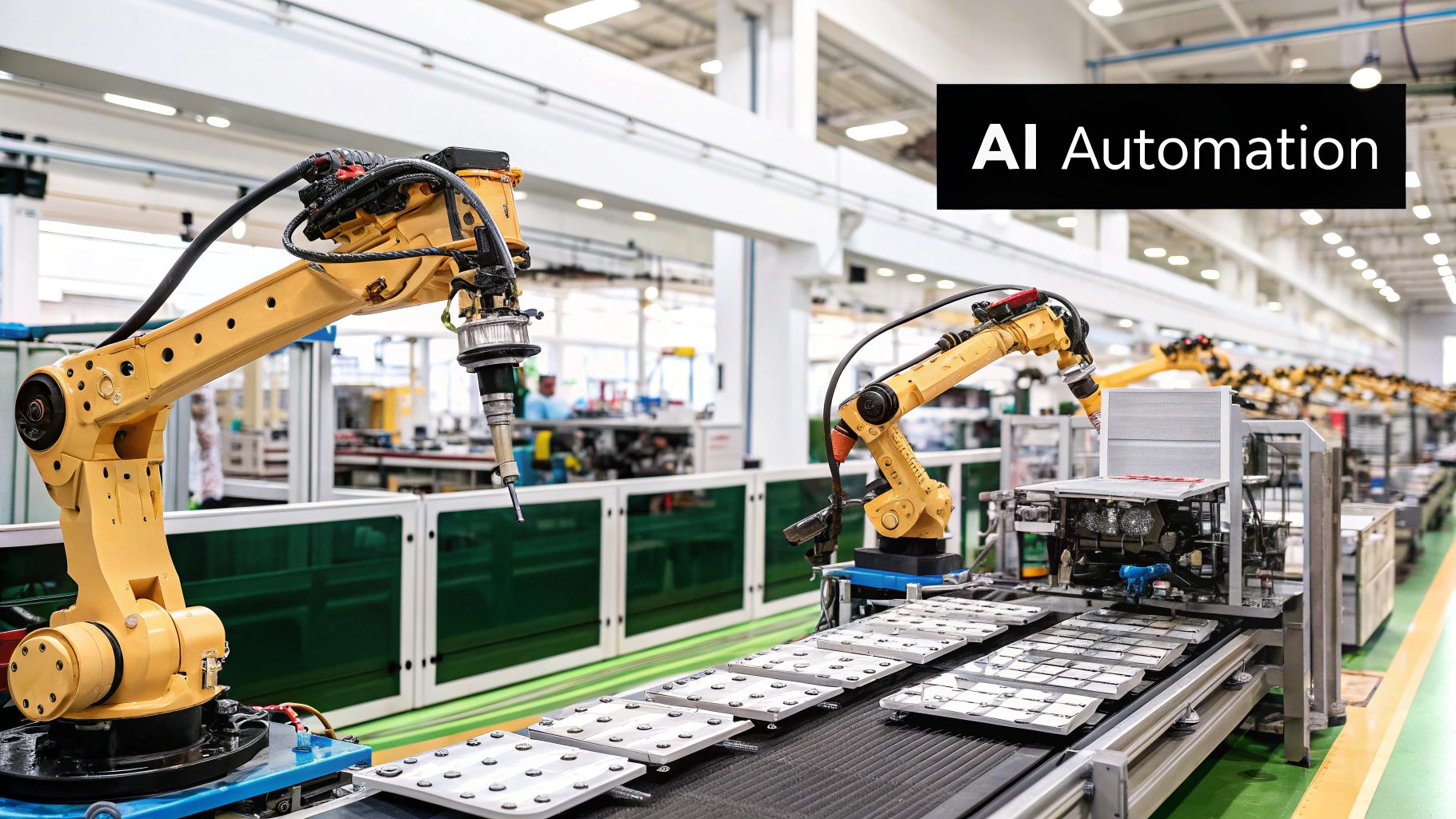
The big shift we're seeing is from basic automation to what we call intelligent augmentation. Automation is simple: a machine does a repetitive task, like a robot on an assembly line. Augmentation is much more collaborative—it’s about AI working with a person to make them better at their job.
A perfect example is in customer service. An agent can use an AI assistant that instantly pulls up a customer’s entire purchase history, suggests solutions to their problem, and even drafts a friendly reply. The agent is still in charge, but now they can solve complex issues with more speed and accuracy than ever before.
As AI pioneer Andrew Ng often says, "AI is the new electricity." A century ago, electricity didn't just power one invention; it became the foundation for countless innovations. AI is that same underlying force for the next generation of business tools and processes.
This team-up between human and machine is where the magic happens. On average, AI saves an employee about 2.5 hours every day by handling tedious tasks. The business impact is clear: 28% of business leaders report using AI to cut costs, and 66% have hired new roles specifically to manage AI systems. You can find more details on how companies are benefiting in recent studies.
What This Looks Like in Your Business
Let's bring this down to earth with a few real-world scenarios.
-
For your Marketing Team: An AI tool can analyze your website visitors and predict which ones are most likely to buy something. This lets your sales team stop wasting time on lukewarm leads and focus their energy on people who are genuinely interested.
-
For your Operations Manager: In a warehouse, AI can analyze past sales data and weather forecasts to predict demand for things like umbrellas or ice cream. This means no more overstocking unpopular items and, more importantly, no more running out of your best-sellers.
-
For your Content Creator: Think of generative AI as a brainstorming partner that never gets tired. It can suggest five different blog titles, draft social media posts, or create a few starter images for a new ad campaign, turning a process that used to take hours into one that takes minutes.
In every case, AI isn't taking over the job. It’s providing data-driven shortcuts and handling the heavy lifting, empowering your team to make smarter, faster decisions. That collaborative partnership is the true story of AI in the modern workplace.
Where AI Is Delivering Real Business Results

It’s one thing to talk about AI theory, but it’s way more interesting to see where it’s actually helping businesses make money. The future of artificial intelligence in business isn't some distant dream; it's happening right now, in departments that are moving it from the "experimental" pile to the "must-have" list.
We aren't just talking about small efficiency gains here. We're seeing huge shifts in how work gets done. By taking over the tedious, data-heavy tasks, AI is freeing up teams to focus on strategy, creative problem-solving, and the high-value human connections that really matter.
Hyper-Personalized Marketing Journeys
Not too long ago, marketing felt like shouting into a crowd and hoping someone listened. Campaigns were aimed at broad groups like "women aged 25-40," which meant most of the messaging felt generic and missed the mark.
AI has completely changed the game. Think of it as a personal shopper for every single one of your customers, constantly learning their tastes from their browsing history, past purchases, and even how they interact with your emails. This makes hyper-personalization possible on a massive scale.
An online clothing store is a perfect example:
- Before AI: A customer who bought running shoes might get a generic email about a "20% off all sportswear" sale. It's okay, but not very personal.
- With AI: That same customer now gets an email suggesting a specific brand of moisture-wicking socks that other runners love. It might also include a link to a new trail route in their area and a helpful reminder when their shoes are projected to wear out. The message feels like it was made just for them, which dramatically increases the chance of another sale.
Smarter and Faster Customer Service
Customer service is another area seeing huge benefits from AI. In the past, support was limited by how many people you had on staff, leading to long waits and frustrated customers, especially late at night.
Now, AI-powered chatbots and virtual assistants offer instant, 24/7 support. They can handle a huge volume of common questions—like "Where is my order?" or "How do I reset my password?"—without a human ever stepping in. This isn't just about being faster; it's about using your team's time wisely.
As one customer experience expert noted, "The true value of AI in customer service isn't replacing humans, but freeing them. When chatbots handle 80% of routine questions, human agents can dedicate their full attention to the complex, sensitive issues that truly require a personal touch."
This shift lets your skilled support team become true customer advocates. They get to focus on building relationships and solving tricky problems, which not only improves the customer experience but also makes their own jobs much more interesting.
Proactive and Predictive Operations
In manufacturing, waiting for something to break is a costly game. It leads to unexpected downtime, expensive emergency repairs, and messed-up production schedules.
This is where AI-powered predictive maintenance is a lifesaver. Imagine putting small sensors on your most important machines. These sensors constantly feed data—like temperature, vibration, and energy use—into an AI model.
The AI quickly learns what "normal" looks like for that machine. From there, it can spot tiny changes that are invisible to a person but signal that a failure is coming. Instead of a sudden breakdown, the system sends an alert: "Heads up! The motor in Machine 4 is vibrating slightly more than usual. We recommend replacing it during your next scheduled maintenance."
The before-and-after story is powerful:
- Before: A key production line suddenly stops, halting all work for 12 hours and costing thousands in lost revenue.
- After: A scheduled maintenance check, prompted by an AI alert, replaces a weakening part during off-hours. The result? Zero unplanned downtime.
This forward-thinking approach is at the heart of the future of artificial intelligence in business, turning operations from a frantic fire drill into a calm, data-driven process. These applications are just the beginning, and there are countless opportunities to build on these ideas. You can even explore some forward-thinking ventures in our guide to 10 artificial intelligence startup ideas.
The market's explosive growth reflects this potential. By 2030, the artificial intelligence market is projected to hit an incredible $1.85 trillion, with larger companies being twice as likely as smaller ones to adopt these tools.
How Different Industries Are Adopting AI
Artificial intelligence isn't a niche technology for tech geeks; it's a game-changer popping up everywhere. It’s reshaping how doctors diagnose diseases, how banks stop fraud, and even how you get that perfect "you might also like" recommendation when you're shopping online.
Let's look at a few areas where AI is already making a huge impact.
Healthcare's Diagnostic Co-Pilot
In medicine, AI is becoming an amazing partner for doctors. Think of it as a super-powered assistant that can analyze complex medical scans and records faster and sometimes more accurately than a human ever could. AI algorithms can be trained to look at X-rays or CT scans and spot tiny, early signs of disease that the human eye might miss.
For example, a doctor might use an AI tool to double-check a mammogram. The AI isn't there to replace the doctor's judgment. Instead, it offers a powerful second opinion, helping them catch potential problems earlier and with more confidence. For patients, that can mean getting a faster, more accurate diagnosis when it matters most.
- Early Cancer Detection: Some AI models can identify early-stage breast cancer in mammograms with incredible precision.
- Analyzing Patient Data: By sifting through health records, AI can predict which patients are at high risk for conditions like sepsis, allowing doctors to intervene before it's too late.
Finance's Silent Guardian
The financial industry was one of the first to jump on the AI train, and it’s easy to see why. Banks handle a mind-boggling number of transactions every second, making them a prime target for fraudsters. AI acts as a silent, always-on security guard.
Machine learning algorithms constantly watch transaction data, learning the "normal" spending habits for each customer. The moment something looks fishy—say, your card is suddenly used for a big purchase in another country—the system flags it for review in milliseconds. This real-time defense protects both customers and the bank from huge losses.
As one financial tech expert put it, "AI doesn't just catch fraud; it anticipates it. By analyzing millions of data points, we can identify and neutralize threats before they can even cause damage, creating a far more secure financial ecosystem."
Retail's Personal Shopping Assistant
Have you ever felt like an online store just gets you? That's AI working its magic behind the scenes. Retail giants like Amazon have perfected the art of the AI-powered recommendation engine. These systems look at your browsing history, what you've bought before, and even what other shoppers with similar tastes are buying.
It's much more than just showing you related products. The goal is to create a personalized shopping trip that feels like it was designed just for you. This personal touch doesn't just boost sales—it builds real customer loyalty by making shopping feel easy and fun.
The image below shows just how much AI is shaking up supply chains, driving higher adoption by cutting costs and speeding up delivery.
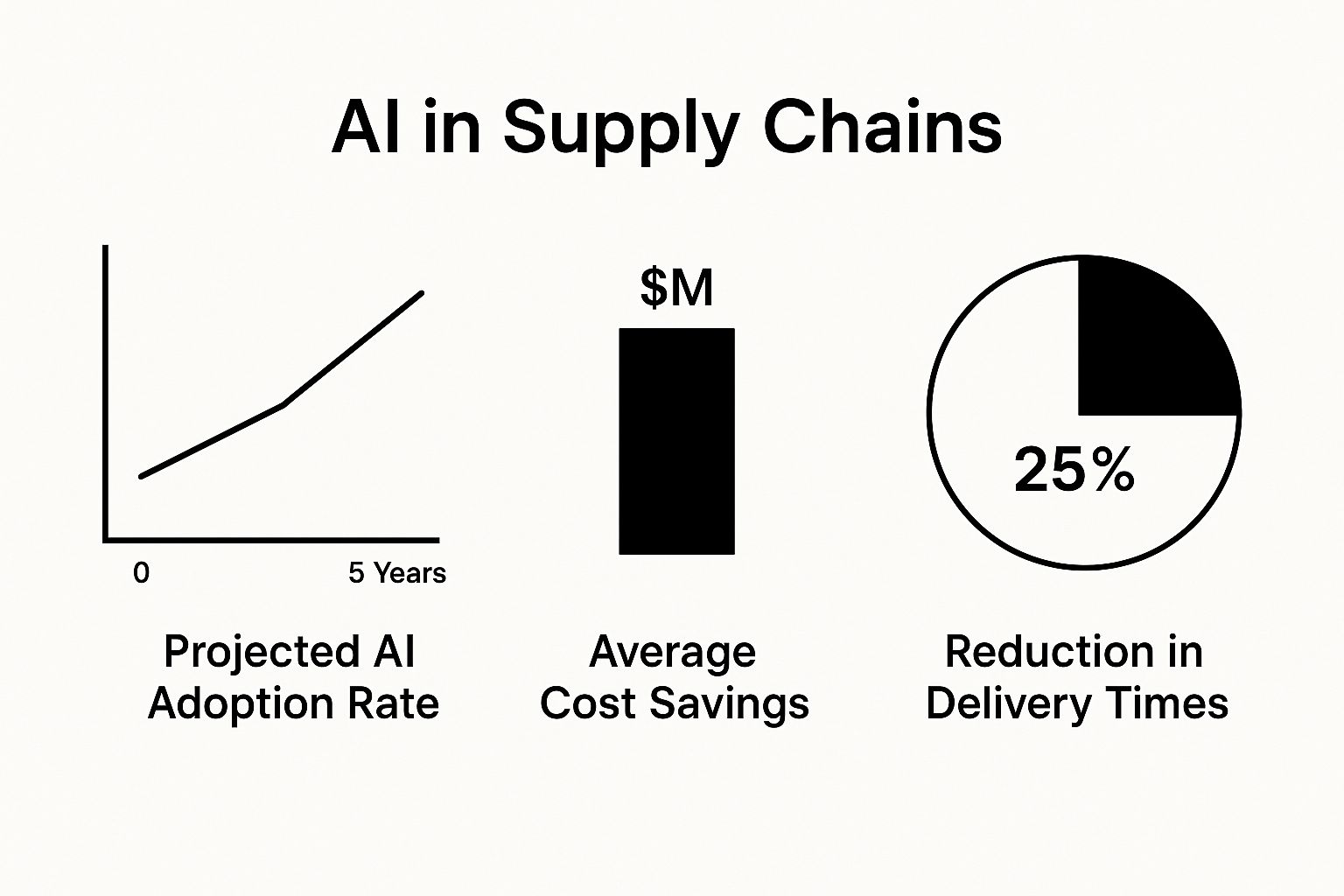
It’s clear from this data that businesses are wasting no time putting AI to work to build smarter, faster, and more efficient logistics networks.
The Data-Driven Revolution
How quickly a field adopts AI often depends on how much data it deals with every day.
AI Adoption Levels by Key Industry
Here's a quick look at how different sectors are stacking up when it comes to bringing AI on board.
| Industry | Adoption Level (High/Medium/Low) | Primary AI Use Case |
|---|---|---|
| IT & Telecom | High | Network optimization, cybersecurity, customer service automation |
| Finance & Banking | High | Fraud detection, algorithmic trading, risk assessment |
| Healthcare | Medium | Medical imaging analysis, drug discovery, predictive diagnostics |
| Retail & eCommerce | Medium | Personalization engines, supply chain optimization, demand forecasting |
| Manufacturing | Medium | Predictive maintenance, quality control, robotics automation |
| Transportation | Low | Autonomous vehicles, route optimization, traffic management |
As the table shows, industries that are swimming in data, like IT and finance, have naturally been the quickest to adopt AI. The IT and telecom sector alone is projected to add $4.7 trillion in value by 2035 through these efficiencies.
Ultimately, whether on a factory floor or in a hospital, the fundamental advantage of AI is the same: it gives us the ability to turn overwhelming amounts of information into clear, actionable insights. This unique power to make sense of complexity is exactly why AI is making such a profound impact everywhere it goes.
Navigating the Common AI Implementation Hurdles

The potential of AI is huge, but getting started is rarely a straight line. Many businesses are excited about the future of artificial intelligence in business, but jumping in without a plan can lead to some big headaches. It’s a bit like deciding to climb a mountain because the view is great—if you don't have a map or the right gear, you’re not going to get very far.
Getting started with AI can feel overwhelming, but knowing what roadblocks to watch out for is half the battle. From the sticker shock of development costs to finding people who actually know how to use the tech, these challenges are very real. The good news? They are totally solvable if you're smart about it.
Tackling High Costs and an Unclear ROI
Let's be real: one of the first things that stops any business is the price tag. Building a custom AI solution can be super expensive, and it's tough to get your boss to approve a big spend without a clear idea of what the company will get back. This "what's the return on investment?" question is a major reason why so many cool AI ideas never actually happen.
While enterprise AI adoption is at an all-time high—over 80% of companies are at least testing the waters—actual success is a different story. It’s pretty shocking to learn that only about 25% of AI projects end up delivering the return on investment (ROI) they promised. Even fewer are scaled across the entire organization. You can get a deeper look into these common AI adoption challenges and what causes them.
So, what's the fix? Instead of trying to do everything at once with a massive, company-wide project, start small. Pick a low-risk pilot project that solves one specific, measurable problem.
- Solve a Real Pain Point: Choose a small but annoying problem, like manually sorting customer support emails. An AI tool could automate that for a relatively low cost. For example, a company might spend just a few hundred dollars a month on a tool that saves their support team 10 hours a week.
- Track Everything: Measure the before and after. How many hours did your team get back? How much faster did customers get a reply?
- Show the Value: Once you have real numbers showing a positive ROI, it becomes way easier to get everyone on board for bigger, more ambitious projects later on.
Bridging the AI Talent Gap
Another common roadblock is the talent shortage. There’s a myth that you need to hire a whole team of PhD-level data scientists before you can do anything with AI. The truth is, the demand for AI specialists is super high, which makes them both hard to find and expensive to hire.
"The biggest mistake I see is companies trying to buy their way into AI by hiring a few experts and hoping for magic. The most successful approach is to cultivate AI literacy within your existing team. Empower the people who already know your business inside and out." – Dr. Eva Chen, AI Strategy Consultant
Often, the best solution is already in your building: training your current team. You’d be surprised how many of your employees are excited to learn new skills. Offering them training on modern, user-friendly AI tools can create a powerful in-house talent pool. This isn't just cheaper; it also puts the technology in the hands of people who deeply understand your business's unique problems and goals.
Overcoming Data Privacy and Security Concerns
AI runs on data, which immediately brings up big questions about privacy and security. Handling customer information requires extreme care. One mistake can break customer trust and lead to serious legal trouble. So, it's smart to be cautious.
The answer is to build a solid data governance plan from day one. This isn't just a job for your IT department; it needs to be a core part of your business strategy.
- Know Your Data: Get a clear picture of what data you’re collecting, where you're storing it, and who can access it.
- Prioritize Anonymization: Whenever possible, use anonymous or grouped data to train your AI models. This protects individual privacy while still giving you the insights you need.
- Stay Compliant: Make sure all your data practices follow regulations like GDPR or CCPA.
By treating data with the respect it deserves, you build a foundation for AI that is not only powerful but also trustworthy.
Getting Your Business Ready for the AI Future
Jumping into AI doesn't mean you have to become a tech giant overnight. It’s more about a slow and steady shift in how your company thinks. It's about building a culture that sees data as a valuable resource and treats learning as a constant, ongoing process. This is a marathon, not a sprint.
The first step isn't about writing big checks for expensive software. It all starts with being curious and taking a hard look at the actual problems you're trying to solve. The key is to focus on business pain points that AI can genuinely help with, rather than just chasing the latest shiny technology.
Start Small and Prove the Value
The best way to get going is to pick small, manageable pilot projects that can deliver a clear, measurable win. Forget about a massive, company-wide AI rollout right away. Instead, find one specific, nagging issue and solve that.
For example, maybe your marketing team is struggling to personalize their emails as your customer list grows. This is a perfect test case. You could try an AI tool that analyzes customer data to create smarter, more targeted email campaigns. To see what this looks like in practice, check out our guide on how to use AI for marketing. When you can show a real result—like a 15% increase in email open rates—it becomes way easier to get support for bigger AI projects down the road.
"For the non-technical leader, the first step is deceptively simple: ask 'what if?' What if we could predict our top customers' needs before they even ask? What if we could answer every support query instantly? Frame AI not as a technology, but as a tool to answer those fundamental business questions."
This approach connects your AI strategy to real-world results, not just abstract tech goals. It builds momentum by collecting small, undeniable wins.
Invest in Your People First
The technology is only half of the story. Your team is the other, arguably more important, half. You don't need to go on a hiring spree for data scientists right away. A much more sustainable approach is to train the people you already have—the ones who know your business, your customers, and your industry inside and out.
It all comes down to creating a culture where learning is celebrated. Here are a few practical ways to do that:
- Provide Accessible Training: Offer workshops or online courses that explain basic AI concepts in plain English and introduce tools that are relevant to your team's actual work.
- Encourage Experimentation: Give your teams a safe space to play with user-friendly AI platforms. Let them try things out without worrying about messing up.
- Celebrate AI Champions: Find the people in your organization who are genuinely excited about this stuff. Let them lead small projects and share what they learn with their coworkers.
By building AI knowledge from the ground up, you're creating a team that doesn't just know how to use new tools, but is actively looking for new ways to apply them. This people-first strategy is the most reliable way to secure your organization's place in an AI-driven world.
Common Questions About AI in Business
Let's be honest, figuring out where to start with AI can feel like a huge task. But you're not alone. Most business leaders I talk to have the same core questions when they're just starting to explore it. Here are some straightforward answers to get you on the right track.
How Can My Small Business Afford to Use AI?
This is probably the biggest question out there for smaller companies, and it makes perfect sense. There's a persistent myth that AI means spending a fortune and hiring a whole team of data scientists. Thankfully, that's just not the case anymore.
The game has completely changed. Today, countless powerful AI tools are available as affordable, subscription-based services. Instead of building a complex system from the ground up, you can simply pay a monthly fee for software that handles anything from marketing automation to customer service chatbots. It's no different than subscribing to any other business software—you get all the power without the crippling development cost.
The best advice I can give is to start small. Find one low-cost tool that solves a single, nagging problem. Once you see a tangible return on that small investment, you’ll have the confidence and the proof you need to go bigger.
Is AI Going to Replace My Team's Jobs?
This is on everyone's mind, and the answer isn't a simple "yes" or "no." The reality is that AI is less of a replacement and more of a powerful collaborator. It’s built to take on the tedious, data-heavy tasks that slow your team down and keep them from doing their best work.
Think about it this way: AI can sift through sales data in seconds or answer basic customer questions 24/7. This frees up your people to focus on big-picture strategy, creative problem-solving, and strengthening client relationships—all the uniquely human things that drive a business forward. Often, AI ends up creating new roles centered on managing these systems, fundamentally shifting job descriptions rather than just eliminating them.
What Is the Very First Step We Should Take?
Getting started is much simpler than most people think. The absolute best first step is to identify one specific business problem or bottleneck that's holding you back. Don't start by shopping for AI tools; start by looking for your team's pain points.
- Is your sales team spinning its wheels chasing unqualified leads?
- Is your customer support team constantly answering the same five questions?
- Are you struggling to make your marketing messages feel personal and relevant?
Once you’ve locked onto a clear, manageable problem, then you can start looking for an AI tool designed to solve it. This approach guarantees you're bringing in technology with a clear purpose and a measurable goal, setting you up for an early win that builds momentum for everything that comes next.
At YourAI2Day, our mission is to cut through the hype and deliver practical AI insights for the real world. To keep learning and stay ahead, check out our latest AI trends and guides.