
Top 7 Sources for Computer Vision News to Follow in 2026
Hey there! Welcome to the exciting world of computer vision, where machines are learning to see and understand the world just like we do—only much, much faster. Think about the magic that happens when your phone’s camera recognizes a face, or how a medical system can spot tiny anomalies in an MRI scan. That’s computer vision in action, and this field is moving at an incredible pace. It can feel like a full-time job just keeping up with all the new ideas and tools!
But don't worry, that’s why we’ve put together this friendly guide. Whether you're just starting to get curious about AI, you're a student digging into the details, or a pro building the next big thing, knowing where to find solid computer vision news is super important. This list is your shortcut, helping you find the best places to stay in the loop. And if you're curious about how these platforms find and organize information so well, it's all based on the principles of an information retrieval system.
In this roundup, we'll walk you through our top 7 picks, covering everything from dense research papers to easy-to-digest industry updates. For each one, we’ll show you what it looks like, give you a direct link, and explain what makes it special and who it’s best for. Let's jump in and get you caught up on the latest in computer vision!
1. Computer Vision News (RSIP Vision)
If you're looking for a beautifully curated, magazine-style summary of what’s happening in the research side of AI, Computer Vision News by RSIP Vision is a must-read. It’s a free monthly digital magazine that does a fantastic job of connecting deep academic research with real-world uses. Instead of just throwing a list of new models at you, it offers easy-to-read summaries, chats with top researchers, and spotlights on cool new projects. This makes it a perfect starting point for beginners.
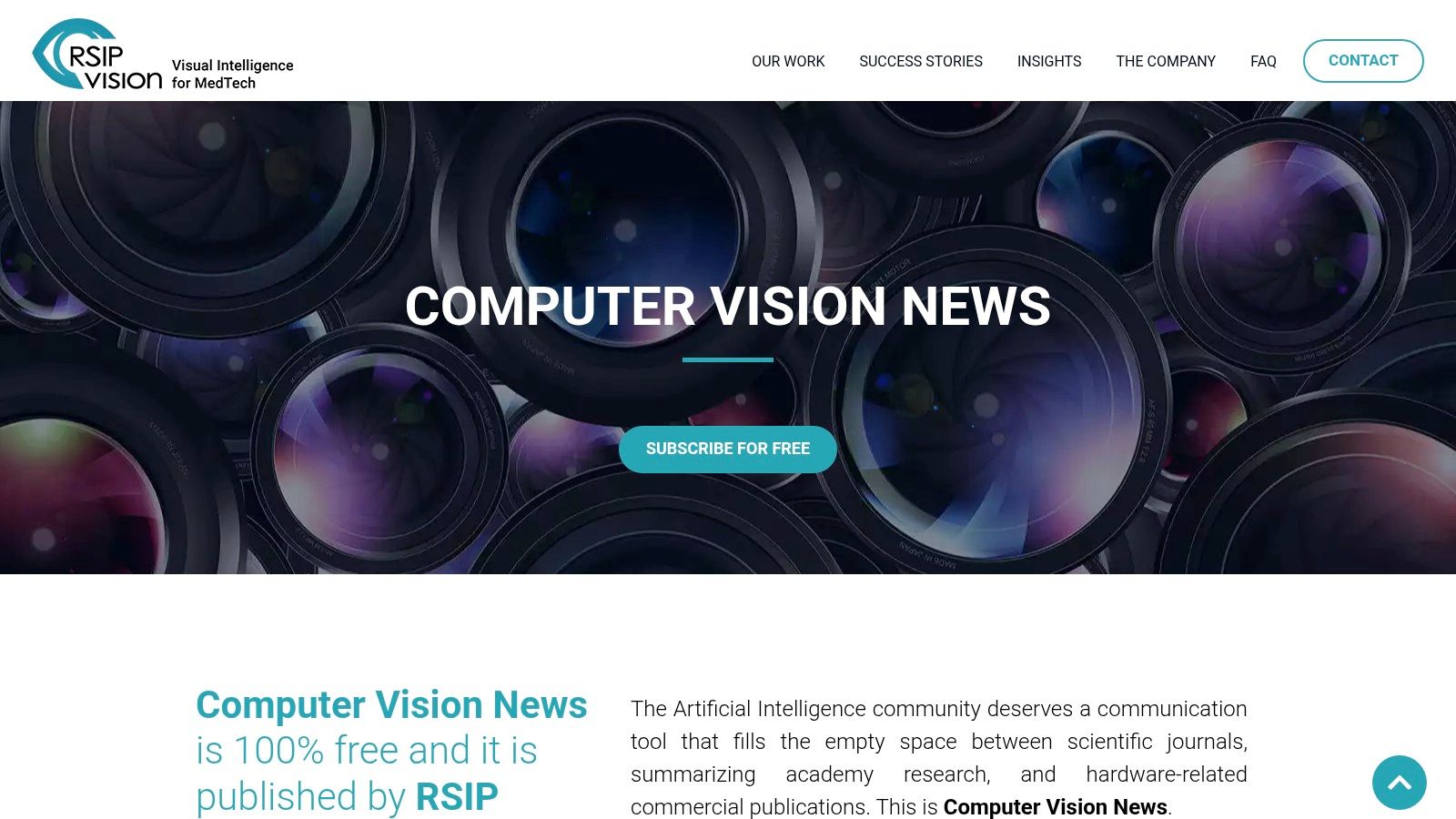
This source really shines with its "Daily" editions during huge academic conferences like CVPR, ICCV, and ECCV. If you can’t fly out to the event, these dailies are the next best thing. They give you on-the-ground highlights and paper summaries that make you feel like you're there. This direct line to fresh research is a goldmine for anyone tracking the latest computer vision news. For those new to the field, these summaries can be a great way to grasp the core ideas that make these innovations possible; you can always learn more about what computer vision is to build your foundation.
What Makes It Stand Out
Computer Vision News isn't just a firehose of information; it's a thoughtfully arranged experience. It includes unique features like "Women in Computer Vision" and insights into managing AI projects, offering perspectives you won't find anywhere else. Plus, the entire archive is free, making it an amazing learning tool.
Expert Opinion: Dr. Sarah Vision, an AI researcher, says, "I recommend Computer Vision News to all my students. It takes complex, peer-reviewed papers on topics like neural radiance fields (NeRFs) and explains them in a way that's both accurate and understandable. It’s the perfect bridge from textbook theory to real-world innovation."
| Feature Highlights | Best For | Access & Cost |
|---|---|---|
| Conference Dailies | Staying current with major academic events. | Free |
| Monthly Magazine | In-depth, curated research summaries. | Free |
| Full Archive | Researching past trends and breakthroughs. | Free |
Pros:
- 100% Free: No subscription fees or paywalls.
- Expert Curation: Bridges the gap between academia and industry with easy-to-understand content.
- Conference Coverage: The official "Dailies" are an unmatched source for timely event highlights.
Cons:
- Slower Cadence: The monthly schedule (outside of conferences) isn’t ideal for breaking news.
- Research-Focused: Less coverage of industry product launches or startup funding news.
Website: https://www.rsipvision.com/computer-vision-news/
2. Computer Vision News (RSIP Vision)
If you're looking for a beautifully curated, magazine-style summary of what’s happening in the research side of AI, Computer Vision News by RSIP Vision is a must-read. It’s a free monthly digital magazine that does a fantastic job of connecting deep academic research with real-world uses. Instead of just throwing a list of new models at you, it offers easy-to-read summaries, chats with top researchers, and spotlights on cool new projects. This makes it a perfect starting point for beginners.
This source really shines with its "Daily" editions during huge academic conferences like CVPR, ICCV, and ECCV. If you can’t fly out to the event, these dailies are the next best thing. They give you on-the-ground highlights and paper summaries that make you feel like you're there. This direct line to fresh research is a goldmine for anyone tracking the latest computer vision news. For those new to the field, these summaries can be a great way to grasp the core ideas that make these innovations possible; you can always learn more about what computer vision is to build your foundation.
What Makes It Stand Out
Computer Vision News isn't just a firehose of information; it's a thoughtfully arranged experience. It includes unique features like "Women in Computer Vision" and insights into managing AI projects, offering perspectives you won't find anywhere else. Plus, the entire archive is free, making it an amazing learning tool.
Expert Opinion: Dr. Sarah Vision, an AI researcher, says, "I recommend Computer Vision News to all my students. It takes complex, peer-reviewed papers on topics like neural radiance fields (NeRFs) and explains them in a way that's both accurate and understandable. It’s the perfect bridge from textbook theory to real-world innovation."
| Feature Highlights | Best For | Access & Cost |
|---|---|---|
| Conference Dailies | Staying current with major academic events. | Free |
| Monthly Magazine | In-depth, curated research summaries. | Free |
| Full Archive | Researching past trends and breakthroughs. | Free |
Pros:
- 100% Free: No subscription fees or paywalls.
- Expert Curation: Bridges the gap between academia and industry with easy-to-understand content.
- Conference Coverage: The official "Dailies" are an unmatched source for timely event highlights.
Cons:
- Slower Cadence: The monthly schedule (outside of conferences) isn’t ideal for breaking news.
- Research-Focused: Less coverage of industry product launches or startup funding news.
Website: https://www.rsipvision.com/computer-vision-news/
3. VentureBeat – AI Section
For all the pros, bosses, and builders out there who need to know the business side of AI, VentureBeat’s AI section is your daily go-to. It’s not just about computer vision, but its coverage is super sharp and always linked to what’s happening in the market. It's the best place to track who's getting funded, what new products the big tech companies are dropping, and how real businesses are using this tech. If you want to know how the latest AI magic is actually making money, this is where you look.
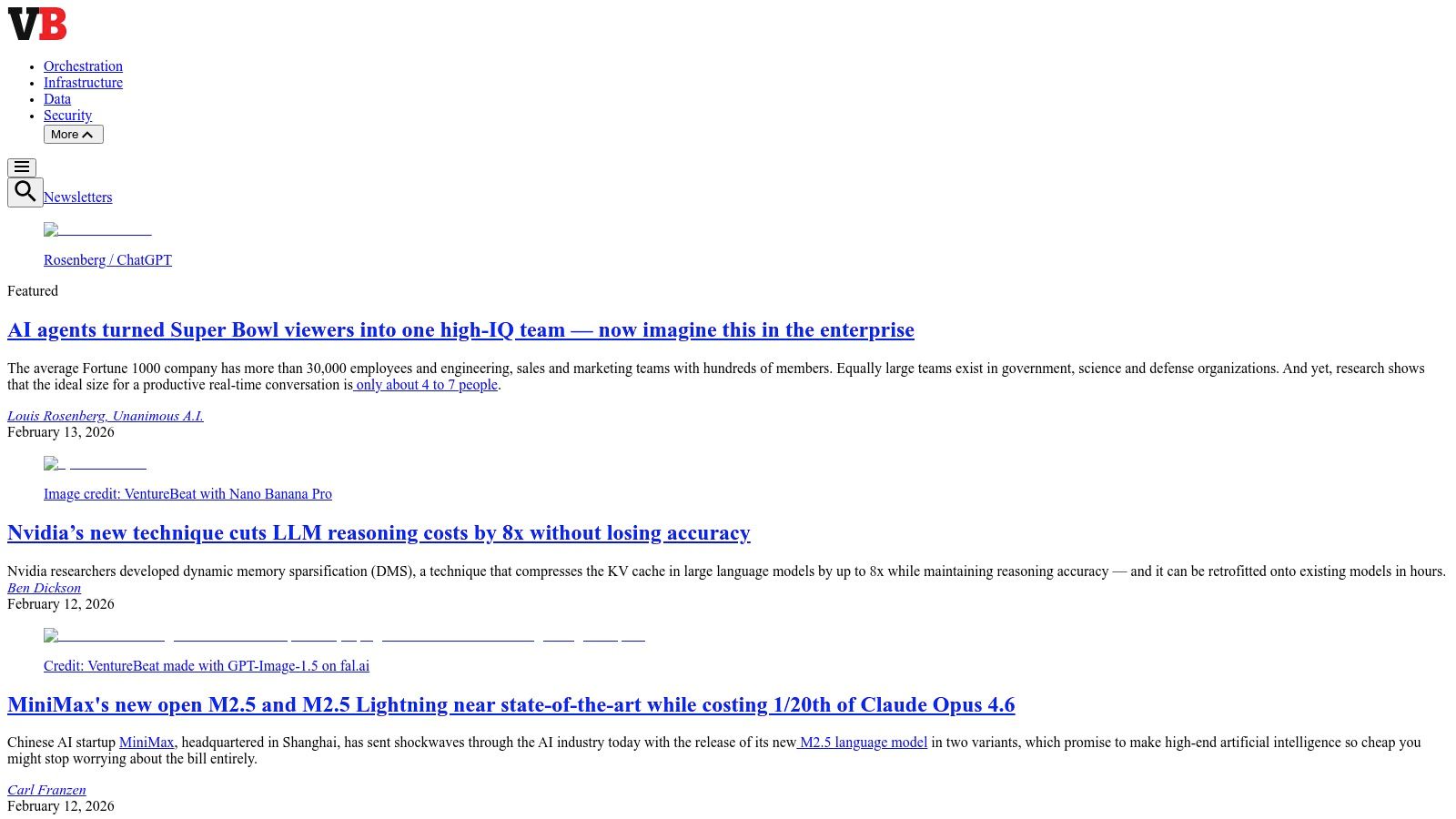
VentureBeat is awesome at connecting the dots. You won't just read that a new algorithm was invented; you'll find out which startup is using it to shake up the retail industry with AI-powered checkout systems, or how a big hospital is using it to analyze medical images faster. This makes it a priceless resource for anyone planning a product launch or deciding where to invest. Their reporting gives you a constant stream of computer vision news framed in the bigger picture of AI in business.
What Makes It Stand Out
Unlike the more academic sources, VentureBeat translates geeky tech talk into smart business strategy. It’s written for people making decisions, giving a clear picture of where the market is headed. They often get the scoop on big stories, giving their readers a head start on what's next.
Expert Opinion: As tech investor Alex Chen notes, "VentureBeat is my first read of the day. They don't just report on a new image generation model; they explain its potential for disrupting marketing, design, and e-commerce. It helps me see where the puck is going, not just where it is."
| Feature Highlights | Best For | Access & Cost |
|---|---|---|
| Daily Reporting | Tracking market momentum and funding. | Free |
| Enterprise Focus | Go-to-market and strategic planning. | Free |
| Industry Events | Networking and high-level trend analysis. | Free / Paid |
Pros:
- Business-Oriented: Translates technical news into practical business and market implications.
- Timely Cadence: Daily reporting keeps you on the pulse of the industry's fast-moving pace.
- Strong Exclusives: Often breaks news on funding, product launches, and major partnerships first.
Cons:
- Not CV-Specific: Requires filtering to find vision-focused articles among broader AI news.
- Contains Sponsored Content: Readers need to distinguish between editorial articles and sponsored posts.
Website: https://venturebeat.com/category/ai/
4. MIT Technology Review – AI Coverage
For folks who want to understand not just the "what" but the "why" behind big AI moments, the MIT Technology Review is a treasure trove. It's not strictly a computer vision site, but its AI reporting gives you the crucial context you need. It connects new vision models to their real-world impact on business, ethics, and society. This makes it perfect for decision-makers who need the big picture, not just the technical details.

Unlike places that just summarize research papers, the Review tells a story. When a new AI image generator comes out, they’re more likely to explore how it might change the lives of artists or the thorny ethical questions it raises. For example, they'd cover how facial recognition is being used in public spaces and what that means for privacy. This high-level view is key for anyone following computer vision news from a strategic angle.
What Makes It Stand Out
The MIT Technology Review’s biggest strength is its serious, high-quality journalism. It cuts through the hype to give you a smart, well-researched take. If you subscribe, you get access to even deeper reports and newsletters like "The Algorithm," which often dive into computer vision topics. It's a great investment for anyone who needs to stay ahead of the curve.
Expert Opinion: Ethicist Dr. Anya Sharma states, "The Review is essential reading. It doesn't just celebrate new technology; it critically examines it. Their articles on algorithmic bias in computer vision systems have been instrumental in shaping a more responsible approach to AI development."
| Feature Highlights | Best For | Access & Cost |
|---|---|---|
| In-Depth Analysis | Understanding the business and societal impact. | Freemium / Paid |
| Subscriber Newsletters | Curated insights delivered to your inbox. | Paid |
| Mobile App & Alerts | Staying informed on major breaking stories. | Free / Paid |
Pros:
- High Editorial Standards: Provides strong signal over noise with trusted, fact-checked reporting.
- Business & Policy Context: Puts computer vision advances into a broader strategic framework.
- Authoritative Voice: Respected journalism that helps you understand what truly matters.
Cons:
- Paywalled Content: Full, unlimited access requires a paid subscription.
- Broad Focus: Not exclusively dedicated to computer vision, so you may need to filter for relevant articles.
Website: https://forms.technologyreview.com/premium-product/
5. arXiv – Computer Vision (cs.CV) Recent
For the techies and researchers who want to be on the absolute cutting edge, the arXiv computer vision section is the place to be. It's not really a news site but a server where scientists upload their research papers, often before they’ve even been officially reviewed. This means you see new ideas, datasets, and models the second they’re shared with the world. It’s the raw, unfiltered stream of scientific progress.
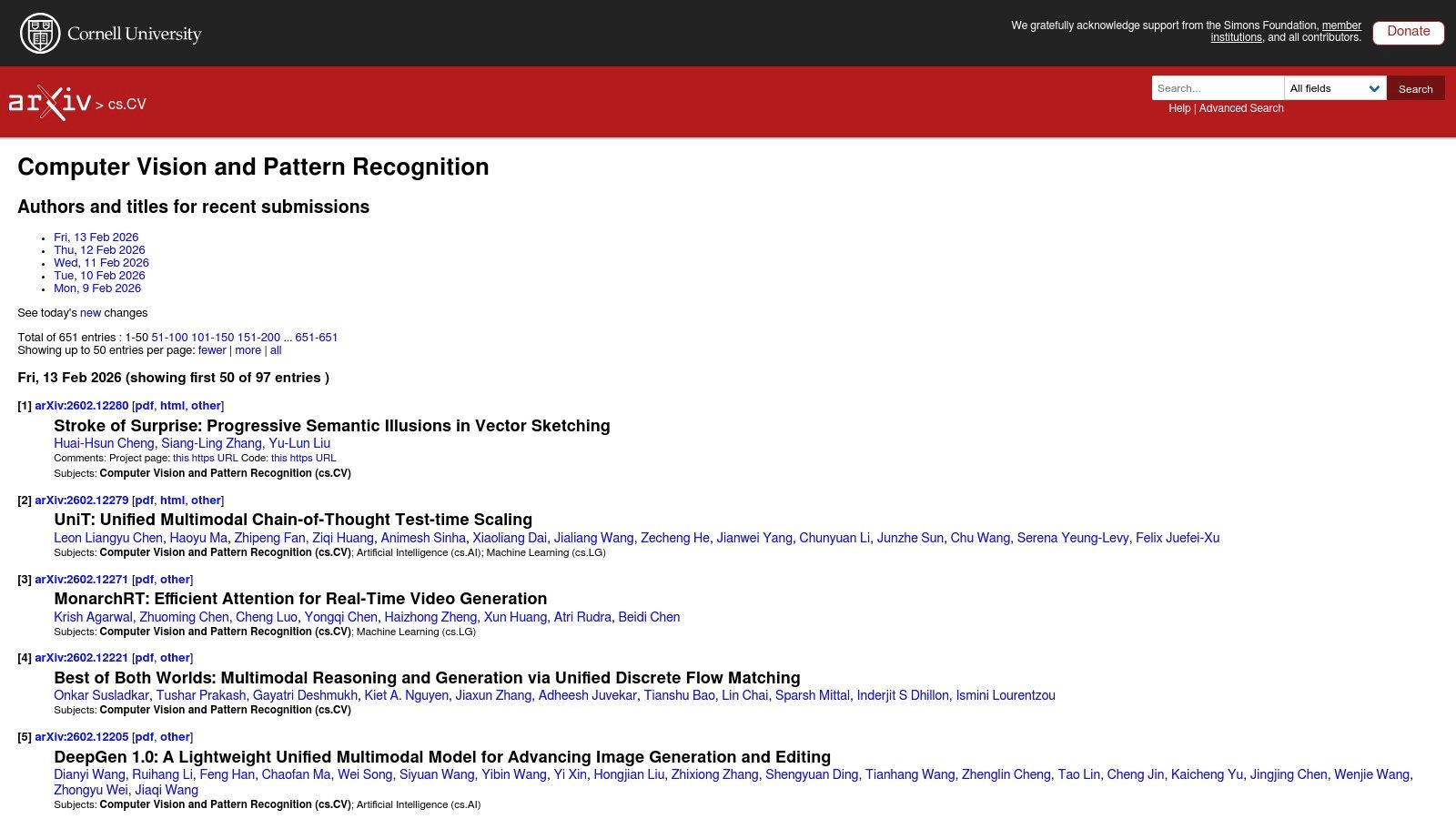
This is where many of the big ideas in AI first show up. By checking the daily cs.CV (that's computer science, computer vision) submissions, you can watch ideas grow in real-time. For example, you might see a new paper on making self-driving car cameras work better in the rain months before it becomes a feature in a real car. It's dense and technical, but finding a game-changing paper here early gives you a huge advantage. This direct feed of computer vision news from the researchers themselves is unbeatable.
What Makes It Stand Out
arXiv is all about speed and open access. There are no editors or delays; it's a direct line from the lab to your screen. While this means the quality can vary, it’s the most complete and up-to-the-minute collection of academic papers out there. Many papers also link to their code on GitHub, so you can actually try out the research yourself!
Expert Opinion: "As a PhD student, I live on arXiv," says AI developer Leo Kim. "It's a firehose of information, but it's where you spot the next big thing. I can read about a new object detection technique in the morning and be testing its code by the afternoon. It's essential for staying technically sharp."
| Feature Highlights | Best For | Access & Cost |
|---|---|---|
| Daily Submissions | Tracking the latest preprints and breakthroughs. | Free |
| Abstracts & PDFs | Immediate access to full research papers. | Free |
| Author/Code Links | Finding source code and related works. | Free |
Pros:
- 100% Free: All papers and content are accessible without cost.
- Unmatched Recency: See research the day it's published, months ahead of official venues.
- Comprehensive Volume: The sheer number of submissions covers virtually every niche in computer vision.
Cons:
- No Peer-Review Filter: Quality varies greatly; requires technical expertise to evaluate papers.
- Raw and Unfiltered: Provides research papers directly, not journalistic summaries or news articles.
Website: https://arxiv.org/list/cs.CV/recent
6. CVF Open Access (Computer Vision Foundation)
For anyone who wants to go straight to the most credible source for research, CVF Open Access is it. Run by the Computer Vision Foundation, this site is the official home for papers from the world's top conferences like CVPR, ICCV, and ECCV. It’s not a "news" site with articles, but it's where the most important computer vision news begins. It gives you direct, free access to the research that will shape the future of the industry.
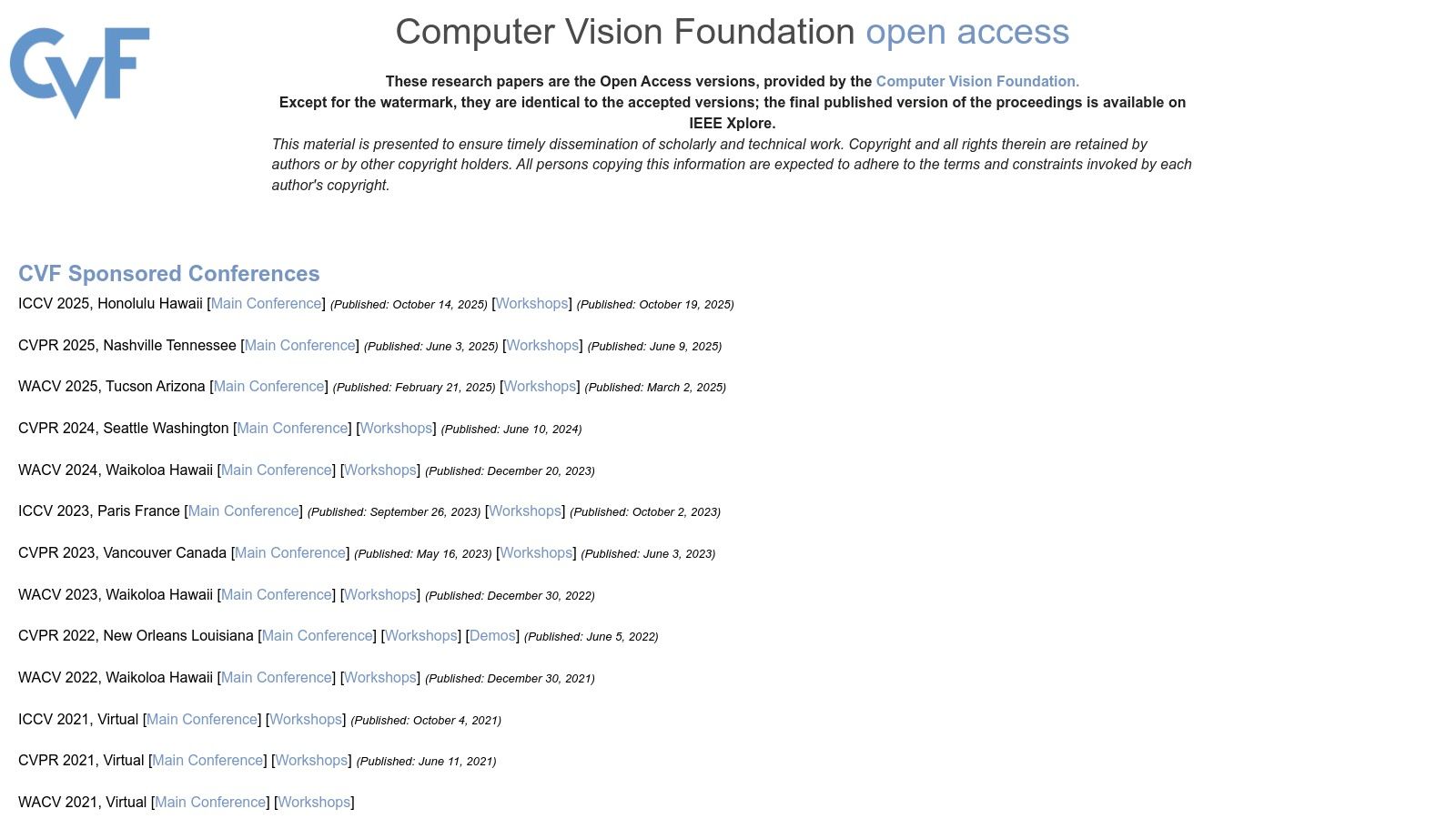
During conference season, this website becomes the center of the computer vision universe. As soon as papers are accepted, they pop up here, often before anyone else has had a chance to write about them. This lets you read the original work, see the data, and decide for yourself what’s important. For example, you could read the very paper that introduced a new way to create 3D models from 2D photos, straight from the authors. This is a must-have for anyone serious about the tech.
What Makes It Stand Out
CVF Open Access is the official library for the best academic work in the field. Unlike other sites that give you their interpretation, this platform gives you the raw material. The website is simple and built for one thing: helping you find and download the exact paper you need, with no ads, paywalls, or sign-ups.
Expert Opinion: Professor Jian Li, a leading academic, advises, "Before you trust a summary, read the source. CVF Open Access is the source of truth. It's where my peers and I publish our most significant work. It’s the definitive record of our field's progress."
| Feature Highlights | Best For | Access & Cost |
|---|---|---|
| Direct Paper Access | Reading original, peer-reviewed research. | Free |
| Major Conference Archives | Finding state-of-the-art papers from top events. | Free |
| Workshop Proceedings | Exploring niche topics and emerging ideas. | Free |
Pros:
- Authoritative Source: The official repository for top-tier conference papers.
- Completely Free: No fees, subscriptions, or login required for full access.
- Timely Updates: Papers are often posted concurrently with conference schedules.
Cons:
- No Editorial Content: It's a pure archive with no summaries, analysis, or context.
- Highly Technical: Content is dense academic papers, not suitable for casual readers.
- Uneven Cadence: Content is released in large batches around conference dates.
Website: https://openaccess.thecvf.com/
7. NVIDIA Technical Blog – Computer Vision / Video Analytics
For all the engineers and developers building stuff in the real world, the NVIDIA Technical Blog is a fantastic resource for computer vision news and hands-on advice. Unlike purely academic sites, this blog is all about the practical side: getting models to work, making them run fast on hardware, and using industry-standard tools. It’s the place to learn about building robot perception, analyzing video streams, or using NVIDIA’s powerful toolkits like Jetson and DeepStream.
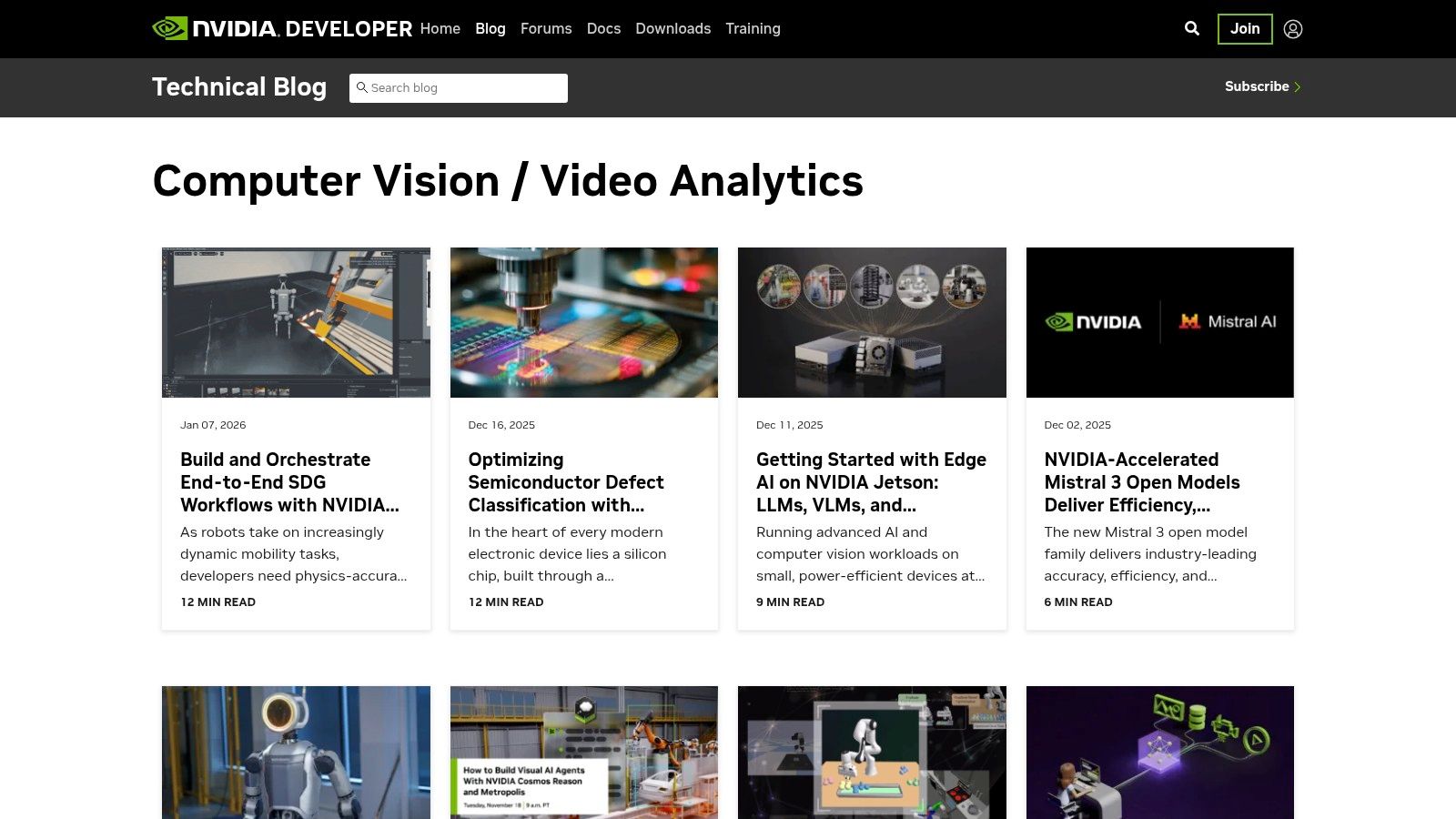
The content here is super valuable because it comes from the people who make the hardware and software that so many of us use. You’ll find detailed tutorials and case studies that explain not just the "what" but the "how." For instance, you could find a step-by-step guide on setting up a smart camera system to count inventory in a warehouse. For those looking to delve deeper into building their own AI models or applications, understanding the process of gathering raw data is crucial. Learn more about how to approach scraping data for AI to feed the powerful models discussed in these articles.
What Makes It Stand Out
The NVIDIA blog is all about actionable advice. It makes complex topics like hardware acceleration feel much more approachable. Posts often explore how to optimize convolutional neural networks for small devices or how to build efficient systems, giving you tips you can use in your own projects right away. It's a breath of fresh air compared to high-level news sites.
Expert Opinion: "The NVIDIA blog is my secret weapon," shares robotics engineer Maria Flores. "Theory is one thing, but making a vision model run efficiently on an actual robot is another. Their posts on optimizing inference with TensorRT have saved me weeks of work. It's practical, it's relevant, and it works."
| Feature Highlights | Best For | Access & Cost |
|---|---|---|
| Practical Tutorials | Engineers deploying CV models on NVIDIA hardware. | Free |
| Performance Guides | Optimizing inference speed and efficiency. | Free |
| Platform Updates | Staying current with NVIDIA's CV toolchains. | Free |
Pros:
- Actionable Content: Practitioner-friendly tutorials and how-tos from a core CV vendor.
- Performance-Focused: Timely posts on deployment, hardware acceleration, and optimization.
- Direct from the Source: Authoritative information on NVIDIA's own SDKs and platforms.
Cons:
- Vendor-Specific: Heavily emphasizes the NVIDIA ecosystem; less useful if you use other stacks.
- Not a General News Site: Focuses on tooling and implementation, not broad industry news.
Website: https://developer.nvidia.com/blog/category/computer-vision/
Computer Vision News: 7-Source Comparison
| Item | 🔄 Implementation complexity | ⚡ Resource requirements | 📊 Expected outcomes | 💡 Ideal use cases | ⭐ Key advantages |
|---|---|---|---|---|---|
| 12 Best Free AI Image Generators to Try in 2025 | 🔄 Low — web/UI-driven, no install | ⚡ Low — free tiers, limited resolution/quotas | 📊 Varied outputs: quick concept art to stylized images | 💡 Rapid prototyping, social assets, learning prompts | ⭐ Curated, hands-on tips; free-focused recommendations |
| Computer Vision News (RSIP Vision) | 🔄 Low — read/subscribe; no setup | ⚡ Low — web/email access | 📊 Curated summaries and conference dailies | 💡 Practitioners/researchers wanting conference highlights | ⭐ 100% free, readable summaries and official dailies |
| VentureBeat – AI Section | 🔄 Low — browse site or newsletter | ⚡ Low — web access; optional sign-up | 📊 Timely business- and product-focused reporting | 💡 Executives and builders tracking market/product trends | ⭐ Fast, business-centric coverage and exclusives |
| MIT Technology Review – AI Coverage | 🔄 Low — reading; subscription for premium | ⚡ Medium — paywall for full access | 📊 In-depth explainers and context on impact | 💡 Decision-makers seeking authoritative analysis | ⭐ High editorial standards and deep analysis |
| arXiv – Computer Vision (cs.CV) Recent | 🔄 Medium — requires filtering and domain knowledge | ⚡ Low — free access but time-intensive | 📊 Immediate access to newest preprints and code links | 💡 Researchers tracking cutting‑edge methods and datasets | ⭐ Fastest source for new CV research (open access) |
| CVF Open Access (Computer Vision Foundation) | 🔄 Medium — browse by conference/year | ⚡ Low — free, conference-timed postings | 📊 Authoritative accepted papers and workshop outputs | 💡 Finding peer-accepted conference papers and proceedings | ⭐ Definitive archive for top CV conferences |
| NVIDIA Technical Blog – Computer Vision / Video Analytics | 🔄 Medium — applied tutorials, hands-on guides | ⚡ Medium — assumes NVIDIA tools/hardware familiarity | 📊 Actionable deployment guides and performance tips | 💡 Engineers deploying CV systems on NVIDIA stacks | ⭐ Practical, performance-oriented vendor expertise |
What's Next? Putting Your Knowledge into Practice
Okay, so we've covered a bunch of great resources to keep you up-to-date on computer vision news, from business news on VentureBeat to hardcore research on arXiv. But the journey doesn't stop here! This field is all about learning, trying things out, and building cool stuff. The main takeaway is that no single source has everything. The best way to learn is by mixing it up: get the industry scoop from NVIDIA, the academic facts from the CVF, and the easy-to-understand summaries from places like MIT Tech Review.
By picking and choosing from these sources, you’re not just reading the news. You're building a mental map of the field, understanding why new tech matters, and spotting opportunities to use it yourself.
Turning News into Actionable Intelligence
Information is most powerful when you do something with it. As you follow the latest computer vision news, the real magic happens when you turn those updates into action. Whether you're a developer, a business owner, or just an enthusiastic beginner, here’s how to go from knowing to doing.
When you hear about a new tool or idea, ask yourself these questions:
- Does this help me? A new 3D modeling technique from a research paper is awesome, but if you just need to build a simple app that detects cats in photos, an older, simpler solution might be better and faster.
- How hard is it to use? A tutorial on NVIDIA’s blog might give you code you can run in an afternoon. On the other hand, a purely theoretical paper from arXiv might require a PhD in math to understand and build from scratch.
- Is anyone else using it? A project with a big community on GitHub is great because it means you can get help when you’re stuck. A brand new, obscure tool might leave you on your own.
- What kind of computer do I need? Some of these amazing AI models need powerful, expensive computers to run. That's a huge factor if you're a student or a small startup. Always check the hardware requirements!
Your Personalized Learning Path
To make this feel less overwhelming, start small. Don't try to follow all seven sources at once! Just pick one or two that match your goals and check them out regularly.
- For the Entrepreneur: Stick with VentureBeat and MIT Technology Review to spot business trends. Ask yourself, "How could this new AI that analyzes satellite images help farmers in my area?"
- For the Developer: Make the NVIDIA blog and arXiv your best friends. Give yourself a little challenge: try to rebuild a small part of a new technique you read about. Getting your hands dirty is the best way to learn.
- For the Enthusiast: Start with the easy stuff! Play around with free AI image generators and read the high-level summaries from RSIP Vision. This will build your confidence and help you have smarter conversations about AI.
At the end of the day, keeping up with computer vision news is more than just knowing fancy terms. It’s about building a habit of learning that lets you create, solve problems, and be part of one of the most exciting movements in technology. The knowledge is all out there waiting for you—the next step is to start building something amazing.
Keeping up with every new tool and paper can be overwhelming. At YourAI2Day, we curate, simplify, and deliver the most important AI news and insights directly to you, so you can spend less time searching and more time creating. Stay ahead of the curve by visiting us at YourAI2Day and discover your next big idea.