10 Practical Business Process automation examples for Your Small Business
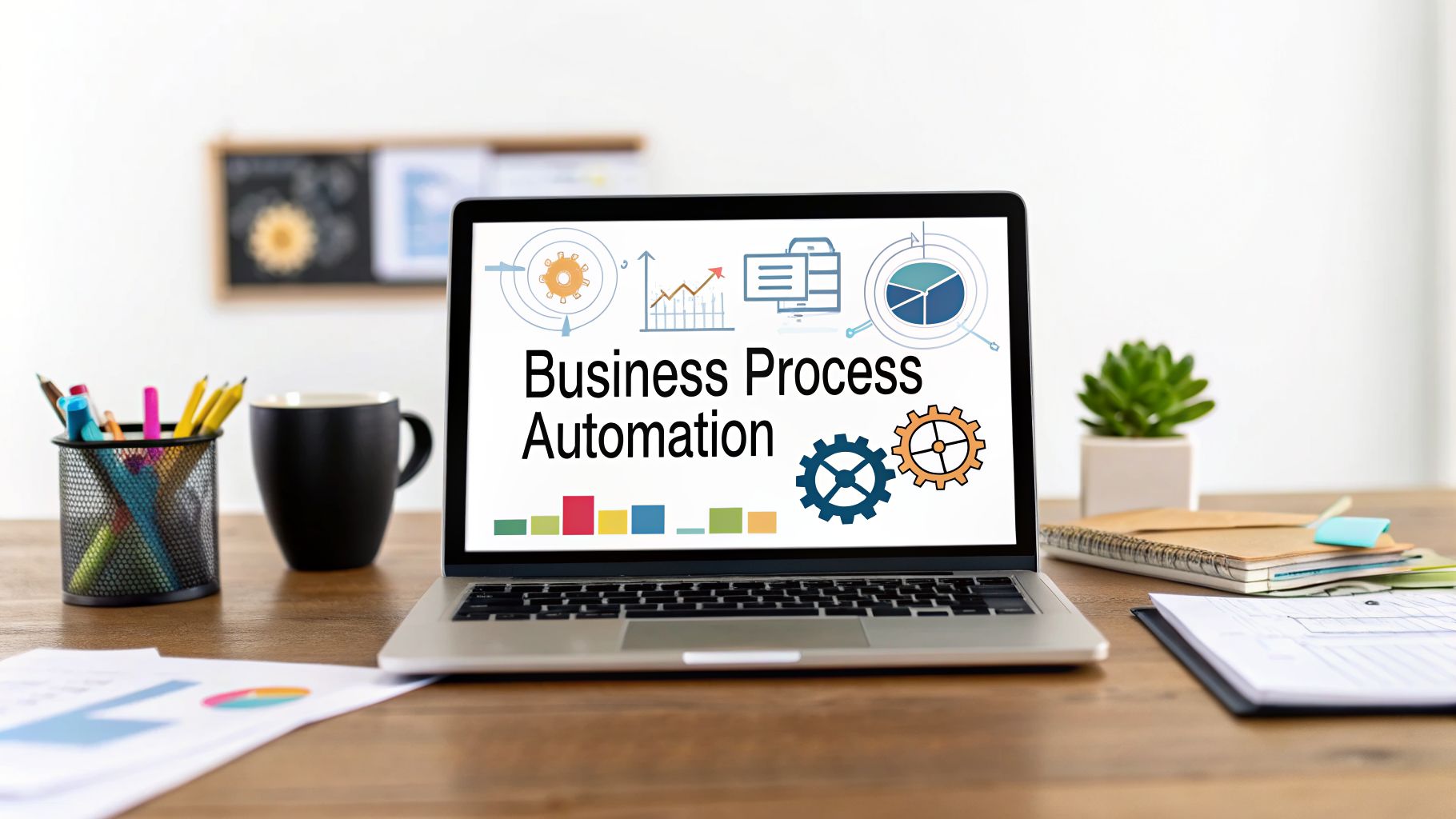
Hey there! If you're a business owner or team lead feeling buried under a mountain of repetitive tasks, you've come to the right place. Let's talk about Business Process Automation (BPA). Forget the complex jargon; BPA is simply about using smart tools to handle the boring stuff, so you and your team can focus on what really matters—growing your business.
This guide is for anyone new to automation, especially if you're feeling overwhelmed by all the buzz around AI. We’re skipping the dense theory to show you how automation works in the real world with some super practical business process automation examples. We'll break them down by department—HR, finance, sales—you name it. For each one, you'll get:
- Actionable tips you can use right away.
- Simple ways to track if it's working (KPIs).
- Tool ideas to get you started.
Even better, you don't need to be a coding genius. A lot of modern automation is built on "low-code" platforms. If you've ever used a drag-and-drop website builder, you've got the basic idea. Microsoft's Power Platform, for instance, is a suite of low-code automation tools that makes building workflows much easier. Our goal is to give you a clear map to put routine work on autopilot. Let's dive in and see how you can free up your team for the fun, creative work that drives your business forward.
1. Invoice Processing and AP Automation
Chasing invoices, manually typing in data, and dealing with piles of paper—sound familiar? This is a classic time-sink for any business, big or small. It’s not just tedious; it's also prone to human error, which can lead to late payments and unhappy vendors. Accounts Payable (AP) automation is a fantastic first business process automation example to tackle.
Imagine a system that automatically "reads" invoices the moment they land in your inbox. Using technology called Optical Character Recognition (OCR), it scans and pulls out key info like the vendor name, amount due, and invoice number. Then, it checks this against your purchase orders and sends it to the right person for approval, all based on rules you set up.
Strategic Breakdown
- Accuracy Boost: Think of this as more than just reading text. Modern systems use AI and machine learning to understand the context of an invoice. They can spot the vendor, line-item details, and even get smarter over time. This is a great illustration of the practical difference between AI and automation—the AI adds a layer of intelligence to an otherwise repetitive task.
- Cost and Time Reduction: Automation can slash invoice processing costs by over 80%. Instead of taking days or weeks, an invoice can be processed in hours. This also means you can take advantage of early payment discounts from vendors!
- Enhanced Visibility: No more "Where is that invoice?" emails. A digital system gives you a real-time dashboard showing the status of every single payment, making cash flow forecasting a breeze.
Actionable Takeaways
To get started, don't try to automate everything at once. Pick your top 5-10 vendors who send you the most invoices in a standard format. This will give you a quick, satisfying win and help your team get comfortable with the new system.
Expert Tip: Before you automate, grab a whiteboard (or a big piece of paper) and map out your current approval process. Who needs to sign off on what? What happens if an invoice is over a certain amount? Documenting this a a blueprint is crucial for setting up the software correctly.
Tools like UiPath Document Understanding, SAP's intelligent processing, and solutions from Automation Anywhere provide robust platforms for building and deploying these automations. They integrate directly with existing ERP and accounting systems, creating a seamless flow of financial data.
2. Email and Document Routing with AI
We all know the pain of an overflowing inbox. Important requests get buried, and responses get delayed. AI-powered email and document routing is a game-changer. It automatically sorts, prioritizes, and forwards incoming messages to the right person or department—instantly.
This type of business process automation uses something called Natural Language Processing (NLP) to understand what an email is about. Based on what it "reads," it applies rules you've created to send it to the right place. This is a lifesaver for anyone dealing with lots of customer inquiries or support tickets.

Strategic Breakdown
- Accelerated Response Times: Instead of one person manually sorting a shared inbox (like
[email protected]), the AI does it in seconds. A sales lead goes to the sales team, a support question goes to the helpdesk, and a billing query goes to finance. Response times drop from hours to minutes. - Improved Accuracy and Consistency: The AI applies the same rules every single time, removing human error and subjectivity. No more accidentally sending a big sales lead to the wrong person!
- Intelligent Prioritization: The AI doesn't just route; it prioritizes. It can spot urgent words like "system down" or recognize an email from a VIP client and flag it for immediate attention. This helps your team focus on what's most important first.
Actionable Takeaways
Start by defining your main email categories. Think about the most common types of emails you get, like "Sales Inquiry," "Technical Support," or "Invoice Question." You can even look at your past emails to train the AI on how to classify new messages correctly.
Expert Tip: Create a simple way for your team to give feedback. If an email gets misrouted, have a button or a folder where they can move it. This not only fixes the immediate error but also teaches the AI to be more accurate next time. It's like training a very smart assistant.
Tools like Microsoft 365's intelligent routing features, Google Workspace automation rules, and platforms from Kore.ai or IBM Watson offer powerful capabilities. They can be combined with chatbots to provide an initial automated response while the email is being routed, further improving the customer experience.
3. HR Onboarding and Employee Lifecycle Automation
A new hire's first few weeks are a huge deal, but manual onboarding can be a mess of paperwork, delayed logins, and inconsistent training. It’s a bad first impression that puts a lot of stress on your HR team. Automating HR tasks, from welcoming new hires to managing payroll, is another powerful business process automation example that makes life easier for everyone.
It works by creating a digital checklist. When a new hire signs their offer, the system can automatically: send out contracts for e-signature, request necessary documents, set up their email and Slack accounts, and even enroll them in their first training modules. The same logic works for offboarding, ensuring a secure and smooth exit.
Strategic Breakdown
- Improved Employee Experience: A smooth, automated welcome makes new hires feel valued and ready to go. They get the tools and info they need on day one, helping them feel productive faster and improving retention in the long run.
- Compliance and Security: Automation ensures everyone follows the same process. Every new hire fills out the right forms, and every departing employee's access is shut down immediately, closing security gaps and reducing compliance risks.
- Scalable HR Operations: This is huge for growing businesses and entrepreneurs. Automation lets your HR function scale without having to hire more admin staff. Your team can then focus on the human side of HR—like building culture, developing talent, and keeping employees happy.
Actionable Takeaways
Start with the most repetitive part of your onboarding process, which is usually collecting new hire paperwork and setting up their IT accounts. This gives you an immediate win and builds momentum for automating more complex tasks later on.
Expert Tip: Before automating anything, get your HR team in a room and map your current onboarding and offboarding processes from start to finish. Identify every manual step, every email, and every point of friction. This map is your blueprint for a successful automation project and ensures you get early buy-in from the people who will use it most.
Tools from Workday, SAP SuccessFactors, and BambooHR offer extensive built-in automation features. For more customized workflows that connect multiple disparate systems, RPA platforms like UiPath and Automation Anywhere can bridge the gaps, creating a truly end-to-end automated employee journey.
4. Customer Service Chatbots and Ticket Automation
Manual customer support can quickly get swamped with the same questions over and over, leading to long waits and unhappy customers. A classic business process automation example is using AI-powered chatbots to handle the frontline. These bots can offer 24/7 support, instantly answering common questions and freeing up your human agents for the more complex issues.

Using Natural Language Processing (NLP), these bots understand what a customer is asking for, categorize the support ticket, and send it to the right person. For phone calls, an automated phone answering service can handle initial questions and direct callers efficiently, ensuring a smooth handoff. It’s all about getting customers the help they need, faster.
Strategic Breakdown
- Instant Gratification: Chatbots can resolve up to 80% of routine questions like "Where is my order?" or "How do I reset my password?" without any human help. That immediate answer is what customers love.
- Intelligent Triage: AI analyzes incoming support tickets to figure out their urgency and topic. It then automatically assigns them to the right team, so critical issues get addressed first and nothing gets lost.
- Continuous Improvement: These bots learn from every conversation. By analyzing what worked and what didn't, the bot's answers get more accurate and helpful over time.
Actionable Takeaways
Start by identifying your top 10-15 most frequently asked questions. You can find these by looking through your support emails and chat logs. Build your chatbot's knowledge base around these questions to make an immediate impact.
Expert Tip: Always provide an easy "escape hatch" to a human. The goal is to help customers, not trap them in a frustrating bot loop. Make the "talk to a person" option obvious and easy to find. This protects your brand and keeps customers happy.
Tools like Zendesk, Intercom, and Drift provide powerful, user-friendly platforms for building and deploying these automations. For more custom solutions, frameworks like Google's Dialogflow and Amazon Lex offer the building blocks for creating highly specialized conversational AI experiences.
5. Contract Lifecycle Management and Review Automation
Manually managing contracts is a high-stakes, stressful job. It involves drafting, reviewing endless clauses, and tracking critical dates for renewals. It's not only slow but also risky—a missed deadline or a bad clause can cost you a lot of money.
Contract Lifecycle Management (CLM) automation helps by using AI to manage contracts from start to finish. These systems can automatically create agreements from templates, pull out key terms like dates and obligations, and flag risky language for your legal team to review. This is one of the more advanced business process automation examples, showing how AI can provide deep analysis on top of a standard workflow.
Strategic Breakdown
- Risk Mitigation: The AI can compare a new contract against your pre-approved legal language. It instantly highlights weird wording, missing clauses, or high-risk terms, so your legal team can focus on the real problems.
- Accelerated Sales Cycles: By automating the review of routine contracts like NDAs, you can get deals signed much faster. This frees up your legal team from boring admin work and lets your sales team close deals.
- Proactive Management: Get automatic alerts for important dates, like contract renewals or expirations. This prevents you from missing opportunities or accidentally letting a contract lapse. This principle of intelligent interaction also applies to AI-powered customer service agents.
Actionable Takeaways
Start with your most standard, high-volume agreements, like Non-Disclosure Agreements (NDAs). This lets you build and test your rules on lower-stakes documents before moving on to more complex contracts.
Expert Tip: Involve your legal team from day one. Their expertise is crucial for building the custom clause libraries and setting the risk-scoring rules that power the automation. The goal is to augment your legal experts, not replace them.
Tools like Icertis Contract Intelligence, ContractPodAi, and Kira Systems offer powerful platforms for this purpose. They are designed to analyze complex legal language and integrate with CRM and ERP systems, providing a single source of truth for all contractual data.
6. Lead Scoring and Sales Pipeline Automation
Sales teams often struggle to figure out which leads are ready to buy versus who's just window-shopping. Manually qualifying leads is slow and subjective, leading reps to waste time on dead ends while hot leads go cold. Automating lead scoring helps by using data to objectively prioritize the best opportunities.
This type of automation uses algorithms to analyze a lead's behavior. Did they open an email? Visit your pricing page? Do they work for the right kind of company? Based on these actions, it assigns a score to each lead. High-scoring leads are automatically sent to your sales reps, giving them a prioritized list of who to call first. This is a business process automation example that directly boosts your revenue.
Strategic Breakdown
- Focus on High-Value Opportunities: By automatically ranking leads, automation ensures your sales team spends their time on people who have shown real buying intent. This improves conversion rates and shortens the sales cycle.
- Sales and Marketing Alignment: An automated scoring system gets your sales and marketing teams on the same page. Marketing can see which campaigns are bringing in quality leads, and sales gets prospects who are genuinely interested, reducing friction between the two teams.
- Predictive Insight: Modern systems use AI to go even further. They can analyze past data to predict which deals are at risk of falling through and forecast future revenue more accurately. This gives you a much clearer view of your business's health.
Actionable Takeaways
Start by defining what a "quality lead" really means for your business. Look at your past sales data—both wins and losses—to identify the common behaviors and attributes that signal a great prospect.
Expert Tip: Don't set your scoring rules and forget them. Check in regularly and adjust the scores based on what's working. A lead characteristic that was important last quarter might be less relevant today. Constant tuning keeps the system effective.
Tools like Salesforce Einstein, HubSpot's predictive lead scoring, and 6sense offer robust platforms for this. They integrate with your CRM and marketing tools to create a unified system for managing and converting leads from initial contact to a closed deal.
7. Expense Report Processing and Reimbursement Automation
Managing expense reports is a universal headache. It’s a mess of lost receipts, manual data entry, and slow reimbursements that frustrates everyone. Automating this process is another excellent business process automation example that delivers immediate relief.
Modern expense apps use OCR to scan receipts from a photo on your phone. The system automatically pulls out the vendor, date, and amount, then uses AI to categorize the expense and check it against your company policy. If everything looks good, it's automatically approved and queued for reimbursement. If there's an issue, it's flagged for a manager to review.
Strategic Breakdown
- Policy Enforcement and Compliance: Automation enforces your spending rules in real time. If an employee tries to submit a meal expense that's over the limit, the system can flag it instantly. This stops non-compliant spending before it even happens.
- Employee Experience Boost: This makes a huge difference for your team. Instead of hoarding receipts and spending hours on a spreadsheet, they can submit expenses in seconds. Happy employees and faster reimbursements for everyone!
- Fraud Detection: AI can analyze spending patterns to spot anomalies and potential fraud. For example, it can identify duplicate receipts or unusually high expenses, providing a layer of security that manual checks often miss.
Actionable Takeaways
Start by clearly communicating the new process and policies to all employees. Test it with a small pilot group, like your most frequent travelers, to work out any kinks before you roll it out to the whole company.
Expert Tip: Create a detailed and easily accessible digital guide to your expense policy. The automation software relies on these rules, so having a clear, unambiguous policy is the foundation for a successful implementation. Ensure it covers everything from per diems to what constitutes an acceptable receipt.
Tools like Expensify, SAP Concur, and Divvy are leaders in this space, offering mobile-first solutions that make expense reporting nearly effortless. These platforms often integrate directly with corporate credit cards and accounting software, creating a closed-loop system for managing all business spending.
8. Data Entry and Form Processing Automation
Manual data entry is the definition of a repetitive, mind-numbing task. It's slow, prone to errors, and eats up valuable hours that could be spent on much more important work. Automating data entry is one of the most accessible and impactful business process automation examples, especially for beginners.

This automation uses "bots" (Robotic Process Automation or RPA) to act like a human. These bots can read information from forms, emails, or scanned documents, copy the data, and paste it into other systems like your CRM or a spreadsheet—all without a single keystroke from a person.
Strategic Breakdown
- Foundation for Bigger Projects: Data entry is the perfect starting point for your automation journey. It's rule-based and high-volume, making it an ideal candidate for a quick win. This helps you build confidence and get buy-in for more ambitious projects later.
- Drastic Error Reduction: Unlike humans, bots don’t get tired or make typos. They enter data with near-perfect accuracy, eliminating costly mistakes in customer records, financial reports, and inventory.
- Immediate Productivity Gains: Freeing your team from data entry allows them to focus on problem-solving, analysis, and customer interaction. This not only boosts productivity but also makes their jobs more interesting and fulfilling.
Actionable Takeaways
To begin, pick a process that's both high-volume and simple, like processing standardized customer sign-up forms. This minimizes risk and gives you a clear way to measure how much time and effort you're saving.
Expert Tip: Before writing a single line of automation script, document every data field and its destination. Create a clear "map" that shows exactly where information from Field A on the source form needs to go in Field X of the target application. This mapping document is the blueprint for your bot.
Tools like UiPath Document Understanding, Automation Anywhere IQ Bot, and ABBYY FlexiCapture are purpose-built for this. They offer user-friendly interfaces to train bots on different document types and integrate them seamlessly into your existing software stack.
9. Supply Chain and Inventory Management Automation
Managing a supply chain with manual processes is like trying to navigate a maze blindfolded. It's full of stockouts, overstocking, and shipping delays that hurt your bottom line. Supply chain automation uses technology to manage and optimize everything from inventory levels to final delivery.
This process often uses AI to analyze past sales data, market trends, and even external factors like holidays to predict what customers will want to buy. Based on these predictions, the system can automatically create purchase orders, adjust stock levels, and provide real-time tracking of shipments. This is a critical business process automation example for any business that sells physical products.
Strategic Breakdown
- Predictive Demand Forecasting: AI goes beyond simple guesswork. It identifies complex patterns to produce surprisingly accurate demand forecasts. This helps you stock the right products at the right time, minimizing both lost sales and costly excess inventory.
- Dynamic Inventory Optimization: Automation doesn't just order more stock; it optimizes it. The system can automatically rebalance inventory between locations, suggest when to reorder, and identify slow-moving products that need to be put on sale, freeing up your cash. Much of this relies on processing documents like purchase orders, a task where AI-powered document processing software is a huge help.
- Improved Resilience: A digitized supply chain gives you a full view of what's happening. When disruptions occur, like a shipping delay, the system can instantly alert you and even suggest alternative solutions, making your whole operation more agile.
Actionable Takeaways
To start automating your supply chain, start small. Focus on a single product line or a specific warehouse to pilot the technology. This allows you to work out kinks and demonstrate value before a company-wide implementation.
Expert Tip: Data quality is everything. Before you implement any new system, conduct a thorough audit of your existing data sources, including sales history, supplier lead times, and inventory records. Inaccurate or incomplete data will only lead to poor automated decisions.
Tools like SAP Integrated Business Planning, Oracle SCM Cloud, and Blue Yonder offer powerful platforms for this type of automation. They integrate with existing enterprise systems to create a unified view of your supply chain operations.
10. Compliance and Regulatory Reporting Automation
Keeping up with rules and regulations is a huge challenge, especially for businesses in fields like finance and healthcare. Manually monitoring for changes to laws like GDPR or HIPAA is a draining, high-risk job. One mistake can lead to big fines and damage to your reputation.
Compliance automation helps by creating a system that automatically monitors regulatory updates, scans your internal data, and generates the necessary reports. This business process automation example is all about managing risk. The system can flag potential compliance issues in real time, letting you fix them before they become serious problems.
Strategic Breakdown
- Risk Mitigation: Automated systems continuously scan for regulatory changes, giving you timely alerts. This proactive monitoring ensures you're never caught by surprise by a new rule, dramatically reducing the risk of fines.
- Operational Efficiency: Automation frees your compliance team from the manual grind of collecting data and preparing reports. They can then focus their expertise on interpreting complex rules and advising the business—a much better use of their time.
- Audit Trail and Defensibility: Every action and report is logged automatically, creating a detailed audit trail. This is incredibly valuable during an external audit, providing clear proof that you have strong compliance processes in place.
Actionable Takeaways
Start by identifying your most critical and time-consuming compliance task. Whether it's preparing for a specific audit or generating a monthly data privacy report, focus on automating one high-impact area first to prove the value.
Expert Tip: Involve your legal and compliance experts from day one. Their knowledge is essential for configuring the system's rules and workflows correctly. Automation tools are powerful, but they are only as good as the legal logic they are programmed to follow.
Tools such as Workiva's Wdesk, Compliance.ai, and platforms from major consulting firms like Deloitte and EY offer specialized solutions. These systems often include pre-built libraries for major regulations and integrate with your existing business systems to pull the necessary data for reporting.
Top 10 Business Process Automation Use Cases Comparison
| Use Case | 🔄 Implementation Complexity | ⚡ Resource Requirements | 📊 Expected Outcomes | 💡 Ideal Use Cases | ⭐ Key Advantages |
|---|---|---|---|---|---|
| Invoice Processing and AP Automation | Medium–High; ERP integration & training required | High; OCR, connectors, licensing, data mapping | ⭐⭐⭐⭐; 80–90% faster processing, fewer payment errors | 💡 High-volume invoicing, finance teams, centralized AP | Reduces errors; improves cash flow visibility; audit trails |
| Email and Document Routing with AI | Medium; needs training data and rule tuning | Medium; NLP models, historical email dataset, monitoring | ⭐⭐⭐; 60–70% less handling time, improved response SLAs | 💡 Customer-facing teams, high email volume orgs, support centers | Faster routing; better prioritization; phishing detection |
| HR Onboarding and Employee Lifecycle Automation | Medium; multiple HR system integrations | Medium; HRIS connectors, background check APIs, workflows | ⭐⭐⭐⭐; onboarding reduced to days, ~40% lower HR costs | 💡 Scaling startups, fast-growing companies, distributed teams | Consistent onboarding; compliance; reduced admin burden |
| Customer Service Chatbots and Ticket Automation | Medium; dialog design + NLU tuning | Medium; conversational AI, CRM integration, training data | ⭐⭐⭐⭐; handles 50–80% inquiries, ~90% faster responses | 💡 High-volume support, 24/7 service needs, FAQ-heavy products | 24/7 support; lower support costs; faster resolution |
| Contract Lifecycle Management and Review Automation | High; legal model training and template setup | High; ML models, clause libraries, legal oversight | ⭐⭐⭐⭐; 70–80% faster review, reduced legal risk exposure | 💡 Enterprises, legal teams, high contract volumes | Consistent terms; risk flagging; renewal tracking |
| Lead Scoring and Sales Pipeline Automation | Medium; requires historical data & model tuning | Medium; CRM data, analytics engine, ongoing retraining | ⭐⭐⭐⭐; 20–30% higher conversions, shorter sales cycles | 💡 B2B sales orgs, inbound-heavy pipelines, SDR teams | Prioritizes high-value leads; improves sales efficiency |
| Expense Report Processing and Reimbursement Automation | Low–Medium; policy rules and OCR tuning | Medium; receipt OCR, policy engine, accounting integration | ⭐⭐⭐⭐; 75–85% faster processing, fewer policy violations | 💡 Distributed teams, frequent travelers, SMBs | Faster reimbursements; fraud detection; lower admin cost |
| Data Entry and Form Processing Automation | Low; can be quick to deploy for standard forms | Low–Medium; OCR/IDP, mapping, basic RPA bots | ⭐⭐⭐⭐⭐; 5–10x speed increase, near-elimination of manual errors | 💡 High-volume repetitive forms, back-office tasks, beginners | Immediate ROI; improved data quality; easy scaling |
| Supply Chain and Inventory Management Automation | High; cross-system integration and forecasting setup | High; demand models, IoT/shipment feeds, ERP links | ⭐⭐⭐⭐; 20–30% lower holding costs, fewer stockouts | 💡 Retail, manufacturing, multi-node distribution networks | Better forecasting; optimized inventory; reduced disruptions |
| Compliance and Regulatory Reporting Automation | High; continuous rule updates and validation | High; regulatory libraries, reporting engines, audit logs | ⭐⭐⭐⭐; 50%+ workload reduction, stronger audit readiness | 💡 Regulated industries (finance, healthcare), audit-heavy orgs | Consistent compliance; audit trails; reduced violation risk |
Your Next Steps: Turning Automation Ideas into Action
Whew! We've covered a lot of ground, from automating invoices to optimizing your supply chain. The main takeaway is simple: automation, especially with a little AI magic, isn't some far-off concept for giant corporations. It's a practical toolkit you can start using right now to make your business run smarter and faster.
It can feel a bit overwhelming, but you don't have to do it all at once. The best way to get started is to take one small, strategic step.
From Inspiration to Implementation: A Practical Roadmap
Seeing these business process automation examples is one thing; putting them into practice is another. To bridge that gap, you need a clear, manageable plan. Don’t try to boil the ocean. Instead, focus your energy where it will make the most immediate impact.
Here is a simple, three-step framework to get started:
Identify Your Biggest Bottleneck: Look back at the list of examples. Which one made you say, "Ugh, that's us"? Is it the soul-crushing manual data entry? The endless back-and-forth on expense reports? Or the time you waste answering the same customer questions? Find the one process that, if you fixed it, would give your team the biggest sigh of relief.
Conduct a Pilot Project: Once you've picked your target, run a small-scale test. You don't need a huge, expensive platform to start. If invoices are your pain point, try an AP automation tool with just one vendor. If it's customer support, set up a simple chatbot to answer your top five most-asked questions.
Expert Opinion: As tech analyst Maria Flores notes, "A pilot project de-risks automation. It allows you to measure ROI on a small scale, work out the kinks, and build a powerful business case for wider adoption. A successful pilot with clear metrics is the best way to get buy-in from leadership."
Measure, Learn, and Expand: Track how your pilot project is doing. Did it save time? Cut down on errors? Make your employees happier? Use that data to improve your approach. Once you have a proven success story, you can use it as a blueprint to tackle the next process on your list.
The True Value of Automation: Empowering People
There's a common myth that automation is about replacing people. That's not it at all. The real goal is to empower your team. By automating the boring, repetitive tasks, you free your employees to focus on what they do best: thinking strategically, solving complex problems, and building great relationships with customers.
Think of it this way: you didn’t hire an accountant to be a data entry clerk or a marketing specialist to manually score leads. You hired them for their expertise. Automation hands them back the time to apply that expertise. This shift not only boosts productivity but also improves job satisfaction and reduces burnout, creating a more engaged and effective workforce. The business process automation examples in this article aren't just about operational gains; they are about unlocking the full potential of your human talent. The future of your business is one where technology handles the mundane, and your team is empowered to achieve the extraordinary. What will you automate first?
Ready to find the perfect AI tool for your first automation project? YourAI2Day is a powerful AI tool discovery platform that helps you compare and select the best software for your specific business needs. Visit YourAI2Day to explore curated lists, read expert reviews, and turn your automation ideas into reality.