
Benefits of Artificial Intelligence: Your Everyday Superpower
Ever feel like you could use an extra hand? At its core, artificial intelligence brings some incredible benefits to the table by being that smart assistant you've always wanted. It shines at automating those repetitive, soul-crushing tasks, gives us data-backed insights for making smarter choices, and helps create amazingly personal experiences for users. Think of it as a powerful partner, one that makes businesses more efficient, simplifies our daily routines, and even speeds up scientific breakthroughs.
What Is Artificial Intelligence and Why Does It Matter Now
Let's strip away the jargon and get real about what AI is. Forget the Hollywood robots for a second. A better way to think about AI is as a smart sidekick that learns from experience, adjusts on the fly, and can even guess what's coming next. It's the secret sauce that lets your GPS predict traffic to find the quickest route or the clever system that lines up your next favorite show on Netflix.
Essentially, AI is all about teaching computers to do things that normally require a bit of human brainpower. It's not one single thing, but a whole collection of different technologies and methods. If you want to dive deeper into the nuts and bolts, our guide to understanding AI technology is a great place to start. The ultimate goal is simple: solve problems and make things work better.
The Sudden Rise of AI
So, why is AI the talk of the town all of a sudden? The idea has been floating around for decades, but only recently did all the pieces fall into place, turning it from a sci-fi dream into a practical tool we can all use. It's like baking—you need the right ingredients and a hot enough oven for things to come out right.
- Powerful Computing: Today's computers are absolute beasts, capable of crunching through mind-boggling amounts of data in the blink of an eye.
- Big Data: We're swimming in data—the "ingredients" AI needs. These massive datasets allow systems to learn patterns, spot trends, and make surprisingly accurate predictions.
- Smarter Algorithms: Researchers have cooked up brilliant new ways for AI to learn, making the models more precise and capable than ever before.
This trio created the perfect conditions for AI to finally take off. It has officially broken out of the research labs and landed squarely in our phones, homes, and offices.
As Christina Inge, an instructor at Harvard's Division of Continuing Education, puts it, "Your job will not be taken by AI. It will be taken by a person who knows how to use AI."
This observation nails a critical truth: knowing how to work with AI is becoming a non-negotiable skill. Its recent surge isn't just hype; it represents a fundamental change in how we get work done. The real magic happens when we start seeing AI as a partner—a tool that takes care of the grunt work so we can focus on the bigger picture, the creative ideas, and all the things humans are uniquely good at. AI is here to boost our capabilities, not replace us.
How AI Is Driving Business Growth and Productivity
Forget the sci-fi hype for a moment. The real story behind artificial intelligence is its tangible, day-to-day impact on businesses of all sizes. It’s not about sentient robots; it’s about practical tools that boost efficiency and unlock new avenues for growth. Think of AI as the ultimate workhorse, taking on the monotonous, repetitive tasks that eat up your team's valuable time and energy.
Consider the endless hours your team might spend on manual data entry, scheduling meetings, or sifting through customer feedback. AI handles this kind of work effortlessly. For example, a small e-commerce shop could use an AI tool to analyze thousands of customer reviews in seconds, instantly flagging common themes like "slow shipping" or "love the packaging." This frees up the owner to focus on what humans excel at: big-picture strategy, creative problem-solving, and building real customer relationships.
Boosting Efficiency with Smart Automation
One of the first places you'll see AI make a difference is in streamlining your operations. It’s like giving your business a new gear, allowing you to handle routine processes automatically, which cuts down on human error and saves a ton of time. This is where AI automation for businesses truly shines.
Take marketing, for example. AI can personalize campaigns on a scale that was simply impossible before. Instead of blasting one generic email to your entire list, AI systems can tweak messages based on an individual's past behavior, making every communication feel relevant and personal. Imagine a customer who recently bought running shoes getting a follow-up email with tips for runners, not a generic sales pitch. The result? Much better engagement and stronger customer loyalty.
"Your job will not be taken by AI. It will be taken by a person who knows how to use AI." – Christina Inge, Harvard Division of Continuing Education Instructor
This quote nails it. AI isn't about replacing people; it's about making them better at their jobs. The businesses that are really getting ahead are the ones training their teams to use these tools, turning automation into a genuine competitive edge.
This is all possible because of AI's core abilities—adapting to new data, predicting outcomes, and making intelligent suggestions.
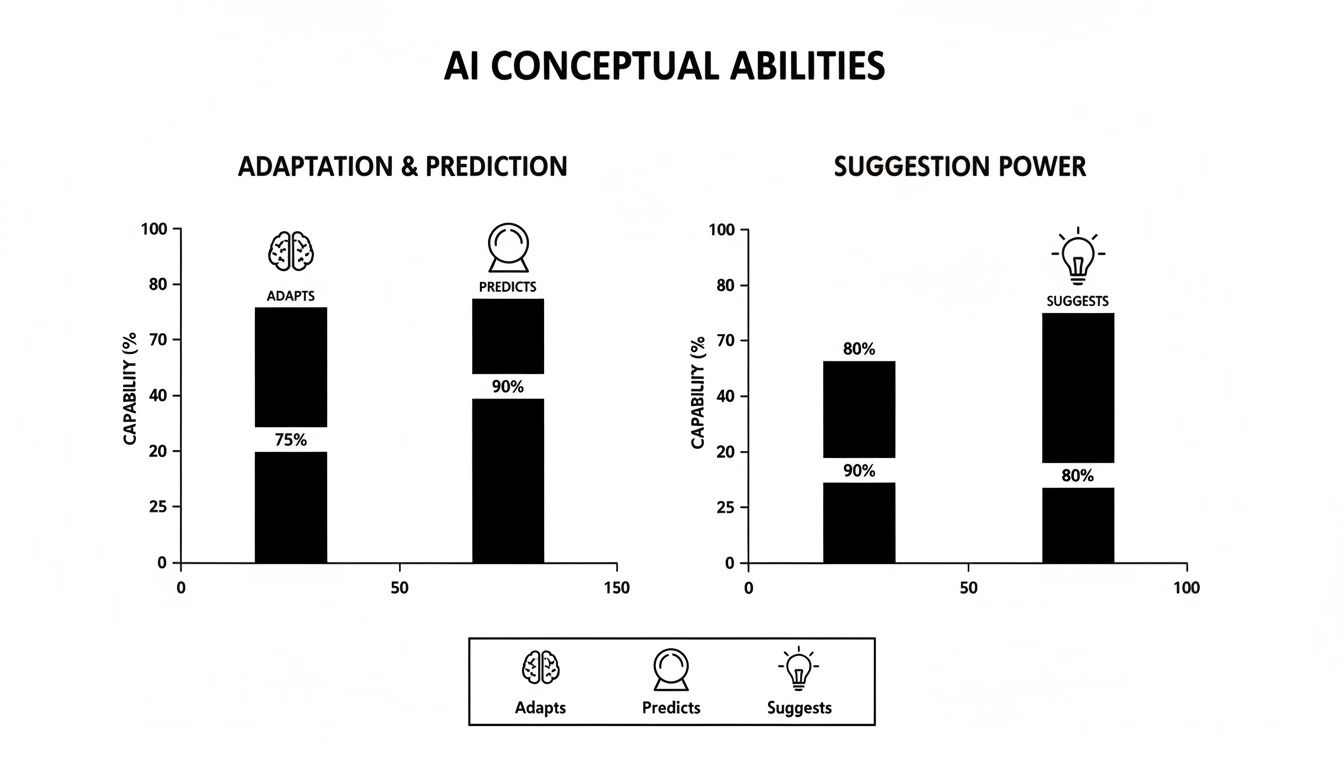
These capabilities are the building blocks that allow AI to do everything from optimizing a complex supply chain to crafting a perfectly targeted marketing message.
How AI Transforms Key Business Departments
To see how this plays out in the real world, let's break down how different departments are putting AI to work. The applications are incredibly diverse, but the goal is always the same: work smarter, not harder.
| Department | AI Application Example | Primary Benefit |
|---|---|---|
| Sales | A real estate agent uses an AI CRM to predict which past clients might be ready to sell their home. | Higher conversion rates by focusing sales efforts on high-value leads. |
| Marketing | A small business uses generative AI to create dozens of social media ad variations for A/B testing. | Increased ROI on ad spend through rapid, data-informed optimization. |
| Customer Support | A local florist implements a 24/7 chatbot to answer common questions like "What are your store hours?" | Improved customer satisfaction and reduced wait times. |
| Finance | An accountant automates invoice processing and uses AI to flag unusual expenses for review. | Reduced operational costs and enhanced security. |
| Human Resources | A startup uses AI to screen resumes for specific skills, like "Python programming" or "project management." | Faster, more efficient hiring cycles. |
As you can see, AI isn't a one-size-fits-all solution. It's a versatile toolkit that can be applied to solve specific problems and drive measurable results across the entire organization.
From Data Insights to Measurable Growth
Beyond just doing things faster, AI is also a phenomenal tool for making smarter, data-driven decisions. Instead of relying on gut feelings or historical anecdotes, you can use AI to dig deep into market trends, forecast demand, and understand what your customers really want.
- Supply Chain Optimization: Major retailers like Walmart use AI to predict product demand with incredible accuracy, ensuring your favorite snacks are always in stock while preventing costly waste. This has a direct and massive impact on the bottom line.
- Enhanced Customer Service: Intelligent chatbots do more than just answer FAQs. They provide instant, round-the-clock support, freeing up human agents to solve the truly complex, high-touch problems that require empathy and critical thinking.
- Data-Backed Strategy: AI tools can analyze sales data to show you not just what is selling, but why. These insights give leaders a clear, evidence-based path forward for future strategies.
The economic numbers are starting to tell a compelling story. The 2025 AI Index Report found that sectors heavily exposed to AI have seen faster revenue growth since 2022. Even better, wages in these fields have climbed twice as fast, with skilled workers who know how to use AI earning up to a 25% premium. This shows that AI is creating higher-value roles, not just eliminating old ones.
Best of all, these powerful tools are no longer reserved for giant corporations. A wave of accessible and affordable AI platforms has leveled the playing field, giving small businesses the ability to compete like never before. From automating social media schedules to managing inventory, AI is proving to be a powerful engine for growth for everyone.
AI Applications That Enhance Your Daily Life
While AI is making huge waves in the business world, its real magic often shows up in the small, everyday moments. The benefits of artificial intelligence aren't just for big corporations; they are woven right into our daily routines, quietly making life simpler, more connected, and honestly, a lot more fun. It’s like a silent partner, anticipating what we need and saving us precious time.
Just think about how you start your day. For many of us, a smart home assistant like Alexa or Google Assistant is the first "person" we interact with. You might ask it to play a morning playlist, give you a quick weather update, and add milk to the shopping list—all before you’ve even had your first sip of coffee. This isn’t just about convenience; it’s a seamless way to kick off the day, managed by an AI that learns your habits.
Your Personal Entertainment Guru
When the day finally winds down, AI often steps in as our personal entertainment director. Ever wonder how Netflix or Spotify just gets you, always knowing what you want to watch or listen to next? That's the power of recommendation engines, one of the most common—and powerful—AI applications out there.
These systems are brilliant at analyzing your viewing or listening history. They compare your tastes with millions of other users and then predict what you'll enjoy next, spotting subtle patterns you might not even notice yourself.
- For movie lovers: It digs up that indie film you've never heard of but is perfectly your style.
- For music fans: It curates a "Discover Weekly" playlist that introduces you to your next favorite band.
- For shoppers: It suggests products on Amazon that are the perfect companion to something you just bought.
This isn’t random guesswork. It’s a sophisticated process that makes finding new things feel personal and effortless, saving you from the black hole of endless scrolling. It's one of the clearest examples of how AI applications in daily life are already working for you behind the scenes.
"The best AI doesn't feel like technology at all; it feels like a helpful friend who just gets you," says tech journalist Kara Swisher. "It anticipates your needs and makes complex choices feel simple and intuitive."
This friendly intuition is what makes AI so valuable in our personal lives. It’s constantly learning from our behavior to deliver a more tailored and enjoyable experience, whether we're picking a movie or just trying to navigate our commute.
An Unexpected Creative Partner
Beyond managing our playlists and daily routines, AI is also popping up as a fantastic partner for creativity. It's breaking down the barriers to artistic expression, letting anyone bring their ideas to life, no matter their technical skill. It's like having an art assistant, a music producer, and a travel agent all rolled into one.
Generative AI tools can take a simple text prompt and spin it into a breathtaking piece of digital art. Want to see a "cyberpunk cat drinking coffee in a neon-lit alley"? An AI can whip that up in seconds, opening up a whole new world of visual storytelling for everyone.
In the same way, other tools can help you compose a melody, write a poem, or even just brainstorm ideas for a story. The point isn't to replace human creativity but to give it a boost. AI can handle the tedious parts, like finding the right chord progression or suggesting a rhyming word, so you can stay focused on your vision.
Even planning a vacation gets an upgrade. Instead of spending hours on research, you can ask an AI to map out a complete seven-day itinerary for a trip to Tokyo, complete with restaurant suggestions, travel routes, and hidden gems. This kind of creative and logistical support just goes to show how deeply the benefits of artificial intelligence can enrich our personal hobbies and passions.
AI in the Lab and the Clinic: Pushing the Boundaries of Human Health
Beyond the world of business and daily convenience, AI is making some of its most meaningful impacts in healthcare and scientific research. This isn't just about efficiency—it's about saving lives, finding cures faster, and tackling some of the most complex challenges humanity faces. Think of AI as a powerful new tool in the hands of doctors and scientists, one that can see things and connect ideas in ways that were never possible before.
Imagine an algorithm that has studied millions of medical scans, from X-rays to MRIs. It learns to spot the faintest, earliest signs of diseases like cancer with incredible precision, sometimes noticing subtle patterns that even a trained human eye might overlook. For example, a system developed at Google Health has shown it can detect breast cancer more accurately than human radiologists. This gives doctors a powerful "second look," helping them catch problems earlier when treatments are far more likely to succeed.
This isn't science fiction; it's already in use in clinics today. AI systems are trained on massive datasets of medical images, and the result is a diagnostic process that’s becoming faster, more consistent, and more accurate. For patients, that can mean getting a crucial head start in their fight against a serious illness.
Finding New Cures at Unprecedented Speed
One of the most exciting frontiers for AI is drug discovery. Bringing a new medicine to market is traditionally a grueling process, often taking more than a decade and costing billions of dollars. AI is starting to radically shorten that timeline by helping with the most difficult and time-consuming steps.
Finding a new drug is like searching for a single key that fits a very specific molecular lock among billions of possibilities. AI can crunch immense biological datasets to predict which compounds are most likely to work against a particular disease, effectively pointing researchers in the right direction and slashing years off the initial search.
According to Dr. Andrew Hopkins, CEO of Exscientia, a company pioneering AI in drug discovery, "AI allows us to explore a vast chemical space with a speed and precision that was previously unimaginable. It's about designing the right medicine for the right patient, faster."
This ability to process and synthesize vast amounts of information is also changing how basic scientific research gets done. A human scientist might spend an entire career mastering one specific field. An AI, on the other hand, can read and find connections between millions of research papers from dozens of different disciplines in the blink of an eye.
Your Tireless Research Assistant
This is where AI really shines as a partner in discovery. It can spot a link between a genetic study published in Japan and a protein analysis from a lab in Germany, suggesting new hypotheses that no single researcher might have ever thought to explore.
Here are a few ways AI is already pushing science forward:
- Genomic Analysis: AI can scan a person's genetic code to flag risks for certain diseases or predict how they'll respond to different drugs. This is the foundation of true personalized medicine.
- Disease Modeling: Researchers are using AI to build sophisticated simulations of how viruses mutate or how a disease might spread through a population, helping public health experts prepare for future outbreaks.
- Climate Science: By analyzing huge volumes of satellite and sensor data, AI models are getting better at predicting extreme weather events, identifying areas at high risk for natural disasters, and helping us find better ways to address climate change.
These aren't just incremental improvements. They represent a fundamental shift in how we approach problem-solving. By taking on the heavy lifting of data analysis, AI frees up our best and brightest minds to do what they do best: ask creative questions, design experiments, and make the intuitive leaps that lead to the next great breakthrough. The future of health and science is being built on this powerful collaboration between human intellect and artificial intelligence.
Creating a More Accessible and Inclusive World with AI

Beyond boosting productivity or recommending movies, one of the most profound benefits of artificial intelligence is its ability to build bridges and tear down barriers. For millions of people with disabilities, AI isn't just a convenience—it's a key to greater independence, connection, and opportunity. It’s helping create a world where technology finally adapts to people, not the other way around.
Imagine trying to navigate a busy city without being able to see. It’s a daunting thought. But now, AI-powered apps like Microsoft’s Seeing AI can act as a personal guide right from a smartphone. Using the phone's camera, these tools can identify objects, read street signs aloud, and even describe the people in front of you. This is AI in action, turning what was once a stressful journey into a manageable one and giving people a new layer of confidence.
Fostering Connection Through Communication
Communication gaps can be incredibly isolating, especially for individuals who are deaf or hard of hearing. AI is tackling this challenge head-on with real-time captioning services that are more accurate and available than ever before. Whether it's in a classroom, a business meeting, or just watching a video online, these tools instantly transcribe spoken words into text.
This technology ensures everyone can follow along and participate in the conversation. It’s a simple concept with a massive impact, fostering a more inclusive environment where no one feels left out. These aren't just features; they are lifelines that connect people to their communities and colleagues.
"AI's greatest promise in accessibility isn't just about solving problems; it's about creating a world where everyone has the tools to fully participate," notes Jenny Lay-Flurrie, Microsoft’s Chief Accessibility Officer. "It’s about empowering people and building a more equitable society for all."
This shift toward empowerment is a recurring theme. Instead of relying on others for certain tasks, individuals can use these smart tools to navigate their world on their own terms. That fosters a powerful sense of independence and self-reliance.
Personalizing Education for Every Learner
The classroom is another area where AI is making a huge difference. For too long, the traditional one-size-fits-all teaching method has failed to meet the diverse needs of every student. AI-powered adaptive learning platforms are changing that by creating personalized educational journeys for each learner.
These tools can pinpoint a student's unique strengths and weaknesses, adjusting the difficulty of lessons in real time. If a student is struggling with a specific math concept, the AI can offer extra practice or explain it in a completely different way. On the other hand, if a student masters a topic quickly, it can introduce more advanced material to keep them engaged.
This creates a learning environment that is:
- Supportive: Students get help exactly when they need it, which cuts down on frustration and builds confidence.
- Engaging: The curriculum adapts to each student's pace, preventing boredom and keeping them motivated.
- Effective: By focusing on individual needs, these platforms help improve learning outcomes across the board.
Ultimately, these applications show that the benefits of artificial intelligence go far beyond a company's bottom line. AI is becoming a fundamental tool for social good, creating a more accessible, understanding, and inclusive world where technology serves humanity in its truest sense.
Getting Started with Simple and Powerful AI Tools
Ready to see what all the fuss is about? The best way to really "get" AI is to just start using it. And here's the good news: you don't need to be a tech wizard. Many of the most useful AI tools today are built for everyone, delivering practical results right out of the box with zero coding required.
It helps to think of these tools not as one single, all-knowing brain, but as a team of specialized assistants. You've got a writing pro to polish your emails, a graphic designer to whip up social media posts, and a sharp scheduler to organize your calendar. The goal is to make AI feel genuinely helpful, not intimidating.
Your First Step Into the World of AI
Jumping in is much easier than you probably think. A flood of AI tools has hit the market, and many offer free versions that are more than capable for personal use or a small business. This is your chance to experiment without commitment and see what clicks for you.
Here are a few popular, user-friendly tools you can try today:
- Writing Assistants: Tools like Jasper or Copy.ai are lifesavers for writer's block. Ask them to draft an email, brainstorm blog post ideas, or create a compelling product description in seconds. The time you save on content creation is immediate.
- Design Platforms: Need a quick graphic for an Instagram post? Canva's Magic Studio lets you just describe what you want, and it will generate professional-looking visuals in minutes. It puts great design in everyone’s hands.
- Meeting Summarizers: If you're constantly in meetings, something like Otter.ai will change your life. It records the audio, transcribes it in real-time, and then spits out a neat summary with key action items. It's like having a personal note-taker in every call.
"The best way to learn AI is to treat it like a new app on your phone," advises tech expert Marques Brownlee (MKBHD). "Download it, play around, and see how it might make your day a little easier. There's no right or wrong way to start."
Finding AI Opportunities in Your Daily Grind
The real magic happens when you start applying these tools to your own work and life. To find the best starting point, look for the small, repetitive tasks that slowly drain your time and energy. Think of it as an audit of your daily routine.
Ask yourself, what am I doing that is:
- Repetitive? Think about the things you do the exact same way every day or week. This could be anything from scheduling social media posts to answering the same customer questions over and over.
- Time-Consuming? What tasks eat up hours but don't require your best strategic thinking? This might be transcribing interviews, sifting through data, or organizing files.
- A Creative Block? Where do you get stuck? Maybe it’s coming up with a catchy headline, brainstorming new ideas, or just creating a quick visual for a presentation.
Once you pinpoint just one or two of these pain points, you can find an AI tool that directly solves that problem. This turns "AI" from an abstract buzzword into a genuinely useful part of your personal toolkit.
Your Top Questions About AI Answered
As we've explored all the ways AI can make a difference, you've probably got some questions bubbling up. That's completely normal. This technology is moving at lightning speed, so let's clear up a few of the most common concerns people have when they're just starting out.
Will AI Take My Job?
This is the big one, isn't it? It’s probably the first thing that comes to mind for a lot of people. While it’s true that AI will automate certain tasks, history has shown us that new technology usually changes jobs, it doesn't just eliminate them.
Think of AI less as a replacement and more as a powerful assistant. It’s here to take over the tedious, repetitive parts of your job—the stuff that drains your energy. This frees you up to double down on what people do best: thinking creatively, solving tricky problems, and connecting with other humans. The real advantage in the coming years will likely go to those who learn to work alongside AI, not those who worry about being replaced by it.
Is AI Hard or Expensive to Get Started With?
It used to be, but not anymore. One of the most incredible things happening right now is how accessible AI has become. You don't need a huge budget or a squad of data scientists to tap into its power. Many of the best tools out there have free plans or are incredibly affordable.
You can find simple, intuitive apps for just about anything:
- Writing tools that can help you nail the tone of an important email.
- Design apps that whip up social media graphics in a snap.
- Smart schedulers that can organize your week without all the back-and-forth.
You can start playing with these tools right now on your phone or computer. No coding, no special training required.
"The best way to learn AI is to treat it like a new app on your phone. Download it, play around, and see how it might make your day a little easier. There's no right or wrong way to start."
Where Can I Learn More About AI?
Getting up to speed on AI is easier than you think, and you don't have to go back to school to do it. A fantastic first step is checking out some of the free introductory courses on platforms like Coursera or edX. Simply following a few good tech news sites is another great way to keep a pulse on what’s new.
The most important thing? Don't feel pressured to become an expert overnight. Just start small. Pick one or two tools that sound genuinely useful or fun, and just experiment. You'll be surprised how quickly you start to see the possibilities for yourself.
Ready to dive deeper and stay ahead of the curve? At YourAI2Day, we provide the latest news, tools, and insights to help you make sense of artificial intelligence. Explore our resources and join a community of learners at https://www.yourai2day.com.