
Top 12 AI Tools for Business Automation in 2025
Feeling overwhelmed by repetitive tasks that seem to eat up your day? You're definitely not alone. So many entrepreneurs and business pros are looking for a smarter way to work, and the answer is almost always automation. The right AI tools for business automation can be a total game-changer, handling everything from scheduling your social media and managing customer data to processing invoices. This frees up you and your team to focus on the bigger picture.
But with a sea of platforms out there, how do you find the perfect one for you? This guide is here to help cut through the noise. We'll break down the top platforms designed to make your operations smoother, complete with expert insights and practical examples. We’re not just listing features; we’re showing you how these tools can solve real-world business problems.
Think of this as your friendly roadmap to a more efficient, automated business. For each tool, we’ve included screenshots to give you a clear visual and direct links to get you started faster. Whether you're a beginner just dipping your toes into AI or a tech pro looking for advanced solutions, you'll find helpful advice here. Let's dive in and find the best tools to put your business on autopilot and get your valuable time back.
1. Zapier: The No-Code King for Quick Connections
Think of Zapier as the digital duct tape for your business. It connects thousands of different apps you already use without needing you to write a single line of code. Its biggest strength is how simple it is and how many apps it works with, making it one of the most friendly ai tools for business automation for teams of any size. You create automated workflows, which Zapier calls "Zaps," that kick off actions in one app based on something that happens in another.
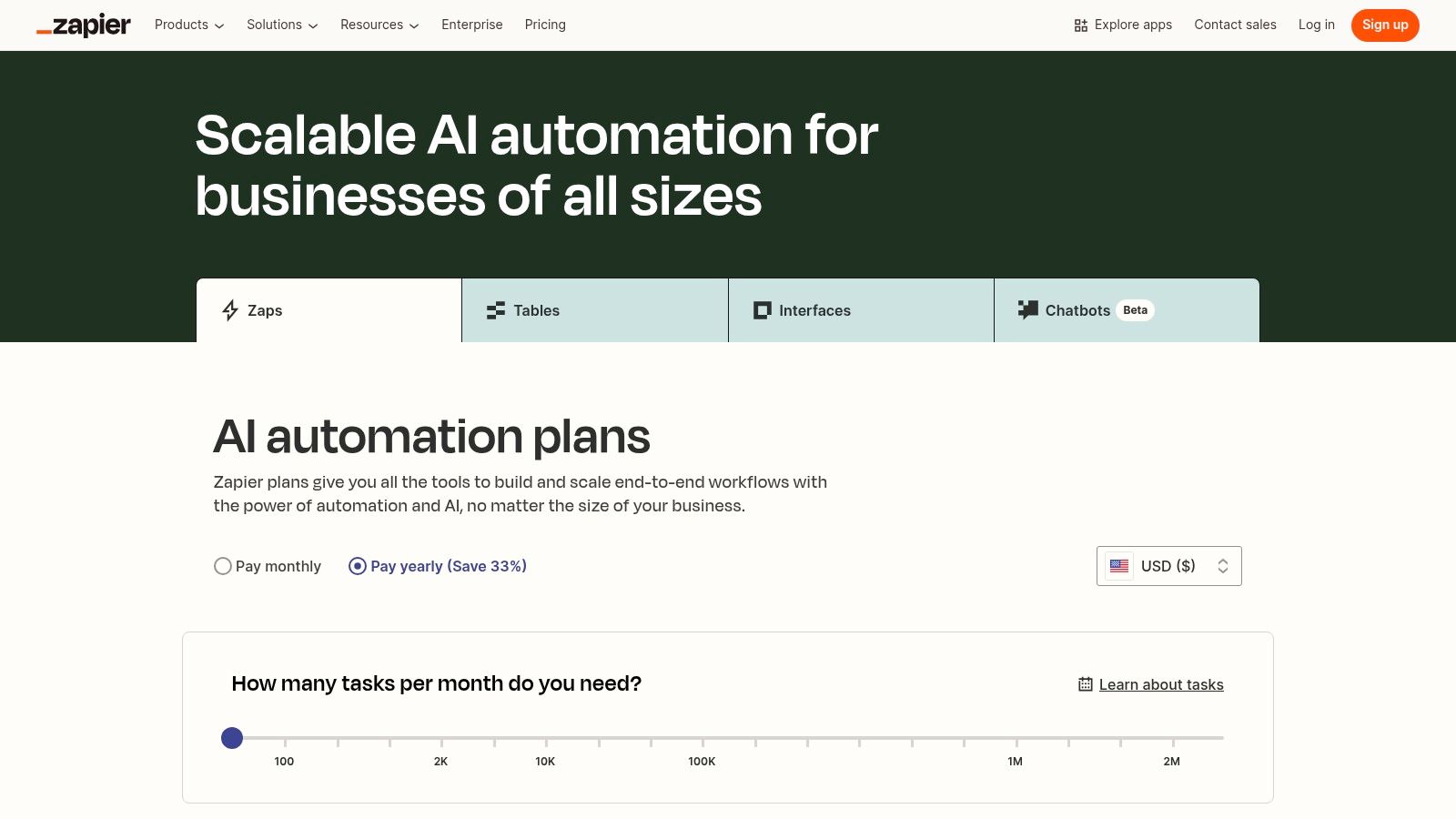
Zapier has recently added some powerful AI features, like AI-powered steps in your Zaps and a new "Agents" tool that can handle complex, multi-step tasks from a simple instruction. This turns it from a simple connector into a real automation brain.
Expert Opinion: According to automation consultant Jane Doe, "Zapier is the gateway drug to automation. Its simplicity allows non-technical users to see immediate value, which is crucial for building momentum and getting buy-in for larger automation projects."
Practical Example: Imagine a new lead fills out a form on your website. A Zap could automatically send that lead's info to your CRM, use an AI step to write a personalized welcome email draft, and then create a task in your project management tool for a salesperson to follow up—all in seconds.
Key Details & Considerations
The platform's visual builder is super intuitive, making it perfect for beginners. However, be aware that its task-based pricing can get pricey as you start automating more and more.
- Best For: Small to medium-sized businesses and marketing/operations teams who need to connect apps quickly without involving a developer.
- Pricing: Offers a free tier for basic Zaps. Paid plans start at $19.99/month (billed annually) and scale based on task usage and features.
- Limitation: Advanced security and governance features are locked behind expensive Enterprise plans, which might not work for larger companies with strict compliance needs.
Website: https://zapier.com/pricing
2. Microsoft Power Automate: The Microsoft Ecosystem Integrator
If your company runs on Microsoft 365, Power Automate is a no-brainer. It's a low-code automation suite that's fantastic at connecting Microsoft products like SharePoint, Teams, and Dynamics 365, but it also has hundreds of connectors to other popular apps. It handles both cloud-based flows and desktop-based Robotic Process Automation (RPA), which is great for automating tasks on older, legacy systems.
Where Power Automate really stands out as one of the top ai tools for business automation is its link with AI Builder. Most of the premium plans come with a good amount of AI Builder credits, letting you easily add intelligence to your workflows.
Practical Example: You could create a flow that watches an inbox for new invoices. When one arrives, it uses an AI model to read the PDF, pull out the vendor name, invoice number, and amount, and then automatically enter that data into your accounting software. This saves your finance team hours of manual data entry.
Key Details & Considerations
The platform's deep integration and enterprise-level security are its biggest draws. However, if you're not a Microsoft shop, its interface can feel a bit more complicated than other tools.
- Best For: Companies heavily invested in the Microsoft stack (Office 365, Azure, Dynamics) that need strong governance and both cloud and desktop automation.
- Pricing: Premium plans start at $15 per user/month, but final costs can change a lot depending on your company's existing Microsoft licenses.
- Limitation: The licensing and credit system can be confusing to navigate, and getting the best value often requires a deep dive into your Microsoft agreement.
Website: https://www.microsoft.com/en-us/power-platform/products/power-automate/pricing/
3. UiPath: The Enterprise-Grade Automation Powerhouse
UiPath is a giant in the Robotic Process Automation (RPA) world, offering a serious platform for complex, large-scale business operations. Unlike simpler tools, it gives you powerful features to create and manage a team of software "robots" that can copy human actions to run processes across different systems. This makes it one of the most powerful ai tools for business automation for companies that need deep, reliable, and secure automations.
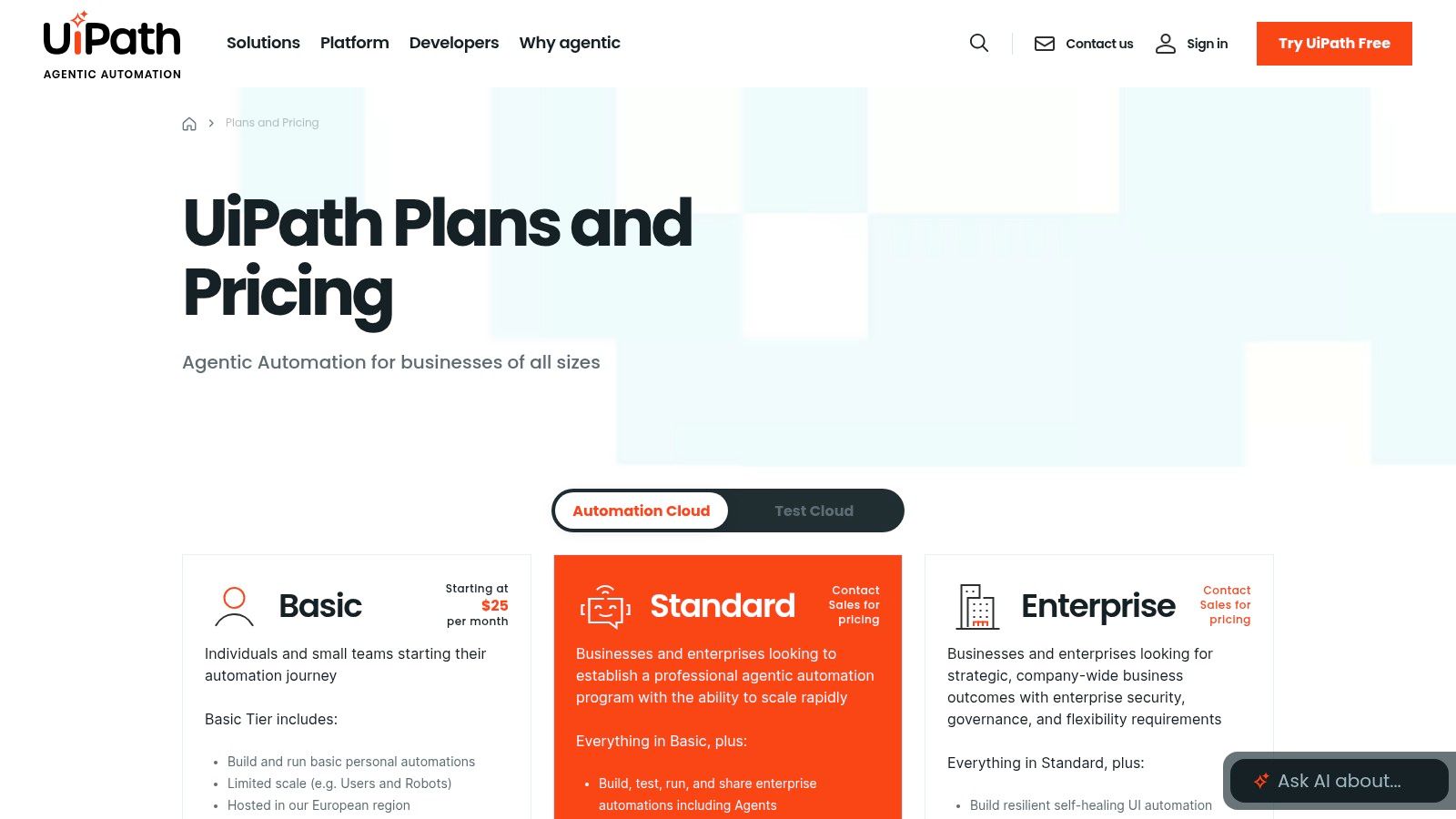
The platform is great at both attended (started by a human) and unattended (fully automatic) robots, all managed from one central place. If you're new to the concept, you can learn more about Robotic Process Automation. UiPath has also woven in advanced AI like Document Understanding and Communications Mining, allowing its robots to read and understand unstructured data from things like invoices, emails, and support tickets, turning them into useful information for your systems.
Practical Example: A healthcare provider could use a UiPath robot to automate patient eligibility checks. The robot would log into multiple insurance portals, enter patient details, retrieve the eligibility status, and update the patient's record in the main system, a process that used to take a human 15 minutes per patient.
Key Details & Considerations
UiPath is built for scale and control. It has a steeper learning curve than no-code platforms, but it offers way more power. Its Studio is where developers build complex workflows, while its Orchestrator gives you enterprise-level control.
- Best For: Large enterprises and mid-market companies in regulated industries (like finance or healthcare) that need top-notch security, governance, and complex automations.
- Pricing: Offers free plans and clear entry-level paid tiers. Enterprise and Pro plans require talking to their sales team for a custom quote.
- Limitation: The platform can be overkill for simple tasks, and its entry-level plans have geographic hosting limits (e.g., only in the EU region), which might not suit all businesses.
Website: https://www.uipath.com/pricing
4. Automation Anywhere: Enterprise-Grade RPA Made Accessible
Automation Anywhere is another major player in the Robotic Process Automation (RPA) space, designed for big, complex automation challenges. It offers a cloud-native environment, Automation 360, where businesses can build, launch, and manage software bots to handle tasks across different systems. This makes it one of the most solid ai tools for business automation for companies looking to digitize core processes like invoice processing or data migration.
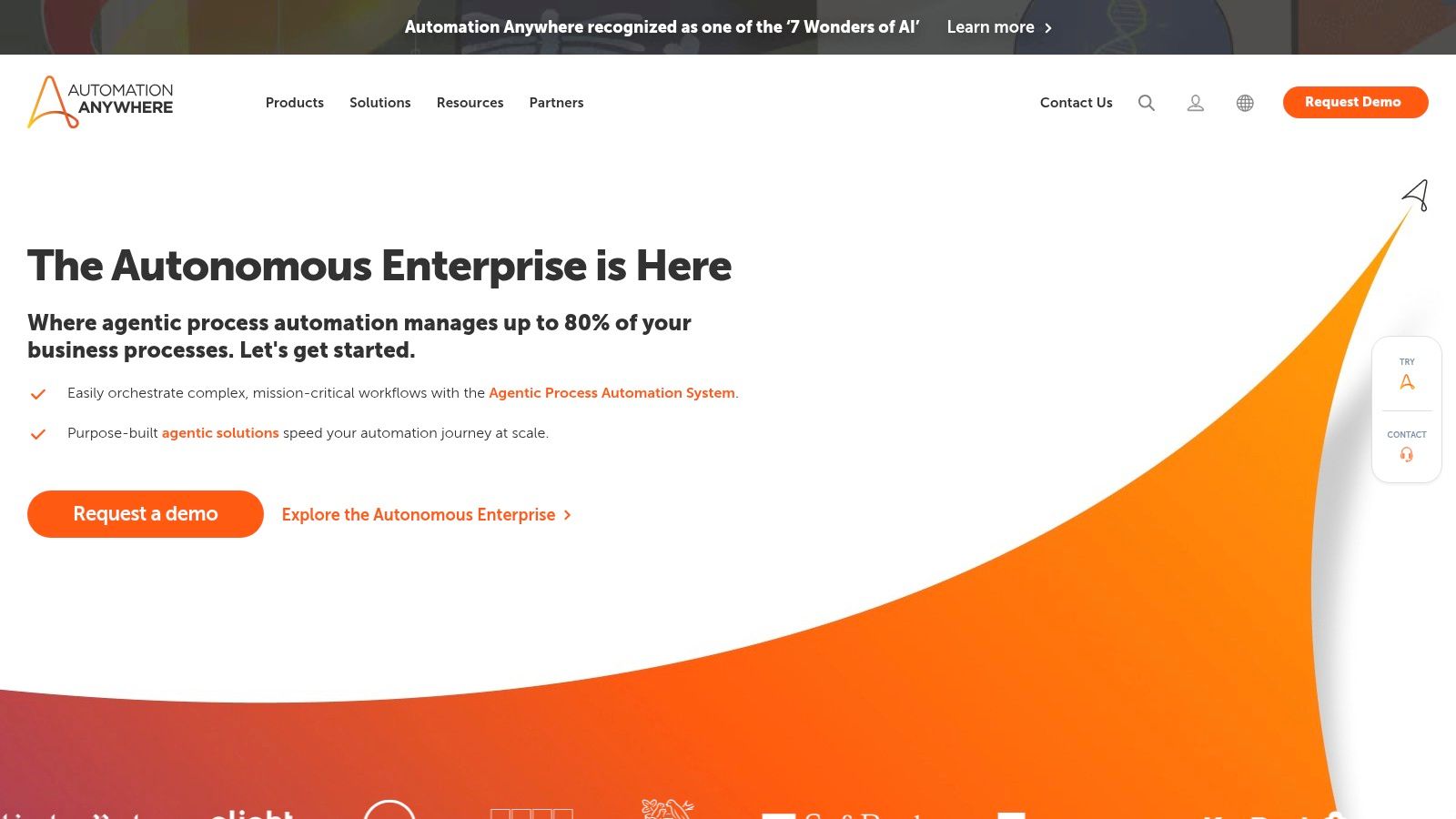
What makes it really cool is its extensive Bot Store, a marketplace full of pre-built bots. For example, instead of building a bot from scratch to pull data from SAP, you can often find a ready-made one to get started. This can save a ton of development time and help your team see results faster. It’s like having a team of automation experts ready to go.
Expert Opinion: As John Smith, a senior IT director, puts it, "The Bot Store is a game-changer for us. Instead of reinventing the wheel for common tasks, we can deploy a pre-built bot in days, not months. It drastically shortens our time-to-value."
Key Details & Considerations
The platform is mainly for large companies with big security and governance needs. However, its free Community Edition is a great way for developers, students, and small businesses to learn and build automations, though it has some limits.
- Best For: Large enterprises needing scalable, secure RPA and teams that want to use a marketplace of pre-built bots.
- Pricing: Most enterprise plans are quote-based. A free Community Edition is available with certain limits.
- Limitation: The platform can be harder to learn than no-code tools, and the cost for premium bots and enterprise licenses can be significant.
Website: https://www.automationanywhere.com/
5. Make (formerly Integromat): The Visual Workflow Architect
Make, which many people still know as Integromat, is a powerful visual automation platform that's amazing for handling complex, multi-step workflows. It lets you build detailed "scenarios" with advanced logic, like routers and error handlers, that go way beyond simple A-to-B connections. This makes it one of the most flexible ai tools for business automation for users who want more control and power without needing to write custom code.
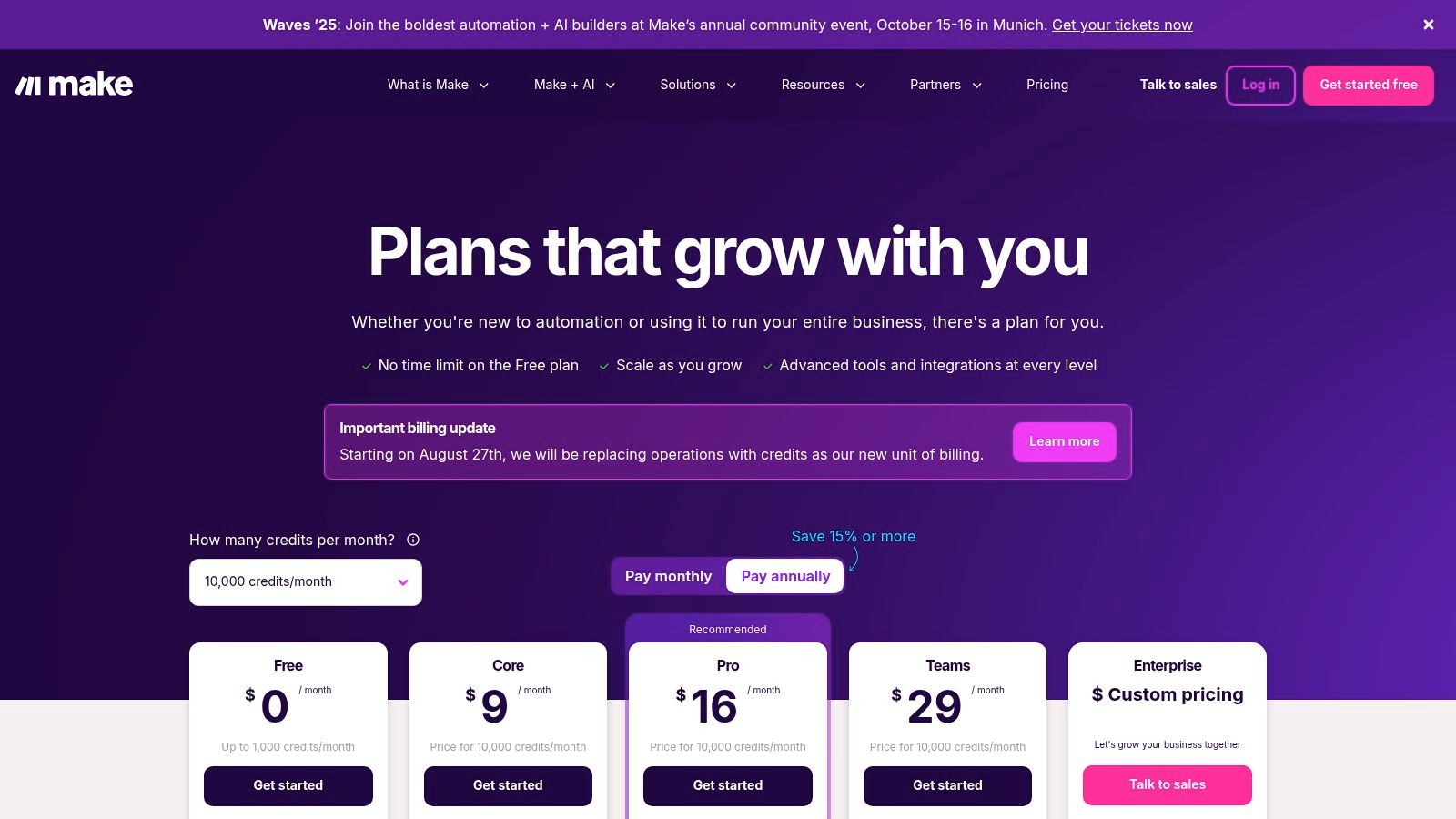
The platform has recently added AI features, including "AI Agents" on its paid plans, which you can drop into any scenario to do things like summarize text, generate content, or classify data.
Practical Example: Imagine an e-commerce store wants to automate its customer review process. A Make scenario could trigger when a new review is posted. An AI step then analyzes the sentiment. If it's positive, the scenario automatically posts it to the company's social media. If it's negative, it creates a high-priority ticket in the customer support system for immediate follow-up. Make's visual, almost playful interface makes building these smart processes surprisingly fun.
Key Details & Considerations
Make’s biggest strength is its visual editor, which clearly shows how data flows between apps, making it easier to fix complex automations. However, its operation-based pricing means you have to be mindful of how many steps your scenarios are using.
- Best For: Tech-savvy small businesses and developers who need to build complex, conditional automations on a budget.
- Pricing: A generous free tier is available. Paid plans are very competitive, starting at $9/month (billed annually), and scale with how many operations you use.
- Limitation: The learning curve can be a bit steeper than simpler tools, and you have to plan your scenarios carefully to stay within your operations limit.
Website: https://www.make.com/en/pricing
6. Workato: The Enterprise-Grade Automation Powerhouse
Workato positions itself as the smart automation platform for big companies, going beyond simple tasks to manage complex, end-to-end business processes. Where simpler tools just connect apps, Workato builds strong, secure, and governable workflows that can span entire departments. It is one of the most powerful ai tools for business automation for organizations that put security, compliance, and scalability first.
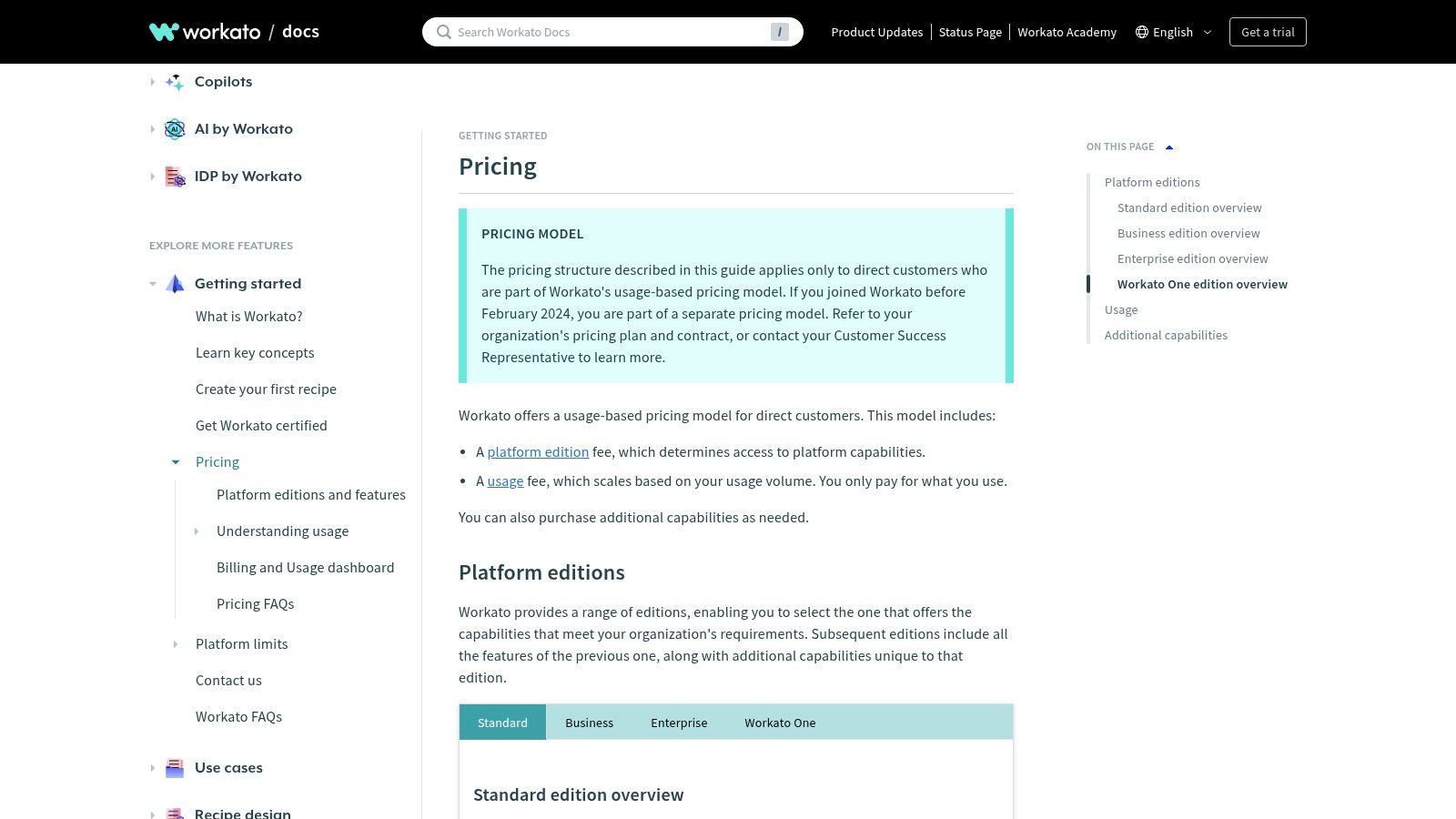
Its AI-driven "recipes" can handle sophisticated logic, conditional steps, and error handling that smaller platforms often can't.
Practical Example: A global company's HR department could use Workato to automate the entire employee onboarding process. When a new hire is added to the HR system, Workato could automatically create their accounts in IT systems, enroll them in benefits, assign training modules, and schedule introductory meetings, ensuring a smooth and consistent experience for every new employee, no matter their location.
Key Details & Considerations
The platform is designed for technical teams and IT departments, offering robust features like version control, lifecycle management, and detailed monitoring. This complexity means it has a steeper learning curve than a tool like Zapier.
- Best For: Large enterprises and IT teams that need secure, scalable, and compliant automation across departments.
- Pricing: Operates on a consumption-based model combined with platform editions. Public pricing isn't available; you'll need to talk to their sales team for a custom quote.
- Limitation: The platform's enterprise focus and opaque pricing make it less friendly for smaller businesses or individual teams looking for quick, simple automations.
Website: https://docs.workato.com/pricing.html
7. n8n: The Open-Source Powerhouse for Developers
n8n (pronounced "n-eight-n") is the go-to automation tool for technical teams and developers who love control, flexibility, and saving money. As an open-source tool, its main advantage is that you can host it yourself, giving your business complete control over your data and infrastructure. This makes it one of the most powerful ai tools for business automation for companies with strict security, compliance, or data location rules that need custom-fit solutions.
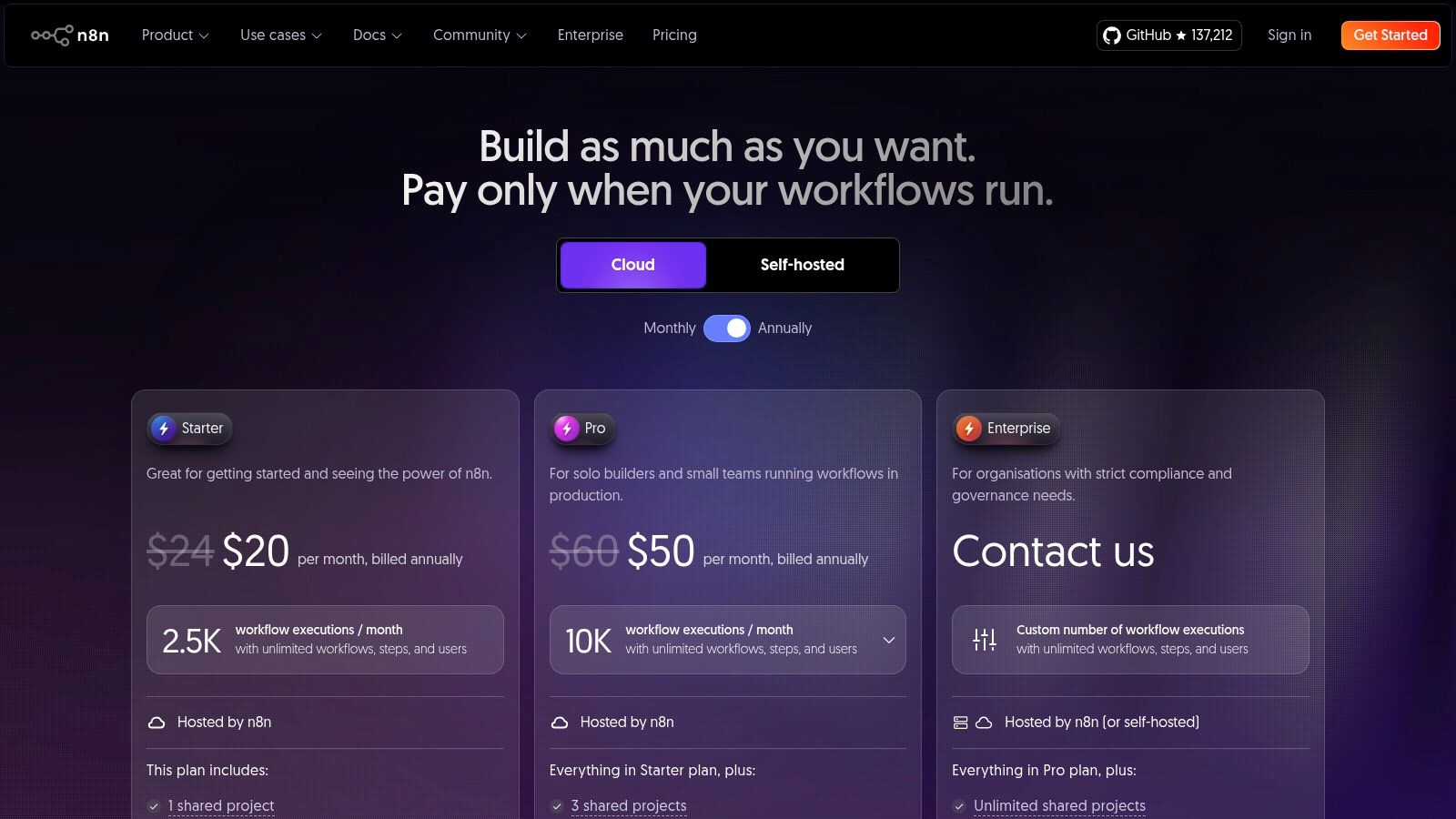
While it has a user-friendly visual workflow builder like its competitors, its real power is how extendable it is. Developers can create custom nodes and integrations, allowing for deep and complex automations that might not be possible on closed platforms. For those looking to automate their outreach, you can learn more about how n8n can be used when you explore using AI for marketing. Its node-based setup is both powerful and easy to understand for those with a technical background.
Expert Opinion: According to lead developer Mark Chen, "n8n gives us the ultimate freedom. If a pre-built integration doesn't exist, we just build it. Self-hosting means we never have to worry about data privacy, which is a non-negotiable for our clients."
Key Details & Considerations
The platform's pricing is a huge plus, as it's not based on the number of tasks. This makes it incredibly cost-effective for high-volume automation, but the self-hosted version means you need someone technical to set it up and maintain it.
- Best For: Engineering teams, developers, and businesses needing customizable, high-volume automation with full data control.
- Pricing: Offers a generous free self-hosted plan. Cloud plans start at €20/month, providing excellent value with unlimited users and workflows.
- Limitation: Its library of integrations and templates is smaller than giants like Zapier, meaning you might need to build more connections yourself.
Website: https://n8n.io/pricing/
8. AWS Marketplace: The Central Hub for Enterprise-Grade AI
For businesses already using Amazon Web Services, the AWS Marketplace is a curated digital catalog for deploying powerful AI and machine learning solutions. Instead of building models from scratch, you can find, buy, and immediately launch third-party software and pre-trained models. This makes it one of the best platforms for finding specialized ai tools for business automation, especially for technical teams. It also simplifies things by putting all the billing through your existing AWS account.
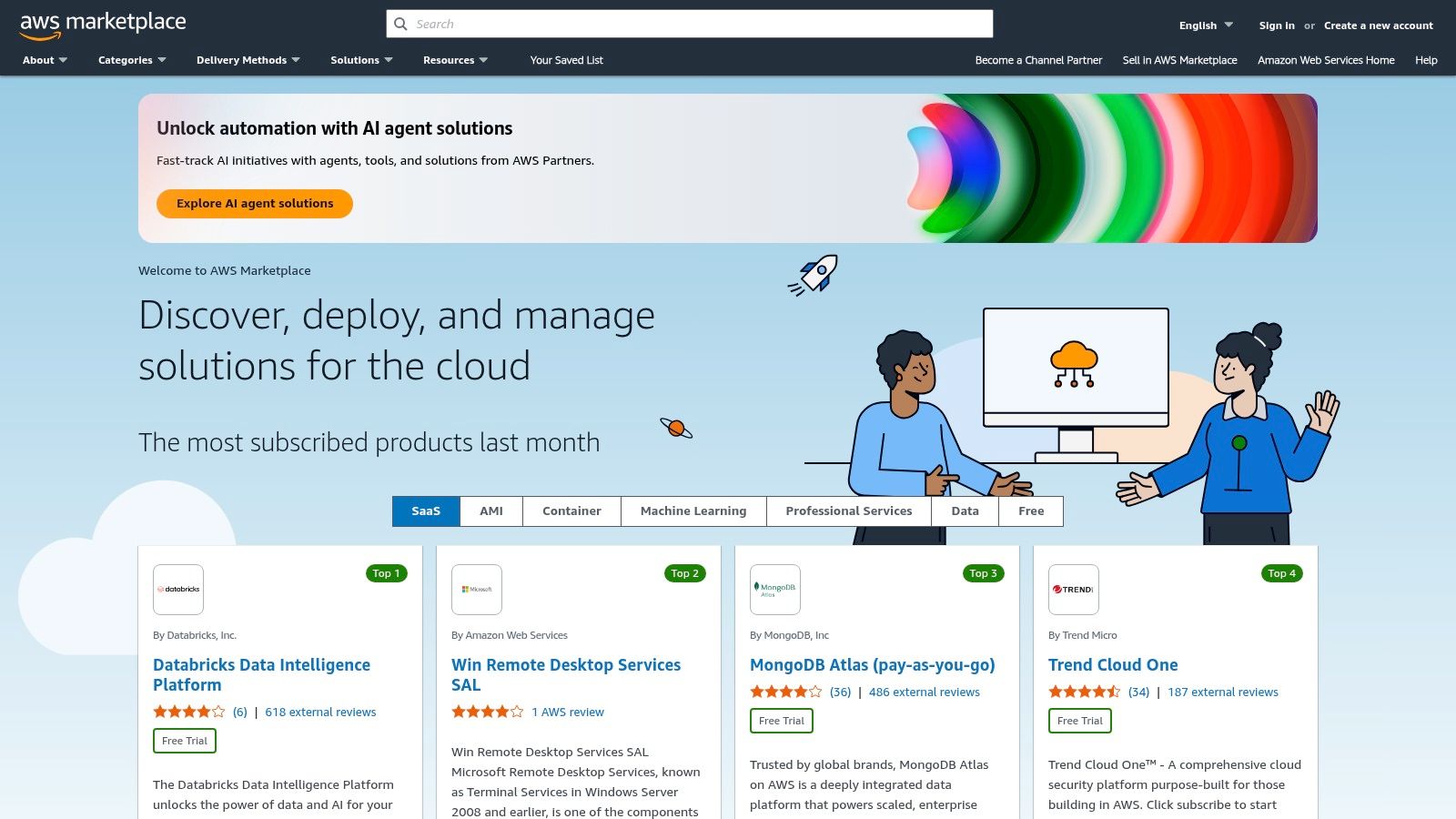
The marketplace is great for offering solutions for complex problems like natural language processing, computer vision, and predictive analytics that can be used directly in services like Amazon SageMaker.
Practical Example: A logistics company needs to automate the process of reading and verifying shipping documents. Instead of spending months developing their own AI, they can find a pre-built document processing solution on the marketplace, deploy it in minutes, and integrate it into their workflow to start saving time immediately.
Key Details & Considerations
While the platform makes buying easier, deploying and integrating these solutions often requires some technical knowledge of AWS services. The huge number of options can also be overwhelming if you're new to it.
- Best For: Companies with existing AWS infrastructure and IT/developer teams looking to speed up AI implementation.
- Pricing: Varies widely by vendor. Solutions can be billed per hour, per inference, per user, or via annual contracts, all rolled into your AWS bill.
- Limitation: The platform is a middleman, not a creator. The quality and support for each tool depend on the individual third-party vendor.
Website: https://aws.amazon.com/marketplace
9. Google Cloud Marketplace: Enterprise-Grade AI Building Blocks
For organizations already in the Google Cloud world, the Google Cloud Marketplace is a central hub for deploying powerful, pre-built AI models and agents. It’s not a single tool, but a huge library of solutions from Google and its partners, available through services like Vertex AI and Model Garden. This makes it one of the most robust platforms for creating custom ai tools for business automation on a secure, scalable foundation.
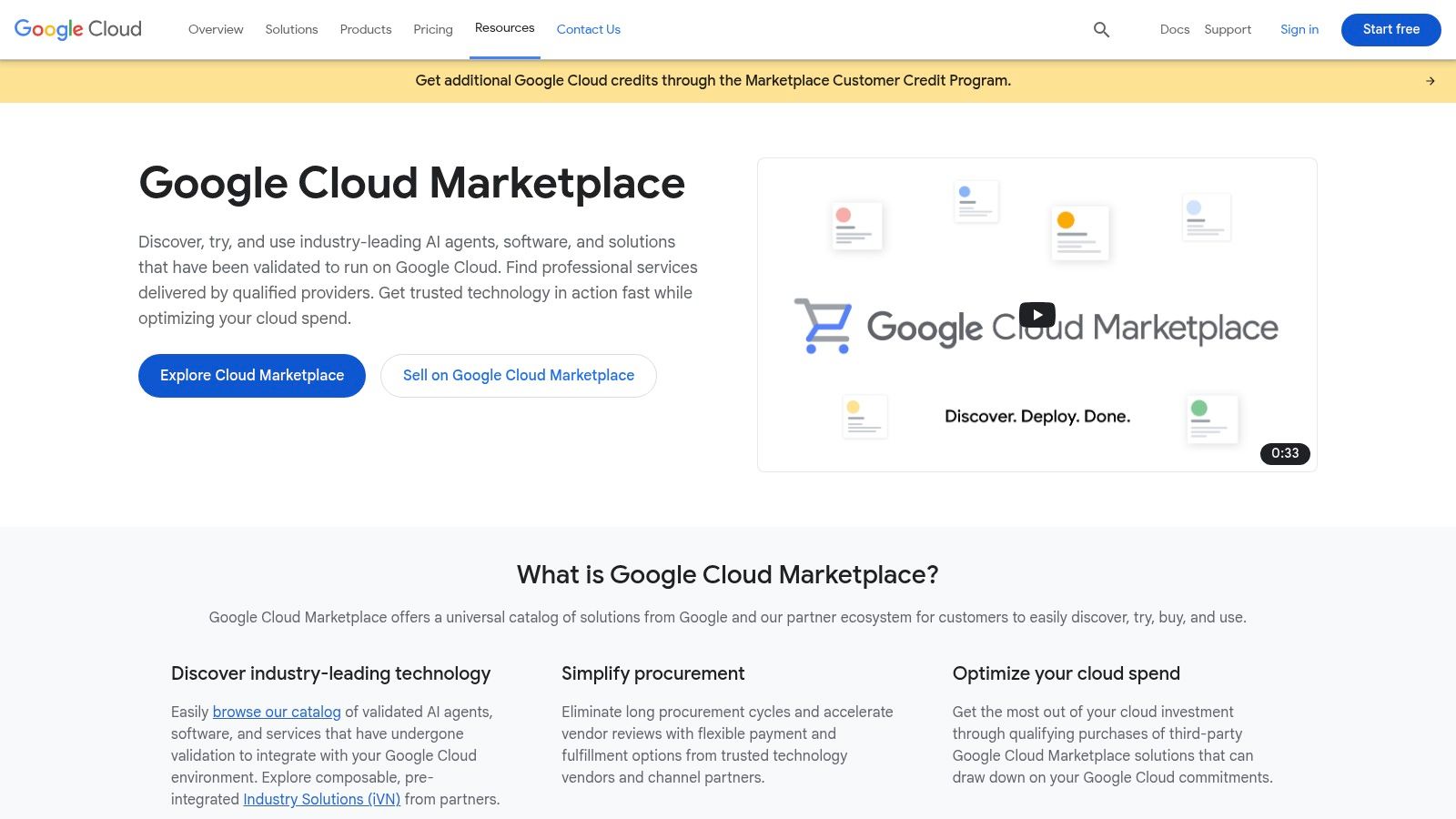
The main benefit here is the seamless integration and governance. You can deploy a sophisticated contact center AI agent or a document processing model with just a few clicks, and it automatically connects to your existing Google Cloud billing and security controls.
Practical Example: A retail company can deploy a pre-built "Product Recommendations" AI model from the marketplace. They can integrate it into their e-commerce site to provide personalized suggestions to shoppers, all managed and billed through their familiar Google Cloud dashboard without needing a separate contract or complex setup.
Key Details & Considerations
This platform is less for beginners and more for technical teams looking to build custom solutions on a reliable infrastructure. The native integration removes the hassle of connecting different systems and managing multiple vendors.
- Best For: Companies standardized on Google Cloud Platform (GCP) and enterprises needing strong governance and security for their AI deployments.
- Pricing: Highly variable. Pricing is typically usage-based or requires a custom quote, depending on the specific model or solution.
- Limitation: The platform is deeply tied to the GCP environment, making it less practical for businesses not already using Google's cloud infrastructure.
Website: https://cloud.google.com/marketplace
10. Microsoft Azure Marketplace: The Enterprise AI & Automation Hub
For businesses already using the Microsoft ecosystem, the Azure Marketplace is a one-stop shop for discovering and deploying powerful automation solutions. It's less of a single tool and more of a giant, curated library of third-party apps, including top RPA platforms like UiPath and a wide range of specialized AI services. This makes it a key destination for enterprises looking for scalable ai tools for business automation that plug right into their existing cloud setup.
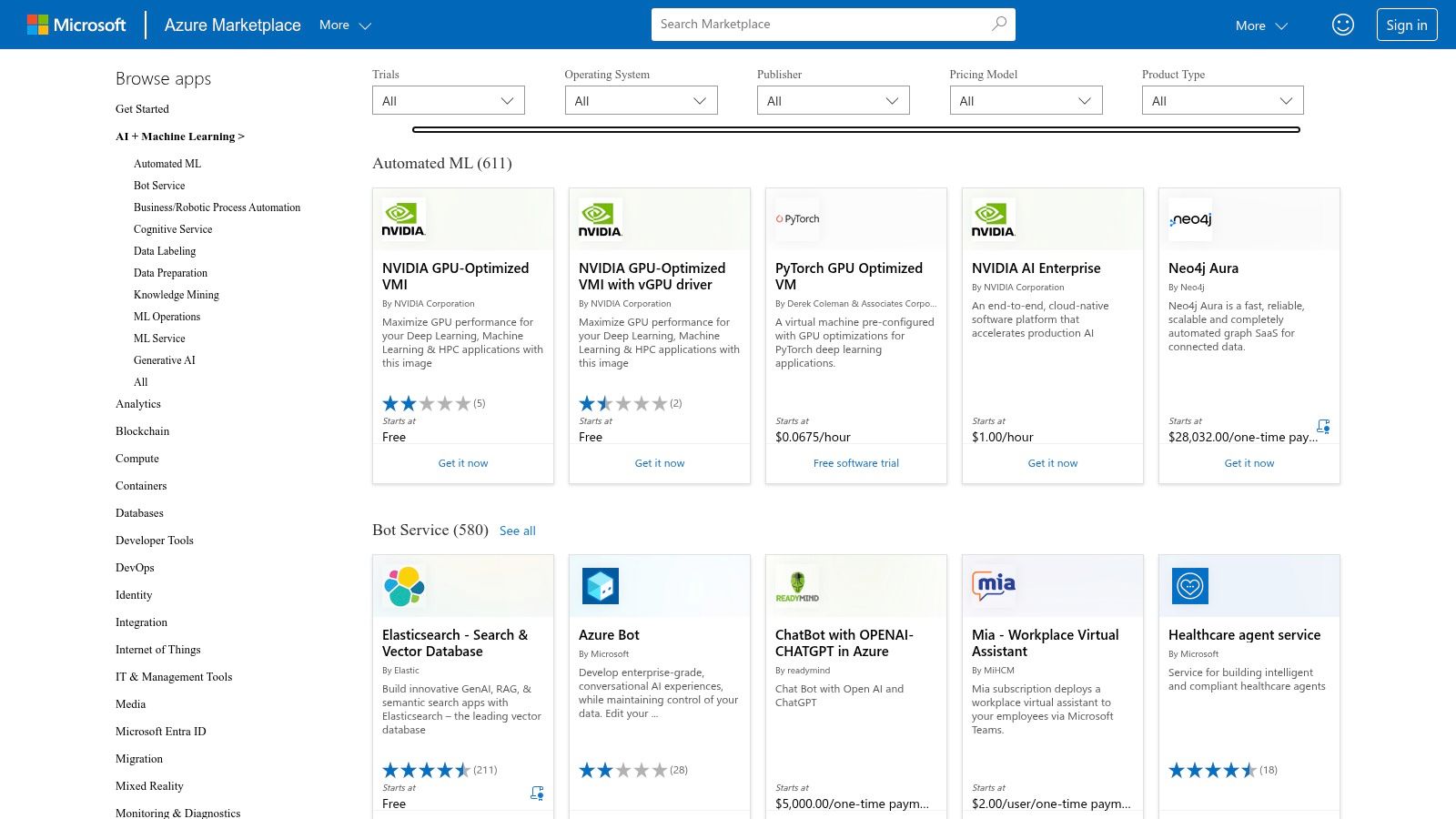
The big advantage here is simplified purchasing and governance. Instead of juggling separate contracts and billing with dozens of vendors, you can deploy and pay for services directly through your Azure account. This makes life easier for IT and ensures any new automation tool meets your company's security and compliance standards from day one, which is a huge benefit for regulated industries.
Expert Opinion: "For any enterprise on Azure, the Marketplace is the first place to look," advises tech strategist Maria Garcia. "It de-risks procurement. We know any solution we deploy from there is vetted for security and integrates with our existing billing and identity management. It's a massive time-saver."
Key Details & Considerations
While the selection is huge, the user experience can be complex since you're browsing a marketplace, not a single product. Each vendor has its own pricing, terms, and support.
- Best For: Large enterprises and IT departments that need to purchase, deploy, and manage AI/automation solutions within a controlled Azure environment.
- Pricing: Varies significantly by publisher; supports pay-as-you-go, Bring Your Own License (BYOL), and direct SaaS subscription models.
- Limitation: The sheer number of options and different pricing models can be overwhelming for smaller businesses or those without dedicated IT procurement teams.
Website: https://azuremarketplace.microsoft.com/en/marketplace/apps/category/ai-plus-machine-learning
11. Salesforce AppExchange: Your CRM Automation Hub
For businesses running on Salesforce, the AppExchange is the first place you should look to expand your automation capabilities. It's a massive enterprise marketplace filled with thousands of apps, components, and bots designed to plug directly into your CRM. Think of it less as a single tool and more as a curated superstore for powerful ai tools for business automation that are pre-approved to work securely with your Salesforce data.
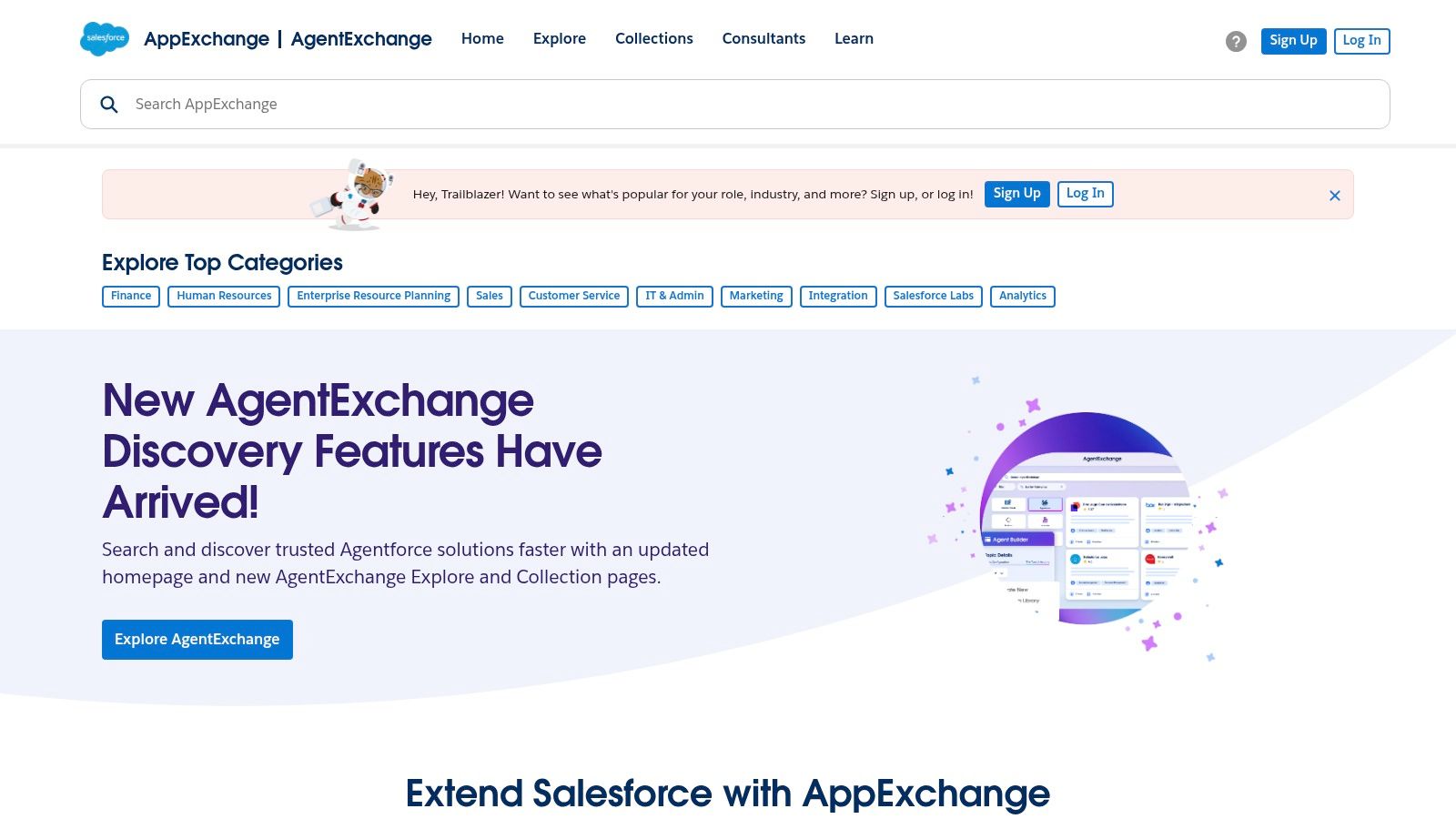
The platform shines by offering native and third-party solutions that fill specific process gaps. For instance, you can find apps that connect to RPA platforms like UiPath to automate data entry or service apps that use AI to route customer tickets more intelligently. The key advantage is the deep, secure integration; these apps are built for Salesforce, ensuring a smoother setup and a more unified workflow than a separate tool might offer.
Practical Example: A sales team can install an app from the AppExchange that automatically scans incoming emails, identifies key contacts, and creates or updates lead records in Salesforce. This eliminates the manual work of data entry and ensures the CRM is always up-to-date with the latest customer interactions.
Key Details & Considerations
The real value here is the size of the ecosystem and the security that comes with Salesforce-approved apps. However, it's only useful if you're a Salesforce customer, and browsing the huge number of options can sometimes be a lot to take in.
- Best For: Existing Salesforce customers looking to automate sales, service, and marketing processes directly within their CRM.
- Pricing: Varies wildly. Many apps offer free trials or freemium versions, but most are subscription-based, with costs set by the individual app developer.
- Limitation: The platform is a closed ecosystem; its benefits are only for Salesforce users. Also, the licensing for advanced AI features can be complex and may require a careful look.
Website: https://appexchange.salesforce.com/
12. G2 – iPaaS Category: Your Research Starting Point
G2 isn't a tool itself, but it's a critical first stop for any business serious about automation. It's a software marketplace where you can compare different Integration Platform as a Service (iPaaS) solutions based on real, verified user reviews. Think of it as the ultimate research platform for finding the right ai tools for business automation by learning from what others have experienced. You can filter platforms by company size, features, and user satisfaction to create a personalized shortlist.
The platform's best feature is its side-by-side comparison grids, which let you quickly see how top tools stack up on key features, pricing, and support quality. For beginners, the detailed buyer guides and category reports are incredibly valuable for understanding what's out there. This peer-driven insight helps you get past the marketing fluff and find platforms that genuinely solve problems like yours, which is a crucial step before you spend any money.
Practical Example: You're torn between Zapier and Make. On G2, you can read dozens of reviews from other small business owners, see screenshots of both platforms in action, and compare their pricing models side-by-side. You might discover that users consistently praise Make for its handling of complex workflows, which could be the deciding factor for your specific needs.
Key Details & Considerations
G2 is fantastic for helping you discover and check out tools, but remember it's a review site, not a vendor. Always back up what you read by signing up for a free trial of the software yourself.
- Best For: Any business leader or IT professional doing initial research and comparing vendors for automation software.
- Pricing: Free to browse and compare platforms.
- Limitation: While reviews are verified, the descriptions provided by vendors can be biased. It's smart to double-check claims and focus on the unfiltered user feedback.
Website: https://www.g2.com/categories/ipaas
AI Business Automation Tools Comparison
| Platform | Core Features / Integration ✨ | User Experience / Quality ★★★★☆ | Value Proposition 💰 | Target Audience 👥 | Unique Selling Points 🏆 | Price Points 💰 |
|---|---|---|---|---|---|---|
| Zapier | No-code builder, 7,000+ app integrations, AI agents | Fast setup, broad connector library | Quick time-to-value 💰✅ | SMBs, teams needing fast automation | Wide app ecosystem, AI-enhanced workflows ✨ | Free plan + tiered pricing 💰 |
| Microsoft Power Automate | Cloud & desktop RPA, 5,000 AI Builder credits | Strong governance, native MS365 integration | Competitive per-user pricing 💰 | Microsoft ecosystem enterprises 👥 | Deep MS stack integration, RPA + AI Builder 🏆 | Per-user licensing tiers 💰 |
| UiPath | Attended/unattended bots, orchestration, doc processing | Enterprise-grade stability (99.9% uptime) | Clear entry-level + scale path 💰 | Large enterprises, complex RPA use 👥 | Robust governance & support, scalable tiers 🏆 | Tiered licensing, enterprise plans 💰 |
| Automation Anywhere | Cloud-native bots, Bot Store marketplace | Strong enterprise adoption | Fast deployment with bot packs | Enterprises, SMB devs & students 👥 | Marketplace with prebuilt bots ✨ | Quote-based, Community Edition💰 |
| Make (formerly Integromat) | 2,000+ apps, scenario editor, AI agents | Affordable, powerful complex workflows | Very competitive pricing 💰 | SMBs needing custom workflows 👥 | Flexible scheduling with AI support ✨ | Competitive plans, usage-limited 💰 |
| Workato | Enterprise connectors, usage-based billing | Robust governance, monitoring | Flexible consumption pricing 💰 | Large organizations, enterprises 👥 | Enterprise-grade security & lifecycle controls 🏆 | Usage-based, consult sales 💰 |
| n8n | Open-source, self-hosted, unlimited workflows | Developer-friendly, flexible hosting | Cost-effective at scale 💰 | Tech-savvy teams, self-hosters 👥 | Self-host with compliance, customizable automations✨ | Affordable cloud + self-hosted |
| AWS Marketplace | AI/ML software, one-click deployment on AWS | Large catalog, AWS billing/governance | Variety + consolidated billing 💰 | IT teams, AWS users 👥 | Vast AI/ML offerings, easy AWS integration 🏆 | Usage-based on AWS pricing |
| Google Cloud Marketplace | Curated AI agents/models, seamless Vertex AI support | Strong governance, native cloud integration | Enterprise controls + integration 💰 | Google Cloud organizations 👥 | Tight Google Cloud ecosystem integration 🏆 | Usage & quote-based pricing 💰 |
| Microsoft Azure Marketplace | Wide AI/RPA apps, BYOL & SaaS support | Simplified Azure procurement | Broad partner ecosystem | Azure-centric enterprises 👥 | Centralized billing, diverse AI solutions 🏆 | Varies by publisher 💰 |
| Salesforce AppExchange | 8,000+ apps, RPA connectors, robust security | Deep Salesforce integration | Many free trials available 💰 | Salesforce CRM customers 👥 | Native CRM automation & partner apps 🏆 | Varies by app, mostly subscription |
| G2 — iPaaS Category | Side-by-side comparisons, verified reviews | Up-to-date peer feedback | Free research resource 💰 | Buyers researching iPaaS & automation 👥 | Trusted user reviews & detailed market insight 🏆 | Free access |
Your Next Step: Choosing the Right Automation Tool
We've explored a wide range of powerful AI tools for business automation, from friendly no-code connectors like Zapier to heavy-duty enterprise platforms like UiPath. The big takeaway is this: the power to automate is more accessible than ever, no matter your company's size or how tech-savvy you are.
The most important thing to remember is that there's no single "best" tool for everyone. The perfect solution is the one that fits your specific needs, your current tech setup, your team's skills, and your budget. A small marketing agency might love Make for its visual workflows, while a large bank will need the security and scale of a platform like Workato.
A Practical Framework for Selection
Making the right choice can feel like a lot. To make it easier, just start with one high-impact area. Don't try to automate everything at once.
- Identify the Pain Point: Where does your team spend the most time on boring, manual tasks? Is it data entry, qualifying new leads, or onboarding new employees? Pick one specific process to focus on first.
- Evaluate Your Resources: Be realistic about your team's skills. Do you have developers who can handle custom code, or do you need a completely visual, drag-and-drop tool? This will immediately help you choose between tools like n8n and Zapier.
- Start with a Pilot Project: Almost every tool on this list offers a free trial or a free plan. Use it! Pick one simple workflow, build it, and test it for a couple of weeks. For example, try automating the process of saving email attachments to a specific cloud folder. This low-risk experiment will tell you a lot about the tool's usability and potential benefits.
- Consider Future Scalability: The tool you pick today should be able to grow with you. Think about where you want to be in the future. Will you need to connect more complex apps or handle way more tasks? Make sure your chosen platform has a clear path for scaling up.
Implementing AI Automation Successfully
Remember that bringing in ai tools for business automation isn't just a tech project; it's a strategic move for your business. Real success comes from a change in mindset where your whole team is actively looking for ways to work smarter, not harder.
Encourage your employees to think like "automators" by asking, "Can we do this more efficiently?" As you see the time saved from your first small project, you can confidently start automating more processes across other departments. The world of AI is moving incredibly fast, and by taking this first smart step, you're setting up your business to be more agile, productive, and competitive for years to come.
Ready to stay on the cutting edge of AI and discover the next wave of transformative tools? The landscape of ai tools for business automation is constantly changing. At YourAI2Day, we provide the latest news, in-depth guides, and expert insights to help you navigate it all. Visit YourAI2Day to keep your business ahead of the curve.