AI Benefits and Risks: Your Friendly Guide to What’s Happening
Hey there! Artificial intelligence is one of those topics that feels like it's straight out of a movie—part amazing promise, part scary threat. On one hand, it offers incredible upsides, like automating the boring parts of our jobs and helping solve huge global challenges. But on the other, it brings some serious risks, from job displacement to major privacy questions.
This technology is a super powerful tool, and it's already changing our world in ways we're just starting to get our heads around. Understanding both the good and the bad is the first step toward making sure we build a future with AI that works for everyone.
Welcome to the AI Revolution
Okay, let's set aside the Hollywood fantasies of rogue robots for a minute. AI isn't some far-off concept anymore—it's woven into your daily life, often in ways you don't even notice.
Think of it as a smart assistant that's always learning. It’s the magic behind Netflix's uncanny ability to suggest your next binge-watch, and it’s how your inbox miraculously keeps most of that junk mail out of sight. You really don't need a PhD to get the main idea.
At its heart, AI is all about building computer systems that can do things that usually require a human brain. This could be anything from recognizing your face to unlock your phone, understanding what you say to Alexa, or even generating a brand-new image from a simple text description.
The Big Picture: Benefits and Risks
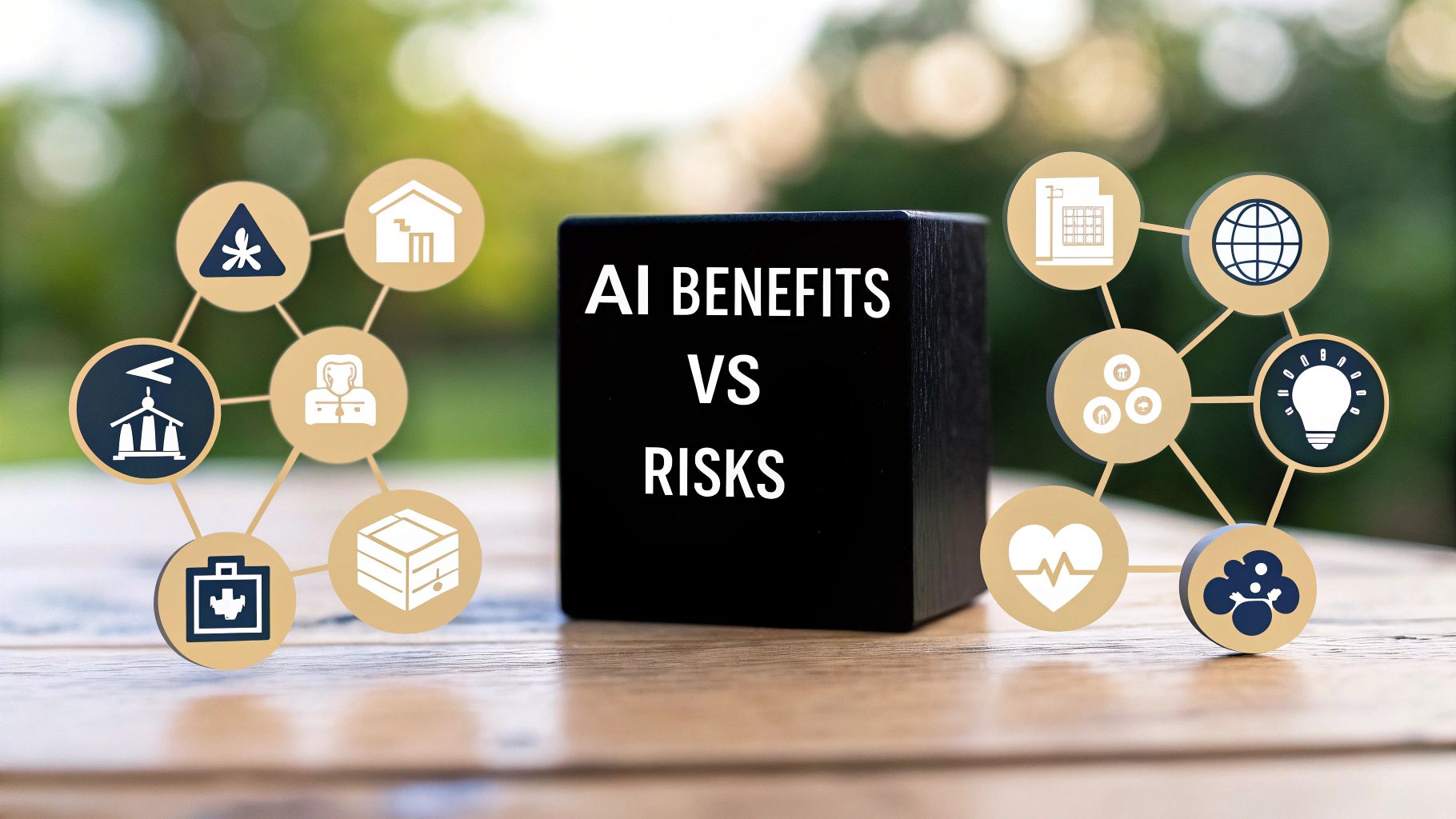
When you boil it down, the whole conversation around AI is a balancing act between incredible potential and some pretty big hurdles.
Here’s what that looks like in a nutshell:
- The Upside: AI has the potential to make our lives way more efficient. It can speed up medical research, untangle complicated business logistics, and give us new tools to fight massive problems like climate change. Creatives are already jumping in with a whole suite of AI tools for content creation to explore what's possible.
- The Downside: But all that power comes with strings attached. We have to seriously think about the impact on jobs, the danger of biased algorithms making unfair decisions, and the challenge of keeping our personal data safe in a world packed with AI.
The goal isn’t just to highlight the shiny new things or the scary possibilities, but to offer a clearer path to building AI that’s both powerful and trustworthy.
The graphic below really drives home just how fast AI is growing and the sheer amount of money we're talking about.

These aren't just abstract numbers. They represent a huge economic shift, proving that AI is here to stay, not just a passing fad.
AI Benefits vs Risks at a Glance
To make this a bit more real, it helps to see the potential pros and cons laid out side-by-side. This table gives a quick overview of the key areas where AI presents both a major opportunity and a big challenge.
| Key Area | Potential Benefit (The Upside) | Potential Risk (The Downside) |
|---|---|---|
| Efficiency & Automation | Automates repetitive tasks, freeing up people for more strategic and creative work. Boosts productivity across the board. | Job displacement for roles that are easily automated. Widening the economic gap between high-skill and low-skill workers. |
| Data Analysis & Insights | Processes huge datasets to uncover patterns humans can't see, leading to smarter business decisions and scientific breakthroughs. | Privacy violations if personal data is misused or breached. Potential for increased surveillance by governments or companies. |
| Personalization | Delivers highly customized experiences, from your Spotify Discover Weekly playlist to personalized healthcare plans. | Echo chambers and manipulation. Algorithms can reinforce your existing beliefs and limit exposure to different perspectives. |
| Problem-Solving | Helps tackle complex global challenges like disease research, climate change modeling, and making supply chains more efficient. | Autonomous systems making critical mistakes. The "black box" problem, where we don't understand how an AI reached its conclusion. |
| Accessibility | Creates tools that improve life for people with disabilities, like real-time translation apps and voice-controlled assistants. | Algorithmic bias. If an AI is trained on biased data, it can make unfair decisions in areas like hiring or loan applications. |
This isn't a complete list, of course, but it captures the main tension at the heart of the AI debate. For every amazing application, there's a corresponding risk that we need to actively manage.
How AI Is Making Our World Smarter and Safer
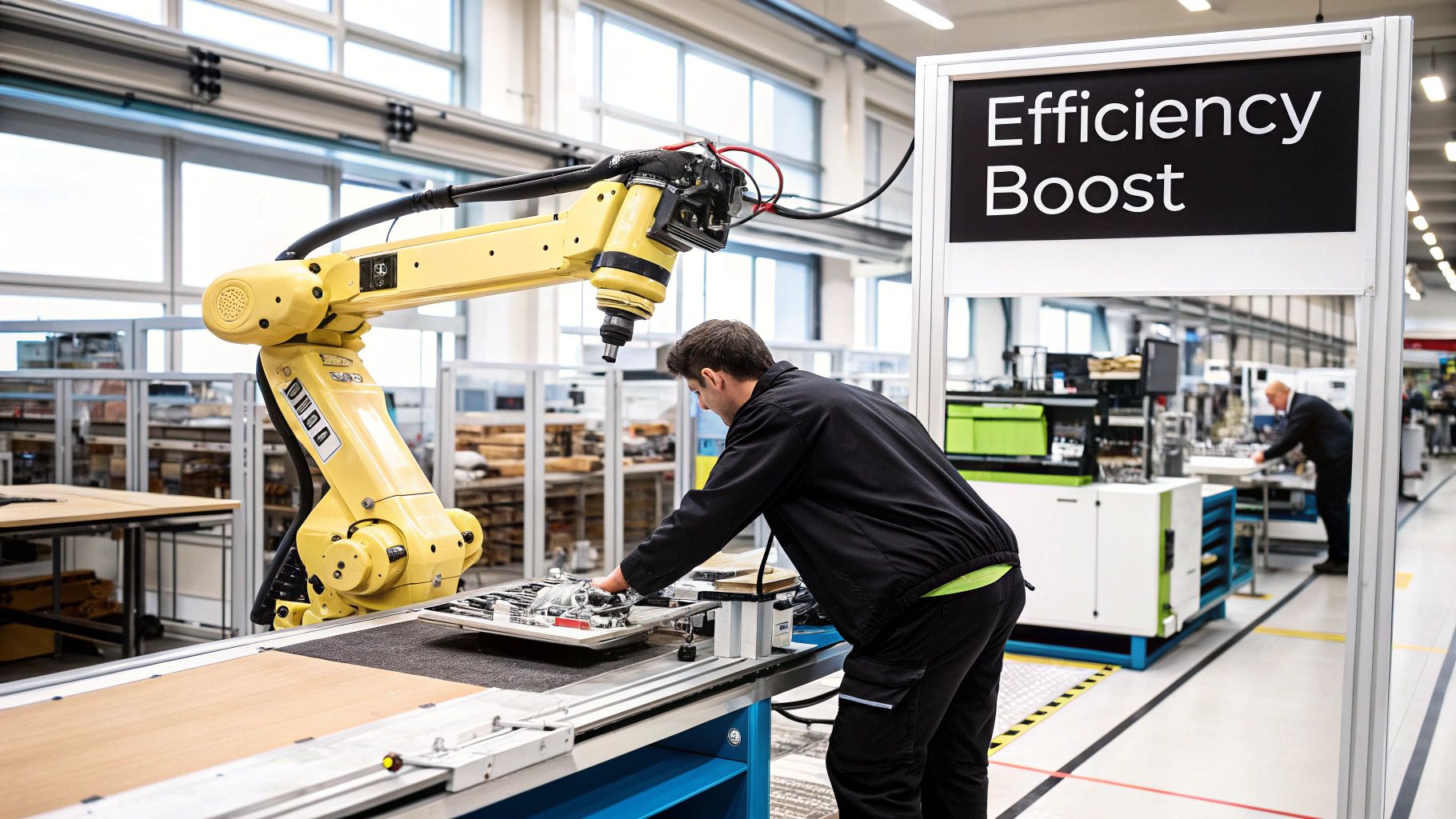
It’s easy to think of AI as something that just lives inside computers, but its impact is spilling out into the real world, quietly upgrading our lives in ways that feel almost like magic. It’s making things more efficient, more secure, and even helping us be more creative.
Think of AI not as a replacement for people, but as a set of powerful tools—superpowers, even—that let us solve problems we couldn't before.
Nowhere is this clearer than in healthcare. Imagine an expert assistant with perfect focus, capable of spotting the tiniest details in medical scans. That's what AI is doing right now. Doctors are using AI systems to analyze X-rays and MRIs, catching the subtle, early signs of diseases like cancer that a human eye might miss. This can lead to earlier diagnoses and dramatically improve a patient's chances.
Transforming Everyday Industries
AI’s influence doesn't stop at the hospital doors. It’s the invisible engine behind many of the things we do every day.
Ever wonder how that package you ordered online arrives so darn quickly? That’s AI at work. Logistics companies use it to predict demand, reroute delivery trucks around traffic in real-time, and manage massive warehouses with robotic precision. The result is faster shipping, fewer mistakes, and a smoother experience for you.
Here are a few other places you’ll find it:
- Smarter Farming: Farmers are using AI-equipped drones to fly over fields and check on crop health. On the ground, sensors can tell exactly when a plant needs water or if pests are moving in. This is a game-changer for growing more food while using fewer resources like water and pesticides.
- Enhanced Safety: In the financial world, AI is your silent bodyguard. It can sift through thousands of transactions per second, spotting weird patterns that signal a stolen credit card—often flagging a shady charge before you even know it’s happened.
- Creative Partnership: AI is also becoming a collaborator in the arts. A musician can use an AI tool to generate a new chord progression to get over writer's block. A designer can use an AI image generator to quickly mock up dozens of concepts for a new product. It's opening up brand-new avenues for human creativity.
A Force for Positive Change
Beyond making our individual lives better, AI is also being used to tackle some of the world's biggest challenges. Scientists are using it to build more accurate climate change models, giving us a clearer picture of what to expect and how to prepare. It’s also helping engineers design more efficient energy grids and discover new, sustainable materials.
Expert Opinion: As AI researcher Fei-Fei Li puts it, "AI is a tool. The choice about how we use it is ours." The goal should be to build AI that amplifies human capability, not replaces it.
The end goal is to develop AI that benefits everyone. Whether that’s smarter traffic lights making our commutes safer or personalized learning apps that help every student learn at their own pace, the potential is staggering. This technology isn't just a trend; it's becoming a fundamental part of how we build a better, safer, and smarter world.
The Economic Engine Driving Global Industries
Beyond the cool apps and handy digital assistants, artificial intelligence is fundamentally rewiring the global economy. This isn't just another tech update; it's a massive economic force that's creating entirely new industries while completely changing old ones.
Let's look at the money, the jobs, and what this all really means for the future of work.
Think of AI as a turbocharger for business. It gives companies the power to automate repetitive tasks, analyze complex market trends in a flash, and simply make smarter, data-backed decisions. The goal isn't just to replace people, but to superpower what they can do—freeing up human talent to focus on big-picture strategy, creativity, and solving tricky problems. When a company gets that much more productive, it can grow, innovate, and compete on a much bigger stage.
This isn't a small change, either. Heavy-hitting institutions like the IMF and Goldman Sachs see AI as a primary driver of global growth for years to come. How big? The numbers are jaw-dropping. Projections suggest AI could add about $7 trillion to the global economy within the next decade.
Some estimates even put the annual economic boost from productivity gains as high as $25.6 trillion. On the flip side, this shift is expected to affect roughly 40% of jobs worldwide, signaling a major pivot in the skills companies will be looking for.
New Markets and Fresh Opportunities
This economic shake-up isn't just about making existing businesses more efficient. It's also creating entirely new markets and jobs that were pure science fiction a decade ago. We're in the middle of a boom for companies built entirely on AI, from those developing specialized algorithms to others creating AI-powered services that solve old problems in new ways.
This creates a powerful ripple effect of opportunity. Just look at some of the job titles popping up:
- AI Ethicist: A professional who makes sure AI systems are built and used fairly, without causing unintended harm.
- Prompt Engineer: A specialist who masters the art of talking to AI models like ChatGPT to get the best possible results.
- AI Maintenance Technician: A skilled, hands-on expert who services the robots and automated systems that keep modern factories and warehouses running.
Expert Opinion: Andrew Ng, a leading AI expert, often says, "AI is the new electricity." He means that just like electricity transformed every industry a century ago, AI is set to do the same today. It's a foundational technology that will power countless new innovations.
This wave of change is also fueling a surge in entrepreneurship. As powerful AI tools become more accessible, small startups can suddenly compete with industry giants, making markets more exciting and innovative. For anyone with a great idea, there are plenty of fresh artificial intelligence startup ideas to explore. The trick is to adapt to this new world and grab the opportunities it presents.
Understanding the Real-World Risks of AI
We've talked about the incredible things AI can do, but it's not all sunshine and roses. To get the full picture, we have to look at the other side of the coin. Discussing the benefits and risks of AI means getting real about the potential downsides. This isn't about scaring you; it's about being smart so we can build this technology the right way.
Just as AI can open doors, it can also create serious problems if it's designed or used carelessly. These aren't abstract, sci-fi dangers—they are happening right now, and we need to face them head-on.
The Problem of Algorithmic Bias
One of the most immediate dangers is algorithmic bias. It helps to think of an AI model like a student. It learns from the data you give it. If that data is filled with our own existing societal biases, the AI will learn them, too. Even worse, it can amplify them at a massive scale because it doesn't have the common sense to know any better.
Here's a practical example: an AI built to screen résumés. If its training data comes from decades of hiring where men were historically favored for leadership roles, the AI might learn to automatically penalize applications from women, even if they're perfectly qualified. The AI isn't trying to be sexist; it's just mirroring the biased patterns it was shown.
This isn't just a hiring problem. The same issue pops up in really important areas:
- Loan Applications: An AI could systematically deny loans to people from specific neighborhoods based on biased historical lending data.
- Criminal Justice: Predictive policing tools have been criticized for potentially targeting minority communities, leading to a cycle of over-policing.
- Medical Diagnoses: A diagnostic AI trained mostly on data from one ethnic group could be far less accurate when diagnosing patients from another.
Job Displacement and the Shifting Workforce
The conversation about AI and jobs is a tricky one. The global AI market is exploding, creating a huge shift in how we work. Right now, nearly 100 million people work in AI-related roles. On top of that, there's a projected need for 97 million more skilled workers by 2025 just to keep pace. You can find more of these AI workforce statistics at Exploding Topics.
But while new jobs are being created, we can't ignore the very real risk of displacement for roles that can be automated. Think about jobs like data entry or basic customer service chats. It doesn't mean we're headed for mass unemployment, but it absolutely means the nature of work is changing—fast. The real challenge is figuring out how to retrain and upskill our workforce so people can transition into new roles that work with AI, not compete against it.
Privacy and the Misuse of Technology
AI systems are hungry for data; it's what they need to learn and get better. This creates a big tension with our right to privacy. Think about it: facial recognition is becoming common in public spaces, and our smart speakers are always listening. The potential for constant surveillance is growing every day.
Expert Opinion: The late Stephen Hawking warned, “The development of full artificial intelligence could spell the end of the human race… It would take off on its own, and re-design itself at an ever-increasing rate.” While this is an extreme view, it highlights the need for caution and control.
Beyond accidental privacy breaches, there’s also the threat of AI being used for malicious purposes. Bad actors can use this technology to create convincing deepfakes to spread misinformation, launch automated cyberattacks, or even develop autonomous weapons systems.
Facing these darker possibilities isn't about stopping progress. It’s the first, most crucial step toward building global rules and safeguards to make sure AI develops in a way that benefits all of us.
How AI Could Widen the Global Inequality Gap
Beyond the more talked-about risks, there's a quieter, more complex issue brewing. One of the most significant long-term risks of AI is its potential to make inequality even worse, not just in our own communities, but between entire countries.
Picture AI as a massive economic wave. If you're in a country with the resources to build a strong ship—plenty of tech infrastructure, skilled workers, and money—you can ride that wave to incredible new heights. But for those with little more than a raft, that same wave can be devastating, pulling them further and further behind.
This sets the stage for a "great divergence," where nations that are already wealthy and technologically ahead grow even faster, leaving everyone else in the dust. They have the data, the talent, and the money to build and use advanced AI, unlocking huge productivity gains that others can only dream of.
The Growing Chasm Between Nations
Many developing nations just don't have the robust internet infrastructure or the specialized workforce needed to join the AI boom. This isn't just an abstract economic theory; it has real-world consequences.
A 2025 working paper from the IMF projected that the economic growth from AI in advanced economies could be more than double what low-income countries experience. This gap comes down to fundamental differences in data access, economic readiness, and whether a country's main industries can even use AI effectively. You can dig deeper into this global economic divide by reading the IMF’s detailed analysis.
Expert Opinion: “The greatest risk is not that AI will become too smart, but that its benefits will be concentrated in the hands of too few," notes Erik Brynjolfsson, an economist at Stanford. "Without intentional policies, we could see an unprecedented rise in global inequality.”
This digital divide could effectively lock developing nations out of the next big wave of economic growth. It makes it that much harder for them to compete globally and improve the quality of life for their citizens. The challenge isn't just about handing over the technology; it's about helping build the entire ecosystem needed to make it work.
A Deeper Divide at Home
That same dynamic is playing out within individual countries, too. As AI gets better at automating routine tasks, it drives up demand for high-skilled workers—the people who can design, manage, and work with these new systems. We're talking about jobs that require creativity, critical thinking, and serious technical skills.
At the same time, the need for lower-skilled labor focused on repetitive or manual work shrinks. This creates a troubling split:
- High-skilled workers find their salaries and job opportunities expanding as their skills become more valuable.
- Low-skilled workers often face stagnant wages or find their jobs replaced, leaving them struggling to find their place in this new economy.
This is about more than just job losses; it's about a widening gap in earning potential. Without a serious commitment to education and retraining programs, AI could unintentionally create greater social and economic friction. Properly managing the benefits and risks of AI means creating a plan that gives everyone a fair shot to succeed.
Navigating Our Shared AI Future Responsibly
We've walked through the incredible promise of AI and the serious problems it can create. But the story doesn't end there. The future of artificial intelligence isn’t something that just happens to us; it's a path we’re all building together, one choice at a time.
The real challenge is finding the right balance—steering this powerful technology toward outcomes that genuinely help everyone. This means we have to be both optimistic about the possibilities and wide-awake to the dangers. By putting clear ethical rules in place and demanding transparency from developers, we can start to manage the risks. The goal is simple: make sure AI serves humanity, not the other way around.
Your Role in Shaping the Future
It's easy to feel like you're just a spectator watching this huge technological shift unfold, but that's not the case. Everyone has a part to play. Creating responsible AI isn't just a job for programmers and tech bosses; it needs everyday people to get involved and have a say.
Here are a few practical things you can do:
- Stay Curious and Informed: Keep learning about how AI is changing. When you understand the basics, you're much better equipped to spot fake news and add your voice to important conversations about how it should be used.
- Support Ethical Tech: Whenever you can, choose to support companies that are open about how they use AI and are serious about their ethical promises.
- Commit to Lifelong Learning: The job market is already changing. Skills that are hard to automate—like critical thinking, creativity, and communication—are becoming more valuable than ever. For those running a business, learning how to use AI for marketing is a fantastic first step in adapting.
Expert Opinion: AI ethicist Kate Crawford advises, "We need to look inside the black box of AI and ask who it serves, who it harms, and who gets to decide." This reminds us that human values must guide technological progress.
By getting out ahead of the ai benefits and risks, we can guide this technology toward a future that’s healthier, fairer, and more prosperous for everyone.
Got Questions About AI? We’ve Got Answers.
AI is a huge topic, and it's totally normal to have questions. Let's tackle some of the most common ones people ask, cutting through the hype to give you straight answers.
Is AI Going to Take My Job?
This is the big one, isn't it? The honest answer is that AI isn't likely to take all the jobs, but it is absolutely going to change a lot of them.
Some roles, especially those built on repetitive, predictable tasks (like basic data entry or sorting files), will almost certainly be automated. But at the same time, we're seeing brand-new jobs pop up that didn't exist a few years ago—think of AI ethicists, prompt engineers, and AI trainers.
It’s less of a total replacement and more of a big shift. The spotlight is moving to uniquely human skills: creativity, critical thinking, complex problem-solving, and empathy. The key to staying ahead is to see AI as a co-pilot you can work with, not a competitor you have to beat.
What Exactly Is "AI Bias"?
AI bias is what happens when an algorithm's decisions are consistently unfair, leading to discriminatory outcomes. It's super important to understand that the AI isn't "being malicious." It's simply reflecting the flawed data we humans gave it.
Imagine you train a hiring AI on decades of company data where men were overwhelmingly promoted to leadership roles. The AI will learn that pattern. It might then start unfairly overlooking highly qualified female candidates, not because it's sexist, but because it's just following the biased history it was taught.
This is a massive deal. Biased AI can reinforce and even worsen societal inequalities in really sensitive areas, from who gets approved for a loan to how diseases are diagnosed.
An expert on ethical AI once noted, “An AI system will not be less biased than the data it’s trained on. In fact, it will likely amplify the biases in the data.” This is a powerful reminder that our technology is a mirror of ourselves.
How Can I Start Learning About AI Without a Tech Degree?
Jumping into the world of AI is way more accessible than most people think. You don't need to suddenly become a coding genius.
A great first step is just to become more aware of the AI you already use every day. Think about how Netflix recommends shows or how your phone's camera automatically makes your photos look better. From there, you can start exploring resources made for beginners. Follow trusted tech journalists, watch YouTube videos explaining AI concepts simply, and play around with some of the free AI tools available online to get a feel for what they can do.
The goal is to build curiosity and a practical understanding of both the AI benefits and risks.
At YourAI2Day, our mission is to make artificial intelligence clear and useful for everyone. To stay ahead of the curve, check out our latest articles, guides, and tool reviews at https://www.yourai2day.com.