Your Guide to the AI Art Gallery
An AI art gallery is any space, whether it's a physical room or a digital environment, that’s built to showcase artwork created with artificial intelligence. This is where the line between human creativity and machine learning blurs, giving rise to everything from incredible digital paintings to mind-bending interactive installations.
Welcome to the Future of Creativity
Picture yourself walking into a gallery where every single piece is the result of a partnership between an artist and an algorithm. This isn't some far-off sci-fi concept; it's the new reality of the AI art gallery. Forget the quiet, formal halls of old. These are vibrant, living spaces where imagination and technology collide, and you're invited to join the fun.
So what does an “AI art gallery” actually look like in practice? It’s not just one thing! It could be a traditional brick-and-mortar gallery in New York or Paris hanging gorgeous prints of AI-generated work, an immersive virtual world you explore with a VR headset, or an online marketplace where artists sell their creations directly to collectors just like you.
The Artist and the AI Co-Pilot
A common misconception is that the AI is the artist. It's much more accurate to think of the AI as a super-powered co-pilot. An artist starts with a vision—a feeling, a complex idea, or even a line from a poem. They then use carefully written text prompts to guide the AI, which acts as a creative collaborator to turn those abstract thoughts into stunning visuals.
As artist Paul Mouginot, who works under the name aurèce vettier, explains, when an AI is trained on personal data, "It becomes a reflective device for poetic speculation." The process is less about a machine creating on its own and more about an artist wielding a new, incredibly flexible tool.
This unique partnership helps artists explore ideas at a speed and scale that were previously unimaginable. For a practical example, imagine an artist wants to create a series about "forgotten cities." Instead of spending weeks sketching, they can prompt an AI with "ethereal city of glass, overgrown with bioluminescent moss, cinematic lighting, forgotten by time." In minutes, they get dozens of visual starting points, allowing them to refine their vision with every new iteration. This kind of rapid-fire experimentation is at the very heart of the AI art process.
This new wave of art isn't just a niche curiosity—it's also a booming market. After being valued at $3.2 billion in 2024, the AI art market is projected to skyrocket to $40.4 billion by 2033. That incredible growth shows just how deeply AI is being woven into the fabric of modern creativity. You can dive deeper into the statistics shaping the AI art market and see how it's expected to evolve.
Making AI Art Accessible to Everyone
The best part? You don’t need to be a programmer or a tech genius to get involved. The beauty of the AI art gallery lies in its growing accessibility. Many online platforms and virtual spaces are designed with beginners in mind, offering a warm, welcoming entry point for anyone curious about this new frontier.
Here’s a quick rundown of what makes this movement so exciting:
- New Forms of Expression: Artists are now creating visuals that simply weren't possible before, from entire ecosystems of speculative flora to otherworldly, dream-like landscapes.
- Interactive Experiences: Many galleries aren't just for passive viewing. They invite you to interact with the art, sometimes even allowing you to change it in real-time.
- Global Community: Online galleries are connecting artists, collectors, and enthusiasts from all corners of the globe, building a dynamic creative community that's always changing.
As we go on, we'll look at where you can find these galleries, introduce some of the pioneering artists leading the charge, and even walk through how you can start your very own collection.
Where Can You See AI Art?
So, you're ready to dive in and see what all the buzz is about. The great news is that the AI art gallery isn't some exclusive, single location. It's a whole world of different spaces—some you can walk into, others you can click into—each offering its own unique perspective on this new wave of creativity.
Whether you love the quiet, tangible feel of a traditional gallery or the mind-bending possibilities of a virtual one, there’s a place for you to start exploring. From major art hubs to the comfort of your couch, opportunities to experience AI art are popping up everywhere.
Physical Exhibitions: The Tangible Experience
Believe it or not, even the most established art institutions are making room for AI. Major galleries in art capitals like New York, London, and Paris are increasingly showcasing AI-assisted works. Often, these exhibitions place AI art right alongside traditional paintings and sculptures, creating a fascinating conversation between the old and the new.
Events like NVIDIA’s GTC Paris conference have hosted curated galleries that put a spotlight on artists using AI to realize their vision. Walking through one of these shows is a fantastic way to see high-quality prints and massive digital installations up close. It really grounds the art, giving a physical weight and presence to something born from a digital prompt.
Visiting a physical exhibition gives you a tangible connection to the work. As artist Matthew Drinkwater put it, it's a "cultural and technological inflection point" where you can witness how digital concepts are refined long before a single physical object is made.
Virtual and Augmented Reality Galleries: The Immersive Frontier
For an experience that truly pushes the boundaries, VR galleries are where it's at. When you put on a VR headset, you aren’t just looking at art—you’re stepping inside it. These digital worlds can defy physics, with floating sculptures, interactive light installations, and entire environments that shift and react as you move through them.
Platforms like Spatial and Mona give artists and curators the tools to build their own custom virtual galleries. Anyone from anywhere in the world can then visit. It’s like having an all-access pass to a museum that’s always open and constantly evolving.
Online Platforms and Communities: The Digital Main Street
Honestly, the most accessible AI art gallery is probably already open in one of your browser tabs. Countless artists share their daily experiments and finished pieces on online platforms that have become vibrant, sprawling, informal galleries.
Here’s where you’ll find them:
- Artist-Centric Hubs: Websites like DeviantArt and Artbreeder are hotspots for AI art. They act as massive, public sketchbooks where you can see the creative process unfold and even chat directly with the artists.
- Social Media Feeds: Instagram, Pinterest, and X (formerly Twitter) have become dynamic, ever-scrolling galleries. Artists use these platforms to build communities, share works in progress, and get immediate feedback. It makes art discovery a natural part of your daily life.
- NFT Marketplaces: For those interested in the collecting side of things, platforms like SuperRare, Foundation, and OpenSea are the primary markets. Think of them as high-end digital galleries where ownership and authenticity are publicly tracked on the blockchain.
Comparing AI Art Gallery Experiences
To help you decide where to start, here’s a quick breakdown of what each type of gallery experience offers.
| Gallery Type | Experience | Accessibility | Example Platforms/Venues |
|---|---|---|---|
| Physical Exhibitions | Tangible, high-impact viewing in a traditional setting. | Limited to physical location and gallery hours. | Galleries in major cities, tech conferences, art fairs. |
| VR/AR Galleries | Fully immersive and interactive; defies physical limitations. | Requires a VR headset or AR-capable device. | Spatial, Monaverse, VR Chat. |
| Online Platforms | Casual, community-driven discovery and direct artist interaction. | High; accessible from any web browser or mobile app. | Instagram, DeviantArt, Pinterest. |
| NFT Marketplaces | Focused on collecting and investing; verifiable ownership. | High; requires a crypto wallet for transactions. | SuperRare, Foundation, OpenSea. |
Each of these avenues provides a different way to connect with AI art, so don't be afraid to explore them all to find what resonates with you.
Much of the art you'll find on these platforms is created using a wide array of powerful tools. If you’re curious about the technology behind the images, our guide on the best free AI image generators is a great place to start. No matter where you choose to look, you're only a few clicks away from discovering your next favorite AI artist.
Spotlighting the Visionary Artists Behind the Art
Behind every powerful piece you'll find in an AI art gallery is a human artist with a distinct vision. The AI isn't the creator; it's an incredibly complex instrument, and it takes a skilled conductor to make it sing. This is a celebration of the visionaries who are showing the world that AI is a tool for amplifying creativity, not replacing it.
These pioneers are more than just tech-savvy operators. They are researchers, poets, and storytellers who’ve discovered a new medium. By looking at their work, we can see just how much new creative ground opens up when an artist and an algorithm work in tandem.
Refik Anadol: The Architect of Data Dreams
If you’ve ever seen a building appear to breathe with liquid light, chances are you’ve witnessed the work of Refik Anadol. The Turkish-American artist is renowned for his massive public art installations that spin vast, invisible datasets into mesmerizing visual symphonies.
Anadol doesn't just make pictures; he builds what he calls "data paintings" and "data sculptures." He and his team feed AI models everything from oceanic sensor data to millions of archival photos. The output is a stunning, ever-shifting visual that can feel like stepping into the planet’s memory or a city's collective consciousness.
His work Unsupervised famously took over the lobby of New York's Museum of Modern Art (MoMA). For this piece, an AI was trained on the museum's entire collection, spanning over 200 years of art. The result is an installation that constantly reinterprets art history, generating dream-like forms that feel both alien and strangely familiar. It's a profound look at how AI can help us see our own culture in a completely new light.
Claire Silver: A Pioneer of AI and NFTs
In the world of digital art and NFTs, Claire Silver has carved out a space as a major voice and an influential creator. As one of the earliest artists to fully embrace generative AI, her work is immediately recognizable for its classical, painterly quality, but with a surreal, futuristic twist. Her pieces often feel like lost masterpieces from an alternate history.
Silver’s process is a delicate dance of collaboration. She works with AI as a partner, guiding it with prompts to generate the foundational elements. From there, she meticulously curates, edits, and composites—sometimes blending parts from hundreds of different generations to realize her final vision.
Her influence goes beyond her own art. Silver is a well-respected thinker in the field, championing the concept of "AI-collaborative art." She consistently makes the case that the artist's taste, skill, and storytelling ability are what ultimately infuse the work with soul and value.
A digital art curator recently put it this way: "What makes an AI artwork truly stand out isn't the complexity of the tech, but the clarity of the artist's voice. We look for pieces that tell a story, evoke emotion, and show a clear, intentional hand guiding the algorithm. The best AI art makes you forget about the AI and just focus on the art."
The Importance of Human Intent
The work of artists like Anadol and Silver drives home a critical point: the "work" in AI art isn't about physical brushstrokes, but about immense intellectual and creative labor. This process involves several key skills:
- Conceptualization: It all starts with a strong, unique idea. The artist must have a vision before the AI can help bring it to life.
- Prompt Engineering: This is the craft of writing nuanced, detailed text prompts to steer the AI's output. It's a true skill that takes endless practice.
- Curation: The artist must sift through hundreds, sometimes thousands, of generated images to find the perfect one—or the right pieces to combine.
- Post-Production: The final stage often involves extensive editing, refining, and compositing to perfectly match the AI's output to the artist’s vision.
These artists prove that an AI art gallery isn't just a showcase of what machines can do. It's a testament to human ingenuity and our relentless drive to find new tools to tell our stories.
How to Start Your Own AI Art Collection
Ever find yourself scrolling through stunning AI-generated images and thinking, "I wish I could own that"? The good news is, you absolutely can. The old myth that art collecting is only for the super-rich is just that—a myth. Starting your own AI art collection is surprisingly straightforward and a powerful way to support the artists shaping this new creative frontier.
You don't need a huge bankroll to get started. The first, and most enjoyable, step is to simply dive in and explore. Fire up Instagram or X (formerly Twitter) and search for hashtags like #AIart, #MidjourneyArt, or #StableDiffusion. You’ll find a never-ending feed of new work from artists around the globe. Follow the ones that catch your eye. A simple like, comment, or share goes a long way in supporting them and connecting you to the community.
Making Your First Purchase
When you find an artist whose work you truly connect with, you're ready to think about acquiring a piece. This usually comes down to two options: buying a digital original, which is often an NFT, or getting a physical print.
Don't get spooked by the "NFT" acronym. An NFT (Non-Fungible Token) is really just a digital proof of ownership. Think of it as a unique, unforgeable certificate of authenticity that lives on a public record called a blockchain. It’s how the digital world verifies that even if an image can be copied infinitely, only one person can own the original.
Ready to buy your first NFT? The process looks something like this:
- Set Up a Digital Wallet: You’ll need a crypto wallet to hold your digital art and currency. MetaMask and Coinbase Wallet are popular, user-friendly choices for beginners.
- Buy Some Crypto: Most NFT marketplaces operate on cryptocurrencies like Ethereum (ETH).
- Visit a Marketplace: Go to a platform like Foundation or OpenSea where the artist lists their work, connect your wallet, and you're ready to make a purchase.
Expert Advice for New Collectors
We reached out to a veteran digital art collector for their best piece of advice for someone just starting out. Their answer was refreshingly simple.
"Don't buy for investment; buy for love. Your first piece should be something that genuinely speaks to you, something you'd be happy to look at every day. The financial aspect can come later, but your initial connection to the art is what makes collecting meaningful."
This insight is golden, whether you're buying a digital file or a physical print. If you'd rather have something you can hang on your wall, many AI artists offer high-quality prints. When going this route, always buy directly from the artist or a trusted gallery. This ensures you're getting an authentic piece. Pay attention to the details—paper quality, printing method, and whether it’s a limited edition signed by the artist. These factors are what give a print its lasting value.
This isn't just a niche hobby anymore. The average share of digital works in art collections jumped from just 3% in 2024 to 13% in 2025, driven largely by younger collectors embracing this fusion of tech and creativity. You can explore the full report on the digital art boom from Art Basel to see the data for yourself.
As your collection grows, you might start thinking about the market and legal side of things. A common question is, Can You Sell AI Generated Art? Understanding the answer is key to making smart decisions. And if you're feeling inspired to try your own hand at this, we've got you covered—check out our guide on how to create AI art.
So, you've been exploring the world of AI art, maybe even collected a few pieces that speak to you. Now you’re getting that itch—the one that says, "I could do this. I could build my own space for this art." Good. Launching your own AI art gallery, whether it’s in a physical space or online, is probably more within reach than you imagine. It's your chance to add your voice and vision to this incredible creative movement.
Think of it less like opening a store and more like becoming a storyteller. A gallery isn't just a wall of pictures; it's a narrative. The absolute first thing you need to figure out is your gallery's core focus. Trying to be everything to everyone is a surefire way to get lost in the noise. A sharp, specific niche is what will make you memorable.
Defining Your Gallery’s Unique Niche
What’s the story you're dying to tell? Your niche is your identity—it’s what will draw in a dedicated audience and make it a whole lot easier to find the right artists.
Here are a few practical examples to get the wheels turning:
- Genre-Specific: Go deep into a style you love. For example, you could open a gallery dedicated to "AI-Generated Gothic Romanticism," "Solarpunk Futures," or "Analog-Style AI Photography."
- Thematic Focus: Build your collection around a powerful idea. Think "AI's take on Nature," "Digital Dreamscapes," or "The Rebirth of Portraiture."
- Regional Artists: Champion the creators in your own backyard. You could build an entire community by focusing on artists from a specific city or region.
- Tool-Specific: Showcase what a particular AI model can really do. An entire gallery dedicated to the unique aesthetic of Midjourney or the flexibility of Stable Diffusion could be fascinating.
Once you have a theme, the hunt for artists begins. This is the fun part. Dive into Instagram and X, follow hashtags that align with your niche, and actually talk to people. A simple, genuine message goes a long way. You'll find most artists are excited by the prospect of being featured in a space that truly gets their work.
Choosing Your Platform and Building Your Space
With your theme locked in and a growing list of artists, it's time to build the actual gallery. You’ve got great options that fit just about any budget or technical comfort level.
For a truly immersive feel without writing a line of code, look into virtual gallery tools. Platforms like Kunstmatrix or Spatial give you ready-made 3D environments where you just upload your art. People can "walk" through your exhibition from their web browser, which creates a really memorable experience. They handle all the tricky stuff like room design and lighting, so you can just focus on the art.
Of course, a beautifully designed dedicated website is another fantastic route. Using a platform like Squarespace or Wix, you can create a clean, elegant online portfolio for your gallery. This approach gives you total control over your branding and how visitors interact with the art.
An expert virtual gallery founder shared this key piece of advice: "Don't get paralyzed by the platform. The single most important first step is to define your curatorial voice. Pick a theme you are passionate about, and the rest will follow. A gallery with a strong point of view on a simple website is far more powerful than a fancy virtual space with no story."
The Art of Curation and Storytelling
Curation isn't just about picking pretty pictures. It’s about arranging them to tell that story we talked about. Think about the rhythm and flow of your exhibition. How does one piece lead you to the next? You might group artworks by their color palette, subject, or the emotion they evoke.
Your job is to guide the visitor's eye and mind on a journey. A thoughtfully curated gallery does more than just show art—it sparks ideas and leaves a real impression.
And if you’re thinking about a physical show with prints, don't underestimate the power of presentation. Knowing some professional art hanging techniques can turn a simple display into something that feels truly high-end, giving each piece the respect and attention it deserves. By zeroing in on a strong theme and curating with intent, your gallery won't just be another page online; it can become a real destination.
Navigating the Big Conversations in AI Art
AI art galleries are exciting, but the conversations happening around them are just as compelling as the images on display. This new frontier is forcing artists, collectors, and legal experts to ask some tough questions about what creativity and ownership even mean anymore.
There are no easy answers here. The goal isn't to tell you what to think, but to give you a map of the debates currently shaping the future of art.
The Big Question of Copyright and Ownership
One of the most tangled issues is copyright. When a machine helps create an image, who gets to own it? The artist who guided the process? The company that built the AI? Or does the work simply belong to everyone? Right now, the law is scrambling to keep up.
The U.S. Copyright Office, for example, has made it clear that a work made entirely by an AI isn't eligible for copyright because it lacks human authorship. But what about art where a person made significant creative choices using AI as their tool? That’s the gray area where most of the legal battles are being fought. For a closer look at how this content is defined, you can explore the nuances of what AI-generated content is and the debates it sparks.
The controversy doesn't stop there. It also digs deep into the data these AI models are trained on. Many models learned their skills by analyzing billions of images from across the internet, including copyrighted art from creators who never gave permission.
As one digital art critic notes, "The debate isn't just about technology; it's about ethics and consent. The most pressing issue is ensuring that the human artists whose work forms the foundation of AI models are acknowledged and, where appropriate, compensated. Attribution is everything."
This has sparked a major push for "ethically sourced" datasets and greater transparency from AI companies about how their models were trained. It’s a fundamental question of fairness and giving credit where it’s due.
Before you can display art, you need a space for it. This simple flowchart breaks down the foundational steps of getting a gallery off the ground, moving from your initial idea to the final launch.
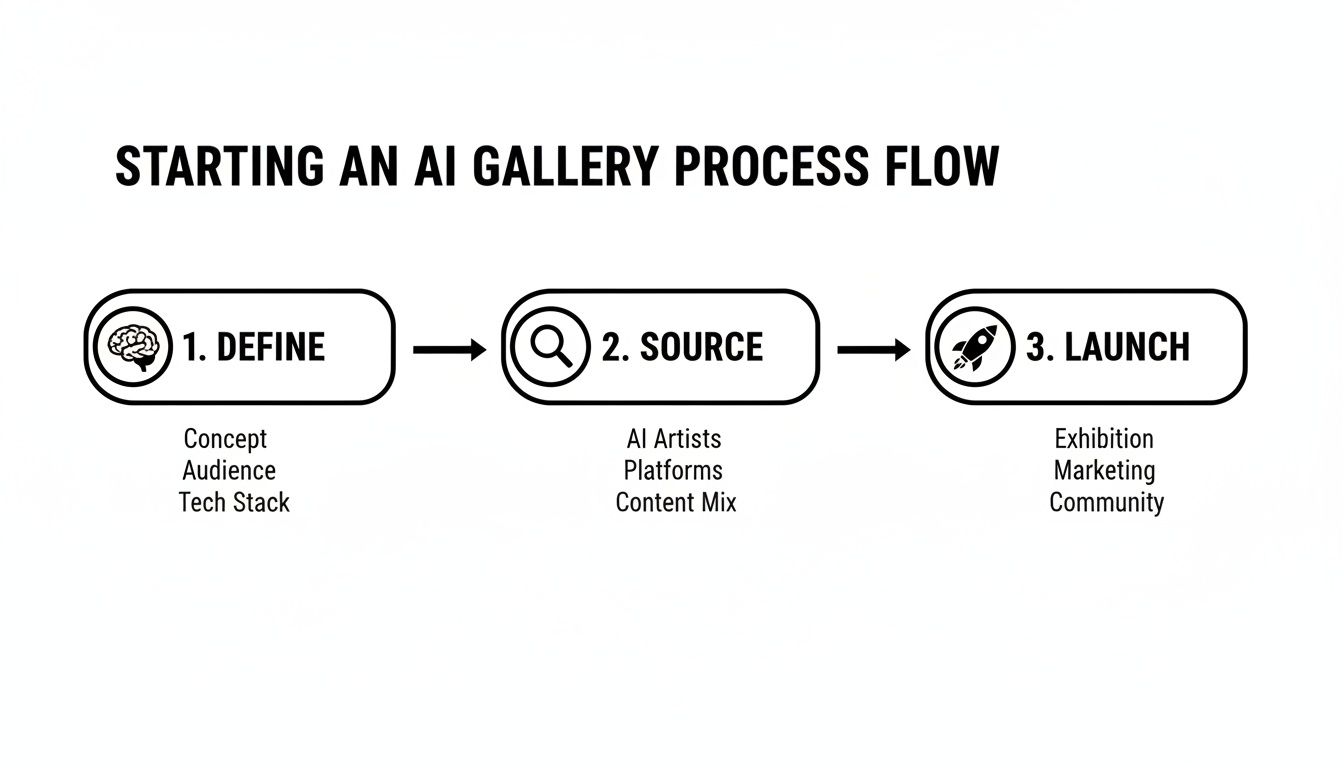
As you can see, it all starts with a clear vision. Defining your focus (Define) is the bedrock for finding the right art (Source) and successfully opening your doors (Launch).
Can a Machine Truly Be Creative?
Beyond the legal and ethical weeds, we get to the core philosophical question: is an AI actually creating, or is it just an incredibly advanced parrot?
- On one hand, many argue that true art stems from consciousness, intention, and lived experience—all things a machine doesn't have. In this view, AI is an impressive instrument, like a new kind of camera or paintbrush, but the human artist remains the sole creator.
- On the other hand, some believe that if a piece of art makes you feel something, its origins don't matter. They point to the emergent, often unpredictable results from AI as a new form of collaboration, where the machine can push its human partner into completely new creative territory.
There’s no consensus, and that’s precisely what makes this moment so fascinating. By engaging with these questions, you’re doing more than just looking at art—you’re participating in the conversation that will define it for this century.
Frequently Asked Questions About AI Art Galleries
Diving into the world of the AI art gallery can bring up a lot of questions. It's a new frontier, mixing familiar art world concepts with brand-new technology. To clear things up, here are some answers to the questions we hear most often.
Do I Need Special Gear to Visit Virtual Galleries?
Not at all. One of the biggest misconceptions is that you need a fancy headset to get started. While some of the most mind-blowing experiences are designed for VR systems like the Meta Quest, most virtual galleries are built to run right in your web browser.
Platforms like Kunstmatrix and Spatial have made it incredibly simple. You can explore stunning 3D exhibitions with just your keyboard and mouse. This makes it easy to check out what the virtual gallery scene is all about without investing in any special equipment.
How Do I Know if AI Art Is Original?
This is a crucial question, and it gets right to the core of what digital ownership means today. When an artwork is sold as an NFT (Non-Fungible Token), its authenticity and history are recorded on a blockchain—a decentralized and public digital ledger that's virtually impossible to alter.
For collectors, the blockchain is the new certificate of authenticity. An expert in digital assets once put it perfectly: "Think of the blockchain as the artwork's unbreakable provenance. It's the modern way to verify you're buying the real deal, directly from the artist or a verified owner."
If you're buying a physical print of AI art, the old rules still apply. The safest bet is always to purchase directly from the artist or through a reputable gallery that can guarantee the work's legitimacy.
Can I Actually Make Money with My Own AI Art?
Absolutely. We're seeing more and more artists build successful careers from their AI-generated creations. It's not just a hobby; it's a viable path. Here are a few of the most common ways they're earning an income:
- Selling NFTs: Artists often list their original digital files on marketplaces like OpenSea or Foundation.
- Offering Physical Prints: You can sell high-quality physical prints of your work through an Etsy shop or your own personal website.
- Taking Commissions: Many clients are looking for custom AI art. You can work with them directly to bring their specific prompts and ideas to life.
A key first step is building an audience. Sharing your portfolio on platforms like Instagram or X (formerly Twitter) is a fantastic way to connect with potential buyers and get your work seen.
At YourAI2Day, our mission is to make AI clear and accessible for everyone. Keep learning with our in-depth articles, tool reviews, and community discussions. Explore more at https://www.yourai2day.com.