A Beginner’s Guide to the Latest AI Technology
Feeling a bit lost in all the chatter about the "latest AI technology"? You're definitely not the only one. It feels a lot like the early days of the internet—this massive, world-altering force is suddenly becoming a practical tool for everyone. This guide is your friendly map, helping you understand what AI is right now, why it’s such a big deal, and how you can actually start using it.
Your Friendly Guide to Modern AI
If you're just dipping your toes into artificial intelligence, the jargon can feel a little intimidating. But let’s cut through that. At its heart, modern AI is all about creating smart tools that can understand information, generate new ideas, and take action to help us with real-world tasks. Forget the sci-fi robots; think of it as a super-capable partner for your daily life.
This massive shift didn't happen overnight. It’s the result of incredible advances in computing power and our ability to work with huge amounts of data. AI has broken out of the research lab and is now embedded in the apps on your phone, the software you use at work, and the creative tools you can find online. My goal here is to give you a clear, straightforward tour of the most important developments happening today.
What Can AI Actually Do for You?
Instead of trying to define AI as a single, monolithic thing, it's much more useful to think of it as a collection of capabilities. These skills are designed to solve specific problems and open up new possibilities, whether you're a student, a creative professional, or a business owner trying to stay competitive.
The main functions of the latest AI technology really boil down to three key things:
- Understanding: AI can sift through massive datasets to spot patterns, answer complex questions, and make sense of information. Imagine a researcher who can read and comprehend millions of pages in the time it takes you to read this sentence. For example, a doctor could use an AI tool to quickly analyze thousands of medical studies to find the latest cancer treatments, a task that would take a human months.
- Creating: This is the magic of generative AI. It can produce entirely new content from a simple prompt—whether that's drafting an email, writing a blog post, designing a logo, or even composing a short piece of music.
- Acting: Modern AI can also execute tasks and automate entire workflows. Practical examples are all around us, from sorting your email inbox and powering customer service chatbots to helping developers write code more efficiently.
This simple concept map helps visualize how these core functions—understanding, creating, and acting—are the building blocks for everything AI can do.
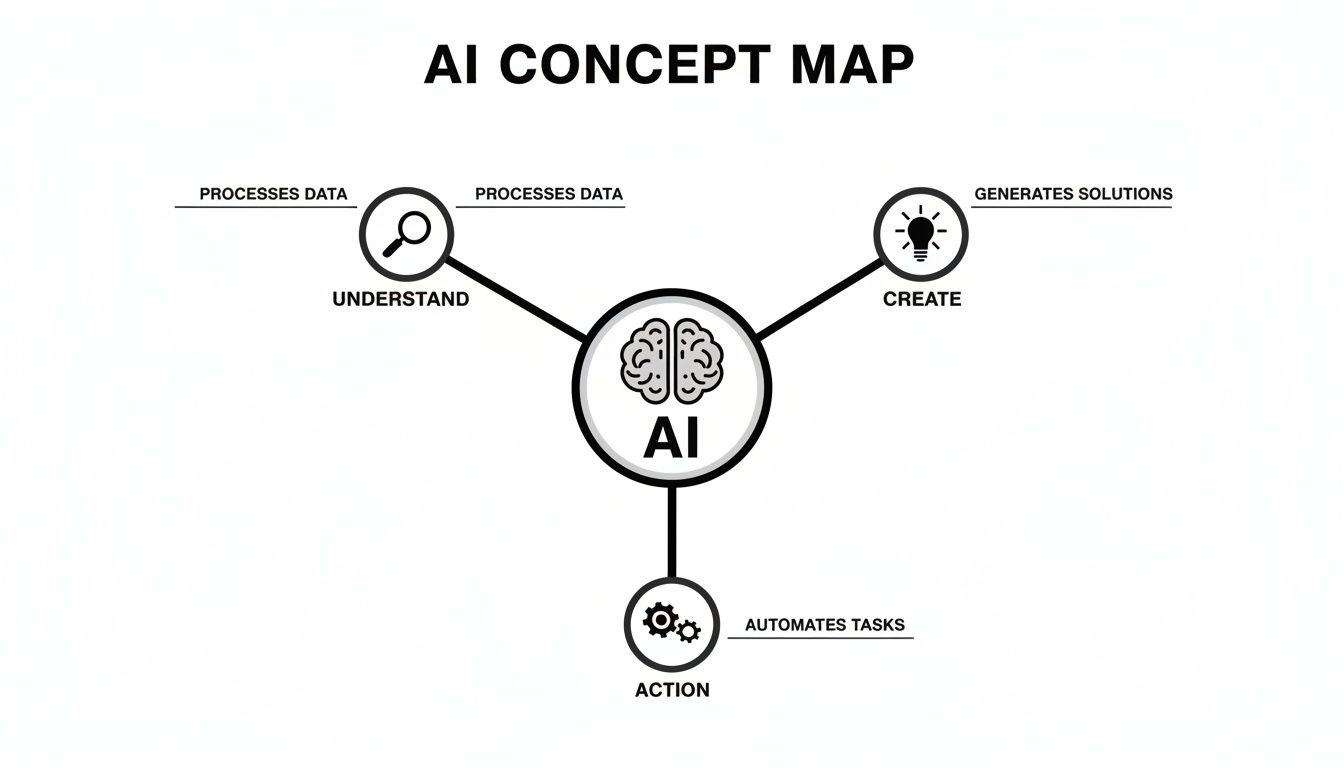
As you can see, today's AI isn't just about crunching numbers. It’s a dynamic cycle of comprehension, creation, and execution that puts powerful new tools in our hands.
The Engines of Creation: Generative AI and LLMs Explained
Ever wondered how a tool like ChatGPT can draft a perfect email in seconds? Or how Midjourney can whip up a stunning fantasy landscape from just a few words? That's not magic. It's the handiwork of two of the most significant pieces of latest AI technology right now: generative AI and Large Language Models (LLMs).
Let's unpack these in a friendly way. At the heart of most text-based AI tools, you'll find an LLM. The easiest way to picture an LLM is to think of the autocomplete on your phone, but scaled up to an almost unimaginable degree.
Imagine an autocomplete that's consumed a huge chunk of the internet—books, articles, websites, you name it. It has learned the patterns, the context, and the subtle relationships between words so well that it can predict what comes next with startling accuracy. That predictive ability is what lets it string together coherent paragraphs, answer complex questions, and even adopt different writing styles.
The Power of Prediction
This "next-word prediction" is the fundamental building block. When you tell an LLM to "write a marketing slogan for a new coffee shop," it doesn't actually think about coffee or marketing. It just calculates the sequence of words that are statistically most likely to follow your request, based on the mountains of data it was trained on.
This whole process happens incredibly fast, word by word, to build out complete and often surprisingly creative sentences. If you want to get into the nitty-gritty of how it all works, you might be interested in learning more about Large Language Models and how they work.
So where does generative AI fit in? It's the broader category, and LLMs are just one piece of it. Think of generative AI as the endlessly creative artist, and an LLM is its specialized tool for working with words. But this artist has a lot more tools in its belt.
As tech analyst Benedict Evans puts it, "Generative AI is a machine for creating plausible text, plausible images, plausible audio. The key word is 'plausible.' It doesn't know what's true, it knows what's likely." This insight helps us understand these tools as powerful assistants, not all-knowing oracles.
Beyond Text to a World of Creation
Generative AI applies the same core ideas of pattern recognition and prediction to create all kinds of new content. And this isn't just about remixing old stuff; it’s about generating something entirely new that has never existed before.
To really get a handle on its power, it helps to understand what is AI generated content, which can be anything from a simple paragraph to a complex 3D model.
Here are just a few examples of what generative AI can do:
- Images and Art: Describe a scene like "a cyberpunk city street at night in the rain, with glowing neon signs," and an AI image generator will create a completely unique picture from your prompt.
- Music and Audio: AI can compose original musical scores in different genres, create custom sound effects, or even generate a realistic voiceover from a simple script. A podcaster, for example, could type in their intro script and get a professional-sounding voiceover in minutes.
- Code: Developers are now using AI assistants to write, debug, and optimize code, dramatically speeding up the entire software development lifecycle.
This creative capability is attracting a lot of attention—and money. Generative AI is the hottest ticket in town, pulling in $33.9 billion in global private investment in 2024 alone. Some forecasts even predict the generative AI market could balloon to $1.3 trillion over the next decade, which points to a huge shift in how we create and innovate. You can read the full research about these AI investment trends for more details.
To help you visualize the different flavors of these tools, here's a quick breakdown.
A Quick Look at Different Generative AI Models
| AI Type | What It Does | Popular Tools | Best For |
|---|---|---|---|
| Text-to-Text | Generates human-like text from a prompt. | ChatGPT, Gemini, Claude | Writing articles, summarizing text, brainstorming, coding assistance. |
| Text-to-Image | Creates images from written descriptions. | Midjourney, DALL-E 3, Stable Diffusion | Creating digital art, concept designs, marketing visuals, illustrations. |
| Text-to-Video | Generates video clips from text prompts. | Sora, Pika, Runway | Short-form content, animated storyboards, product demos. |
| Text-to-Audio | Produces music, voiceovers, or sound effects. | Suno AI, ElevenLabs | Creating royalty-free music, podcast intros, voice narration. |
As you can see, each type of model opens up new creative possibilities. Ultimately, these technologies are creative engines. They take a simple prompt—a spark of an idea—and turn it into a fully formed piece of work, making them incredible tools for brainstorming, content creation, and problem-solving across countless fields.
How AI Sees, Hears, and Understands Our World
So far, we've mostly talked about AI's skill with language. But the next massive leap forward is all about giving AI senses—letting it perceive and interpret the world much like we do. This is where multimodal AI enters the picture, and it's a really exciting development for beginners to watch.
Think about how you have a conversation. You aren't just processing words. You're reading facial expressions, hearing the tone of voice, and maybe even looking at a picture someone is showing you. You naturally weave all these inputs together—sight, sound, language—to grasp the full meaning. Multimodal AI is designed around that exact principle.
Instead of just crunching text, these systems can process and connect information from different sources, or "modalities," simultaneously. It's a huge step up from a simple chatbot, making AI far more aware of context and nuance.
What Multimodal AI Can Do
The easiest way to get your head around multimodal AI is to look at what it can actually do. It's the engine behind some of the most genuinely useful and futuristic tools coming out today. This isn't just an abstract concept; it's already here.
Here are a few practical examples of this technology in action:
- See and Describe: Snap a photo of what’s in your fridge, and a multimodal AI can suggest recipes based on the ingredients it "sees." Google Lens is a great real-world example of this.
- Listen and Summarize: It can watch a video, process the dialogue, recognize the action in the scenes, and give you a quick, accurate summary. Imagine summarizing a two-hour lecture into five bullet points!
- Draw and Build: A developer could sketch a rough website layout on a piece of paper, and a multimodal AI can turn that simple drawing into working code.
This ability to fuse different types of data unlocks a completely new level of problem-solving. We're essentially teaching AI to understand context the way a person does.
Dr. Fei-Fei Li, a leading AI researcher from Stanford, explains it perfectly: "For AI to be truly intelligent, it needs to understand the world in all its richness and complexity. Multimodal AI is a critical step towards that goal, allowing machines to perceive and reason about the world more like humans do."
Real-World Applications Are Here Today
This stuff isn't science fiction. Multimodal AI is already having a tangible impact, especially in creative industries and accessibility. Artists and designers are using these tools to bring ideas to life, generating stunning images, music, and even video from a mix of text descriptions and visual examples.
For accessibility, this technology is a true game-changer. Apps are emerging that can describe a person's surroundings in real-time to someone with a visual impairment, effectively turning a smartphone camera into a guide.
Communication is another area where it’s making waves. To see how AI handles different data types, consider how an AI Audio Translator works. These tools don't just spit out a word-for-word transcription; they analyze tone and context to deliver far more accurate and natural-sounding translations.
By learning to juggle multiple inputs, AI is building a much more holistic understanding of our world. If you want to dive deeper into the language piece of this puzzle, our guide on what Natural Language Processing is explains how it all fits together.
Making AI Faster and More Private with Edge AI

What if AI could work instantly on your phone or laptop without sending a single byte of your data to the cloud? That’s the entire idea behind Edge AI, one of the most practical and privacy-focused shifts in modern artificial intelligence. It's all about bringing the brainpower of AI directly to where you are.
Think of it like this: traditional cloud AI is like ordering takeout. You send your order (data) to a restaurant across town, they cook it in their massive kitchen (a distant data center), and then deliver it back to you. It works, but there's a delay, and you have to trust them with your information.
Edge AI, on the other hand, is like having a master chef in your own kitchen. The work happens right there, on your device. It’s faster, completely private, and works even when your internet is out.
Why On-Device AI Is a Game-Changer
You’re probably already using Edge AI and don't even know it. The facial recognition that unlocks your smartphone in a split second? That's Edge AI. The real-time language translation app that functions perfectly offline in another country? Yep, that's Edge AI, too.
By crunching the numbers locally, these tools give you answers in milliseconds. This on-device approach makes AI feel less like a clunky program you have to connect to and more like an invisible, native feature of your device.
The main benefits for users are incredibly clear:
- Speed: Responses are instantaneous. There's no lag waiting for data to travel to a server and back, which is essential for things like smart cameras and responsive voice assistants.
- Privacy: Your personal data—your face, your voice, your sensitive documents—never leaves your device. This is a huge win for security and peace of mind.
- Reliability: Since it doesn't need a constant internet connection, Edge AI is far more dependable, especially on the go or in places with spotty Wi-Fi.
An expert in mobile computing might say, "The future of AI isn't just in massive data centers; it's in the palm of your hand. Edge AI makes artificial intelligence personal, responsive, and secure by design, which is essential for building user trust."
How Edge AI Keeps Your Information Safe
Data privacy is a massive concern for almost everyone these days, and Edge AI provides a solid answer. Most older AI models required you to upload your information to a central server, creating a central point of failure and potential vulnerabilities.
With Edge AI, the model runs right on your hardware. Your photos stay on your phone, and your voice commands are processed locally on your smart speaker. This is a core part of modern privacy-by-design strategies. If you find this topic interesting, you can learn more about Federated Learning and its privacy benefits, which is a related technique that helps train smarter on-device models without compromising user data.
Ultimately, Edge AI is changing how we interact with technology. It's making our devices quicker, our data safer, and our daily lives a little bit easier. It’s a quiet but powerful shift that puts more control right back where it belongs: in your hands.
Putting the Latest AI Technology to Work in Your Business

Alright, we've covered some of the mind-bending concepts behind modern AI. Now for the part that really matters: how do you actually make it work for you? The thought of bringing AI into your operations can feel huge and complicated, but it doesn't have to be some massive, expensive overhaul.
The trick is to start small and zero in on a real, tangible problem. Forget about adopting AI just for the sake of it. Instead, look at the daily friction points in your workflow. What are the repetitive, soul-crushing tasks that eat up time and energy? That's where you start.
Identify Your Pains First
Before you even think about specific tools, take a step back. The best opportunities for AI are often hiding in plain sight, disguised as everyday annoyances.
Think about common areas where AI can deliver a quick win:
- Customer Support: Are your inboxes flooded with the same questions day after day? An AI chatbot can handle those common queries 24/7, freeing up your team for the trickier, more human conversations.
- Marketing Content: Ever feel like you’re on a content treadmill, struggling to keep up with blog posts, social updates, or newsletters? Generative AI can be your writing partner, drafting initial versions that you can then polish and perfect.
- Data Analysis: Staring at a spreadsheet full of sales figures or customer feedback, trying to find the story? AI tools can spot patterns and pull out key trends in seconds—insights you might have easily missed.
The goal here is to pinpoint one specific, nagging problem. This "problem-first" approach is the key to getting real value from AI right away, instead of getting bogged down in the tech itself.
As one business consultant wisely noted, "The biggest mistake I see small businesses make is chasing the newest shiny AI toy. The smart move is to identify a clear business challenge first and then find the right tool to solve it. AI should be a solution, not just a project."
This insight gets to the heart of the matter: strategy before technology. It's exactly this practical mindset that's fueling the explosion in AI adoption. The global AI market is on track to hit around $294.16 billion in 2025, which is a massive 26% jump from the year before. This isn't just hype; it's businesses finding real-world applications. By 2032, some projections even suggest the market could swell to an incredible $1.77 trillion. You can discover more insights about the growing AI market size on explodingtopics.com.
A Real-World Example: A Small E-Commerce Store
Let's make this concrete. Picture a small e-commerce shop that sells handmade jewelry. The owner, Sarah, is a one-person show—she designs, manages the website, packs orders, and runs all the marketing.
Her biggest headache? Customers who add items to their cart and then disappear. She knows she's leaving money on the table but simply doesn't have the time to chase them down with personalized emails.
Here’s how she put AI to work:
- The Problem: A high cart abandonment rate with zero time for manual follow-up.
- The AI Solution: Sarah found an affordable email marketing platform that came with a built-in AI writing assistant.
- The Process: She set up a simple automated sequence. Now, when a customer abandons a cart, the AI generates a friendly, personalized reminder email. It even helps her test different subject lines to see what works best.
- The Result: In just the first month, Sarah recovered 15% more abandoned carts. That translated directly into a significant sales bump, all from a tool that cost less than a few coffees a week.
Sarah’s story proves you don't need a team of data scientists to get results. So many of today’s AI tools are built to be user-friendly and surprisingly affordable. The old myth that AI is just for giant corporations is completely out of date. With the right strategy, even the smallest business can find a way to make the latest ai technology a powerful ally.
Navigating the Future of AI Responsibly
As we get more comfortable using the latest AI technology, it's only natural to start thinking about the bigger picture. All this incredible power comes with a very real responsibility to use it thoughtfully. This isn't about some sci-fi doomsday scenario; it's about being smart and informed users who understand both the potential and the pitfalls.
When people talk about AI ethics, two topics always come up: data privacy and algorithmic bias. They might sound complicated, but the core ideas are pretty straightforward. Data privacy is all about having control over your personal information, while algorithmic bias is simply a question of fairness. Let's dig into what that actually means.
Understanding Algorithmic Bias
Algorithmic bias happens when an AI system produces results that are consistently unfair or prejudiced. It’s important to remember this isn't because the AI is "thinking" maliciously. It's a garbage-in, garbage-out problem—the AI is just reflecting the biased data we humans fed it in the first place.
Think of it like this: imagine training an AI to be a hiring manager by only showing it resumes from the past 50 years. Since historical hiring practices often favored men for leadership roles, the AI might learn to unfairly penalize qualified female applicants simply because their profiles don't match the historical data pattern. Understanding this helps us learn to question AI-generated results instead of just blindly accepting them.
"Building ethical AI isn't just the job of a few engineers in a lab," an AI ethics expert might say. "It's a responsibility we all share as developers, business leaders, and everyday users. Our choices—from the data we use to train models to how we question their outputs—shape a future where technology serves everyone fairly."
Practical Steps for Responsible AI Use
You don't need a technical degree to be a responsible AI user. It really just comes down to developing some healthy habits and keeping a critical mindset. With global investment in AI skyrocketing—the U.S. alone funneled $109.1 billion into private AI ventures in 2024—these tools are only going to become more common, making mindful usage that much more important. You can discover more insights about AI investment trends on statista.com.
Here are a few simple ways you can navigate the future of AI more responsibly:
- Think Critically: Always treat AI-generated information as a first draft, not the final word. Double-check its claims, especially when you're making important decisions.
- Be Mindful of Your Data: Understand what personal information you're giving to AI applications. Take a moment to read privacy policies and stick with tools from companies that are transparent about how they handle your data.
- Question the Source: Get in the habit of asking yourself where the AI might have gotten its information. If you're using a tool for research, consider the potential for hidden biases baked into its training data.
- Provide Clear Instructions: The more specific and unbiased your prompts are, the better and fairer the results will be. You have a direct hand in shaping the AI's output.
Ultimately, using AI responsibly is about empowerment. It’s not about fearing the technology, but about becoming a thoughtful and educated user. By asking the right questions and staying aware, you can make sure the AI tools in your life are helpful, fair, and secure.
Common AI Questions, Answered
If you’ve made it this far, your head is probably buzzing with questions. That’s a good thing! It means you're thinking critically about what this all means. Let's tackle some of the most common ones that pop up when people are first diving into artificial intelligence.
Do I Really Need to Know How to Code to Use AI?
This is one of the biggest misconceptions out there, and the answer is a resounding no. While creating a new AI model from the ground up is a deeply technical task, using one is a completely different ballgame.
Think of it this way: you don't need to be an automotive engineer to drive a car. The same principle applies here. Today's best AI tools are designed for everyone, not just programmers. If you can write a text message, you have the skills to prompt tools like ChatGPT to draft an email or use Midjourney to generate an incredible image. The focus has shifted from coding to communicating.
Is AI Going to Take My Job?
It’s the elephant in the room, isn't it? The truth is a lot more complex than a simple "yes" or "no." History has shown us time and again that new technology changes jobs, but it rarely eliminates them outright. AI is more likely to be a co-pilot than a full-on replacement.
Remember when spreadsheets became mainstream? Accountants weren't suddenly out of a job. Instead, the tedious, manual calculations were automated, freeing them up to focus on higher-level financial analysis and strategy. AI is doing the same thing, but across many more fields. It's taking over the repetitive tasks, which lets us humans lean into what we do best: creative thinking, complex problem-solving, and genuine connection.
An industry expert might put it this way: "The most successful professionals in the coming years won't be those competing against AI. They'll be the ones who master working with it. The real skill is learning how to collaborate with these tools to get better, faster results."
How Can I Start Learning More About AI Without Getting Overwhelmed?
The best way to learn is simply to start doing. You don't need to enroll in a university course or bury yourself in technical textbooks (unless you want to!). The most practical approach is to get your hands dirty with the tools that are already available, often for free.
Here are a few easy ways to get started today:
- Start small and be practical. Use free tools like Google Gemini or ChatGPT for simple, everyday things. Ask for help writing a tricky email, planning a vacation itinerary, or just brainstorming ideas. Pay attention to what it's good at and where it stumbles.
- Keep up with the news, casually. Find one or two high-quality AI newsletters or websites you enjoy reading. The goal isn't to become an expert overnight but to stay aware of the big changes without drowning in jargon.
- Play around. When you hear about a cool new AI tool, go check it out. Most have free versions you can experiment with. There’s no substitute for that hands-on experience; it's the fastest way to build a real intuition for what the latest AI technology is capable of.
Here at YourAI2Day, our entire goal is to demystify artificial intelligence. We create clear guides, share the latest news, and provide resources to help you feel confident in this new era. Explore our other articles and join the community to continue your AI journey.