A Beginner’s Guide to AI and Data Mining
Hey there! Ever heard the terms "AI" and "data mining" tossed around and wondered how they actually fit together? You're in the right place. They team up to turn massive amounts of raw data into smart, actionable decisions. Think of data mining as the discovery process—like a detective finding hidden clues—while AI is the genius partner who uses those clues to predict the future or automate complex tasks.
This incredible partnership is the engine behind everything from your Netflix queue to sophisticated business forecasting. Let's dive in and see how it all works in simple, friendly terms.
Decoding the Digital Detectives
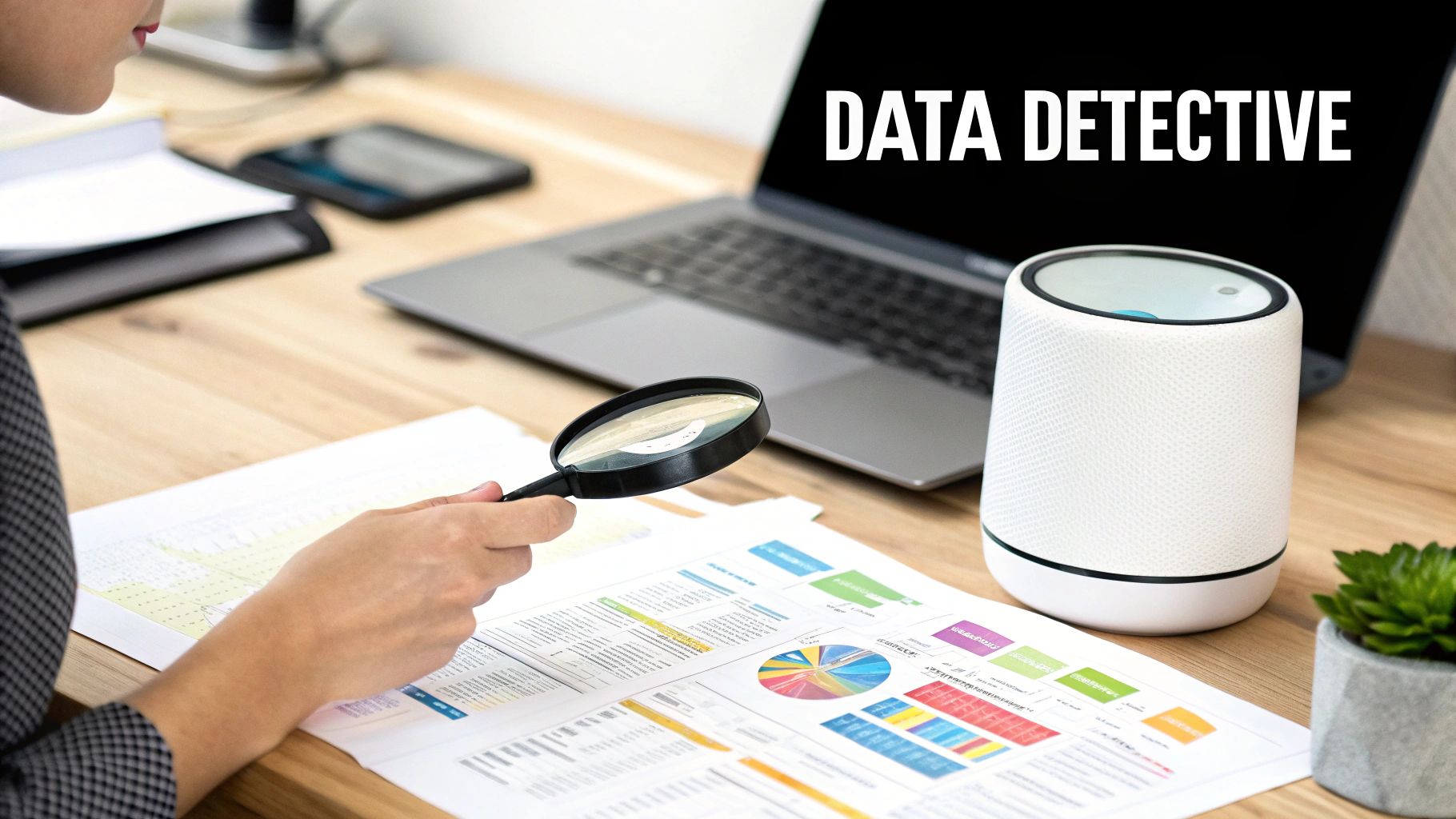
Welcome to the world of data. It can feel like a gigantic, disorganized library where crucial information is scattered everywhere. So, how do we find what we're looking for? This is precisely where the combination of AI and data mining shines.
Let's skip the dense technical definitions and think of them as a team of digital detectives.
Data mining is the lead investigator. Its mission is to sift through mountains of evidence—your data—to uncover hidden clues, unexpected connections, and meaningful patterns that aren't visible on the surface. It’s focused on answering the question, "What happened here, and what trends can we spot?"
Artificial intelligence (AI) is the brilliant partner who learns from those clues. It takes the patterns found by data mining and uses them to predict what might happen next or to make smart decisions on its own. AI tackles the question, "Given what we've learned, what's likely to happen in the future?"
The Power of Partnership in Practice
This teamwork isn't just theoretical; it’s at play all around you, every single day. Take your favorite streaming service. Data mining algorithms analyze the viewing habits of millions of people, finding patterns like, "Viewers who watched Movie A also tend to love TV Show B."
Then, AI steps in. It uses that pattern to build a personalized recommendation engine, suggesting TV Show B specifically to you right after you finish Movie A. This simple but effective workflow is a perfect example of how the two work together to improve your experience. To really get a handle on data mining's scope, it helps to understand its sub-fields, like text mining, which is all about pulling insights from unstructured text.
As data expert Dr. Eva Wallace puts it, “AI without data mining is like a brain without memories. Data mining provides the historical context and patterns that AI needs to learn, adapt, and make intelligent predictions.”
Ultimately, this duo is changing how businesses function. Companies are no longer just hoarding data; they're actively using it to understand their customers, streamline operations, and find their next big opportunity. This guide will walk you through exactly how that relationship works, from the core concepts to real-world applications. Let's get started!
AI vs. Data Mining: What's the Difference?
It’s easy to see why people often lump "AI" and "data mining" together. They're both deeply rooted in data and frequently work in tandem, but they have fundamentally different jobs. Getting a handle on their distinct roles is the key to understanding how they combine to produce such powerful results.
Let’s start with a simple analogy. Think of a seasoned detective and a high-tech crime prediction unit.
Data mining is the detective. This is the gumshoe work. The detective sifts through mountains of evidence—interview transcripts, forensic reports, and security footage (your data)—looking for clues. They’re searching for hidden connections, motives, and patterns. Their goal is discovery: finding the "who, what, and where" that’s already buried in the case files.
Artificial intelligence (AI) is the crime prediction unit. This unit takes the detective's findings—the established patterns and suspect profiles—and builds a system to anticipate the future. It might predict where the next crime is likely to occur or identify a new transaction that fits the profile of a known fraud scheme. The goal here is action: to make an intelligent guess or automate a decision based on what the detective uncovered.
Two Sides of the Same Coin: Goals and Processes
At its heart, data mining is about looking backward to make sense of what’s already happened. It’s an exploratory process that uses historical data to pull out meaningful patterns, trends, and correlations.
Imagine an e-commerce company digging through last year's sales figures. Data mining is the process that reveals a fascinating insight: 70% of customers who buy high-end running shoes in the spring also purchase GPS watches within the next 30 days. That discovery is the gold nugget unearthed by data mining.
AI, on the other hand, is all about taking that gold nugget and putting it to work for the future. It takes that "shoes and watches" pattern and builds a smart system to act on it. An AI-powered marketing tool could automatically send a targeted discount for GPS watches to a customer exactly two weeks after they purchase those specific running shoes. This is where their objectives really diverge.
According to industry analyst Mark Chen, "Data mining finds the 'what' in your data—the patterns and relationships. AI takes that 'what' and builds the 'so what'—the automated systems and predictive models that drive business value."
Comparing AI and Data Mining at a Glance
To put it all into perspective, let's break down their core differences side-by-side. This table really highlights how each one brings something unique to the table in a data-driven workflow.
| Aspect | Data Mining | Artificial Intelligence (AI) |
|---|---|---|
| Primary Goal | To discover hidden patterns, anomalies, and insights in existing datasets. It's an exploratory process. | To build systems that can perform tasks, make predictions, or automate decisions based on learned patterns. |
| Core Process | Involves techniques like clustering, classification, and regression to analyze historical information. | Involves developing algorithms and models that learn from data and then act or predict autonomously. |
| Typical Output | Reports, visualizations, identified trends, and sets of rules (e.g., "75% of customers in this group churned"). | A functional model, a recommendation engine, a chatbot, or a system that automates a task (e.g., fraud detection). |
| Question It Answers | "What interesting patterns can we find in our historical data?" | "Based on these patterns, what will happen next, or what action should we take?" |
While they have different jobs, one thing is clear: modern AI can't function without solid data mining. The prediction unit is useless without the detective's hard-won evidence. In the same way, AI models can't make accurate predictions without the clean, relevant, and insightful patterns that data mining brings to light.
Their relationship is truly symbiotic. One finds the knowledge, and the other puts that knowledge into action. You can learn more about the different ways AI learns from data by exploring our guide on supervised vs unsupervised learning.
How AI Enhances the Data Mining Process
It’s easy to think of data mining as just a prep stage for AI, but that’s only seeing part of the picture. The real breakthrough happens when AI doesn’t just use the results of data mining but actively gets involved in the mining process itself. This partnership turns a simple one-way street into a powerful, self-improving loop.
Traditionally, data mining was a serious grind. Analysts would pour countless hours into cleaning messy datasets, figuring out which pieces of information actually mattered (a process called feature selection), and manually testing one model after another. This is where AI comes in and completely changes the game.
Automating the Heavy Lifting
AI-powered tools are brilliant at automating the most mind-numbing, time-sucking parts of data mining. Picture a massive customer database riddled with missing fields, typos, and inconsistent formatting. An AI algorithm can intelligently scrub that data clean, fill in the blanks, and standardize everything with a speed and accuracy no human team could ever hope to match.
For example, imagine a spreadsheet where customer states are entered as "CA," "Calif.," and "California." An AI tool can instantly recognize these are the same thing and standardize them all to "CA," saving someone hours of tedious work. This automation makes the entire workflow incredibly fast and reliable. For a closer look at how this works in practice, you can find great examples in this guide on AI for Data Analysis.
"AI acts as a force multiplier for data mining," says tech strategist Lena Petrova. "It allows us to ask more complex questions of our data and get answers in minutes, not weeks."
The flow is simple but powerful: raw data gets refined through mining, and then AI brings those insights to life.
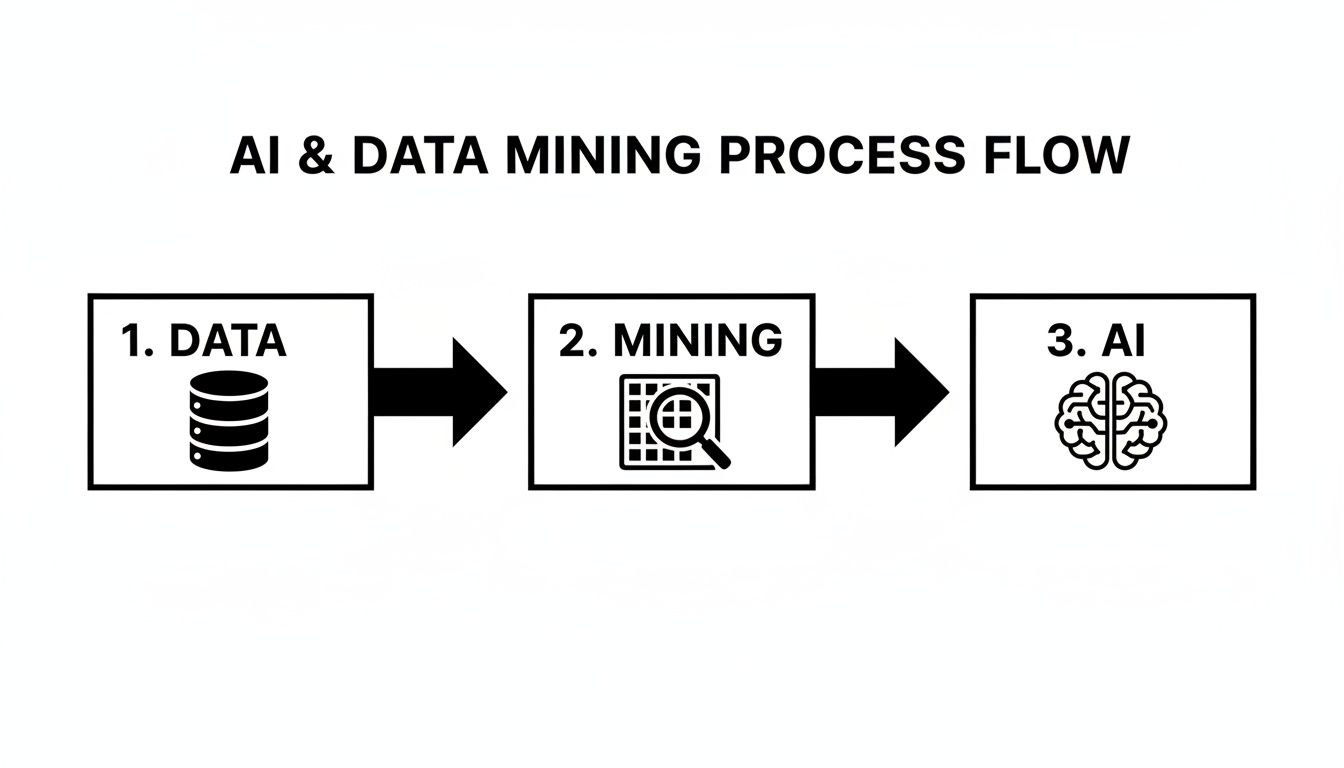
As you can see, AI isn't just the final destination; it's the engine that can supercharge the whole mining journey.
Uncovering Deeper, More Subtle Patterns
Beyond just doing things faster, AI brings a unique ability to spot complex patterns that even a seasoned analyst could easily miss. Humans are good at seeing straight lines and simple connections, but AI is built to find the tangled, non-linear relationships buried deep inside the data.
Let's take a retail example. A human analyst might spot a basic correlation: people who buy coffee beans also tend to buy milk. An AI model, on the other hand, might uncover something far more specific. It could find that customers who buy a particular brand of organic coffee on a Tuesday morning are 85% more likely to also buy artisan bread, but only if the weather is sunny. That’s a level of detail that’s almost impossible to find by hand.
This powerful combination of AI and data mining isn't just a neat tech trick; it's a massive economic engine. The global AI market is on track to balloon from USD 294.16 billion in 2025 to an incredible USD 2,480.05 billion by 2034. This explosion is fueled almost entirely by AI's ability to unlock the hidden value in data.
Making Data Mining Accessible to Everyone
Maybe the biggest impact AI has had is the rise of Automated Machine Learning (AutoML). You can think of AutoML as a "data scientist in a box." These platforms use AI to automate the entire workflow of building, testing, and deploying predictive models.
With an AutoML tool, someone with little to no coding background can get incredible results. Here’s how it usually works:
- Upload a dataset: Start with something like a spreadsheet of customer sales history.
- Define a goal: Tell the system what you want to predict, like "which customers are about to cancel their subscription?"
- Let the AI work its magic: The platform automatically cleans the data, runs it through hundreds of different algorithms, and serves up the best-performing model.
This is a huge deal. It puts the power of predictive analytics into the hands of marketers, financial analysts, and small business owners—people who don't have a dedicated data science team on standby. It’s truly bringing the benefits of data mining to a much wider audience.
Real-World Examples of AI and Data Mining
Theory is one thing, but seeing AI and data mining in action is where it all clicks. These technologies aren't just for tech giants; they're solving real, tangible problems across industries you interact with every day. Let's look at a few mini-stories of this powerful duo at work.

Safer and Smarter Industrial Operations
Think about a massive mining operation where safety and efficiency are everything. For decades, predicting equipment failures or finding the richest ore deposits relied on a mix of expert guesswork and old data. Now, intelligent data analysis is completely changing the game.
Mining companies are swimming in information from geological surveys, drone imagery, and thousands of sensors on their heavy machinery. Data mining algorithms dive into this mountain of data to find subtle patterns that signal trouble ahead—like a tiny vibration increase that comes just before a critical machine failure.
This is where AI takes the baton. It builds predictive models based on these patterns to forecast equipment breakdowns before they happen, paving the way for proactive maintenance. The results are huge: operations are safer, and costly downtime is slashed.
This combination is fueling incredible growth. The AI in mining sector, valued at USD 35.47 billion in 2025, is projected to skyrocket to USD 828.33 billion by 2034. By turning sensor data into actionable intelligence, some companies have cut equipment downtime by up to 50%. You can dig deeper into these numbers in this AI in mining market report.
The real magic happens when data mining uncovers a hidden truth—like a specific sensor reading that points to a future safety risk—and AI turns that truth into an automated alert that saves lives.
Hyper-Personalized Shopping Experiences
Ever felt like an e-commerce site was reading your mind? That’s no accident; it’s a perfectly executed team-up between AI and data mining. Online retailers are masters at collecting data on your every digital move.
- Clicks: Every single product you look at.
- Time Spent: How long you linger on an item’s page.
- Cart Additions: Things you consider but don't buy right away.
- Purchase History: A complete record of everything you've ever bought.
Data mining chews through this massive dataset to find behavioral patterns. It might discover that customers who buy a certain brand of coffee maker are also very likely to be interested in sustainable, fair-trade coffee beans. Or it could spot a group of shoppers who always browse on their phones but switch to a desktop to finalize their purchases.
AI then uses these insights to build a hyper-personalized shopping journey just for you. It’s the engine behind the recommendations that show you those coffee beans right after you add the coffee maker to your cart. It’s what sends you a reminder email with a small discount for the item you left behind. It’s not just about selling more; it's about making your shopping experience feel seamless and intuitive.
Stopping Financial Fraud in Its Tracks
The financial world moves at lightning speed, and unfortunately, so do fraudsters. Banks and credit card companies handle millions of transactions every second, making it impossible for humans to manually flag suspicious activity. This is a perfect job for our dynamic duo.
The process kicks off with data mining. Analysts feed algorithms decades of transaction data—both legitimate and fraudulent. The system learns to spot the subtle red flags that often signal a fraudulent purchase. These clues aren't always obvious; it might be a small purchase at a new location followed by a large one, or a transaction happening at an odd time of day for that specific customer.
Once these patterns are locked in, an AI model is trained to spot them in real-time. This model watches live transactions and assigns a risk score to each one. If a purchase looks highly suspicious, the AI can step in automatically.
The result? A fraudulent transaction can be blocked in milliseconds, often before the money even leaves the account. This is why you get an instant text asking, "Did you just spend $500 in a different country?" This real-time defense saves consumers and businesses billions of dollars every year, all thanks to patterns found by data mining and the instant decisions made by AI.
Your First Toolkit: Essential AI and Data Mining Tools
Jumping into AI and data mining can feel like a huge leap, but you don't need a massive budget or a data science degree to get started. The right software makes all the difference, turning complex processes into something more like putting together a puzzle.
Let's break down a few key types of tools that are perfect for anyone just starting out. Think of them as different trails up the same mountain—some involve coding, others are purely visual, but they all lead to valuable insights.
For Those Who Want to Code: Python and Its Libraries
If you're open to writing a little code, Python is the place to begin. It's often called the "Swiss Army knife" of data science, and for good reason. The language is known for being straightforward to learn, and its massive community means you're never more than a quick search away from an answer.
But Python’s real magic lies in its libraries—packages of pre-written code that do the heavy lifting for you.
- Pandas: This is your best friend for wrangling data. Imagine a spreadsheet that can handle millions of rows and lets you clean, filter, and reshape your information with simple commands. That's Pandas.
- Scikit-learn: Ready to build your first predictive model? Scikit-learn takes incredibly complex machine learning algorithms and boils them down into easy-to-use functions. It’s the perfect launchpad.
- Matplotlib & Seaborn: Data is just numbers until you can see it. These two libraries are fantastic for creating charts and graphs, helping you spot hidden patterns and share your findings in a way anyone can understand.
For a Visual Approach: No-Code Platforms
What if you want the power of data mining without writing a single line of code? You're in luck. No-code platforms let you build powerful workflows using a visual, drag-and-drop interface. It’s a lot like building with LEGOs—you just connect different blocks that represent each step of your analysis.
Two of the most popular choices here are KNIME and RapidMiner. These tools let you visually map out your entire process, from importing and cleaning data to building a model and seeing the results.
Here’s a quick look at the KNIME interface. Notice how you can just connect nodes to create a clear, logical data workflow.
This visual approach really demystifies the whole process. You get to focus on the what and why of your analysis instead of getting bogged down in the how of coding syntax. It's a fantastic way to grasp the fundamentals of data modeling. In fact, getting the data ready is the most critical first step, which we cover in our guide on data preparation for machine learning.
For When You Need More Power: Cloud-Based Services
As your projects get bigger and more ambitious, you'll eventually need more computing muscle than your laptop can offer. That's where cloud platforms like Google AI Platform, Amazon SageMaker, and Microsoft Azure Machine Learning come in.
While they sound intimidating, these platforms offer surprisingly user-friendly interfaces to help you build and deploy sophisticated models at scale. Best of all, they handle all the complicated server management behind the scenes. This makes them a great next step for when you've outgrown the basics but aren't quite ready to build an entire infrastructure from scratch.
The tools themselves are just the beginning; they are the unsung heroes powering AI's ability to generate insights. The market for these tools is growing rapidly, proving just how critical they are for modern business.
The industry momentum is hard to miss. According to Research Nester, the data mining tools market was valued at USD 1.5 billion in 2025 and is on track to hit USD 4.5 billion by 2035. A huge part of that growth is driven by cloud-based tools that give businesses the scalable power they need to handle massive datasets and integrate AI into their daily operations.
Navigating Ethical Challenges in Data Mining
When we wield the power of AI and data mining, we take on a serious responsibility. Digging through massive datasets isn't just about crunching numbers; when personal information is involved, you're handling the details of people's lives. It's a responsibility we have to get right.
One of the most immediate concerns is data privacy. It’s so critical that regulations like the General Data Protection Regulation (GDPR) in Europe have set firm ground rules for how organizations can handle personal data. The principle is straightforward: people have a right to know how their information is used and to have it kept safe. This makes transparency and security non-negotiable legal requirements, not just nice-to-haves.
Confronting Algorithmic Bias
Another massive hurdle is algorithmic bias. AI models are only as good as the data they learn from. If that data is riddled with historical prejudices, the AI will inevitably learn and amplify those same biases. This isn't just a theoretical risk; it creates real-world harm.
Think about an AI tool designed to screen résumés for a software engineer position. Let's say it's trained on the company's hiring data from the past 20 years. If the company historically hired men for these roles, the AI will learn to associate male-coded language or specific backgrounds with a "good fit." It might then unfairly penalize or outright reject exceptional female candidates. The AI isn't malicious—it's just reflecting the biased patterns it was shown. To get a better handle on this, it's worth understanding what AI bias is and its various forms.
As AI ethicist Dr. Anya Sharma notes, “An AI system can be a mirror reflecting the best and worst of humanity. The ethical challenge is to ensure we’re showing it a reflection worth learning from.”
Paving the Way for Responsible AI
So, how do we tackle these problems? The answer lies in being proactive and weaving ethical considerations into the fabric of your data mining workflow, right from the very beginning.
- Audit Your Data: Before you even think about training a model, take a hard look at your dataset. Are certain groups underrepresented? Does the data reflect historical inequalities that could poison the outcome?
- Ensure Transparency: You should be able to explain how your models make their decisions. "Black box" models, where the logic is a mystery, are a liability, especially in high-stakes situations.
- Keep a Human in the Loop: AI should be a copilot, not the pilot, for critical decisions like hiring, credit scoring, or medical diagnoses. A human being needs to have the final say.
Adopting these practices helps ensure these powerful tools are used for good, making you a more responsible and ethical practitioner in the field.
Got Questions? We've Got Answers
Stepping into the world of AI and data mining often brings up more questions than answers, especially at the beginning. We hear a lot of the same questions from people just starting out, so we've put together some straightforward answers to help clear things up.
Let's get right to it.
Do I Really Need to Be a Programmer to Use Data Mining Tools?
Absolutely not. While knowing a language like Python is a huge plus, you don't have to be a coder to get started. Honestly, many of the best modern tools were designed specifically for people who don't write code.
Platforms like KNIME or RapidMiner have visual, drag-and-drop interfaces. You can literally build a sophisticated data analysis workflow by connecting blocks on a screen. This makes them perfect for business analysts, marketers, or anyone who wants to find insights without getting bogged down in syntax.
What's the Real Difference Between Machine Learning and Data Mining?
This is a great question because the lines can seem blurry. They are definitely related, but they play different roles on the same team.
Think of data mining as the exploration phase. You're like a detective sifting through all the evidence, looking for hidden connections, strange patterns, and meaningful clues. The goal is pure discovery—finding something valuable you didn't know was there.
Machine learning, on the other hand, is a tool you use during that process. Once data mining uncovers a useful pattern, machine learning builds a model that can use that pattern to make a prediction.
The simplest way to put it is this: Data mining is about discovering patterns, while machine learning is about predicting outcomes based on those patterns. One finds the "what," the other builds the "what's next."
This partnership is what makes so many modern AI systems tick. You can't build a good predictive model without first discovering the patterns worth paying attention to.
How Can a Small Business Get Started with AI and Data Mining?
You don’t need a Fortune 500 budget or a dedicated data science department. The trick is to start small and focus on a single, specific problem you're already facing.
Don't try to boil the ocean. Instead, ask a focused question. For example, "Which of my customers are most likely to buy again?" or "Can I predict which weeks will be our busiest this quarter?"
Start with the data you already have right now. You're probably sitting on a goldmine:
- Sales data from your point-of-sale or e-commerce system.
- Website visitor data from Google Analytics.
- Customer details from your email marketing list.
You can even start with tools you might already own, like Microsoft Excel's Analysis ToolPak, or try a free version of a visual platform like KNIME. The most important thing is to just start. Pick a question, grab your data, and see what simple patterns you can find to make your next business decision a little bit smarter.
At YourAI2Day, our mission is to make artificial intelligence understandable and accessible for everyone. For the latest news, in-depth guides, and honest tool reviews, check us out at https://www.yourai2day.com.