
Artificial Intelligence for Beginners: A Friendly Guide to the Basics
Let's get one thing straight about artificial intelligence: it’s not just about sentient robots from a sci-fi blockbuster. At its heart, AI is really about teaching computers to think, learn, and solve problems much like we do. Think of it as a huge shift from giving a machine rigid instructions to letting it learn from experience and find its own way. It's less "do exactly this" and more "figure out how to do this."
So, What Is Artificial Intelligence Anyway?
If you've ever found yourself scratching your head trying to understand what AI really is, you're in the right spot. Let's slice through the jargon. AI is a massive field in computer science dedicated to building smart machines that can handle tasks usually reserved for human brains.
Imagine you're trying to get a robot to make a sandwich. The old way (without AI) would be to program every single step: "move arm 15 degrees, close gripper, lift bread, move arm 20 degrees…" It's clunky and breaks if anything changes. The AI way is to show the robot thousands of videos of people making sandwiches and let it figure out the most efficient way to do it on its own.
You're Already Using AI (Probably Without Realizing It)
You might be surprised to hear this, but AI is already a huge part of your daily routine. It's the silent partner working behind the scenes to make your digital life a little smoother and more intuitive. This isn't some far-flung concept from the future; it’s a practical reality powering many of the apps you use every day.
Here are just a few practical examples you'll recognize:
- Streaming Suggestions: Ever wonder how Netflix or Spotify just knows you'll love that obscure indie film or that new artist? That’s AI, analyzing your viewing habits and comparing them to millions of other users to make eerily good recommendations.
- Email Spam Filters: Your inbox isn't a total mess thanks to AI. Sophisticated algorithms have been trained on billions of emails to spot the tell-tale signs of junk mail, kicking it to the curb before you ever see it.
- Navigation Apps: When Waze or Google Maps magically finds a shortcut to bypass a sudden traffic jam, you're watching AI in action. It’s crunching real-time data from countless other drivers to plot the smartest route for you.
Expert Insight: "People often think of AI as a single, all-knowing entity like HAL 9000. The reality is that we're surrounded by many specialized, 'narrow' AIs, each one an expert in its own small task. The true power isn't one super-brain, but how these specialized tools work together to create seamless experiences for us."
The Driving Force Behind AI's Growth
So why is everyone talking about AI right now? It boils down to its massive economic and technological impact. The global AI market is already a giant, valued at around $500 billion in 2026. That number represents a staggering jump from just a few years ago, showing just how fast companies are jumping on board.
Even more impressive, forecasts show the market could balloon by 5 to 7 times over the next seven years. This incredible momentum is exactly why getting a handle on the basics of artificial intelligence is no longer optional. You can learn more about the incredible expansion of the AI market and its future potential.
Exploring The Different Types Of AI
Not all AI is created equal. To really get a handle on the basics, it helps to think of artificial intelligence as existing on a spectrum. On one end, you have the specialized tools we use every single day. On the far other end, you have the hyper-intelligent, conscious machines straight out of science fiction.
Right now, almost every piece of AI you encounter fits squarely into one category: Artificial Narrow Intelligence (ANI). You can think of this as "Weak AI." It's an AI that's an absolute master of a single job, but that’s it. It’s powerful, but it operates within a very specific, pre-programmed sandbox.
Narrow AI: The Specialist We Know and Use Today
Narrow AI is the engine humming away behind the scenes of our modern world. It's the intelligence that powers your favorite navigation app, the algorithm that suggests your next movie, and the system that filters spam from your inbox. It excels at its one designated task, often performing it with a speed and accuracy no human could ever match.
Here are a few practical examples of Narrow AI you probably use all the time:
- Voice Assistants: Siri, Alexa, and Google Assistant are brilliant at understanding specific commands. They can set a timer, play a song, or tell you the weather, but they can't have a deep, meaningful conversation about your day.
- Facial Recognition: The tech that unlocks your phone is a perfect example. It's incredibly good at mapping and identifying your unique facial features, but it has no clue if you're happy or sad.
- Recommendation Engines: Think Netflix or Spotify. These systems are experts at analyzing your viewing or listening history to suggest what you might like next. But that same AI can't help you write an email or balance a budget.
This concept map helps tie together how AI's core abilities, like learning and problem-solving, connect to the tools we use in our daily lives.
As you can see, AI's fundamental functions are all geared toward creating practical tools that help us with very specific things.
General AI: The Sci-Fi Dream We're Not At Yet
Now, let's jump to the other end of the spectrum. This is where we find Artificial General Intelligence (AGI), often called "Strong AI." This is the kind of AI you see in the movies—a machine with the reasoning, learning, and cognitive abilities of a human being.
An AGI wouldn't just be good at one thing. It could learn a new skill, reason through a complex problem it's never seen before, and think abstractly, much like we do. It could learn to cook, then write a poem about it, and then discuss the philosophy of taste—all without being specifically programmed for any of those tasks.
To put the two side-by-side, this simple table breaks down the core differences.
Narrow AI vs General AI At A Glance
| Feature | Narrow AI (ANI) | General AI (AGI) |
|---|---|---|
| Scope | Performs a single, specific task. | Can understand, learn, and apply knowledge across diverse tasks. |
| Intelligence | Task-specific, often superhuman in its domain. | Human-like cognitive abilities; general problem-solving. |
| Learning | Learns from data relevant to its one function. | Can transfer knowledge from one domain to another. |
| Consciousness | None. It simulates intelligence without self-awareness. | Hypothetically could possess consciousness or self-awareness. |
| Current Status | Widely used today (e.g., Siri, self-driving cars). | Purely theoretical; does not yet exist. |
The key takeaway is that AGI is still just a concept. We haven't created anything that comes close to this level of flexible, human-like intelligence. While it's the ultimate goal for many researchers, every AI application we use today is firmly in the "narrow" camp.
This distinction is crucial. It helps cut through the hype and separate the amazing tools we have right now from the futuristic ideas that are likely still many years away. Beyond these two main categories, AI is also the driving force behind a huge range of applications, from smart robotics to sophisticated AI automation tools that handle complex business workflows. Understanding where we are today helps you appreciate AI's true power without getting lost in the science fiction.
The Engines That Power AI: Machine Learning And Deep Learning
So, how does an AI actually learn anything? It’s not magic. The real work happens under the hood, powered by two incredible engines: Machine Learning (ML) and its more complex sibling, Deep Learning.
Think of these as the fundamental methods that let an AI graduate from following pre-written instructions to figuring things out on its own. Instead of a developer trying to code for every single possibility, they can feed the system data and let it uncover the patterns. This is the big shift that makes modern AI so powerful.

This ability to learn from data is what separates a smart system from a simple program. It's the difference between a calculator that just follows fixed rules and an algorithm that can predict stock prices by analyzing decades of market trends.
Machine Learning: The Foundation of Modern AI
At its heart, Machine Learning is about teaching a computer by example, not by hard-coded rules. It’s all about pattern recognition. We train a machine on a massive dataset, and over time, it learns to spot connections and make predictions based on what it has seen.
Let’s try a simple analogy. Imagine you’re trying to teach a toddler what a cat is. You wouldn't give them a list of rules like "has pointy ears, whiskers, four legs, and a tail." That's way too abstract and would fall apart quickly (what about a cat with folded ears?).
Instead, you'd show them hundreds of pictures of cats—tabbies, calicos, big ones, small ones. Eventually, their brain starts to connect the dots and build an internal concept of "cat." That's exactly how Machine Learning works. You feed an algorithm thousands of labeled cat photos, and it figures out the tell-tale patterns on its own.
Expert Opinion: "The biggest misconception about Machine Learning is that it's about creating a 'thinking' machine. In reality, it's about creating a prediction machine. We're training systems to make incredibly accurate, data-driven guesses at a scale humans simply can't match. It's more about statistical power than consciousness."
This core idea powers a ton of the tech you use every single day:
- Product Recommendations: When Netflix or Amazon suggests what you should watch or buy next, that’s ML models analyzing the habits of millions of users with similar tastes to yours.
- Email Sorting: Gmail’s ability to flawlessly shunt spam into the junk folder or sort your mail into "Primary" and "Promotions" comes from an ML model trained on billions of emails.
- Fraud Detection: Your bank’s security system uses ML to analyze thousands of transactions a second, looking for strange patterns that scream "fraud!"
In short, ML is the workhorse of AI. It excels at tasks where the rules are too complicated or constantly changing for a human to write down.
Deep Learning: Taking Learning To The Next Level
If Machine Learning is like showing a toddler pictures of cats, what’s Deep Learning? Think of it as a supercharged, more sophisticated version of ML. The technique is actually inspired by the structure of our own brains.
Deep Learning uses something called an artificial neural network, which is built with interconnected layers of digital "neurons." Each layer is responsible for identifying progressively more complex features in the data. This layered, or "deep," structure lets it crack problems that are far more intricate than what standard ML can handle.
Let's go back to our cat example. A basic ML model might learn to spot simple features like "pointy ears" or "whiskers." A Deep Learning model, on the other hand, breaks the problem down through layers:
- The first layer might just see basic lines, edges, and colors.
- The next layer combines those lines to recognize simple shapes, like a nose or an eye.
- A deeper layer then pieces those shapes together to form a cat's face.
- The final layer puts everything together and confidently concludes, "That's a cat!"
This process allows Deep Learning to find incredibly subtle patterns in gigantic datasets. It’s the technology behind some of the most mind-blowing AI feats we see today, like generating photorealistic images from a simple text prompt (like Midjourney) or enabling natural conversations with chatbots (like ChatGPT). For a more detailed breakdown, you can learn more about the differences between Deep Learning vs. Machine Learning in our guide.
This advanced capability is why Deep Learning is the engine behind game-changers like self-driving cars, which must understand a complex, chaotic environment in real-time. It's also how your smart speaker can understand the subtle nuances of your voice commands.
How AI Sees, Hears, And Understands The World
We’ve talked about how AI learns from data, but how does it actually deal with the messy, unpredictable world we live in? AI's ability to see, hear, and understand can feel almost human at times, but it all comes down to specialized fields that translate our world into data a computer can actually process.
These incredible abilities aren't from a single technology but from a mix of specific AI disciplines. Two of the most important are Natural Language Processing (NLP), which is all about language, and Computer Vision, which handles sight. You can think of them as the senses of the digital world.

Getting a handle on these two areas is the key to understanding how applications like chatbots and self-driving cars really work. Let's break down how AI makes sense of our words and our world.
Teaching Computers Our Language With NLP
Natural Language Processing (NLP) is the bit of magic that lets machines read, understand, and even generate human language. It's the reason you can ask your smart speaker a question in plain English and get a sensible answer back, not just a syntax error.
Think about how incredibly complex language is. We've got sarcasm, idioms, slang, and context to worry about. NLP helps computers cut through all that noise. Instead of just seeing words as a string of characters, it learns the relationships and meanings behind them.
You see this technology everywhere:
- Translation Apps: Services like Google Translate use NLP to instantly convert text from one language to another, figuring out grammar and context on the fly.
- Chatbots and Virtual Assistants: When you message customer service online, you’re often talking to an NLP-powered bot trained to understand your issue and point you to a solution. For example, your bank's chatbot can understand "my card won't work" and guide you through troubleshooting steps.
- Sentiment Analysis: Companies use NLP to scan social media posts and product reviews to get a pulse on public opinion, figuring out if the chatter is positive, negative, or neutral.
At its core, NLP is the bridge that closes the gap between how we talk and how computers think. To see how AI handles audio input, it's worth learning about how voice to text AI functions.
Giving AI The Power Of Sight With Computer Vision
While NLP gives AI ears and a voice, Computer Vision gives it eyes. This field trains computers to interpret and understand visual information from the world around them, like images and videos.
Just like we use our eyes to see and make sense of our surroundings, Computer Vision lets machines do the same. This isn’t just about "seeing" pixels; it’s about identifying objects, people, and even activities within that visual data.
Expert Insight: "The goal of Computer Vision isn't just to replicate human sight—it's to exceed it. An AI can analyze thousands of medical scans for signs of disease with a speed and consistency no human radiologist could ever achieve, catching problems earlier than ever before. It's about augmenting human expertise, not just replacing it."
Computer Vision is already changing our lives in very direct ways. You interact with it more often than you probably realize.
Here are a few practical examples:
- Unlocking Your Phone: The facial recognition on your smartphone uses Computer Vision to map your face and confirm it's you in a split second.
- Self-Driving Cars: A vehicle's ability to "see" the road is pure Computer Vision. It identifies other cars, pedestrians, traffic lights, and lane markings to navigate safely.
- Medical Imaging: In healthcare, Computer Vision algorithms analyze X-rays, MRIs, and CT scans to help doctors spot tumors and other issues with far greater accuracy. It essentially acts as a second pair of expert eyes.
By combining disciplines like NLP and Computer Vision, AI can perceive and interact with the world in increasingly sophisticated ways. For a deeper look into this fascinating topic, learn more about what Computer Vision is and how it works in our dedicated guide.
The Big Questions: AI And Our Ethical Future
As AI systems become more and more a part of our daily lives, we’ve moved past just asking how they work. Now, we have to grapple with some much bigger questions about the ethical side of this technology. This isn't about fear-mongering; it's about being responsible and thoughtful as we build tools that will shape our future.
This conversation is happening all over the world. While North America currently leads the pack with a 31.80% market share, the AI scene is exploding in the Asia Pacific region. That market is expected to hit a staggering $112.16 billion by 2026, thanks to huge investments from both governments and private companies. You can discover more insights about the global AI market on Fortune Business Insights.
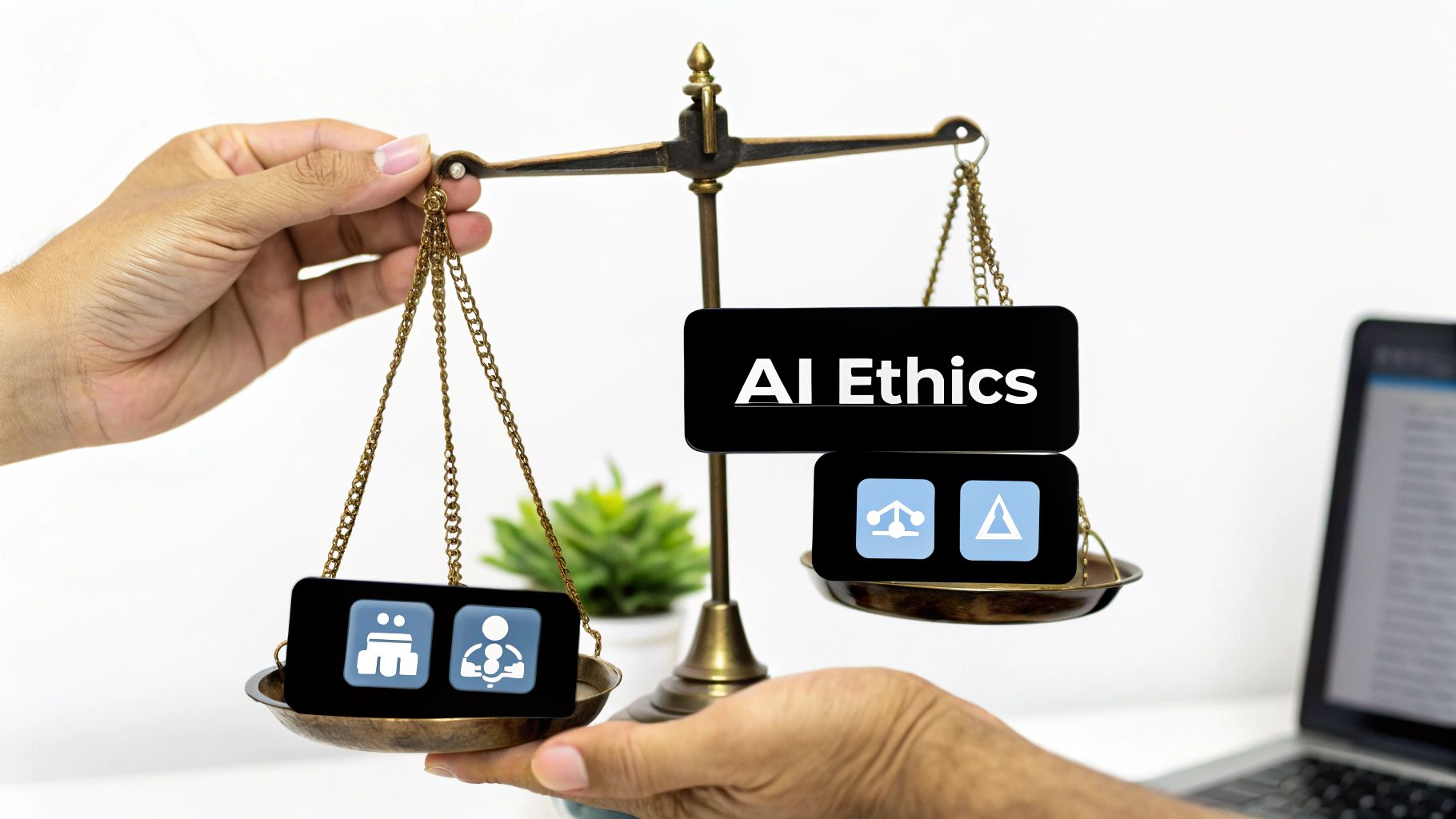
With AI development accelerating globally, it’s clear that we need to get on the same page about the ethical rules of the road.
The Problem Of Algorithmic Bias
One of the most immediate challenges we face is algorithmic bias. AI models learn from the data we give them. Since that data comes from our world, it often contains our own unspoken or historical prejudices.
Think about it: if you train a hiring AI on decades of a company’s records where mostly men were hired for leadership roles, the AI will likely learn to favor male candidates. It’s not because the algorithm is "sexist" in the way a person is; it's just mirroring the biased patterns it was trained on. This has very real consequences for everything from who gets a loan to how bail is set in a courtroom. You can check out our guide on AI bias to get a better handle on how this happens.
Expert Insight: "We must remember that AI systems are a mirror reflecting the data we feed them. If our data is biased, the AI will be biased. The challenge isn't just about building smarter algorithms; it's about curating fairer, more representative data from the start. Garbage in, garbage out has never been more true."
Privacy In A World Of Smart Devices
Data privacy is another minefield. Our smart speakers, fitness trackers, and even our phones are constantly collecting personal data to make our lives easier. But this convenience comes with some tough questions we need to ask.
- Who owns your data? It’s crucial to understand how companies are using, storing, and maybe even selling the information they collect about you.
- How secure is it? The more data a company collects, the bigger the target it becomes for hackers and data breaches.
- Where is the line drawn? For example, is it okay for an insurance company to use data from your fitness tracker to set your health premiums? These are the conversations we need to have.
There are no simple answers here. Navigating this will require a mix of smarter security, better government regulations, and all of us becoming more aware of our digital footprint.
Why We Need Explainable AI
Finally, as we hand over more high-stakes decisions to AI—from medical diagnoses to managing stock portfolios—we absolutely must be able to understand how it arrives at its conclusions. This is the core idea behind Explainable AI (XAI).
Imagine an AI flags a medical scan as cancerous. A doctor can’t just blindly trust that recommendation. They need to know why the AI flagged it. Was it based on a subtle pattern in the tissue, or did it misread a shadow? If the AI is a "black box," it’s impossible to tell. XAI is all about making these systems transparent, so we can see their logic, catch mistakes, and ultimately keep humans in the driver's seat.
Your Next Steps On The AI Learning Path
Feeling fired up after digging into the basics of AI? Let's channel that energy into action. This isn't the end of your journey—it’s the beginning of a hands-on adventure. Honestly, the best way to really get AI is to roll up your sleeves and start playing with it.
You don't need a computer science degree to get your hands dirty. There are so many incredible, easy-to-use tools out there designed for beginners. The goal here is to build your intuition by seeing how these systems actually work.
Start With A Fun, Hands-On Project
A fantastic first step is to play around with a generative AI tool. These are the platforms that create new content—like text, code, or images—from your instructions. It’s a fun, no-pressure way to see AI in action.
Here’s a simple project you can try this week:
- Choose an AI Art Generator: Pick a free tool like Microsoft Copilot (which uses DALL-E 3) or Gemini.
- Write a Simple Prompt: Start with something basic. Think: "a blue dog wearing a superhero cape."
- Iterate and Refine: Now, get more specific. Try changing the prompt to "a photorealistic image of a blue golden retriever wearing a red superhero cape, flying over a city at sunset."
- Observe the Changes: Pay attention to how adding details like "photorealistic" or specifying the setting changes the output. This simple exercise gives you a direct feel for how AI models interpret human language.
This process of tweaking your instructions is called prompt engineering, and it’s a core skill for working with modern AI.
Expert Opinion: "The best way to learn AI is to break it. Push the tools to their limits. Give them weird, creative, or even nonsensical prompts. You'll learn more from the unexpected outputs and 'failures' than you ever could from a textbook. Don't be afraid to experiment."
Resources To Keep You Going
Your learning journey doesn't have to be a solo mission. There are countless free resources built to help you keep building your knowledge without drowning in technical jargon.
Here are a few handpicked places to check out next:
- Interactive AI Experiments: Google's "AI Experiments" website has a collection of simple, browser-based tools that let you play with machine learning concepts in a visual and intuitive way.
- Visual Explainer Videos: YouTube channels like Kurzgesagt or TED-Ed have brilliant animated videos that break down complex AI topics into digestible, engaging stories.
The most important thing to remember is that learning about AI is a marathon, not a sprint. You've already taken the biggest step just by getting started. Keep that curiosity alive, stay playful, and continue exploring.
Got Questions? We've Got Answers
As you dive into the world of AI, you’re bound to have some questions. That's a good thing! It means you're thinking critically. Let's go through some of the most common ones that pop up for beginners to help clear the air and make sure you're starting on solid ground.
Getting these fundamentals straight is a game-changer. It helps you build a mental map of the AI landscape without getting bogged down in the weeds.
Do I Need to Be a Math Genius to Learn AI?
Not at all. This is probably the single biggest myth that scares people away from AI, and it's just not true for most people starting out.
While the researchers creating brand-new algorithms are certainly deep in the trenches with calculus and linear algebra, you don't need that level of math to use or understand AI. For anyone just getting started, the goal is to grasp the big ideas: what is machine learning trying to do? How does a neural network "think"? How can I use these tools to build something cool?
Think of it like driving a car. You don't need to be a mechanical engineer who can build an engine from scratch to be a fantastic driver. You just need to know how the steering wheel, pedals, and mirrors work together to get you where you want to go.
A Pro Tip: "Focus on intuition first, math later. Understanding why an algorithm works is far more valuable for a beginner than memorizing the formula behind it. Practical application builds a foundation that makes the theory much easier to grasp down the road."
Today, the best AI libraries and platforms do all the heavy mathematical lifting for you, so you can focus on solving problems.
What's the Simple Difference Between AI, ML, and Deep Learning?
This is a classic, and thankfully, there’s a simple way to think about it. Imagine a set of Russian nesting dolls.
- Artificial Intelligence (AI) is the biggest doll. It's the whole field, the big-picture dream of making machines that can think, reason, and learn like humans.
- Machine Learning (ML) is the next doll inside. It’s not the only way to create AI, but it’s the most popular one today. ML is all about teaching computers to find patterns in data on their own, rather than programming them with a million rigid rules.
- Deep Learning (DL) is the smallest doll, tucked inside Machine Learning. It's a very specific, powerful type of ML that uses complex, multi-layered "neural networks" to tackle really tough problems, like understanding speech or identifying objects in a photo.
So, Deep Learning is a type of Machine Learning, and Machine Learning is a way to achieve AI. Simple as that.
What Are Some Fun AI Tools I Can Try Right Now?
The best way to get a feel for AI is to roll up your sleeves and play with it. The good news is, you don't need to write a single line of code to start. There are dozens of incredible tools out there that can give you a real, intuitive sense of what AI can do.
Here are a few to get you started:
- For Creating Images: Jump into tools like Microsoft Copilot (which uses DALL-E 3) or Midjourney. You can type a simple phrase—"a fox in a spacesuit, painted in the style of Van Gogh"—and watch it come to life.
- For Writing and Brainstorming: Chatbots are your new best friend. Try ChatGPT or Google Gemini to help you summarize a long article, draft an email, or just bounce creative ideas around.
- For Music Creation: Check out a platform like Suno AI. You can give it a prompt about a mood or a story, and it will generate a completely original song, complete with vocals and instruments.
Messing around with these tools is more than just fun; it's a hands-on way to build your understanding from the ground up.
At YourAI2Day, our mission is to cut through the noise and bring you clear, practical insights into the world of AI. To keep learning, explore our in-depth guides and reviews over at https://www.yourai2day.com.