
A Guide to Data Lifecycle Management for Real-World Value
Ever feel like you're drowning in data? You're not alone. Data Lifecycle Management (DLM) is a simple but powerful idea to help you get control. Think of it as creating a clear plan for your data, from the moment it's created until the day it's deleted. This roadmap ensures every piece of information your organization touches is handled properly, stored smartly, and retired responsibly. It’s how you turn that messy flood of raw data into a reliable, valuable asset.
What Is Data Lifecycle Management and Why It Matters
Let's imagine your business is a massive, bustling library. New books (your data) are constantly arriving from authors and publishers (your apps, sensors, and customer forms). Some are best-sellers and need to be on the front shelf, ready for anyone to check out. Others are niche academic journals—important, but only for a select few—so they go into a protected archive. Over time, some books become outdated and must be removed to make space.
Without a librarian and a cataloging system, that library would descend into chaos. You’d never find the book you need, you'd waste space on irrelevant old editions, and you might accidentally give a sensitive manuscript to the wrong person. This is exactly what happens when a company neglects Data Lifecycle Management. DLM is the expert librarian for your data.
It's a proactive strategy, not just a bunch of IT tasks. It gives you a clear framework for moving data through its various stages, so you always know what you have, where it is, how it’s being used, and when it’s time to say goodbye.
More Than Just a Technical Task
Getting DLM right isn't just about saving a few bucks on cloud storage—it’s a fundamental business strategy that directly affects your bottom line and your ability to compete. Here’s why it’s become so essential for everyone, not just tech wizards:
- It Builds Confidence in Your Data: When everyone knows the data is managed, clean, and organized, they can trust it to make big decisions. For example, a marketing team can confidently launch a campaign based on customer data they know is up-to-date. That confidence is the bedrock for everything from accurate financial reporting to building AI models that actually work.
- It Trims Operational Fat: Storing junk data—what we call redundant, obsolete, and trivial (ROT) data—is a huge money pit. A good DLM strategy automatically archives or purges this dead weight, slashing storage bills and infrastructure costs.
- It Fortifies Security and Compliance: Regulations like GDPR and HIPAA demand you know where sensitive data lives, who can see it, and how long you're legally required to keep it. DLM is your best defense against data breaches and the eye-watering fines that come with them.
At its core, DLM is about taking control. Data volumes are exploding, and trying to manage it all without a plan is a losing game. A clear process for data's entire journey isn't just nice to have anymore; it's essential for survival and growth.
"A solid DLM strategy doesn't restrict data; it unleashes its potential by creating trust and consistency. It’s the difference between owning a valuable asset and being buried by a costly liability." – Chief Data Officer
This deliberate approach also readies your organization for the realities of modern analytics and AI. High-quality, well-managed data is the fuel for any intelligent system. If you feed your AI models garbage, you’ll get garbage insights back. Getting DLM right is the first, non-negotiable step toward becoming a truly data-driven company.
Exploring The Six Stages Of The Data Lifecycle
Think of every piece of data in your company like a product moving through a factory. It has a beginning, a middle, and an end. This entire journey is what we call the data lifecycle, and understanding its stages is the key to managing data well. By breaking it down, you can apply the right rules at the right time, making sure your data stays valuable, secure, and compliant from the moment it's created to the day it's deleted.
To make this real, let's follow the journey of a simple online order from a retail company. This example shows how each of the six stages isn't just a technical step but a critical part of running a smooth business.
This simple diagram captures the essence of that journey: data is created, it gets processed and used, and eventually, it's retired.
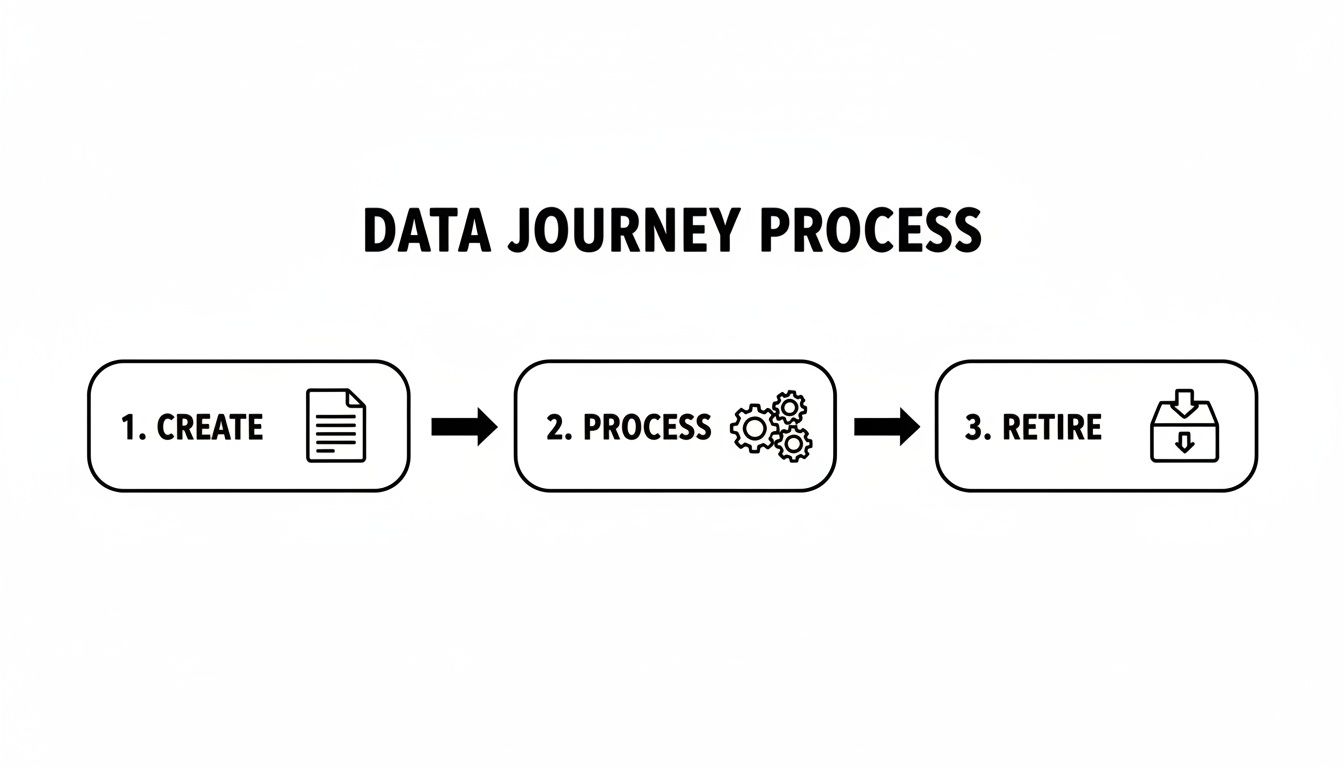
What this shows is that a data lifecycle isn't a one-off event. It's a continuous flow that demands careful attention at every single point.
The Six Stages of Data Lifecycle Management
To give you a clear overview, here’s a quick summary of each stage in the data lifecycle, its main purpose, and a common activity you'd see.
| Stage | Primary Goal | Example Key Activity |
|---|---|---|
| 1. Creation/Collection | To capture accurate and relevant data from its source. | A customer places an order on an e-commerce website. |
| 2. Storage | To keep data in a secure, organized, and accessible home. | Storing the order details in a secure, encrypted customer database. |
| 3. Usage/Processing | To extract value from data for operations and analysis. | The warehouse team uses the order info to pick and pack the items. |
| 4. Sharing/Distribution | To transfer data securely to other people or systems. | Sending the customer's address to a shipping partner like FedEx or UPS. |
| 5. Archiving | To move inactive data to long-term, low-cost storage. | Moving order details from two years ago to a cheaper cloud archive. |
| 6. Destruction | To permanently and securely delete data that is no longer needed. | Securely erasing customer records that are past their legal retention date. |
Now, let’s dig into what each of these stages really looks like in practice.
Stage 1: Data Creation and Collection
This is where it all begins—the birth of data. It can happen actively, like when a customer fills out an order form, or passively, like a website cookie tracking visitor behavior. The whole point here is to capture accurate, relevant information right from the start.
For our e-commerce store, this means the checkout form must have the right fields for the shipping address and payment info. Garbage in, garbage out is a cliché for a reason; if the zip code is wrong here, the package will never arrive.
Stage 2: Secure Storage
Once data exists, it needs a safe and organized place to live. This is way more than just dumping files on a server. It’s about building a structured storage system that balances easy access with tight security. This involves picking the right kind of databases, encrypting sensitive files, and setting up strict access controls.
A customer's order details, full of personal information and payment data, must be stored in a secure, encrypted database. Only authorized staff, like the fulfillment team or customer service, should be able to see the complete file.
Expert Opinion: "The storage phase is where most organizations get into trouble. They treat it like a digital attic, throwing everything in without a plan. A proper DLM strategy turns that attic into a library, where every piece of information is cataloged, secure, and easy to find when needed."
Stage 3: Usage and Processing
Here's where data starts working for you. It gets used for day-to-day operations, analyzed for hidden insights, and processed to support business goals. In our example, the warehouse team uses the order details to pull the correct items off the shelf.
This stage is also where data gets prepped for AI. The marketing team might analyze thousands of anonymized orders to train an AI model that predicts what a customer might want to buy next. Strong data lifecycle management ensures this training data is clean and reliable, which you can learn more about in our guide on data preparation for machine learning.
Stage 4: Sharing and Distribution
Data is rarely a hermit; it needs to move around. It gets shared with other people, different departments, or even outside systems. This could be as simple as the finance team seeing an order invoice or as complex as sending shipping details to an external courier.
The keyword here is control. Every time data is shared, it has to be done securely and with a clear purpose. Our retail company uses a secure API to send the customer’s address to the shipping partner, making sure the transfer is encrypted and auditable.
Stage 5: Archiving
Not all data needs to be at your fingertips forever. After a while, it moves from active use to long-term storage—or archiving. The data is still kept for legal, compliance, or historical reasons, but it’s shifted to cheaper storage systems.
For instance, after an order is fulfilled and the return period has passed, its details might be archived after one year. It's no longer needed for daily operations, but it has to be retained for a legally mandated period for tax purposes.
Stage 6: Destruction
This is the final curtain call for data. It’s the secure and permanent deletion of information that you no longer need or are legally required to keep. Just dragging a file to the trash bin doesn't cut it. Real data destruction involves methods that make the data completely unrecoverable.
Once the legal retention period for the archived order expires (say, seven years for tax records), the company must securely destroy it. This last step is non-negotiable for minimizing security risks and cutting down on storage costs. With AI becoming more common, 61% of IT leaders now say a clear data strategy from creation to destruction is a top priority. They know it's essential, even though 46% admit their outdated systems are a huge roadblock.
The Pillars of Strong DLM Governance and Policy
If Data Lifecycle Management (DLM) is the journey your data takes, then data governance is the map and the rulebook all rolled into one. It’s the framework that brings order to the chaos, providing the clarity and structure you need to manage information with confidence. Without it, a DLM strategy is just a good intention without a plan.
Think of it this way: data governance is about defining who can do what with which data, when, and why. It's not about locking information away in a vault. Instead, it’s about setting clear rules of the road so everyone in your organization knows how to handle data safely and effectively. This structure builds trust—the absolute bedrock of smart business decisions, especially when you’re feeding that data into AI systems.
Building Your DLM Policy Framework
Creating a solid DLM policy doesn't need to be a huge, complicated project. It really just starts with asking and answering a few critical questions about the data you handle every single day. These questions become the practical building blocks of your governance policy, turning abstract ideas into clear rules your team can actually follow.
Here are the core questions your policy must address:
- What data do we actually have? First, you need a clear inventory of your data assets. Where does customer transaction data live? What about employee records or the analytics from your last marketing campaign? You can't protect what you don't know you have!
- How long are we required to keep it? Different kinds of data have different retention requirements, often driven by legal, regulatory, or business needs. For instance, financial records might legally need to be kept for seven years, while old marketing campaign data could be deleted after just one.
- Who is responsible for it? Assigning clear ownership is key. Who is the go-to person for making sure customer data is accurate? Who has the final say on archiving sales reports? Clear roles prevent confusion and finger-pointing later on.
- Who can access it and why? Not everyone needs to see everything. Your policy should define access levels based on roles. A sales rep needs to see their clients' contact info, but they almost certainly don't need access to HR payroll data.
Answering these questions creates a practical guide that moves your data lifecycle management from theory into real-world action. For a deeper dive, you might find our guide on data governance best practices helpful.
Governance Is an Enabler, Not a Barrier
A lot of people hear the word "governance" and immediately think of bureaucratic red tape designed to slow things down. But in reality, a well-designed policy does the exact opposite. It gives your teams the confidence to use data without constantly worrying about breaking rules or making a costly mistake. For a more in-depth look at this, check out a practical guide to trusted data governance for analytics.
"Good governance doesn’t put data in a cage; it builds a safe playground for it. It gives your team the freedom to experiment and innovate because they know the boundaries are clear and the data is trustworthy."
– Sarah Barnes, Data Strategist
This shift in perspective is crucial for AI and data science teams. When data scientists know the information they're using has been properly managed, validated, and documented according to a clear policy, they can build more accurate and reliable models. They spend less time second-guessing the data and more time finding valuable insights. In the end, good governance creates a trusted, consistent environment where innovation can truly thrive.
Benefits and Risks of Data Lifecycle Management
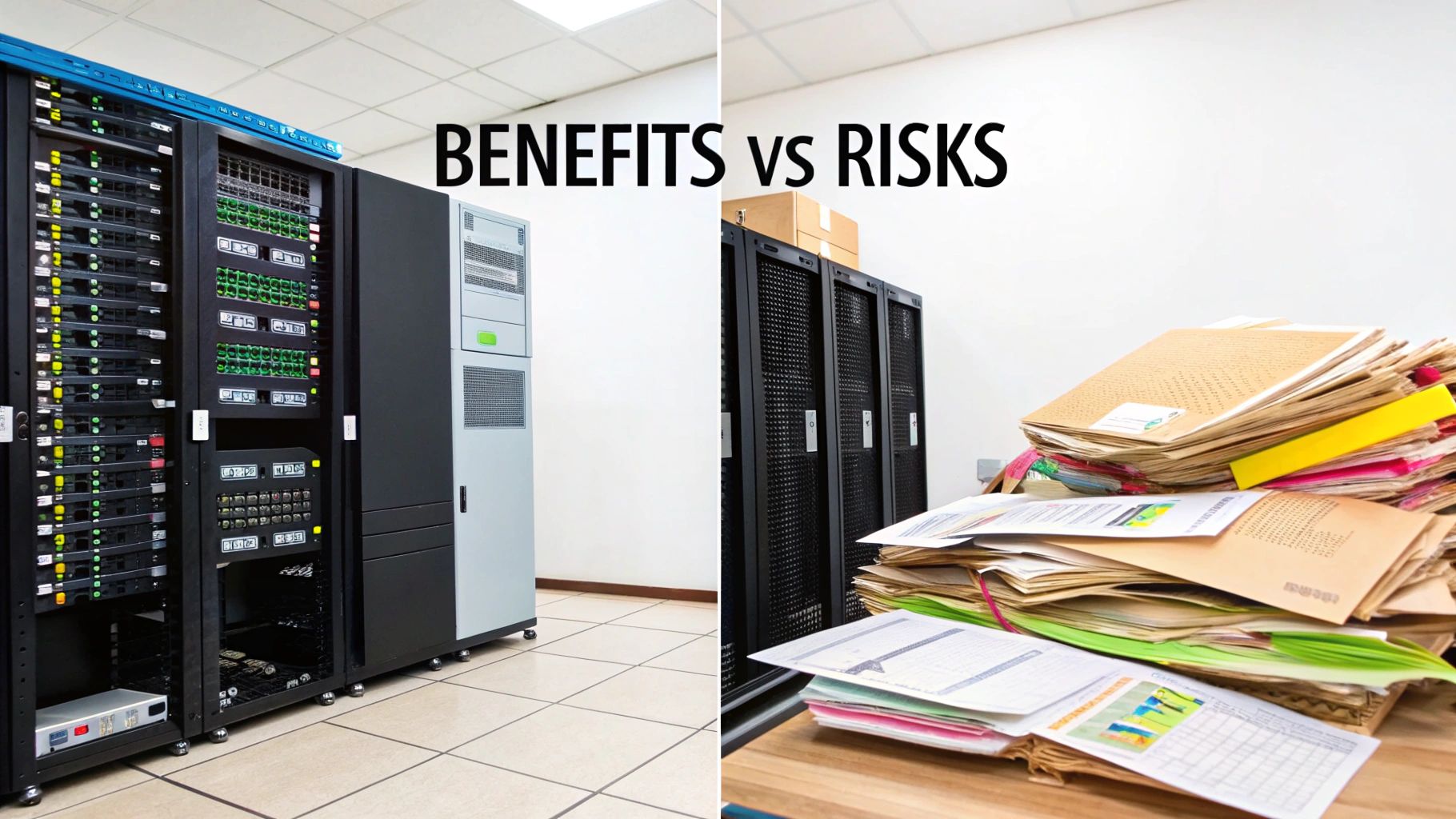
So, what happens when you get data lifecycle management right—or horribly wrong? Think of a well-executed DLM strategy as a perfectly organized warehouse. Everything valuable is protected, easy to find, and handled responsibly. Ignoring it? That’s like letting the same warehouse devolve into a chaotic, costly, and dangerous mess.
The difference is night and day. On one side, you have a business humming along, making smart decisions with clean, reliable data. On the other, you have an organization drowning in a data swamp, burning through resources, and opening itself up to massive financial and reputational damage.
Let's look at both sides of that coin.
The Upside: A Well-Managed Data Lifecycle
When you get DLM right, the benefits ripple across your entire organization. It’s not just some IT cleanup project; it’s a powerful business enabler that delivers a tangible return.
- Drastically Lower Costs: Think about all the redundant, obsolete, and trivial (ROT) data clogging up your servers. An effective DLM process automatically archives or deletes this useless information, freeing up expensive storage. For a small business, this could mean avoiding a costly upgrade to their cloud storage plan. For a large enterprise, this can save thousands of dollars a month.
- More Accurate AI and Analytics: "Garbage in, garbage out" is the oldest rule in the book for a reason. A strong DLM process ensures your models are trained on high-quality, relevant, and current data. The result? Sharper predictions and AI systems you can actually trust to guide business strategy.
- Stronger Security: Unmanaged data is a giant security hole waiting to be exploited. DLM shrinks your attack surface by minimizing the sensitive data you hold and controlling who can access it. When you know what you have and where it is, you can protect it. It’s that simple.
- Simplified Compliance: With regulations like GDPR and HIPAA, proving you handle data responsibly isn't optional. DLM gives you a clear, auditable trail showing how data is managed from birth to deletion, making compliance checks far less painful.
The Downside: The High Cost of Neglect
Now for the other side—the costly and often disastrous consequences of putting DLM on the back burner. This isn't just about being inefficient; it's about exposing your business to disasters that are entirely preventable.
The fragmented nature of modern data stacks only makes things worse. Many companies are juggling dozens of disconnected tools for integration and governance, creating a complex and unsustainable environment. This chaos is a breeding ground for problems, with poor data quality remaining the top challenge for 65% of professionals.
When the average data breach costs $4.4 million, the stakes couldn't be higher. You can read more about what's changing in data management to see just how quickly this space is evolving.
Here are the most common risks you run by doing nothing:
- Crippling Fines and Legal Penalties: Failing to comply with data retention and privacy laws can lead to enormous fines. Regulators don't accept "we couldn't find it" as an excuse.
- Flawed Business Strategy: When your decisions are based on outdated or inaccurate data, you're essentially flying blind. This leads to failed product launches, misguided marketing campaigns, and missed opportunities.
- Wasted Time and Resources: Without DLM, your teams will spend countless hours just searching for information, cleaning messy datasets, and trying to manage that chaotic data swamp. That's time and money that should be spent driving real business value.
Expert Opinion: "Ignoring DLM is like trying to navigate a ship with a broken compass and a map from 50 years ago. You’re not just inefficient; you're actively steering toward disaster. A proper strategy isn't a cost—it's an investment in survival and success."
Your Roadmap to Implementing a DLM Strategy
So, you're ready to get a handle on your data? Moving from the idea of data lifecycle management to actually doing it isn't as daunting as it sounds. The secret is breaking the process down into manageable phases. Think of it less like a massive IT project and more like building a clear, step-by-step assembly line for your information.
This roadmap will walk you through building your own DLM strategy, helping you turn data chaos into a well-oiled, efficient machine.

Phase 1: Discover and Inventory Your Data
First things first: you can't manage what you don't know you have. This initial phase is all about discovery—a mission to map out your entire data landscape. You need to identify every single data source, from customer databases and cloud storage to those forgotten departmental spreadsheets, and get a clear picture of what kind of information they hold.
Practical Example: A marketing team could start by listing all their data sources: the company CRM, their email marketing platform (like Mailchimp), Google Analytics, and the spreadsheets they use to track campaign results.
This inventory is absolutely foundational. A staggering 57% of organizations admit their data isn't AI-ready, a problem that almost always starts with not knowing what assets they have. As companies race to adopt artificial intelligence, having this clear inventory becomes the bedrock for everything that follows.
Phase 2: Define Your Policies
Once you have your data map, it's time to write the rulebook. This is where you translate your business needs and legal requirements into clear, actionable data policies. These rules will dictate exactly how data moves through its lifecycle, from the moment it's created to when it’s securely deleted.
Your policies should answer practical, everyday questions like:
- Retention: How long do we legally need to keep customer invoices for tax audits?
- Access: Who on the marketing team should be able to see and use customer email lists?
- Destruction: What is the official, secure method for deleting sensitive employee data once it’s no longer needed?
A good way to strengthen your DLM strategy is to weave in some solid IT Asset Management (ITAM) best practices. This helps you connect the dots between your digital data and the physical hardware it lives on, securing both.
Phase 3: Select the Right Tools
With your rules established, it's time to pick the right equipment for the job. The tools you need will really depend on your scale and complexity. A small business might get by just fine with meticulously organized spreadsheets and native cloud storage features. An enterprise, on the other hand, will almost certainly need dedicated DLM software to automate classification, archiving, and deletion.
The key is to find tools that fit your policies and can grow with you. There's no sense in over-investing in a complex system you don't need right now, but you also have to be honest about when manual processes are becoming a bottleneck. For connecting disparate systems, it’s worth exploring what cloud-based data integration platforms can offer.
Phase 4: Automate and Monitor
Okay, you've got your policies and your tools. Now it's time to put your DLM strategy into motion. In this phase, automation is your best friend. Use your tools to automatically apply retention rules, archive old files, and flag data for review. Trying to do this manually is not only painfully slow but also a recipe for human error.
Practical Example: You could set up an automated rule in your email system to move all invoices older than one year from an active inbox into a long-term archive folder.
Once the automation is running, continuous monitoring is crucial. You need to regularly check that your processes are working as designed, policies are being enforced, and your systems are secure. This isn't a "set it and forget it" task; it's an ongoing cycle of execution and oversight.
Phase 5: Review and Adapt
Finally, a great DLM strategy is a living one. Business needs change, new regulations pop up, and your data landscape will naturally evolve. You'll want to schedule regular reviews—maybe quarterly or annually—to take a hard look at how your DLM framework is performing.
Are your policies still relevant? Are your tools still effective? This iterative approach is what keeps your strategy aligned with your real-world business goals for the long haul.
Getting Started Checklist
- Identify Data Owners: Assign clear responsibility for each major data category (e.g., finance, marketing).
- Start Small: Pick one critical data type, like customer PII, to pilot your DLM process.
- Document Everything: Create a central, accessible document for your policies and procedures.
- Train Your Team: Make sure everyone who handles data understands their role in the lifecycle.
- Get Buy-In: Explain the "why" behind DLM—cost savings, better security, and sharper insights—to get everyone on board.
Answering Your Top Questions About Data Lifecycle Management
Let's wrap things up by tackling some of the most common questions people ask about data lifecycle management. These quick, clear answers will help solidify your understanding and clear up a few typical hurdles that pop up when teams are just getting started.
What's the Real Difference Between Data Management and Data Lifecycle Management?
This is a big point of confusion for a lot of people, so let's clear it up. The easiest way to think about it is that data management is the entire house, while data lifecycle management (DLM) is the plumbing system inside it.
Data management is the overarching strategy—the grand plan for all your company's information. It covers everything from governance and security policies to the databases you use and the teams who access them.
DLM, on the other hand, is a specific, hands-on process within that larger framework. It’s all about the practical journey of a single piece of data from the moment it’s created to the day it’s finally, securely destroyed. So, data management is the what and why (the big picture), while DLM is the how (the step-by-step flow).
Can a Small Business Actually Do DLM Without Expensive Tools?
Absolutely. You don't need to sink your budget into a complex software suite to get started. For small businesses, the secret to good DLM isn't expensive tech—it's having a clear process.
Start simple. Create a basic data inventory in a spreadsheet. Just map out what data you have, where you keep it, and how long you actually need it. From there, you can write up a simple policy doc that outlines your rules for things like retention and access.
You might be surprised by the features already built into tools you use every day, like Google Workspace or Microsoft 365. They often have basic capabilities for setting retention rules and managing permissions. The goal is to build good habits now; you can always invest in more powerful tools as your business scales.
"Many businesses over-focus on buying the perfect tool and under-focus on building a simple, repeatable process. Start with a clear plan on a whiteboard before you ever think about software. A good plan with basic tools will always beat a great tool with no plan." – Data Strategy Consultant
How Does DLM Directly Affect an AI Model's Accuracy?
Think of DLM as the quality control manager for your AI's brain food. AI models are only as smart as the data they learn from. If you feed them outdated, irrelevant, or just plain wrong information, their performance will suffer. It’s the classic "garbage in, garbage out" problem, but with much higher stakes.
A solid DLM process is your first line of defense. It systematically archives old, stale data and purges information that’s no longer accurate or useful. This ensures your AI is constantly training on a fresh, relevant, and high-quality dataset. For instance, an e-commerce AI that recommends products needs to learn from recent purchase history, not what people were buying five years ago. DLM makes sure that happens automatically.
This isn't just a "nice-to-have." It's fundamental. Disciplined data cycling leads to sharper predictions, more reliable outcomes, and AI systems you can actually trust to make critical business decisions.
At YourAI2Day, we are dedicated to helping you make sense of complex topics like AI and data management. Our platform provides the latest news, expert insights, and practical guides to empower you on your journey. Discover more at YourAI2Day.