AI Solutions for Businesses: A Practical Explainer for Beginners
Let's be honest, when most people hear "AI in business," they picture complex robots or something out of a sci-fi movie. But the reality is far more practical and, frankly, more useful. Think of AI solutions less as a futuristic concept and more as a set of incredibly smart tools designed to make your business run better.
So, What Are AI Solutions for Businesses, Really?

Welcome to the real-world application of AI. If you've been hearing all the buzz but aren't quite sure how it fits into your day-to-day operations, you've come to the right place. The term "AI solution" is broad, but it boils down to one simple thing: using smart technology to solve a specific business problem.
It’s not about replacing people; it’s about giving them superpowers. Imagine a sales rep who knows exactly which leads are most likely to convert or a marketing manager who can predict the perfect moment to launch a campaign. That’s what we’re talking about—AI working behind the scenes to make your team smarter and more effective.
Beyond the Hype: Practical Applications
It's a common misconception that AI is only for massive tech companies with deep pockets. That might have been true a decade ago, but today’s tools are built for businesses of all shapes and sizes, from a family-owned restaurant to a growing e-commerce store.
The trick is to look past the technical jargon and focus on what these tools actually do. At their core, they're designed to chew through repetitive, data-heavy tasks with incredible speed and accuracy. This frees up your people to focus on what they do best: creative problem-solving and building customer relationships.
Here are a few simple examples of what this looks like:
- For a local retailer: An AI tool can analyze past sales to predict which products will be hot next season, helping you avoid costly overstocking. For instance, it might notice a spike in "hiking boots" every year in the two weeks before a local festival, prompting you to stock up.
- For a marketing agency: AI can analyze thousands of data points in seconds to pinpoint the ideal customer for an ad campaign, driving up conversion rates. It could identify that your best customers are females aged 30-45 who live in urban areas and follow three specific lifestyle influencers.
- For a service-based business: A simple AI chatbot can handle common customer questions 24/7, keeping clients happy without adding to your payroll. A plumber's website, for example, could have a bot that asks "Is this an emergency?" and collects basic details like address and issue type.
As tech analyst Jane Doe puts it, "Think of AI not as a cost, but as your most diligent employee. It never sleeps, rarely makes mistakes on repetitive tasks, and consistently finds patterns you might miss."
A Fundamental Shift in How Business Gets Done
This isn't just another passing trend. It's a fundamental change in how modern businesses operate, and the numbers back it up. Nearly four out of five organizations—that's a staggering 77%—are already using or exploring AI. Of those, 35% have fully adopted it into their processes, while another 42% are actively testing out solutions. You can find more insights about AI adoption trends in recent studies.
This guide is your roadmap. We’re going to cut through the noise, demystify the technology, and show you the tangible benefits these tools can bring to your business. Let's explore how to find and implement the right AI solutions to become more efficient, innovative, and competitive.
Exploring The Core Types of AI Business Solutions

Let's open up the AI toolkit. It isn't a single "thing" but a whole collection of specialized tools, each built to solve different business challenges. Understanding these core types is the first real step to seeing where AI can plug into your day-to-day operations to make things faster, smarter, and more efficient.
Think of it like a contractor's toolbox. You wouldn’t use a hammer to cut wood or a saw to drive a nail. In the same way, different AI solutions are built for specific jobs. We'll walk through the most common ones you'll encounter, explained in plain English without the dense technical jargon.
Key AI Solutions and Their Business Functions
To make this crystal clear, let's break down the most common AI technologies and what they actually do for a business. The table below maps each solution to its core function and a practical, real-world example.
| AI Solution Type | Primary Function | Example Business Use Case |
|---|---|---|
| Robotic Process Automation (RPA) | Automating repetitive, rule-based tasks | An HR department uses a bot to process new hire paperwork automatically, like creating accounts and sending welcome emails. |
| AI Chatbots | Providing instant, 24/7 customer support | A website chatbot answers common customer questions ("What's your return policy?") and escalates complex issues. |
| Predictive Analytics | Forecasting future trends based on data | A retail company predicts product demand to optimize inventory levels, preventing stockouts of popular items. |
| Natural Language Processing (NLP) | Understanding and interpreting human language | Analyzing customer reviews to gauge overall sentiment about a new product, sorting feedback into "positive" and "negative" themes. |
| Computer Vision | "Seeing" and interpreting images and videos | A factory uses cameras to spot manufacturing defects on an assembly line, like a scratch on a phone screen. |
| Generative AI | Creating new and original content | A marketing team generates draft ad copy or social media post ideas, providing a creative starting point. |
This table gives you a quick snapshot, but let's dig into a few of these to get a better feel for how they work in practice.
Automation and Intelligent Assistants
One of the most immediate ways AI helps is by taking over the repetitive, manual tasks that eat up your team's time. This is where tools like Robotic Process Automation (RPA) really shine. Imagine a digital assistant that can log into systems, copy and paste data between spreadsheets, and fill out forms—all without a single typo and working around the clock.
Another massively popular tool in this category is the AI chatbot. Forget the clunky bots of the past. Today’s chatbots can understand what a customer actually wants, answer complex questions, and know exactly when to hand a conversation over to a human agent. They act as your first line of customer support, always on and ready to help.
Business process expert John Smith often says, "The goal of AI in business isn't to create a company without humans. It’s to create a company where humans can do their most meaningful work, supported by intelligent automation."
Data Analysis and Future Forecasting
Your business is sitting on a goldmine of data—sales figures, website traffic, customer feedback, you name it. AI can turn that raw information into a real strategic advantage. Predictive Analytics is like a business crystal ball that uses historical data and smart algorithms to forecast what’s coming next.
A retailer, for instance, could use predictive analytics to anticipate a spike in demand for a certain product, helping them optimize inventory and avoid costly stockouts. It’s about shifting from reactive decision-making to proactive planning.
Then you have Natural Language Processing (NLP), which is the technology that gives computers the ability to read and understand human language. It's the magic behind the spam filter in your inbox and the sentiment analysis tools that can tell you how customers really feel based on their written reviews.
Visual and Creative Intelligence
AI is also getting incredibly good at making sense of the visual world. Computer Vision allows systems to "see" and interpret images and videos, which opens up some amazing practical applications:
- Manufacturing: A camera on an assembly line can use computer vision to spot tiny defects in products with far greater accuracy than the human eye.
- Retail: It can analyze in-store traffic patterns to help figure out the best store layout and product placement.
- Safety: In construction, it can monitor a worksite and flag hazards, like a worker not wearing a hard hat.
This visual intelligence is a key ingredient in many modern AI solutions, and it's closely related to another exciting area of AI that’s been grabbing headlines. To see how AI can go beyond analysis to actually create new content, you can learn more about what is generative ai and its powerful applications.
By understanding these distinct categories, you can start to pinpoint the specific AI tool that aligns perfectly with your business goals.
How to Choose The Right AI Solution for Your Business
With so many AI tools on the market, picking the right one can feel like trying to find a needle in a haystack. But here’s the secret: the best way to start isn't by looking at technology. It’s by looking at your biggest business headache.
Think of it like going to the doctor. You don’t walk in and ask for a random prescription; you start by describing what hurts. The same idea applies here. The most effective AI solutions for businesses are the ones that are prescribed to solve a specific, well-defined problem. By focusing on the pain point first, you ensure your investment leads to a real cure, not just a temporary fix.
Start with the Problem, Not the Platform
Before you even glance at a vendor’s website, get your team in a room with a whiteboard. The goal is to pinpoint the exact friction points in your daily operations. Where are the bottlenecks? What repetitive tasks are draining your team's energy and creativity?
A crystal-clear problem statement acts as your compass. It will guide your entire search and stop you from getting sidetracked by flashy features you’ll never actually use.
Here are a few examples to get the ball rolling:
- The Problem: "Our customer support team is swamped with the same handful of basic questions, leading to long wait times and unhappy customers."
- The Problem: "We burn at least 20 hours a week manually keying in data from invoices into our accounting software. It’s slow and full of errors."
- The Problem: "Our marketing emails have abysmal open rates because we're sending the same generic message to our entire list."
When you frame the problem this clearly, the right type of AI solution practically reveals itself. The first problem points directly to an AI chatbot, the second is a perfect job for an RPA tool, and the third screams for a predictive analytics or personalization engine.
Avoid Shiny Object Syndrome
It's incredibly easy to get swept up in the hype of a new tool. But chasing the latest trend without a clear purpose is one of the most common and expensive mistakes a business can make.
A seasoned business consultant often warns clients about this exact pitfall.
"The biggest mistake I see is companies adopting AI for AI's sake," says Sarah Chen, a small business consultant. "They buy the shiniest new tool on the market but have no clear problem to solve. A simple, focused AI that saves your team ten hours a week is infinitely more valuable than a complex platform that no one knows how to use."
This gets to the heart of the matter: value is measured by impact, not complexity. The real goal is to find a solution that fits right into your workflow and solves a genuine need, making your business more efficient and profitable.
Your Vendor Vetting Checklist
Once you’ve narrowed down the type of AI you need and have a few potential vendors in mind, it's time to start asking questions. And don't be shy—ask the tough ones. You're not just buying a piece of software; you're starting a partnership.
Use this checklist to steer your conversations and stack up your options:
-
Integration and Compatibility: How well does this tool play with our existing software, like our CRM or e-commerce platform? A tool that doesn’t "talk" to your other systems just creates more work.
-
Data Security and Privacy: Where is our business data being stored? What security measures do you have in place? Make sure their protocols meet your industry's compliance standards (like HIPAA or GDPR).
-
Scalability and Growth: Can this solution grow with us? If our customer volume doubles next year, can the tool handle the load without the price tag exploding?
-
Training and Support: What does your onboarding process look like? If we hit a snag at 3 p.m. on a Friday, what kind of support can we expect? You want a partner with robust support, not just a generic email address.
By sticking to this problem-first approach and asking the right questions, you can move forward confidently, knowing you’re choosing an AI solution that will be a genuine asset. This is about making a smart, strategic investment in your company’s future.
Your Step-By-Step AI Implementation Roadmap
So, you've pinpointed a business headache and have a good idea of which AI tool might be the fix. That's a huge first step! But how do you actually get from a great idea to a fully functioning solution that moves the needle for your business? This is where a lot of companies get stuck, but it doesn't have to be a complicated mess.
Think of it like putting together a piece of furniture from a kit. You wouldn't just dump all the screws and panels on the floor and hope for the best. You need a clear, step-by-step plan. This roadmap breaks the process down into manageable stages, taking the guesswork out of the equation.
Phase 1: Build a Solid Strategy and Get Your Team Onboard
The very first step has nothing to do with technology and everything to do with people and planning. Your AI project will only work if everyone involved understands the "why" behind it.
Start by defining what success actually looks like. Is it slashing customer wait times by 50%? Automating 15 hours of mind-numbing data entry each week? Set a specific, measurable goal from the outset.
Then, bring your team into the loop early. Address their concerns head-on and show them how the new tool will make their jobs easier, not replace them. When your team sees AI as a helpful co-pilot rather than a threat, they become your biggest champions. Getting this initial alignment right is crucial for a smooth rollout.
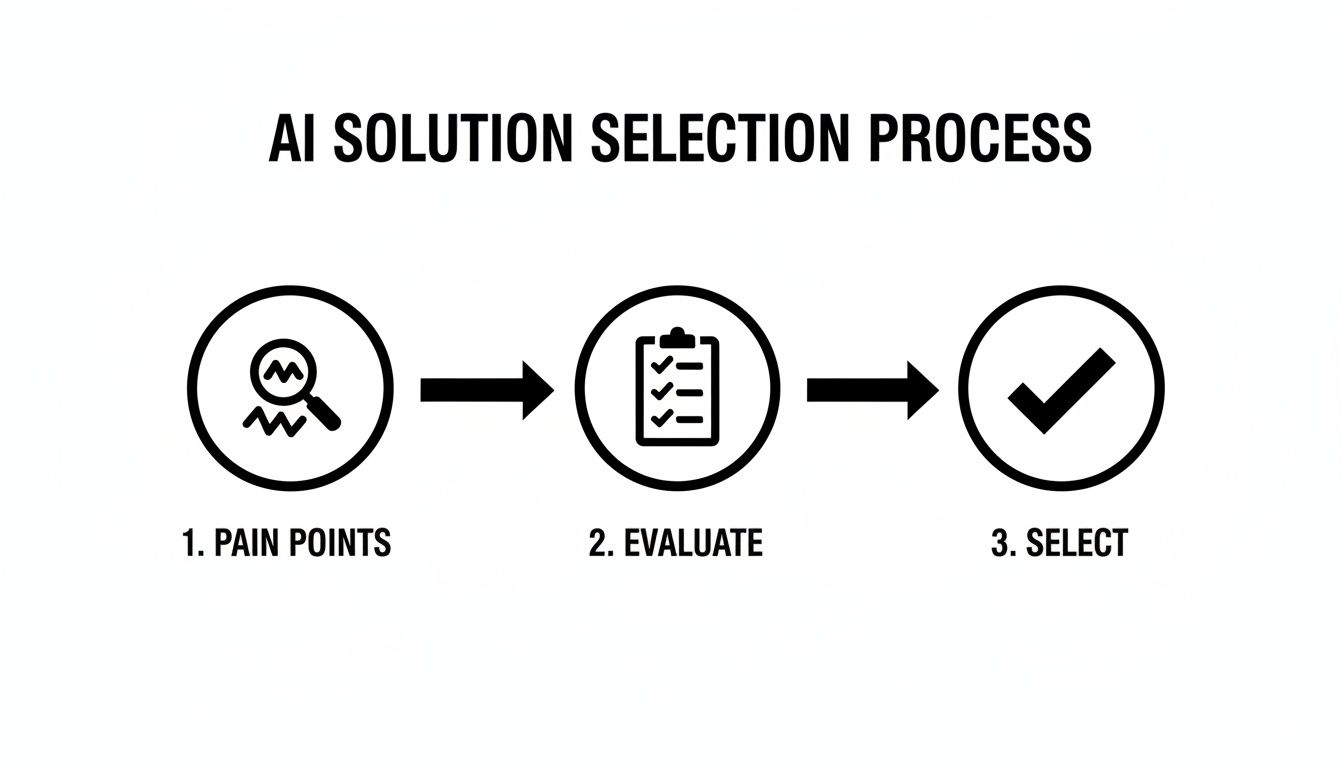
This process highlights a simple truth: successful implementation always starts with a clear problem, followed by careful evaluation and a confident final choice.
Phase 2: Focus on Data Readiness
Now for a critical step that businesses often overlook: getting your data in order. AI models are a bit like brilliant students—they can only learn from the material you give them. If your data is messy, incomplete, or disorganized, your AI's performance is going to be disappointing, to say the least. This concept is called "data readiness."
Don't let the term scare you. It simply means cleaning and organizing the information your AI will use. For instance, if you're setting up a predictive sales tool, you need to make sure your customer purchase histories are accurate and consistently formatted. Taking the time to prepare your data is one of the most important things you can do for AI success.
As data scientist Dr. Emily Carter notes, "'Garbage in, garbage out' is the golden rule of AI. The quality of your AI's output is directly tied to the quality of the data it learns from. Investing time in data readiness upfront will save you countless headaches later."
This phase is all about making sure the foundation of your AI project is solid, setting you up for accurate and reliable results.
Phase 3: Start Small with a Pilot Project
You don’t have to overhaul your entire company at once. In fact, you shouldn't. The smartest approach is to begin with a small, low-risk pilot project. Think of it as a test drive. It’s your chance to see what works, learn from mistakes, and build momentum without betting the farm.
A pilot project isolates the AI solution to one specific area of your business. This focused approach makes it much easier to measure the impact and gather feedback. For a more detailed breakdown, check out our complete guide on building an AI implementation roadmap that you can scale.
Here are a few practical ideas for a pilot:
- A retailer could test an AI-powered recommendation engine on just one product category on their website.
- A marketing team could use a generative AI tool to create ad copy for a single client's campaign.
- An HR department might use an RPA bot to automate the onboarding paperwork for just one new hire to see how the workflow feels.
By starting small, you prove the solution's value on a manageable scale. This creates a powerful success story that makes it much easier to get buy-in for a wider rollout. For another great perspective, this practical AI implementation roadmap offers a detailed guide to help you structure your own journey.
Measuring The Real ROI of Your AI Investment
Let’s talk about the bottom line. Any new technology is a significant investment, and with AI, you have to know it's going to deliver a real return. Figuring out the Return on Investment (ROI) for an AI project isn't just a spreadsheet exercise; it’s about building a solid business case that connects the technology to tangible value.
To do this right, you need to look at both sides of the ledger: what you’ll spend upfront and over time, and where the real, measurable benefits—the money saved or the new revenue earned—will come from. Getting this clear from the start helps you make a smarter investment and track its performance honestly.
Tallying Up the Costs
Before you can see the gains, you need a clear-eyed view of what you're putting in. The costs of AI go well beyond the sticker price of the software. A realistic budget needs to account for a few different things.
- Setup and Integration Fees: This is usually a one-time cost to get the AI tool properly connected and talking to your existing systems, like your CRM or inventory management platform.
- Software Subscriptions: Most AI solutions for businesses are sold on a subscription basis, which means a recurring monthly or annual fee. This price often scales with usage, the number of users, or the features you need.
- Team Training: Your people need to know how to actually use the new tool. Don’t overlook the cost of training; it’s crucial for making sure the technology is adopted and used to its full potential.
Uncovering the Tangible Benefits
This is where the investment starts to pay off. The "return" in ROI comes from the real, measurable value AI brings to your day-to-day operations. These benefits aren't abstract—they show up in your financial reports.
You'll typically see gains in three main areas:
- Reduced Operational Costs: This is often the quickest win. Automation tools can take over repetitive work like data entry or handling basic customer questions, which directly cuts down on labor costs and the risk of expensive human errors.
- Increased Revenue and Sales: AI can be a powerful sales driver. Think of a smart recommendation engine on your e-commerce site that nudges up the average order value, or predictive analytics that helps your sales team zero in on the leads most likely to close.
- Improved Customer Retention: AI-powered chatbots offer 24/7 support, and personalization tools make customers feel understood. When customers are happy and well-supported, they stick around longer, which dramatically increases their lifetime value.
A business leader at a recent tech conference shared this insight: "The true ROI of AI isn't just in automating tasks; it's in elevating what your team can achieve. When you free up talented people from routine work, they can focus on strategy, innovation, and building relationships—activities that drive real, long-term growth."
A Practical ROI Example
Let's walk through a simple scenario. Imagine a small e-commerce company decides to implement an AI-powered product recommendation engine. The one-time setup fee is $2,000, and the software subscription costs $500 per month, or $6,000 per year.
After the first year, the results are in. They’ve seen a 15% increase in average order value and a 5% lift in overall sales, which translates to an extra $30,000 in revenue. On top of that, support tickets related to finding products have dropped, saving the customer service team about five hours a week.
The total investment for the year comes to $8,000 ($2,000 + $6,000). When you weigh that against the $30,000 revenue gain, the net return is a solid $22,000. That's a clear, powerful justification for the investment.
The potential here is enormous. Some research suggests that generative AI alone could add between $2.6 to $4.4 trillion in value annually across the global economy. It’s no surprise, then, that 78% of organizations reported using AI in a recent year—a big leap from 55% the year before. This isn't just a trend; it's a fundamental shift in how business gets done.
You can discover more about future AI business trends to see where the market is headed. By carefully measuring both the costs and benefits, you can move forward confidently and invest in the right AI solution for your business.
Navigating AI Risks and Building Customer Trust
Jumping into AI is exciting, but it also means being smart about the potential pitfalls. The idea isn't to be afraid of AI but to go in with your eyes wide open. When you understand the risks, you can build a solid framework that protects your business, your team, and, most importantly, your customers.
Trust is the bedrock of any good business. When you start weaving AI into your operations, that trust becomes even more crucial. Your customers need to feel confident that their data is secure and that the technology you're using is fair. Let's break down the big concerns so you can innovate with peace of mind.
The Big Three AI Concerns for Businesses
When you boil it down, most of the risks associated with AI fall into three main buckets. Just knowing what they are is the first, and biggest, step.
- Data Privacy: AI models are hungry for data—it's how they learn and get better. This immediately raises a huge question: how are you handling sensitive customer information? A data breach involving an AI system is just as devastating as any other.
- Algorithmic Bias: This one is subtle but incredibly important. An AI is only as good (and as unbiased) as the data it’s trained on. If your historical data contains old prejudices, the AI will learn those same biases and might even make them worse.
- Security: Like any piece of software, AI platforms can be a target for cyberattacks. It's critical to lock down your AI tools to prevent bad actors from manipulating them or using them for a purpose you never intended.
For a deeper look into this topic, our guide on the benefits and risks of AI offers additional context.
Understanding and Preventing Algorithmic Bias
Imagine you're training an AI to screen résumés. If you feed it 20 years of hiring data from a company that historically hired more men for technical roles, what do you think will happen? The AI will likely learn to favor male candidates. It’s not malicious; it's simply mirroring the patterns it was shown.
According to AI ethicist Dr. Anya Sharma, "To fight algorithmic bias, you have to be intentional about fairness. This means feeding your AI diverse and representative data and constantly checking its decisions to see if they're skewed. When it comes to building trust, transparency is your best friend."
A Simple Checklist for Ethical AI Governance
You don't need a team of philosophers to build an ethical AI framework. It really just starts with a commitment to being responsible and transparent. For a more detailed look at the compliance side of things, this guide on navigating AI ethics, EPPA compliance, and risk management in human resources is a fantastic resource.
Here’s a practical checklist to get you on the right track:
- Be Transparent: Make it clear when a customer is talking to a chatbot or another AI. No surprises.
- Prioritize Privacy: Have strong data protection policies in place from the very beginning.
- Audit for Bias: Regularly check your AI's performance to make sure its decisions are fair and equitable.
- Keep a Human in the Loop: For the really important decisions—especially those that affect people’s lives—make sure a human being has the final say.
By getting out ahead of these challenges, you can tap into the incredible power of AI while strengthening the customer trust that keeps your business moving forward.
Common Questions About AI for Businesses
Diving into the world of AI can feel like stepping into a new country—it’s exciting, but you’re bound to have questions. That’s completely normal. We’ve put together answers to some of the most common things business owners wonder about when they start exploring AI solutions for businesses.
Think of this as your practical, no-nonsense guide to clearing up the fog.
Do I Need to Be a Tech Expert to Use AI?
Absolutely not. This is probably the biggest myth holding people back. Modern AI tools are built for business people, not data scientists. Most come with clean, intuitive dashboards and require zero coding knowledge.
The best platforms are designed to solve a specific business problem, hiding all the complex tech under the hood. Seriously, if you can navigate a project management tool or set up an email campaign, you have all the skills you need to get started with today's AI.
Is AI Only for Large Corporations?
Not anymore. It’s true that the big players got a head start, but the game has changed. The market is now full of affordable, scalable AI tools designed specifically for small and medium-sized businesses (SMBs).
Many vendors offer flexible pricing that lets you start small and expand as you grow. From an AI chatbot for a two-person online shop to a content creation tool for a freelancer, there are powerful, budget-friendly options for everyone.
Will AI Replace My Employees?
This is a valid concern, but the reality is far more positive. The smartest way to use AI is to augment your team, not replace them. The whole point is to automate the repetitive, mind-numbing tasks that drain your team's energy.
This frees them up to focus on what people do best: thinking strategically, solving complex problems, and connecting with customers.
One CEO of a growing startup put it this way: "AI is a hyper-efficient assistant that takes care of the grunt work. This gives my skilled employees more breathing room to innovate and push the business forward, making their jobs more meaningful, not obsolete."
How Much Does It Cost to Get Started?
The price tag on AI can range from a cup of coffee to a car, but you don't need a massive budget to get in the game. Many tools offer free trials or starter plans for less than $100 a month. The trick is to begin with a clear, specific problem you need to solve.
A small investment in a tool that saves your team a few hours of manual work every week can pay for itself almost immediately. Start with one pain point, see the value for yourself, and then scale up. This approach makes adopting AI both manageable and financially sound.
Ready to cut through the noise and find the right AI tools for your business? At YourAI2Day, we provide clear insights, practical guides, and the latest news to help you make smart decisions. Explore our resources and start your AI journey with confidence at https://www.yourai2day.com.