What Is Generative AI? A Simple Guide to a Powerful Technology
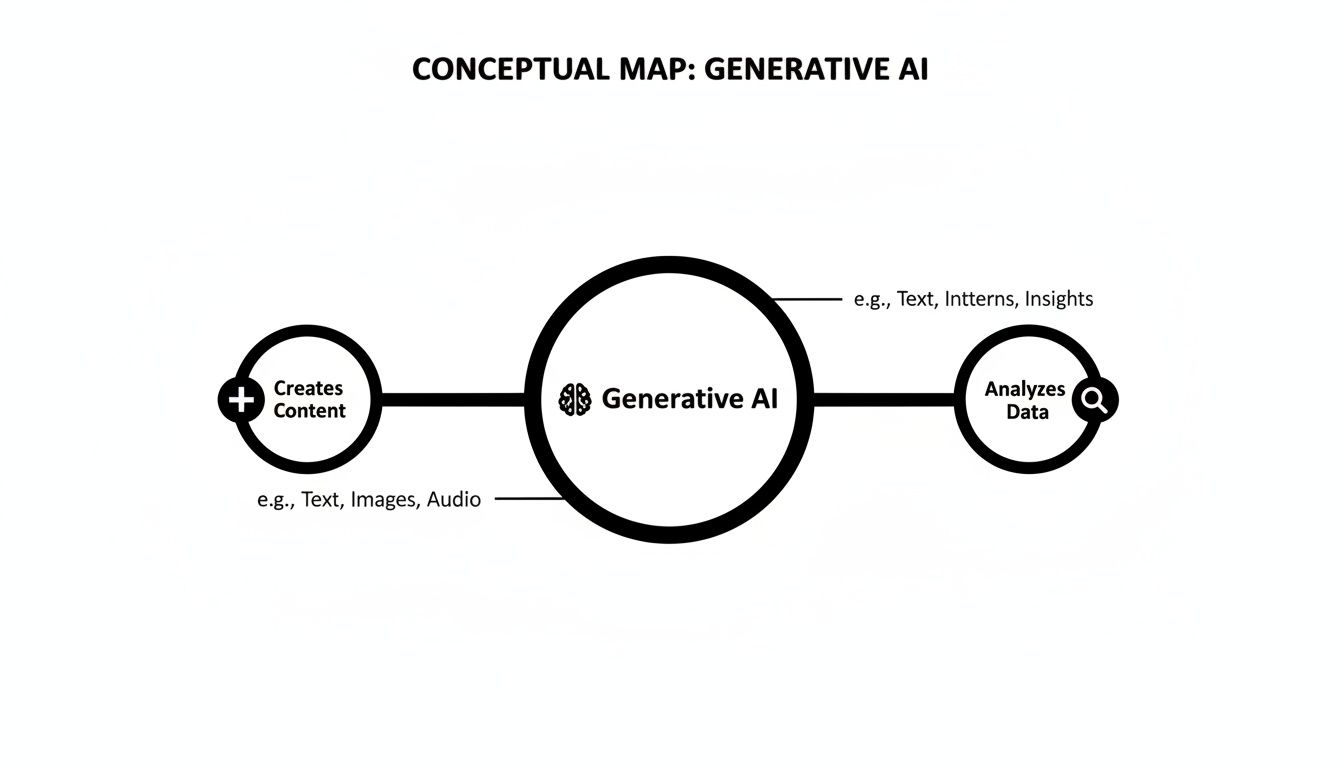
Generative AI isn't just another tech buzzword; it's a fascinating type of artificial intelligence that creates brand-new, original content. We're talking about text, images, music, code—you name it. Instead of just analyzing or sorting the data it's given, it learns the underlying patterns and uses that knowledge to generate something completely novel. It's a bit like the difference between a music critic and a composer.
Unpacking Generative AI From The Ground Up
If you've played around with tools like ChatGPT, you've already had a friendly chat with generative AI. But what’s really going on under the hood?
Let's break it down with a simple analogy. Imagine traditional AI is a super-smart detective. It can look at a thousand photos and expertly identify every single cat in them. That's analysis. Generative AI, on the other hand, is more like an artist. You can give it a quirky request—like "a cat wearing a tiny astronaut helmet"—and it will paint a brand-new picture from its imagination.
This leap from analyzing to creating is what has everyone so excited. It’s the difference between a chef who can identify every spice in a dish and one who can invent an entirely new recipe. This creative power is fueling explosive market growth, with projections soaring from USD 22.21 billion in 2025 to a staggering USD 324.68 billion by 2033. Some forecasts even see the market hitting USD 1.3 trillion by 2032, which gives you a sense of the massive economic shift at play. You can dig into the numbers behind this surge in this detailed report from Grand View Research.
The Core Idea: Creating vs. Analyzing
To really get it, you have to understand the difference between creating something new and just sorting what's already there. The output of these models is AI-generated content—digital stuff made by a machine, not a person. This is what fundamentally separates them from older AI systems.
Traditional AI is a pro at tasks like classification and prediction. For instance, it might sift through historical sales figures to forecast next quarter's revenue or scan your inbox to flag an email as spam. It works with what already exists.
Generative AI, in contrast, is all about synthesis. It takes what it has learned and combines it in new ways to produce something that wasn't there before. A practical example? A small business owner could use it to draft ten different versions of a marketing email in seconds, or a designer could ask it to mock up a new logo concept.
Here’s the logo for ChatGPT, arguably the most famous generative AI tool out there.
This simple icon has become a symbol for a technology that put the power of AI creation into the hands of millions.
Generative AI vs. Traditional AI At a Glance
So, what are the key differences when you put them side-by-side? This simple table breaks it down for you.
| Aspect | Generative AI | Traditional AI |
|---|---|---|
| Primary Goal | To create new, original content (text, images, audio). | To analyze existing data and make predictions or classifications. |
| Core Function | Synthesis and creation. | Analysis and recognition. |
| Example Output | A unique poem, a photorealistic image, a musical score. | A sales forecast, a "spam" or "not spam" label, object detection in a photo. |
| Key Question | "What can we create based on this data?" | "What does this data tell us?" |
At the end of the day, one looks backward to understand what is, while the other looks forward to imagine what could be. Both are incredibly useful, but they solve completely different kinds of problems.
How Generative AI Actually Works
It’s easy to look at generative AI and think it’s some kind of magic, but what's going on under the hood is actually pretty brilliant and, believe it or not, understandable. Let's peel back the curtain without getting bogged down in complex math. Think of this as a tour of the main engines that make this technology tick.
At its heart, generative AI doesn't know anything in the human sense. It’s an incredibly sophisticated pattern-matching machine. It works by sifting through gigantic datasets—think huge chunks of the internet—to learn the probability of which words, pixels, or musical notes are most likely to show up next to each other.
It's all about relationships and context, not consciousness.
This ability to analyze existing data gives it the foundation to create something brand new. It's not just regurgitating what it has seen; it's using its understanding of patterns as a launchpad for originality. Several key architectural models make this happen, each with its own special trick.
Transformers The Expert Librarian
The Transformer architecture is the superstar of the moment. It's the engine driving text-based models like ChatGPT. The best analogy is to think of a Transformer as a world-class librarian who has not only read every book in a colossal library but also understands the intricate connections between all of them.
When you ask this librarian a question, they don't just pull up a book with a few keywords. They grasp the nuance of your query, understand the context, and pull together related ideas from thousands of different sources to construct a perfectly tailored, coherent answer just for you.
What makes this possible is a clever mechanism called "attention," which lets the model weigh the importance of different words in a sentence to get the context right. If you want to dive a bit deeper, our guide on the Transformer architecture explains exactly how this concept changed the game for natural language processing.
GANs The Artist and the Critic
Another fascinating approach is the Generative Adversarial Network, or GAN. You’ll often find these behind the scenes creating hyper-realistic images. The concept is a creative duel between two AIs: a budding artist (the "generator") and a sharp-eyed art critic (the "discriminator").
Here’s how their little competition plays out:
- The artist creates a new image, doing its best to make it look like a genuine masterpiece.
- The critic examines the artwork and declares whether it's a real piece or a forgery.
- The artist takes the critic’s feedback and goes back to the drawing board, getting better at its craft.
- At the same time, the critic gets better at spotting even the most convincing fakes.
This constant back-and-forth pushes both AIs to improve. The process continues until the artist's forgeries are so good that the critic can no longer reliably tell them apart from the real thing. This adversarial training is what produces such stunningly realistic results.
Diffusion Models The Digital Sculptor
Finally, we have Diffusion Models. This is the technology powering many of the most popular AI image tools today, like Midjourney and DALL-E. Imagine a sculptor, but instead of starting with a clean block of marble, they begin with a block of pure, random static—like the "snow" on an old analog TV.
The AI is trained to do one thing exceptionally well: reverse the noise. It meticulously removes the static, layer by layer, in a process of careful refinement. It’s like a sculptor chipping away at the fuzzy chaos to slowly reveal the clear, detailed image hidden within. This gradual denoising process allows for an incredible amount of control and results in the complex, high-fidelity visuals you see everywhere online.
These three models are just a glimpse into the technical "how" of generative AI. While they all work differently, they share a common goal: learn the deep patterns of human creativity from data, then use that knowledge to build something completely new.
Exploring the World of Generative AI Tools
Alright, now that we’ve peeked under the hood at the engines driving generative AI, let’s get to the good stuff: the tools themselves. The technology is one thing, but the apps and platforms are where the magic really happens. This is where complex code becomes a creative partner you can start working with today.
Think of this as a quick tour of the major players on the scene. We’ll cover the masters of language, the visual artists, and a few specialized tools built for specific jobs. Each has its own distinct personality and skillset, making them better suited for different kinds of work.
The Wordsmiths: Large Language Models
Large Language Models (or LLMs) are the heart of almost all text-based generative AI. They’ve been trained on truly staggering amounts of text from the internet, books, and articles to understand the nuances of how we communicate.
-
OpenAI's GPT Series (ChatGPT): This is the one that really kicked the door open for most people. GPT (Generative Pre-trained Transformer) is the model that powers ChatGPT, and it's a jack-of-all-trades. It’s great for conversations, drafting emails, summarizing long documents, and even helping you write code. It’s the ultimate versatile assistant.
-
Google's Gemini Family: Google’s powerful answer to GPT. The Gemini models were built from the ground up to be "multimodal," which is a fancy way of saying they can understand and work with more than just text. You can give them images, audio, and video, and they'll process it all together. It’s the kind of model you could show a picture of your fridge and ask, "What can I make for dinner?"
The Visual Artists: Image Generation Models
If LLMs are the writers, then these models are the painters, photographers, and graphic designers. They take your words and turn them into entirely new, often breathtaking, images.
-
Midjourney: Known for its highly artistic and sometimes surreal style. If you want to create stunning concept art for a video game or a moody, atmospheric landscape, Midjourney is probably your best bet. It has a unique vibe, operating entirely through the chat app Discord, which has fostered a strong community around it.
-
DALL-E 3 (OpenAI): The visual counterpart to ChatGPT. DALL-E 3 is exceptionally good at following detailed instructions in your prompts. It’s a go-to for creating specific illustrations, logos, or scenes that need to match your description precisely. Ask for "an oil painting of a robot playing chess with a squirrel in a park," and it will deliver just that.
-
Stable Diffusion: The open-source hero of the image generation world. While it might have a slightly steeper learning curve, its open nature means there’s a massive community constantly building on it and creating new plugins. Stable Diffusion offers an incredible amount of user control, making it a favorite for tinkerers and anyone who wants to customize the creative process.
As AI pioneer Dr. Fei-Fei Li once said, "AI is not a single technology. It's a constellation of technologies that are enabling machines to perceive, reason, learn, and act." This perfectly captures the ecosystem of generative tools—each is a different star with its own unique light.
Specialized Creators for Niche Tasks
Beyond general-purpose text and images, a new wave of generative AI is popping up to handle very specific jobs. Many tools are designed specifically for AI powered content creation, helping people generate everything from marketing copy to unique product images.
This growing field includes models built for:
- Code Generation: Tools like GitHub Copilot integrate directly into a developer's workflow, suggesting lines of code or even entire functions as you type. It’s like having an expert programmer looking over your shoulder.
- Music Composition: Platforms like Suno can create complete songs—with vocals, instruments, and all—from just a short text prompt describing the genre and mood.
- Video Creation: The next frontier. Emerging models like Sora from OpenAI aim to create high-quality, realistic video clips from nothing but a text description, which could completely change filmmaking and advertising.
Each of these specialized tools takes the core generative AI concept and sharpens it for a specific creative discipline, lowering the barrier for anyone to bring their ideas to life.
How Generative AI Shows Up in Your Life and Work
So far, we've talked about the tech and the big-name models. But where does the rubber meet the road? Let's talk about how this technology is actually showing up in our daily lives and at the office. This isn't some far-off, sci-fi concept anymore. Generative AI is a real tool that people and businesses are putting to work right now to get more creative and efficient.
You've probably already used generative AI today, maybe without even realizing it. Its influence is spreading fast, from the apps on your phone to the way companies create their products. It's helping developers write better code, helping marketers design campaigns, and even brainstorming ideas for your favorite TV shows.
This technology has officially left the research lab and landed squarely in the real world. Just look at the adoption rates. An incredible 92% of Fortune 500 companies, including household names like Coca-Cola and Apple, are already using it to sharpen their operations. The results speak for themselves: 79% of businesses are using it to improve customer experiences, while 67% are streamlining their internal processes. You can dig deeper into these numbers in this breakdown of generative AI statistics.
A Co-Pilot for Creativity and Content
One of the most obvious places you'll see generative AI at work is in creative fields. It’s become a powerful co-pilot for artists, writers, marketers, and musicians. It helps them smash through creative blocks and produce incredible work in a fraction of the time.
Think about a marketing team trying to launch a new energy drink. Instead of spending hours in a stuffy conference room, they can use a tool like ChatGPT to spit out a dozen clever slogans in minutes. Then, they can take the winning slogan and pop it into DALL-E 3 to instantly visualize an entire ad campaign. The whole process, from a vague idea to a polished concept, gets massively accelerated.
Here are a few other ways it's making a difference:
- For Writers and Authors: It can help brainstorm shocking plot twists, flesh out a character's backstory, or even draft the boring, boilerplate sections of a non-fiction book.
- For Musicians: It can generate new melodies, create backing tracks in any genre imaginable, or let a solo artist experiment with a full orchestra without booking a single session musician.
- For Graphic Designers: It can create hundreds of unique logo options, generate illustrations for a blog post, or produce marketing assets from a simple text prompt.
As Andrew Ng, a leading mind in AI, puts it, "AI is the new electricity." He means it's a foundational technology that will soon power almost everything, transforming industries just like electricity did a century ago. It’s not about replacing humans, but augmenting our abilities.
It's all about this new partnership between human intuition and machine intelligence, and it’s unlocking entirely new possibilities.
Powering Up Business and Productivity
Beyond the arts, generative AI is a serious engine for business productivity. It’s taking over repetitive tasks, pulling valuable insights out of messy data, and just generally helping teams work smarter. Companies in every sector, from finance and healthcare to retail, are finding clever ways to weave these tools into their daily workflows.
Let's look at the world of software development. A programmer using GitHub Copilot can write, test, and fix code faster than ever. The AI suggests entire chunks of code, spots potential bugs, and can even explain what a confusing function does. This frees up the developer to focus on the big-picture problems, which is one of the most practical answers to the question, "What can AI do for me?"
In customer service, modern AI chatbots are no longer the frustrating, robotic systems of the past. They can handle complex issues with natural, helpful conversations, 24/7. This keeps customers happy and lets human agents focus their energy on the really tough cases. From drafting legal contracts to summarizing dense medical research, generative AI is quickly becoming a go-to tool for professionals everywhere.
To give you a clearer picture, here's a look at how different industries are putting generative AI to work.
Top Generative AI Applications Across Industries
| Industry | Primary Application | Example Task |
|---|---|---|
| Marketing | Content Creation | Generating blog posts, social media captions, and ad copy. |
| Software Dev | Code Generation & Assistance | Writing boilerplate code, suggesting functions, and debugging. |
| Healthcare | Drug Discovery & Research | Simulating molecular structures to predict drug efficacy. |
| Finance | Fraud Detection & Analysis | Identifying unusual transaction patterns in real-time. |
| Entertainment | Media Production | Creating concept art, generating script ideas, and composing music. |
| E-commerce | Product Descriptions | Writing unique, SEO-friendly descriptions for thousands of items. |
| Legal | Document Analysis | Summarizing long contracts and identifying key clauses. |
As you can see, the applications are incredibly diverse and are already making a tangible impact on how work gets done.
Your First Steps with Generative AI
So, you're ready to jump in and see what generative AI can do. That’s great! This is where the real fun starts, and the best part is you don't need to be a programmer or a data scientist to begin.
The easiest entry point is through one of the many user-friendly tools out there today. Think of platforms like ChatGPT or Microsoft Copilot as your personal creative partners. Getting started is as simple as heading to their website and typing what you want into a chat box. It's built to feel as natural as texting a friend.
At the heart of this interaction is the prompt—the instruction you give the AI. Learning how to write good prompts is the single most important skill you can develop, and it's much more of an art than a science. The clarity and detail of your prompt directly shape the quality of the answer you get back.
The Art of the Prompt
At its core, prompting is really just a conversation. You're simply telling the AI what you want it to create. But a vague request will almost always get you a generic, uninspired response. The real magic happens when you add context, detail, and a clear goal.
Let’s walk through a quick before-and-after.
Vague Prompt:
"Write about dogs."
This gives the AI almost nothing to work with. You'll probably get a dry, Wikipedia-style summary about the domestication of canines. It’s accurate, sure, but it’s not very useful or engaging.
Now, let's inject some personality and specifics.
Specific Prompt:
"Write a funny, four-stanza poem about a lazy basset hound named Barnaby who secretly dreams of becoming an astronaut. Use a cheerful and rhyming AABB style."
See the difference? This prompt gives the model clear directions:
- A Subject: A lazy basset hound named Barnaby.
- A Goal: He has secret dreams of space travel.
- A Tone: Funny and cheerful.
- A Format: A four-stanza poem with an AABB rhyme scheme.
This level of detail provides the AI with guardrails, turning it from a general knowledge database into a focused creative collaborator. The more precise your instructions, the better the output. Crafting these instructions is a skill in itself, and if you want to go deeper, our guide on what is prompt engineering explains the mechanics in more detail.
The quality of your output is a direct reflection of the quality of your input. Think of the AI as an incredibly talented but very literal intern—it will do exactly what you ask, so be specific!
Simple Tips for Better Results
You don't need to be a seasoned pro to get great results. Just keeping a few simple ideas in mind will dramatically improve your prompts.
- Assign a Role: Tell the AI who you want it to be. Start your prompt with something like, "Act as an expert travel blogger…" or "You are a professional copywriter specializing in social media ads…" This immediately frames the context and sets the right tone.
- Provide Examples: If you have a specific style in mind, show, don't just tell. You could say, "Write a product description in the same witty and casual tone as this example: [paste your example here]."
- Iterate and Refine: Your first try doesn't have to be your last. Treat it like a real conversation. If the initial response isn't quite right, give the AI feedback and ask it to try again with a few tweaks.
The Messy Side of AI: Challenges and Ethical Tightropes
Generative AI is undeniably powerful, but it’s not all smooth sailing. With all this creative and productive horsepower comes a minefield of ethical questions and real-world challenges we absolutely have to confront. Getting a true handle on generative AI means looking at the good, the bad, and the ugly.
This isn’t about scaremongering. It’s about being smart and responsible. As these tools become a bigger part of our daily lives, we have a collective duty—developers, users, and lawmakers—to steer this ship in a direction that benefits everyone.
The Double-Edged Sword of Bias and Misinformation
One of the most pressing dangers is AI’s knack for creating incredibly convincing misinformation. We’re talking about "deepfakes"—hyper-realistic but completely fake videos and images. Think about the damage a fabricated video of a CEO announcing a fake bankruptcy or a politician making inflammatory statements could do. The potential for chaos is very real.
But it’s not just about malicious intent. AI models are trained on the internet, which is basically a giant mirror reflecting humanity's best and worst traits, including our biases. If the data an AI learns from is full of prejudice against certain groups, the model will not only learn those biases but can actually amplify them. This can lead to seriously flawed outcomes in crucial areas, from screening job applicants to offering medical guidance.
According to AI ethicist Dr. Timnit Gebru, "We have to move away from the mindset of 'move fast and break things' and towards a mindset of 'slow down and think about the consequences'." This highlights the urgent need for careful, responsible development in the AI space.
Who Owns AI-Generated Art? And What About Our Jobs?
Then there's the tangled web of ownership and copyright. If an AI, trained on the life's work of thousands of human artists, generates a stunning new image, who gets to claim it? The person who wrote the prompt? The company that owns the AI? What about the original artists whose work was used for training? These aren't just philosophical debates; they're the subject of major lawsuits happening right now.
And, of course, the big question on everyone's mind: jobs. It's easy to worry about AI automating tasks humans do today. While that concern is valid, many experts see it more as a shift than a replacement. Think of it like a calculator for an accountant—it doesn't replace the accountant, it just changes how they work. The future will likely demand we lean into uniquely human skills: critical thinking, complex strategy, and empathy. The goal isn't to out-compete the machine but to work with it in smarter ways.
The Future of Generative AI and What Comes Next
If you think generative AI is impressive now, just wait. We're only seeing the very beginning of what's possible, and the next few years are set to bring an even deeper collaboration between human creativity and machine intelligence. The tools we use today will soon feel like quaint precursors to more integrated, intuitive systems that act less like applications and more like genuine partners.
Beyond Text and Images
One of the most significant shifts on the horizon is the move toward true multimodality. This isn't just about handling different types of media; it's about AI models that can think and create across text, images, audio, and video simultaneously. Picture this: you verbally describe a scene, and an AI instantly generates a complete short film—script, visuals, and a custom soundtrack included. This fluid understanding across formats will unlock creative possibilities we can barely imagine.
At the same time, we're seeing a counter-trend to the "bigger is better" model race. The future will also include smaller, highly specialized AI models. These lean, efficient systems will be fine-tuned for specific jobs, making AI much faster and more accessible for niche tasks. This trend paves the way for sophisticated AI agents—autonomous programs that can independently execute complex, multi-step goals on your behalf.
The public's hunger for this technology is undeniable. After its launch in 2022, ChatGPT reached 1 million users in just 5 days, a clear signal of mainstream readiness. This momentum is just the start, with the market for generative AI projected to soar past USD 1.3 trillion by 2032, firmly embedding these tools into our professional and personal lives. You can dive deeper into these incredible growth projections on secondtalent.com.
Ultimately, generative AI is moving from being a tool you command to a proactive assistant that anticipates your needs. From managing your daily schedule to helping researchers solve massive scientific problems, its story is really just getting started.
At YourAI2Day, we're committed to keeping you on the leading edge of this incredible technology. Explore the latest news, tools, and insights to see what's coming next in the world of AI at https://www.yourai2day.com.