
Overcoming Digital Transformation Challenges: A Practical Guide
Let's be honest—digital transformation often comes down to a simple, uncomfortable truth: technology is the easy part. Most of these big, expensive projects don't crash and burn because the software is flawed. They fail because of deep-rooted organizational issues like fuzzy goals, resistance to change, and a complete failure to get employees on board. It's the human element, not the hardware, that makes or breaks the whole thing.
Why Most Digital Transformations Fail
Everyone loves the idea of digital transformation. It conjures images of seamless operations, data-driven decisions, and game-changing innovation. But the road to get there is notoriously rocky. Far too many well-intentioned initiatives end in a heap of unmet expectations and wasted investment.
Think of it like buying a brand-new, top-of-the-line race car. You've got incredible power and engineering at your disposal. But without a skilled driver who knows the track, a clear map of the course, and a pit crew that can adapt on the fly, you're not winning any races. The car itself is just potential waiting to be unlocked.
The Sobering Statistics Of Transformation
This isn't just a hunch; the numbers paint a pretty stark picture. Companies are funneling staggering amounts of money into new tech. In fact, worldwide spending on digital transformation hit around US$1.85 trillion in 2022, a jump of over 16% from the previous year.
And the results? A Boston Consulting Group study found that only 35% of these projects actually hit their targets. Some digital transformation findings suggest the failure or underperformance rate could be as high as 70%. That's a massive gap between investment and impact, and it tells us one thing loud and clear: buying technology is easy, but creating real, lasting change is incredibly hard.
The most common digital transformation challenges aren't about code. They're about people, strategy, and culture.
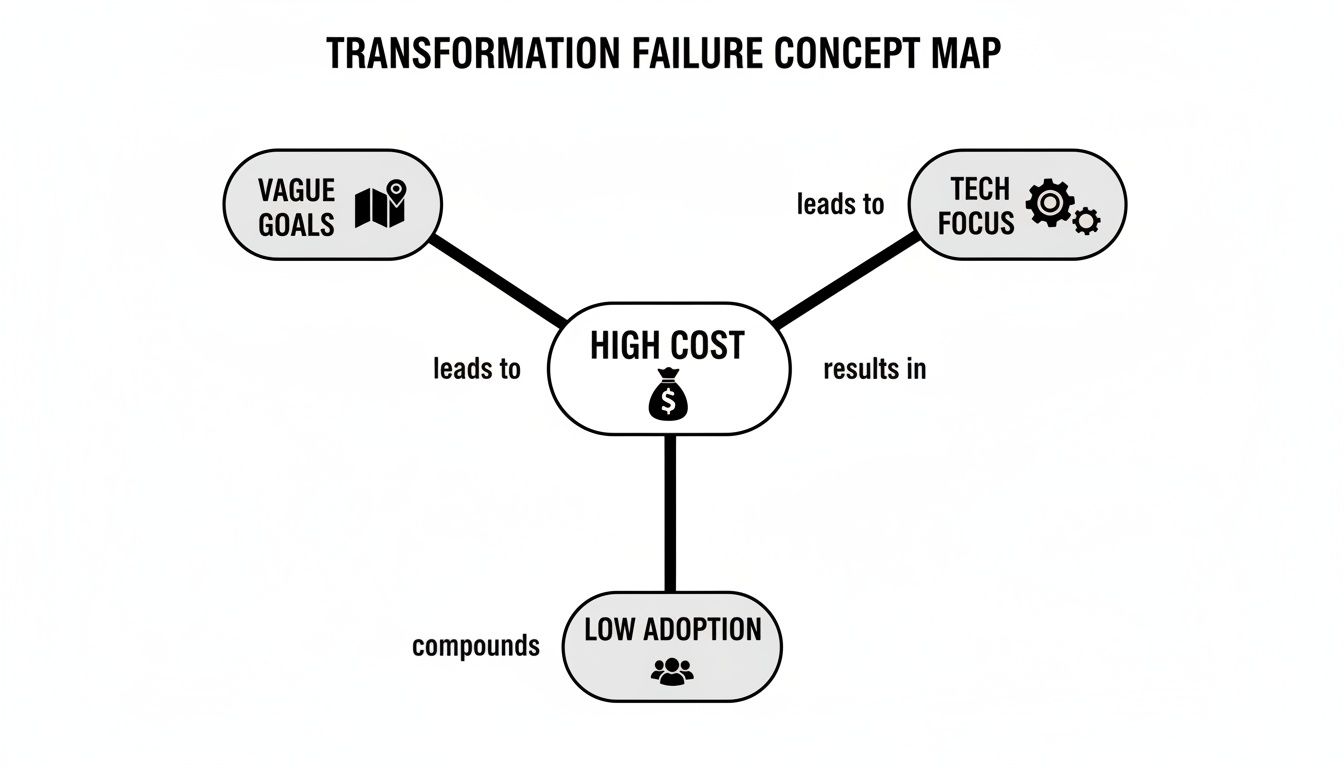
As you can see, a myopic focus on the tech itself, combined with hazy goals, just drives up costs. That expense, without clear value, tanks user adoption and brings the whole project to a grinding halt.
Pinpointing The Common Pitfalls
So, where does it all go wrong? Every company's journey is different, but the roadblocks tend to look remarkably similar. Getting a handle on these common pitfalls is the first step to actually avoiding them.
Expert Opinion: “The biggest barrier to digital transformation is culture. If you don't change the culture, no amount of technology will make a difference.” – Sarah A. Parker, Digital Strategy Consultant
This is an old saying among digital leaders for a reason—it's true. The most frequent culprits behind failed projects include:
- Vague or Unrealistic Goals: If you can't define what success looks like in plain, measurable terms, how will you ever know if you've achieved it? A goal like "improve efficiency" is useless. A goal like "reduce customer ticket resolution time by 25% in Q3" is something you can actually work toward.
- Overlooking the Human Side: You can't just drop a new tool on your team and expect them to embrace it. Without explaining the "why" and showing them what's in it for them, you breed fear and resistance. People need to feel the change is happening with them, not to them.
- Lack of Leadership Buy-In: Transformation has to be championed from the very top. If leaders aren't visibly and consistently committed, the initiative loses steam and gets written off as just another flavor-of-the-month corporate project.
To help you get a quick sense of these recurring issues, here’s a table that summarizes the main blockers.
Quick Look At Top Transformation Blockers
| Challenge Area | What It Looks Like In Practice | Why It Matters For AI |
|---|---|---|
| Organizational Inertia | Departments operate in silos, there's resistance to new processes, and a "we've always done it this way" mentality prevails. | AI relies on cross-functional data and collaboration. Silos prevent AI models from getting the complete picture they need to be effective. |
| Vague Strategy | The project lacks clear business goals, measurable KPIs, or a defined scope. It's often just "we need to do AI." | AI initiatives without a specific problem to solve are just expensive experiments. You end up with a powerful tool and no clear use for it. |
| Skills Gap | Your team lacks the expertise to manage, implement, or even understand the new technology. | AI requires specialized skills in data science, ML engineering, and analytics. Without them, you can't build, maintain, or interpret AI systems. |
| Data Problems | Data is messy, inaccessible, incomplete, or siloed across different systems. There's no single source of truth. | AI is nothing without high-quality data. "Garbage in, garbage out" is the absolute rule here; bad data leads to flawed, biased, or useless AI models. |
Recognizing these potential roadblocks from day one is essential. It lets you move beyond the tech hype and build a strategy that addresses the real, human challenges head-on.
Navigating The Human Side Of Change
Technology might be the engine of digital transformation, but it's your people who are in the driver's seat. You can have the most advanced AI or the sleekest new software on the planet, but if your team doesn't get behind the wheel, you're not going anywhere. This is the human side of change—often the most overlooked and yet the most critical challenge of all.

It really boils down to a simple truth: people are wired to resist disruption. It’s not that your employees are being difficult; it's that change injects a massive dose of uncertainty into their work lives. They start worrying about their roles, questioning if their skills are still relevant, and wondering if this "new way" will actually be better than what they’re used to.
This organizational inertia—the tendency for a company to keep doing things the way they've always been done—is a powerful force. The collective "but this is how we do it here" can bring even the most well-funded project to a grinding halt.
Why Culture Really Does Eat Strategy For Breakfast
Picture this: your company invests a small fortune in a new AI-powered sales platform. On paper, it's a miracle worker—it predicts customer needs, automates tedious follow-ups, and serves up incredible insights.
But your sales team is more than a little skeptical. They're worried the AI will make them obsolete or, worse, replace them entirely. They find the new interface clunky and can't immediately see how it helps them hit their quota. So what happens? They stick to their trusty spreadsheets and the old CRM. That expensive new tool gathers digital dust, and the transformation stalls before it ever really begins.
This exact scenario plays out in businesses every single day. In fact, research consistently shows that poor change management and cultural resistance are top reasons why these initiatives fail. Beyond talent, organizations face a tangled mess of cultural and financial hurdles. Surveys often reveal that competing priorities are a major issue, while 26% of senior executives admit that high costs are a primary roadblock.
Expert Opinion: “The moment you roll out a new tool without first addressing the human concerns, you're setting yourself up for failure. Technology is a magnifier; it will either amplify a great culture into incredible results or amplify a resistant culture into pure chaos.” – David Chen, Change Management Expert
Building A Culture That Welcomes Change
Overcoming this resistance isn't about forcing new tools on people. It's about creating an environment where they actually want to get involved. This takes a deliberate, people-first approach that can turn fear into curiosity and skepticism into genuine enthusiasm. For a deeper look at this process, check out our complete guide on overcoming resistance to change management.
Here are three pillars to start with:
- Communicate, Then Communicate Again: You have to be radically transparent about the why. Explain the business problem you're trying to solve and, crucially, answer the "what's in it for me?" question for your employees. How will this new tech make their jobs easier, more impactful, or more interesting?
- Get People Involved Early: Don't build your solutions in an ivory tower and then "unveil" them. Co-creation is the secret sauce. Invite people from across the company to test new software, offer feedback, and help design the rollout. When people feel a sense of ownership, they become your biggest advocates.
- Make Leadership Visible and Active: Support for the change has to cascade down from the top. When leaders are actively using the new tools themselves and talking openly about the benefits, it sends a powerful signal that this is a real priority, not just another corporate initiative that will be forgotten in six months.
Finding Your Internal Champions
One of the most effective strategies you can use is to identify and empower 'change champions' on your teams. These are the enthusiastic, respected, and often tech-savvy people who just get it.
They aren't always managers. A change champion could be a top-performing salesperson who sees how a new CRM can help them close deals faster, an administrative assistant who loves optimizing workflows, or anyone who commands the respect of their peers.
Give these champions early access, extra training, and a platform to share their wins. This creates an authentic, internal network of advocates. They can answer questions from colleagues, show the value of new tools in a real-world context, and give you honest, on-the-ground feedback. They become the trusted guides who help lead everyone else across the bridge from the old way of working to the new one.
Solving The Digital Skills Gap
You can sink millions into the most advanced AI platform on the market, but without skilled people to run it, that investment is just an expensive paperweight. One of the biggest hurdles in any digital transformation isn't buying the tech—it's finding, training, and keeping the talent needed to make it all click. This growing digital skills gap is a massive roadblock for countless companies.
Think of it like trying to shoot a blockbuster movie. You might have a brilliant director with a grand vision (your leadership), but you can't make a masterpiece without a crew of specialists. You need skilled camera operators, sound engineers, and editors—in this case, your data analysts, AI specialists, and cloud architects. Without that expert crew, the director's vision is just a great idea that never gets made.
This talent shortage is a very real barrier to progress. One study from Harvard Business Review revealed that 38% of organizations see insufficient digital skills as a primary constraint. Echoing that, a 2023 KPMG study found 36% of leaders are worried their current workforce just doesn’t have the right skills. Some analysts even predict that by 2026, a staggering 90% of organizations will face critical IT skills shortages, putting trillions of dollars in potential value at risk.

Pinpointing The Skills You Actually Need
So, what roles make up this modern "film crew" for the digital age? It’s not just about hiring a handful of coders. The skills most in demand today are a potent mix of deep technical know-how and sharp strategic thinking.
Here are the kinds of specialists you’ll almost certainly need on your team:
- Data Analysts and Scientists: Think of these people as your storytellers. They dive into raw, messy data and emerge with the clear, actionable insights that will actually guide your business strategy.
- AI and Machine Learning Specialists: These are your builders. They’re the ones designing, training, and deploying the AI models that automate mundane tasks, predict future trends, and power entirely new customer experiences.
- Cloud Architects: These are the people who lay the foundation. They design and manage the cloud infrastructure that all your new digital tools run on, making sure it’s scalable, secure, and cost-effective.
- Cybersecurity Experts: As you digitize more of your operations, your vulnerability to attack grows exponentially. These experts are non-negotiable for protecting your data, your systems, and your reputation from an ever-growing list of threats.
Upskill, Hire, Or Outsource?
Once you’ve identified the skills you’re missing, you have three main ways to get them: upskill your current team, hire new talent, or bring in external partners. The truth is, there's no single right answer here. The most successful strategies usually involve a smart blend of all three.
A crucial first step is to get a clear picture of where you are versus where you need to be. This usually means conducting a skill gap assessment to benchmark your team’s current capabilities against your future goals.
Here’s a breakdown of how to think about each path:
- Upskilling (Training Your Current Team): This is your best long-term play. Investing in your existing employees builds incredible loyalty and creates a talent pool that has deep institutional knowledge. It’s all about building a culture where learning never stops.
- Hiring (Bringing in New Talent): When you need specialized expertise right now and simply don't have the time to train someone from scratch, hiring is the way to go. It injects fresh perspectives and high-level skills into your organization almost immediately.
- Partnering (Outsourcing to Experts): For specific, short-term projects or highly niche skills, bringing in a consultant or a specialized agency can be the most efficient route. This gives you access to top-tier talent without the long-term cost and commitment of a full-time employee.
Expert Opinion: “Fostering a culture of continuous learning is no longer a 'nice-to-have' company perk. In an era of constant technological change, it's a core business strategy essential for survival and growth.” – Maria Rodriguez, Chief Learning Officer at TechForward Inc.
Creating this kind of learning culture doesn't have to break the bank. It can start with simply encouraging your people to explore high-quality online resources. To help your team get started with the basics of AI, you can point them toward our list of the best free AI courses, which offers a fantastic entry point without a big budget.
Ultimately, solving the skills gap comes down to one core idea: your people are your most valuable asset in any transformation. By strategically investing in their growth, you're not just filling a role—you're building the organizational capability to adapt and thrive for years to come.
Tackling Your Technology And Data Hurdles
Now, let's move past the people-centric issues and get into the nuts and bolts of your technology. The technical hurdles can feel like the most intimidating part of any digital transformation, but they don't have to be. We can cut through the complexity by focusing on two absolute giants: your data and your security.
Think of it like trying to cook a gourmet meal. You've got a brilliant recipe (that’s your strategy), but your ingredients are scattered across a dozen different pantries, some are mislabeled, and others are locked away. The flour is in one room, the eggs in another, and the sugar is somewhere else entirely, but you can't access them all at once.
That's precisely what happens when you try to power an AI model with messy, siloed data. Your data is the raw ingredient for every single digital initiative. If it isn't clean, accessible, and unified, your efforts are doomed from the start. "Garbage in, garbage out" isn't just a clever saying; it's the fundamental law of data science.
Getting Your Data House In Order
Disorganized data is the silent killer of transformation projects. It directly leads to flawed business insights, unreliable AI predictions, and a complete breakdown of trust in any new system you introduce. Before you can even dream of running advanced analytics or machine learning models, you have to get your data house in order.
This means literally breaking down the walls between departments. The marketing team’s customer data, the sales team’s CRM records, and the finance department’s transaction history all need to speak the same language. This is where a clear data strategy becomes non-negotiable. For many businesses, a critical first step is adopting cloud-based data integration to create a single, reliable source of truth.
When your data is unified, you can finally ask a question like, "Who are our most profitable customers?" and get one clear answer—not three conflicting ones from three different teams.
Security Is Not An Afterthought
As you start connecting systems and making data more accessible, your company's digital footprint expands. Unfortunately, so does your vulnerability to cyber threats. The biggest mistake businesses make is treating security as a final box to tick—something to bolt on at the very end.
That approach is a recipe for disaster.
Expert Opinion: “Security shouldn’t be a gate you pass through at the end of a project. It needs to be a foundational part of the entire process, built into every new tool and workflow from day one. Thinking of security as an integrated feature, not a final hurdle, is crucial.” – Cybersecurity Analyst, Gartner
Truly effective security is woven into your strategy from the very beginning. When you evaluate new software, you should be evaluating its security features with equal rigor. When you train employees on new processes, you must also train them on new security protocols. Adopting this "security-by-design" mindset is what protects your data, your customers, and your reputation.
Data And Security Readiness Checklist
Feeling a little overwhelmed by the tech side of things? Don't be. Use this simple checklist to run a quick health check on your data and security readiness. It's a straightforward way to see where you stand and figure out what your immediate next steps should be.
| Checklist Item | Status (Ready / In Progress / Not Started) | Next Action Step |
|---|---|---|
| Data Accessibility | Example: Consolidate customer data from spreadsheets and CRM into one system. | |
| Data Quality | Example: Run a data audit to find and fix incomplete or duplicate records. | |
| Cybersecurity Policy | Example: Draft a simple policy for password management and data handling. | |
| Employee Security Training | Example: Schedule a basic training session on identifying phishing emails. | |
| Data Backup and Recovery | Example: Verify that critical data is being backed up automatically and test a restore. |
This checklist isn't about solving everything at once. It's about taking small, manageable steps to build a solid technical foundation for everything that comes next.
Building Your Transformation Roadmap
Staring down all the potential challenges of digital transformation can feel paralyzing. It's easy to get bogged down worrying about culture, skills, and data all at once. This is where we stop diagnosing problems and start building a real plan. A successful transformation isn't some giant leap into the unknown; it's a series of deliberate, well-planned steps. So let's forget the generic advice and focus on what actually works.
The core idea is simple: think big, but start small. You don't need a five-year, multi-million dollar plan on day one. In fact, that's often a recipe for failure. The smartest approach is to prove the value quickly with a focused pilot project. This builds momentum, creates internal champions, and teaches you invaluable lessons you can use as you scale.

Define What Success Looks Like
Before you write a single line of code or sign a contract for new software, you have to know where you're going. Vague goals like "become more digital" or "use AI" are completely meaningless. You need clear, measurable Key Performance Indicators (KPIs) that are tied directly to a business outcome.
What specific problem are you actually trying to solve? Are you aiming to:
- Reduce customer service response times by 30%?
- Cut down on manual data entry for the finance team by 15 hours per week?
- Increase qualified sales leads from your website by 20%?
These are concrete, tangible goals. They give you a clear target to aim for and make it painfully obvious whether your project worked or not. Without them, you’re just spending money on technology for its own sake.
Start Small With a Pilot Project
Your secret weapon in this whole process is the pilot project. Think of it as a small-scale, low-risk experiment designed to test a new technology or process on a very limited part of the business. The entire point is to get a quick win that demonstrates real, tangible value.
Expert Opinion: “A successful pilot project does more than just test technology; it builds belief. When people see a real, positive impact on their daily work—even a small one—resistance turns into curiosity, and skepticism transforms into support.” – John Maxwell, author and leadership expert
For instance, instead of trying to overhaul your entire sales process at once, you could launch a pilot to implement a new AI-powered CRM for just one sales team. You can measure the impact on their lead conversion rates and get direct feedback before even thinking about a company-wide rollout.
When you're ready to put pen to paper, consider these real strategies for your digital transformation roadmap to help structure your thinking and sidestep common mistakes.
Secure Leadership Buy-In and Communicate the Vision
Even the smallest pilot needs strong backing from the top. Securing leadership buy-in isn't just about getting a budget approved; it’s about making sure your leaders become vocal champions for the change. They have to understand the 'why' behind the project and be ready to communicate that vision over and over again.
Your communication plan is just as critical as your technical plan. Everyone in the organization, from the C-suite to the front lines, needs to know the answers to these questions:
- What problem are we solving? (The pain point)
- How are we planning to solve it? (The pilot project)
- What does success look like? (The KPIs)
- What’s in it for them? (The direct benefit to employees)
This kind of transparency demystifies the whole process and helps manage the natural fear and uncertainty that always comes with change.
Mini Case Study: A Small Business AI Chatbot Success
Let’s look at a practical example. A small e-commerce company selling handmade goods was getting swamped by customer service requests. Their two-person support team was drowning in repetitive questions about shipping times, return policies, and product details. The result? Slow responses and unhappy customers.
Instead of a massive, expensive overhaul, they launched a simple pilot project: an inexpensive AI chatbot on their website.
- The Goal: Reduce the volume of basic support tickets by 50% within three months.
- The Pilot: They used a user-friendly platform to train the chatbot on their 50 most frequently asked questions. They didn't try to make it a know-it-all—just a master of the basics.
- The Rollout: They let the chatbot run for one month, carefully measuring how many questions it resolved without needing a human.
- The Result: The chatbot handled a surprising 65% of incoming queries. This freed up the human agents to focus on complex, high-value customer issues. The win was so clear and immediate that they easily secured the budget to integrate the chatbot more deeply with their inventory system, scaling its capabilities.
This small, focused success story built the confidence—and the business case—they needed to tackle bigger transformation goals down the line.
Your Next Steps On The Transformation Journey
Getting started with digital transformation can feel overwhelming, like you’re staring up at a mountain. We’ve walked through the biggest hurdles—the tricky cultural shifts, the very real skill gaps, messy data, and the struggle to land on a clear strategy. But here’s the most important thing to remember: real success isn't about the software you buy. It’s about building a smart, balanced plan that puts your people and your processes at the heart of it all.
Don't think of this as one massive project with a finish line. It's much more like a continuous cycle of learning, tweaking, and improving. You absolutely do not need to solve every problem on day one. In fact, the most effective way to start is with one single, well-chosen step.
Your goal isn't to "transform" your entire business overnight. It's to find one real, nagging business problem and solve it with a new digital tool or process. That's it.
So, start there. Pinpoint one tangible pain point that everyone complains about. Maybe it's the painfully slow customer response times or a mind-numbing manual data-entry task that eats up hours every week. Put all your energy into fixing that one thing and delivering a clear, measurable win.
That’s how you build momentum. Each small victory proves that change is worth the effort, gradually turning skeptics into believers. It builds the confidence your organization needs to take on the next challenge, and then the one after that. You've got this. Just start small.
Frequently Asked Questions
Diving into digital transformation often sparks more questions than answers, especially when you're just getting started. Let's tackle some of the most common ones we hear from business leaders and their teams.
What Is The Single Biggest Digital Transformation Challenge?
It’s tempting to point fingers at buggy software or messy data, but honestly, the biggest hurdle is almost always cultural resistance. You can spend a fortune on the latest tech, but getting people to change long-standing habits and embrace new ways of working is the real challenge.
Ultimately, your success depends on your team. It's about clear leadership, a vision that everyone can get behind, and making sure your employees are part of the journey, not just passengers. People always come first.
"Technology can be bought, but changing people's mindsets and daily habits requires strong leadership, clear communication, and a compelling vision. It’s always about people first."
How Can A Small Business Start Its Digital Transformation?
The best advice? Start small and fix a real problem. Don't try to overhaul the entire company overnight. Find that one repetitive, manual task that drives everyone crazy or creates bottlenecks, and find a simple digital tool to fix it.
Here are a few practical first steps:
- Get a cloud-based CRM: Move all your customer info from scattered spreadsheets into one central, organized system.
- Use an AI scheduling tool: Automate your social media posts to free up time for genuine customer engagement.
- Adopt a collaboration platform: Switch from endless email threads to something like Slack or Microsoft Teams for faster internal communication.
Your goal is to score an early win. A small, successful project proves the value of the new approach and builds the confidence and momentum you'll need for bigger changes later on.
Is AI Necessary For Every Digital Transformation?
Absolutely not, particularly at the beginning. The true foundation of any successful transformation is just getting your core data and processes digitized. That means getting off paper and making sure your information is clean, organized, and easy to access.
Once you have that solid digital base, AI becomes an incredibly powerful tool you can layer on top. Think of it like building a house: digitization is pouring the concrete foundation. AI is the advanced smart home system you install later. You can't have one without the other.
Ready to stay ahead of the curve and master the tools of tomorrow? At YourAI2Day, we provide the latest news, in-depth guides, and practical insights to help you confidently navigate the world of artificial intelligence. Explore our resources today at https://www.yourai2day.com.