A Practical AI Implementation Roadmap for Your Business
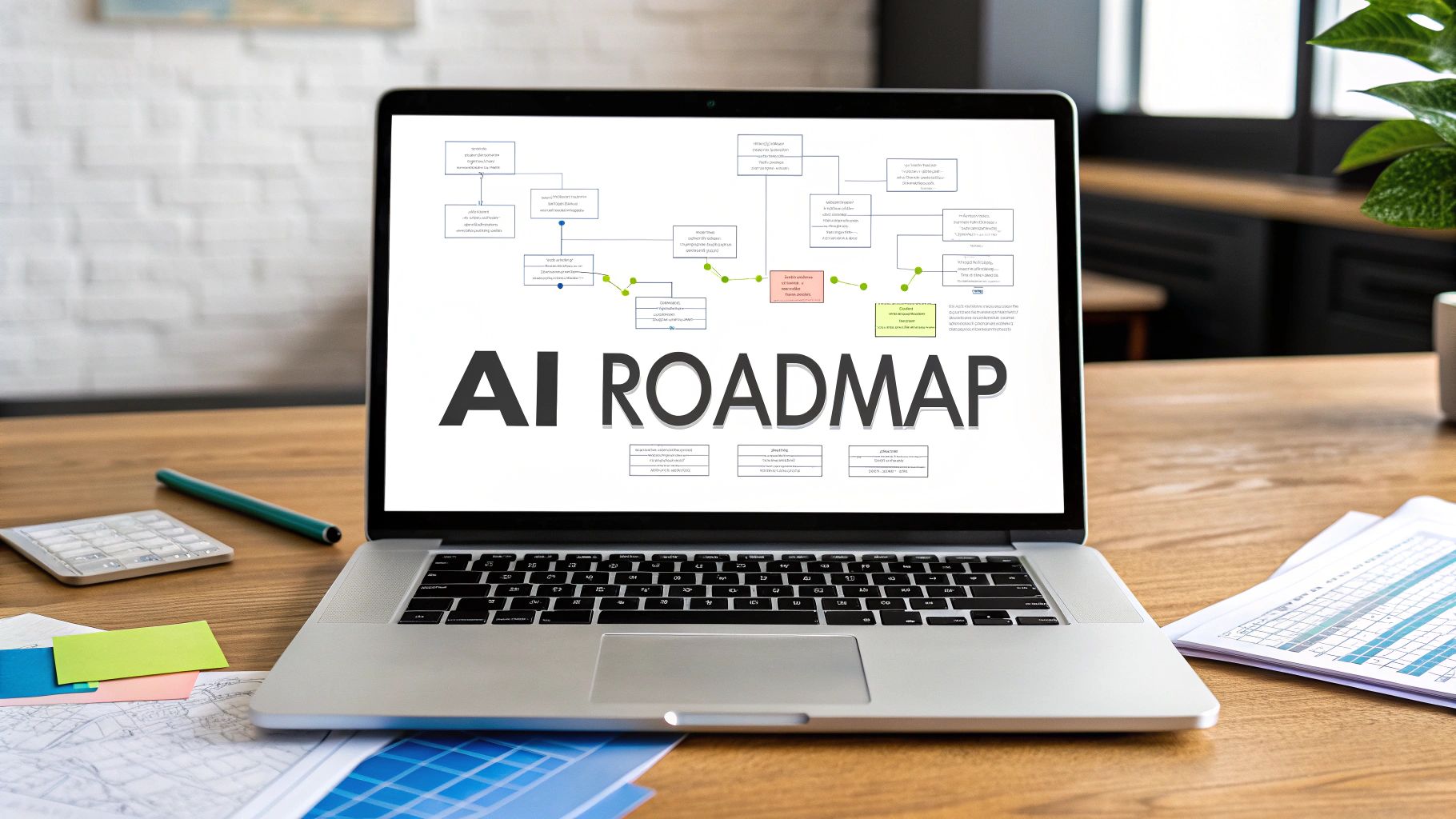
Let's talk about creating an AI implementation roadmap. Think of it as your game plan for bringing artificial intelligence into your business without all the chaos. It's a step-by-step guide that takes you from a fuzzy idea to a real, working AI system that actually helps your bottom line. This isn't about chasing the flashiest new tech; it's a blueprint for solving real problems, getting your data in order, and picking the right projects to get some early wins.
Starting Your AI Journey Without Getting Overwhelmed

Diving into artificial intelligence can feel like trying to drink from a firehose. The hype is everywhere, but solid, practical advice for someone just starting out is surprisingly hard to find. The good news? You don't need a PhD in data science or a perfectly organized dataset to get going. The real secret is to start small and focus on your business, not the technology itself.
So many organizations get this backward. They chase the newest, coolest AI tool before they've even figured out what problem they're trying to solve. That's a classic recipe for an expensive project that goes nowhere. A successful AI implementation roadmap always starts with a simple, honest look at where you are right now.
Assess Your AI Readiness
Before you can draw a map to your destination, you have to know where you're starting from. This "readiness check" doesn't have to be some stuffy, complex technical audit. Think of it as a friendly, practical evaluation of your business fundamentals.
You can get a good sense of things by asking a few straightforward questions.
Take your data, for instance. Is all your customer information organized in a central CRM, or is it scattered across a dozen different spreadsheets and email inboxes? You don't need perfect data to start, but you absolutely need to know where it lives and what shape it's in. Understanding this from the get-go helps you set realistic goals for your first project. Our guide on getting started with AI has more foundational tips for this crucial first step.
"The biggest mistake is falling in love with technology before identifying a business problem. Don't start with the AI tool; start with the pain point." – YC Lian, Executive Director of IT Operations, ServiceRocket
It's all about shifting your mindset from "What cool things can we do with AI?" to "What's our biggest headache that AI could help us solve?"
Find High-Impact First Projects
Your first AI project needs to be a quick win. You're looking for that sweet spot: something that delivers real value but isn't too complicated. This is how you build momentum and show the rest of the company—especially the bosses—that this AI thing is more than just hype. Forget trying to automate the entire company on day one.
Look for the simple, repetitive tasks that are currently eating up your team's time and energy. Those are usually the perfect candidates for a first AI project.
Here are a few practical examples for beginners:
- Customer Service: Could you train an AI chatbot to handle the top 10 most common customer questions? Think of all the time that would free up for your support agents to tackle the truly tricky issues.
- Marketing: What if AI could help draft a first pass of social media posts or a handful of email subject lines? It’s not about replacing your marketing team’s creativity but giving them a helpful assistant to speed up their workflow.
- Sales: Imagine an AI tool that listens to sales calls, summarizes them, and pulls out key customer pain points. This could save your salespeople hours of tedious note-taking every single week.
Choosing a project like this gives you a clear, measurable outcome. Success isn't about deploying some hyper-complex algorithm; it's about saving your support team 10 hours a week or boosting your email open rates by 5%. This approach makes your AI implementation roadmap real and proves its worth right from the start.
Building Your AI Blueprint and Strategy

Okay, you've pinpointed a few promising areas where AI could make a real difference. Awesome! But a collection of cool ideas isn't a plan. This is where we shift from "what if" to "how to," creating a solid blueprint that makes sure every bit of effort pushes the business forward.
An AI tool without a strategy is just an expensive toy. Let's skip the dusty, 50-page document no one will ever read. A practical AI strategy is all about answering a few key questions with total clarity. This is the "why" behind your entire AI implementation roadmap, and it's what will keep you on track when the next shiny tech comes along.
Don't just take my word for it. Organizations that skip the formal strategy stage report a dismal 37% success rate with their AI projects. You can dig into more of these eye-opening AI industry statistics, but the takeaway is clear: planning is what separates a successful initiative from a failed experiment.
Align AI Goals with Business Objectives
This is the most important part of your strategy, hands down. You need to draw a straight line from your AI project to a core business goal. If you can't explain how an AI project will move a key number, you're not ready to start. This is how you get people on board, justify the budget, and ultimately prove it was all worth it.
Let's get practical. "Improve marketing" is a wish, not a goal. We need to be way more specific.
- For a Retailer: "Our goal is to cut online cart abandonment by 15% in the next six months. We'll use an AI personalization engine to recommend highly relevant products before a user leaves, making it more likely they'll complete the purchase."
- For a Manufacturer: "We need to slash unscheduled machine downtime by 20% this year. The plan is to use a predictive maintenance AI that analyzes sensor data to flag equipment that's about to fail before it actually breaks."
- For a SaaS Company: "We want to reduce common customer support tickets by 30%. We'll do this by implementing an AI chatbot trained on our help articles to give customers instant, accurate answers to their questions."
See the difference? Each example is specific, measurable, and solves a real business problem. That clarity turns a tech project into a business solution.
"AI implementation must directly support measurable business objectives. Common strategic goals include revenue growth, cost reduction, operational efficiency improvements, customer experience enhancement, and competitive differentiation." – HP Tech Takes
This expert take drives the point home. AI can't be off in its own little world; it has to serve the bigger mission.
To help you think this through, here’s a breakdown of what a solid AI strategy should include.
Key Components of an AI Strategy
A well-defined strategy ensures everyone is on the same page, from the CEO to the developer. It acts as your north star throughout the whole process.
| Component | Description | Example Question to Answer |
|---|---|---|
| Business Alignment | Clearly connecting AI goals to what the company is trying to achieve. | "How will this AI project help us make more money, save costs, or make customers happier?" |
| Problem Definition | A specific, well-defined problem the AI is going to solve. | "What's the exact bottleneck or customer headache we're trying to fix?" |
| Success Metrics (KPIs) | Numbers you can track to measure the project's impact and ROI. | "What specific numbers (e.g., a 20% reduction in downtime) will tell us we succeeded?" |
| Data Strategy | A plan for getting, managing, and securing the data needed for the AI. | "Do we have the data we need? Is it clean enough, easy to get, and are we allowed to use it?" |
| Technology & Tools | The software, platforms, and gear required. | "Are we going to build this ourselves, buy a ready-made solution, or do a bit of both?" |
| Team & Skills | Figuring out who you need and what they need to know to get it done. | "What skills do we have on our team, and where do we need to bring in help?" |
| Governance & Ethics | Rules for using AI responsibly, fairly, and transparently. | "How will we make sure our AI isn't biased and that we're using data ethically?" |
| Roadmap | A high-level timeline with key steps and milestones. | "What are the major phases from pilot to full rollout over the next 12 months?" |
This table isn't just a checklist; it's a guide for having the right conversations early, which will save you from major headaches later on.
Secure Leadership Buy-In and Build Your Team
You can have the most brilliant plan in the world, but if the bosses aren't on board, it's not going anywhere. The trick to getting their support is to speak their language: results, ROI, and getting an edge on the competition. Use those specific, outcome-driven goals you just defined.
Stop talking about "machine learning models" and "neural networks." Instead, talk about the $50,000 in estimated annual savings from predictive maintenance, or the projected $120,000 revenue boost from smarter product recommendations. When you tie your AI roadmap to dollars and cents, you get their attention.
Once leadership gives you the thumbs-up, it's time to assemble your A-team. You don't need a huge new department for your first project.
Start small with a cross-functional "tiger team" that has these key roles:
- A Business Lead: Someone from the department feeling the pain, like the Head of Marketing or the Plant Manager. They own the problem and will be the one to say if it's a success.
- A Technical Lead: This could be a curious person from your IT team or any tech-savvy employee who's excited about AI and can handle the technical side.
- A Project Champion: An enthusiastic cheerleader who keeps the momentum going, communicates progress, and connects different teams.
This small, nimble group can move much faster and more effectively than a big, slow committee. Their mission is to take this first project from idea to reality, proving the value of your AI implementation roadmap and paving the way for everything that comes next.
Getting Your Data and Tools in Order
With a clear strategy in your back pocket, it's time to roll up your sleeves and get into the nitty-gritty. We all know that AI is only as good as the data it learns from, which can feel a little scary. But here's some good news: you don't need perfectly pristine data to get started. The real trick is to get your data house in order without getting stuck in a year-long cleanup project.
This part of your AI implementation roadmap is all about making practical decisions. What you decide here—about your data and your tools—will set the stage for everything that comes next.
Data Readiness: Good Enough is the New Perfect
You hear the term "data readiness" thrown around a lot. Honestly, it just means your data is clean enough for an AI to learn from and give you results you can trust. It absolutely does not mean perfect.
Think of it like cooking. You don't need fancy, Michelin-star ingredients to make a great meal, but you do need them to be fresh and labeled correctly. The same idea applies here.
Start by focusing on the data you need for your first high-impact project. If you're building a chatbot to handle customer service questions, your immediate focus is your help articles and past support tickets—not your entire sales history from the last ten years.
A classic mistake is trying to clean and organize all company data before a single AI project gets off the ground. This is a fast track to getting stuck. Instead, think "just-in-time" data prep, tackling only the datasets you need for the pilot project right in front of you.
This focused approach lets you move faster and, more importantly, show results sooner. Of course, proper data management is still super important for long-term success. As you begin to scale, building a solid foundation based on data governance best practices will be a lifesaver.
The Big Question: Build vs. Buy
Once your data plan is taking shape, the conversation naturally turns to tools. The AI landscape is flooded with options, and it’s easy to get overwhelmed. At the end of the day, your choice usually boils down to one of three paths:
- Build: You create a custom AI model from scratch, probably using open-source libraries like TensorFlow or PyTorch.
- Buy: You subscribe to a ready-made AI solution, like a plug-and-play chatbot or a pre-built marketing tool.
- Customize: You start with an existing model from a platform and tweak it with your own data to make it specific to your needs.
For any team just starting their AI journey, my advice is almost always to "buy" or "customize." Building from scratch is a huge project that needs deep expertise, a ton of time, and a serious budget. Off-the-shelf tools, on the other hand, let you tap into powerful AI almost immediately.
For example, a small e-commerce business could buy an AI-powered product recommendation tool and have it live on their site in a few weeks. Trying to build that same system in-house? You're easily looking at a year of development and hiring a team of data scientists.
Picking the Right Tool for Your Team
So, how do you actually choose? There isn't one "best" AI tool—there's only the best tool for your specific situation.
To figure this out, you need to be really honest about your own reality. I always tell people to judge their options against these three things:
- Team Skills: Do you have people who are comfortable playing with APIs and doing some light customization? Or do you need a completely no-code tool that anyone can use right out of the box? Be realistic about who you've got on your team.
- Budget: Paid solutions usually have predictable monthly or yearly costs, which makes the finance department happy. Open-source tools might be "free," but they have hidden costs for servers, maintenance, and the expert talent you need to keep them running.
- Timeline: How quickly do you need to see results? A pre-built tool can start delivering value in weeks. Customizing a model will take longer, and building from scratch is by far the slowest path. Make sure these timelines line up with your AI implementation roadmap.
Here's a quick table to help you think it through.
| Factor | Open-Source (Build/Customize) | Paid Solution (Buy) |
|---|---|---|
| Initial Cost | Low to zero for the software itself. | Higher upfront subscription or licensing fees. |
| Total Cost | Can be very high because of servers, talent, and maintenance. | More predictable, with costs tied to usage or number of users. |
| Flexibility | Extremely high. You can build exactly what you want. | Limited to the features and options the company provides. |
| Speed to Value | Slow. Requires a lot of development and testing time. | Fast. Many solutions can be up and running in days or weeks. |
| Support | You rely on community forums and your own team's smarts. | Comes with dedicated support, guarantees, and training. |
For most businesses dipping their toes into AI, a paid solution offers the best mix of speed, support, and predictable costs. It lets you stay focused on solving a business problem, not on the deep technical details of the AI itself.
Moving From a Pilot Project to Full Impact
Your pilot project was a success. The team is buzzing, leadership is impressed, and you’ve proven that AI can solve a real business problem. This is a huge milestone, but it's also where the real work begins and, frankly, where many AI initiatives fizzle out. They get stuck in "pilot purgatory."
So, how do you make that leap from a successful experiment to a fully integrated, impactful business tool?
Going from a small-scale test to a widespread solution is a completely different ballgame. A pilot is about proving if something can work. Scaling is about making sure it works reliably, efficiently, and continuously for everyone, every single time. This stage of your AI implementation roadmap requires a big shift in mindset from innovation to operations.
This simplified workflow shows that the core principles remain the same, even as you scale up. You're still prepping data, choosing tools, and starting small—just on a much bigger and more complex stage.

Let's dig into what it really takes to break out of the pilot phase and achieve company-wide impact.
Introducing MLOps: Your Scaling Secret Weapon
When we talk about scaling AI, we have to talk about MLOps (Machine Learning Operations). Don't let the technical-sounding name scare you. At its core, MLOps is just a set of practices for making your AI systems dependable, repeatable, and automated.
Think of it this way: a chef can cook one amazing meal in their home kitchen (that’s your pilot project). But to serve that same amazing meal to hundreds of customers every night, they need standardized recipes, consistent ingredient sourcing, and a well-oiled kitchen staff. MLOps is that restaurant-grade kitchen for your AI.
It’s about having solid answers to tough questions like:
- How do we automatically keep an eye on the model's performance in the real world?
- What's the plan when the data it sees starts to change (a common issue called "data drift")?
- How can we retrain and roll out an updated, better model without shutting everything down?
Without a good MLOps strategy, your once-brilliant AI model will slowly get worse, becoming less accurate and less useful over time. A solid MLOps foundation ensures your AI investment keeps paying off long after the initial launch.
"A pilot is often a handcrafted solution. When you scale, you have to move from artisanship to automation. MLOps provides the framework to do that reliably and efficiently, ensuring your AI doesn't just work on day one, but on day 100 and day 1000." – Andrew Ng, Founder of DeepLearning.AI
To put this into perspective, here’s a quick comparison of the two stages.
Pilot vs. Scaled AI Deployment
| Characteristic | Pilot Project Focus | Scaled Enterprise Solution Focus |
|---|---|---|
| Primary Goal | Prove it can work and has value. | Deliver consistent, reliable business impact. |
| Data | Clean, static, and often a limited dataset. | Messy, real-time, and huge amounts of data. |
| Infrastructure | Manual setups on a developer's laptop or a single server. | Automated, scalable, and resilient cloud infrastructure. |
| Team Skills | Data science and model building. | MLOps engineering, DevOps, data engineering, and product management. |
| Monitoring | Checking model accuracy every once in a while. | Continuous, automated monitoring of performance, drift, and system health. |
| Deployment | Manual, one-time deployments. | Automated pipelines for frequent, reliable updates. |
| Success Metric | "Did the model work?" | "Is the system delivering on its goals? Is it reliable?" |
This table really shows the shift in thinking you need. It's not just a bigger version of the pilot; it’s a completely different operational challenge.
Overcoming Common Scaling Roadblocks
Scaling an AI solution is, unfortunately, not as common as you'd think. Despite all the buzz, only about one-third of organizations have truly started to scale AI programs across their company. The roadblocks are real. Gartner even predicts that by 2025, a startling 30% of generative AI projects will be abandoned after the proof-of-concept stage.
I once worked with a retail company that built a fantastic AI model to predict when a customer might leave. In the pilot, it worked wonders. But when they rolled it out to their entire customer base, it fell flat. Why? The pilot used a clean, static dataset. The live system had to deal with messy, real-time data from millions of transactions, and the system just couldn't keep up.
They got it back on track by investing in a robust data pipeline and implementing MLOps to monitor for data quality issues, automatically retraining the model on fresh data every single week. Their story is a powerful lesson: the technical and operational backbone for a scaled solution is far more demanding. Planning for artificial intelligence enablement across the entire organization is the only way to succeed.
Create Feedback Loops and Plan for Maintenance
Your AI model is not a "set it and forget it" tool. The world changes, customer behavior shifts, and your data evolves right along with it. A crucial part of your scaling plan is creating feedback loops to capture new information and continuously improve the model.
For an AI-powered customer service bot, this could be as simple as adding a "Was this answer helpful?" button with a thumbs-up/thumbs-down. Those responses create a direct stream of performance data, telling you exactly which answers are landing and which need to be improved.
Similarly, ongoing maintenance is non-negotiable. This isn't just about fixing bugs; it's about proactively keeping your AI healthy.
Your maintenance plan should include:
- Regular Performance Audits: Schedule reviews to check if the model's accuracy is still meeting your business goals.
- Data Drift Monitoring: Use automated tools to send an alert the moment incoming data starts to look different from what the model was trained on.
- Scheduled Retraining: Plan to retrain your model with fresh data on a regular cycle—whether it's weekly, monthly, or quarterly—to keep it sharp and relevant.
By building these operational pillars into your AI implementation roadmap, you give your project the best chance of escaping pilot purgatory and becoming a long-lasting, value-generating asset for your business.
Weaving Governance, Ethics, and Success into Your AI Plan
With great AI power comes a great deal of responsibility. Launching an AI system without clear rules is like handing over the keys to a sports car without a single driving lesson—it’s just asking for trouble. Building AI ethically isn't some side-task on your AI implementation roadmap; it's a core chapter that builds trust and ensures you’re using this incredible technology for good.
This is also where we get real about what success actually looks like. It’s not just about a model having high technical accuracy. True success is measured by real-world business impact—the kind of results that make your leadership team sit up and take notice, proving the whole effort was worth it.
Building Your Ethical AI Framework
"AI governance" can sound a bit intimidating, but at its heart, it’s about asking simple, human-centered questions. We need to make sure the decisions our AI makes are fair, that we can understand them, and that someone is ultimately responsible for the outcomes. You don't need a team of philosophers to get this right, just a commitment to being thoughtful.
The global landscape is also shifting fast. Legislative attention on AI has surged, with a 21.3% jump in AI-related legislative mentions across 75 countries since 2023. That’s a ninefold increase since 2016, which tells you that governance is quickly moving from a "nice-to-have" to a legal must-have. You can explore more about these global AI trends and see why this matters more than ever.
"An AI model is a direct reflection of the data it was trained on. If your historical data contains biases—and let's be honest, almost all of it does—your AI will learn and amplify those biases. Ethical AI isn't about chasing perfection; it's about proactively hunting for these flaws and fixing them." – Rumman Chowdhury, Responsible AI Fellow at Harvard
Start by focusing on three key pillars:
- Fairness and Bias Mitigation: Do the AI's predictions hold up consistently across different groups of people? For instance, if you build an AI model to screen resumes, you must test it relentlessly to ensure it isn't unfairly favoring candidates from a specific gender or background.
- Explainability: Can you actually explain why the AI made a particular decision? If an AI denies a customer a loan, you need to be able to tell that customer why. This is often called "Explainable AI" or XAI, and it's absolutely crucial for building trust.
- Accountability: Who is responsible if the AI makes a mistake? Establish clear lines of ownership from day one. There should always be a human in the loop who is accountable for the system's performance and its impact.
Defining and Measuring Real Success
Technical metrics like model accuracy are important for your data science team, but they don’t tell the whole story. Your leadership team doesn’t really care about a 95% accuracy score in a vacuum; they care about what that accuracy achieves for the business.
This is where you connect your AI project directly back to the Key Performance Indicators (KPIs) you identified in your initial strategy. Success isn't some abstract concept—it’s a number you can track on a dashboard. Your AI implementation roadmap must include a clear plan for measuring these business-focused outcomes right from day one.
Tying KPIs to Business Impact
Let's look at a few practical examples of how to translate technical metrics into business wins. The trick is to move from a data scientist's metric to a business metric that everyone in the company can understand and get excited about.
| Business Function | Technical Metric | Business KPI |
|---|---|---|
| Customer Support | Bot response accuracy | 25% reduction in ticket resolution time |
| Marketing | Click-through rate prediction | 15% increase in marketing campaign ROI |
| Sales | Lead scoring precision | 20% higher sales conversion rate |
| Operations | Predictive maintenance accuracy | $50,000 annual savings in reduced machine downtime |
This approach does two incredibly powerful things. First, it makes the value of your AI project undeniable to everyone, especially non-technical folks. Second, it gives you a concrete way to measure your return on investment (ROI), making it much easier to justify future AI projects and scale up your efforts.
When you can walk into a meeting and say, "Our new AI saved us $50,000 in maintenance costs last quarter," you’ve officially graduated from running an interesting experiment to deploying an indispensable business tool.
Common Questions About AI Implementation
Getting started with an AI implementation roadmap always brings up a lot of questions. That’s perfectly normal! To help clear things up, here are answers to some of the most common questions I hear from leaders who are in the exact same spot you are.
Think of this as your quick-start FAQ to help you turn that AI blueprint into a reality and move forward with confidence.
How Long Does a Typical AI Implementation Take?
Honestly, there’s no magic number. The timeline really depends on how complex your project is.
A simple pilot project using a ready-made AI tool—like setting up an AI chatbot on your website—might take you 3-6 months from idea to launch. That's a great scope for getting a quick win on the board.
But if you're building a custom solution from scratch that involves a ton of data cleanup and model training, you could easily be looking at over a year. The key is to slice your roadmap into smaller, more manageable phases. My advice? Always aim for a quick, visible win early on. It's the best way to build momentum and show everyone that this AI stuff actually works.
What Are the Most Common Mistakes to Avoid?
The single biggest mistake I see is companies getting fascinated with a specific AI technology before they’ve even figured out a business problem it can solve. You have to flip that around. Don't start with the tool; always start with the pain point.
"The biggest mistake is falling in love with technology before identifying a business problem. Don't start with the AI tool; start with the pain point." – YC Lian, Executive Director of IT Operations, ServiceRocket
YC Lian nails it here. Beyond that fundamental trap, here are a few other common missteps to watch out for:
- Underestimating Data Prep: So many teams get caught off guard by just how much work goes into cleaning and organizing data before an AI model can even touch it.
- Forgetting About Leadership: If your executive team isn't genuinely on board with the vision, your project will constantly fight for the budget and people it needs to succeed.
- Ignoring the Scaling Plan: A successful pilot is fantastic, but it's not the end goal. If you don't have a plan for how to scale that solution across the entire company, you'll get stuck in "pilot purgatory."
- Skipping Team Training: You can build the most brilliant AI system ever, but it's worthless if your team doesn't understand how to use it—or why they should.
Do I Need a Team of Data Scientists to Start?
Not always, and definitely not right at the beginning. The world of AI has changed a lot. Today, you can find incredibly powerful "low-code" or "no-code" platforms. This means your existing, tech-savvy employees can often get an AI project off the ground without needing a PhD in data science.
For your first project or two, I highly recommend sticking with these more accessible, off-the-shelf tools. As your AI strategy grows and you start tackling more complex, unique business challenges, that's when it might be time to bring in specialists like data scientists or machine learning engineers. A good AI implementation roadmap plans for this kind of skills evolution from the very beginning.
At YourAI2Day, our goal is to give you the knowledge and tools you need to make your AI journey a success. Our platform is packed with the latest insights and expert advice to help you make smarter decisions at every turn. Discover how YourAI2Day can support your AI strategy.