How to Use AI for Business to Drive Real Growth
When you hear "AI for business," please don't picture some complicated, futuristic robot taking over. Think of it more like smart software you can use to handle repetitive tasks, get a much better read on your customers, and make smarter decisions based on real data. It's about working smarter, not harder.
For anyone just starting out, the best approach is to find one specific, time-consuming job—like answering the same five customer questions over and over again—and let a simple AI tool take it from there. It's a small step that can save you a surprising amount of time.
Why Your Business Should Be Using AI Today

If all the buzz around artificial intelligence leaves you wondering how it actually fits into your day-to-day operations, you're in good company. Many business owners see AI as some far-off, complicated technology, but the reality is much more practical and down-to-earth. Think of it as a tireless assistant working 24/7 to make your business run smoother.
The whole point is to offload the work that drains your time and energy. This frees you and your team up to focus on what really moves the needle: big-picture strategy, creative problem-solving, and building genuine customer relationships. For a lot of small businesses, AI has become the secret weapon for competing with the big guys without needing a massive budget.
If you're new to the concept, it helps to get the basics down first. Taking a moment for understanding AI technology can provide a solid foundation for everything else.
This Isn't a Future Trend—It's Happening Now
The shift to AI isn't some distant forecast; it's a massive change happening right now. In 2025, an estimated 78% of companies worldwide are using AI in some capacity. That's a huge leap from just 20% back in 2017.
What's more, 92% of these businesses are already planning to increase their AI spending. That kind of investment shows a ton of confidence in the value it delivers. This rapid adoption is all the proof you need: AI is no longer a luxury for tech giants. It's an accessible, almost essential, tool for any business looking to stay sharp and efficient.
Expert Opinion: "The biggest myth I see is that you need a data scientist to get started with AI," says tech advisor Jane Chen. "The truth is, the best modern tools are built for business owners, not engineers. They solve real-world problems—like scheduling appointments, drafting social media posts, or making sense of sales data—often in just a few clicks."
What AI Can Actually Do For You
So, what does this look like in practice? Bringing AI into your business can lead to tangible, measurable improvements across the board.
- Get Your Time Back: Automate the monotonous stuff like data entry, sorting emails, and scheduling social media posts.
- Uncover Hidden Insights: Dig into customer feedback and sales data to spot trends and opportunities you might have missed.
- Elevate Your Customer Service: Use AI chatbots to provide instant, 24/7 answers to common customer questions.
- Stop Guessing: Make decisions on inventory, marketing, and sales strategies based on data-driven predictions, not just a gut feeling.
Here’s a quick look at everyday business challenges and how specific AI applications can help solve them.
| Business Challenge | AI Solution Example | Potential Impact |
|---|---|---|
| Overwhelmed customer support team | AI-powered chatbot (Tidio) | 24/7 support, faster response times |
| Time-consuming content creation | AI writing assistant (Jasper) | Create blog posts & marketing copy faster |
| Inefficient meeting scheduling | AI scheduling tool (Calendly) | Eliminates back-and-forth emails |
| Understanding customer sentiment | Social media listening tool with AI | Identify trends, manage brand reputation |
As you can see, these aren't space-age concepts. They are practical solutions designed to solve the nagging problems that slow businesses down every single day.
Finding the Right AI Opportunities in Your Business
Before you even start window shopping for AI tools, the first and most critical step is to look inward at your own business. It's easy to get distracted by flashy new tech, but the real goal is to solve actual problems that are costing you time and money. Think of it as a strategic audit of your daily grind.
The best place to start is by hunting for friction. Where do projects get stuck? What are the tedious, soul-crushing tasks that burn out your team? Getting laser-focused on these specific pain points is the secret to figuring out where AI can make a real difference.
Pinpoint Your Biggest Time Sinks
Every single business has them—those repetitive jobs that feel like you're stuck on a hamster wheel. These are the low-hanging fruit for your first AI project because they offer a huge return for relatively low risk. Nailing a quick win here builds the confidence and buy-in you need to tackle bigger challenges later.
Ask yourself these questions about your core departments:
- Sales: Is your sales team drowning in manual data entry? Are they spending more time updating CRMs and writing follow-up emails than actually selling?
- Marketing: Does your content team feel like a hamster on a wheel, constantly trying to generate fresh social media updates, blog posts, and ad variations?
- Customer Service: Are your support agents answering the same five questions over and over again, all day long? ("What are your hours?" "What's your return policy?")
- Operations: How many hours are lost to manually scheduling appointments, creating invoices, or typing up meeting notes?
These manual chores are practically begging for automation. For those highly structured, rules-based tasks like processing invoices, it’s worth checking out our guide on what is robotic process automation for a deeper dive. The right approach can reclaim a shocking amount of time.
Expert Opinion: "Business owners often think they need a massive, complex AI strategy from day one. I advise the opposite," explains small business consultant David Lee. "Find one annoying, repetitive task that costs you five hours a week and automate it. That small victory proves the value instantly and makes the next step much easier."
Real-World Scenarios to Spark Ideas
Let’s bring this to life with a few practical examples.
Imagine you run an e-commerce store. A huge bottleneck is trying to make every visitor feel like the site was built just for them. Instead of trying to do this by hand (which is impossible), an AI recommendation engine can analyze a user's clicks and past purchases to show them products they'll actually want to buy. That's a direct path to more sales with zero extra work from your team.
Or, maybe you run a local service business—a salon, a law firm, a consultancy. The endless email tag just to book one appointment can be a massive time-drain. An AI scheduling assistant can manage the entire calendar, find open slots, and even send automated reminders. Your front desk staff is suddenly free to focus on the clients who are right in front of them.
By zeroing in on a specific, nagging problem first, you're not just buying a piece of software—you're implementing a solution. This targeted approach is the most reliable way to get an early win and build a solid foundation for using AI across your entire business.
Choosing the Best AI Tools for Your Specific Needs
So, you’ve pinpointed a problem you want AI to solve. Now comes the fun part—diving into a market that is absolutely packed with options. The sheer number of choices can feel overwhelming, but picking the right tool is simpler than it looks. The key is to cut through the noise and focus on what your business actually needs.
For most businesses, especially if you don't have a dedicated tech team, three factors should be at the top of your list: ease of use, seamless integration, and scalable pricing. After all, what good is a powerful tool if your team can't figure out how to use it? Look for platforms with clean, intuitive interfaces that feel straightforward from the start.
The growth in this space is staggering. The global AI market is projected to expand at a compound annual growth rate (CAGR) of 37.3% from 2025 to 2030, meaning its total value will balloon by more than five times in just five years. This isn't just a tech trend; it's a fundamental shift in how business gets done. You can read more about these AI insights to keep you informed.
Focus on Integration and Practical Use Cases
Think about the software that’s already the backbone of your operations. Does your business live and breathe on Shopify? Is your marketing team glued to Mailchimp or HubSpot? The best AI tools aren’t the ones that force you to reinvent your process; they're the ones that plug right into your existing workflows.
This kind of native integration makes adoption much smoother and keeps your data flowing where it needs to.
Let’s look at a couple of real-world scenarios:
-
Taming Your Finances: An AI-powered accounting tool like Dext can be a game-changer. Just snap a photo of a receipt with your phone, and it automatically scans the details, categorizes the expense, and syncs everything with your main accounting software. It’s a direct solution to the mind-numbing task of manual bookkeeping.
-
Unlocking Creativity: Maybe your team needs a creative spark. A generative AI platform can help brainstorm ad copy, whip up social media captions, or even dream up new product names. For example, you could ask it: "Give me 10 Instagram post ideas for a new line of eco-friendly dog toys." There are a ton of great options out there, so it's worth checking out the top AI tools for content creation to find a style that clicks with your brand.
Both examples use AI, but they tackle completely different business challenges. One is all about operational efficiency, while the other fuels creative output. The right choice for you goes back to the specific bottleneck you’re trying to fix.
Start Small and Solve One Problem Brilliantly
It's easy to get drawn in by the promise of an all-in-one AI suite that claims it will fix everything at once. From my experience, that path usually leads to a steep learning curve, a hefty price tag, and a lot of unused features.
A much smarter approach is to start with a single, highly-focused tool.
Expert Opinion: "Begin with a single-purpose tool that solves one nagging problem brilliantly. Master that before you even consider a complex, all-in-one AI suite," advises Maria Rodriguez, a Business Growth Consultant.
This "one problem, one tool" strategy gives you a quick, clear win. Once you’ve mastered an AI-powered scheduler that frees up five hours a week, you'll have the confidence and insight to explore more complex tools. By starting small and scaling intelligently, you can build your AI stack one valuable piece at a time.
Rolling Out Your First AI Project Successfully
You’ve done the hard work of identifying a real business problem and you've even picked out the perfect AI tool to tackle it. Great. But now comes the moment of truth: actually implementing it. How you roll out your new tech is often the single biggest factor determining whether it becomes a game-changer or just another subscription gathering digital dust.
Before you do anything else, you need to get your house in order. Specifically, your data house. You can't expect an AI to deliver sharp insights from messy, disorganized information. Let's say you're implementing an AI-powered chatbot. This foundational step simply means gathering all your FAQs, product specifications, and standard customer service replies into one clean, accessible document for the bot to learn from.
Start with a Pilot Program
I've seen too many companies try to go "all-in" at once, and it rarely ends well. A much smarter, safer approach is to start with a pilot program. Think of it as a test run with a small, hand-picked group. This lets you iron out all the wrinkles in a controlled environment before you launch it company-wide.
This approach not only minimizes disruption but also creates early advocates for the tool. Here’s a simple way to structure your pilot:
- Pick Your Team: Grab a few team members who are generally excited about new tech. You want people who will give it a fair shake and provide honest, constructive feedback. Their enthusiasm can be contagious.
- Define "Success": What does a win look like for this pilot? Be specific. Is it cutting down the time spent on a task by 20%? Is it a measurable lift in lead qualification? Know your target.
- Ask for Brutal Honesty: Make it clear that you want the good, the bad, and the ugly. This is your prime opportunity to fix what’s broken before it becomes a company-wide headache.
This is a continuous loop, not a one-and-done task. You identify the process, bring in the right tool, and then keep a close eye on performance to make sure it's actually delivering.
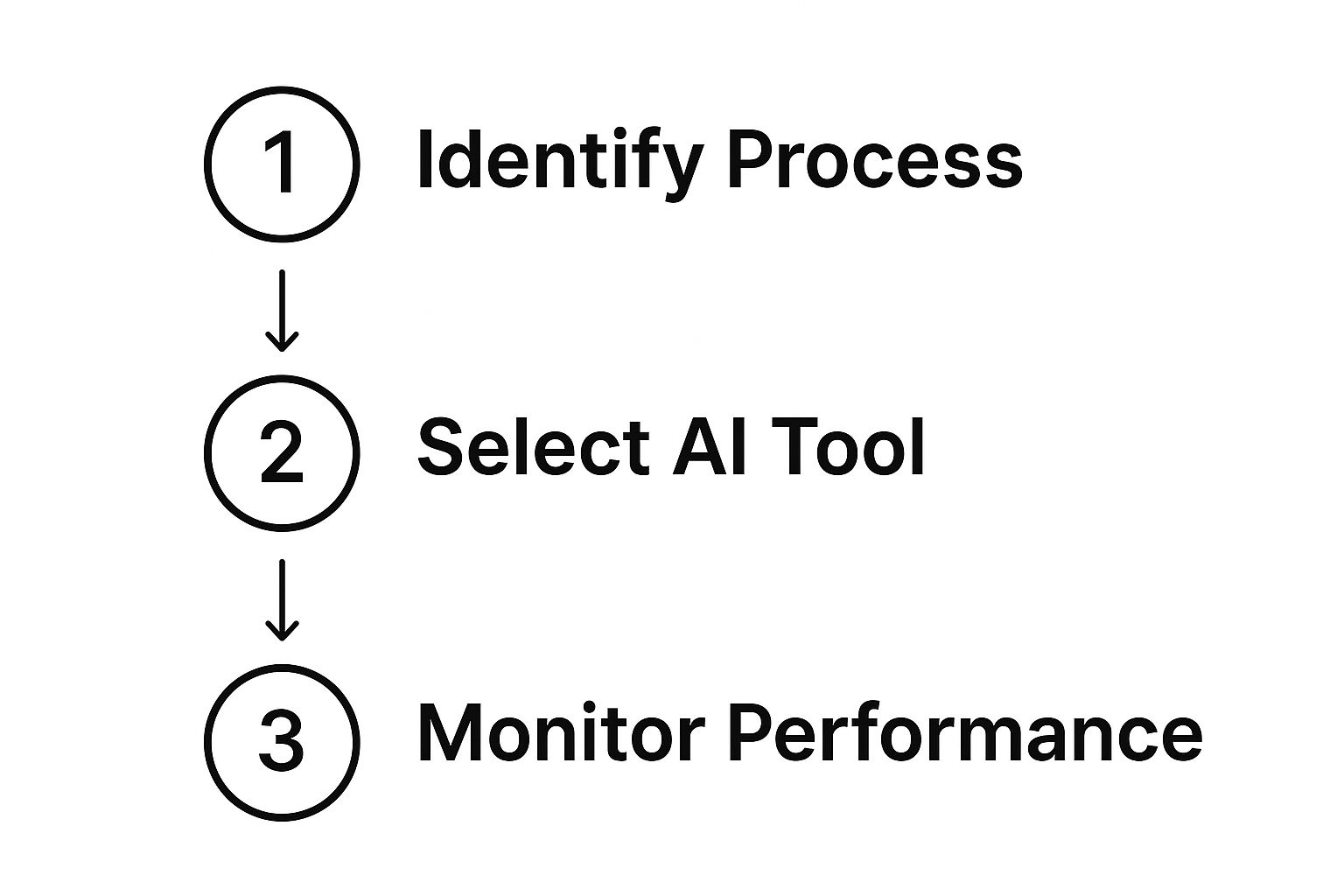
As you can see, a successful rollout is a cycle. You implement, you measure, you refine. And then you do it again.
Frame AI as a Helpful Co-Worker
One of the biggest obstacles you'll face isn't technical—it's human. People are naturally skeptical of change, especially when the word "AI" is involved. The key to getting your team on board is how you frame it. This isn't a replacement; it's an assistant.
Expert Opinion: "The most successful AI rollouts I've seen are the ones that focus on the 'human' side of the equation," notes HR strategist Ben Carter. "When you show your team how a tool can eliminate their most boring tasks, they don't see a threat—they see a solution."
Show your team exactly how this new tool will take the tedious, repetitive work off their plates. For example: "Hey team, this new AI tool will handle writing the first draft of our weekly report, so you can spend your time on the analysis and strategy part." That's what gets people excited. When they see that the goal is to free them up for more interesting, strategic work, they'll be far more willing to give it a try.
Measuring the Real-World Impact of AI on Your Business

Okay, you've pulled the trigger and rolled out your first AI tool. That’s a fantastic first step, but the real work is just beginning. Now comes the question that’s on everyone’s mind, from your team members to your CFO: "Was it actually worth it?"
To truly know if you're using AI effectively, you have to prove its value. We're not talking about fuzzy feelings or vanity metrics. We need to see tangible, real-world outcomes that connect directly to your bottom line—whether that’s in dollars and cents or just precious hours saved. This is how you justify the expense and build a solid case for doing even more with AI down the road.
Looking Beyond the Price Tag
Calculating the return on your AI investment is about more than just looking at the monthly subscription fee. A complete picture includes both the direct cost savings and the new revenue you're generating because of the tool.
It helps to think about it in two simple buckets:
-
Money Saved: This is usually the easiest part to track. Think about the direct costs you've eliminated. Maybe you've cut your freelance copywriting budget in half or significantly reduced overtime hours previously spent on mind-numbing data entry. These are your hard, quantifiable savings.
-
Money Gained: This side of the equation is all about growth. Did those AI-powered email campaigns actually drive more sales? Is your new AI sales assistant qualifying leads so well that your conversion rate jumped? This is new revenue you can pin directly on your AI strategy.
Of course, not every industry is moving at the same speed. Research shows that by August 2025, about one in four businesses in the Information sector were already using AI. That's a rate nearly ten times higher than in fields like Accommodation and Food Services, showing just how much a company's existing digital setup can influence adoption. You can dive deeper into these AI adoption trends from Anthropic's research to see where your industry stands.
A Practical Checklist for Tracking AI Performance
The best way to make this concrete is to track specific metrics from before you introduced the tool and compare them to the numbers after. This before-and-after snapshot is your proof.
Here’s a straightforward checklist to get you started, broken down by common business functions:
| Business Area | Key Metric to Track | Practical Example |
|---|---|---|
| Marketing | Time Spent on Content Creation | Your team used to spend 10 hours a week on social media posts. With an AI writer, they now spend 3. That’s a 7-hour weekly savings. |
| Customer Support | Average Response Time | An AI chatbot slashed your average first-response time from 8 hours to under 2 minutes, leading to happier, more loyal customers. |
| Sales | Lead Qualification Rate | An AI lead-scoring tool helps your sales reps focus only on the best prospects, boosting their conversion rate by 15%. |
A Quick Tip: Don't forget the "soft" metrics. Is your team happier? Less burned out? Freeing your best people from tedious, repetitive tasks is a massive win for morale and retention, even if it's harder to put a number on.
By focusing on these clear, measurable outcomes, you can shift the conversation from, "We bought a new tool," to, "This tool saves us 20 hours a month and grew our qualified leads." That's the language that proves AI is having a real impact on your business.
Answering Your Top Questions About Business AI
Dipping your toes into AI can feel like stepping into a whole new world. It’s a massive topic, and it's perfectly normal to have a few questions (or a lot!) before you jump in. Let's tackle some of the most common concerns we hear from business owners, so you can move forward with clarity and confidence.
Do I Need to Be a Tech Whiz to Use These Tools?
Absolutely not. This is probably the single biggest myth that keeps people from getting started. The best AI tools today aren't built for coders; they're designed for the rest of us—the marketers, the founders, the operators. Most of them have clean, simple interfaces that feel a lot like the apps you already use daily.
Imagine an AI writing assistant that works just like Google Docs, or an AI scheduler that integrates seamlessly with your calendar. You just need to understand your business problem. You don't need to write a single line of code to solve it. The easiest way to get comfortable is to just pick one user-friendly tool and give it a try.
Expert Opinion: "The real skill here isn't technical, it's strategic," says a startup mentor. "It's about knowing what problem you need to solve and finding the right tool for the job. The technology is just how you get there."
Isn't AI Super Expensive for a Small Business?
That’s another common misconception, but the truth is, AI is more accessible than ever. Sure, a massive, custom-built AI system for a Fortune 500 company costs a fortune. But there are thousands of powerful, off-the-shelf AI tools available for a simple monthly subscription, many starting under $30 per month.
The trick is to stop thinking of it as an expense and start seeing it as an investment. These tools are built to handle tasks that would otherwise eat up your time or require you to hire someone.
- Put a price on your time. What’s an hour of your day worth? If a $30 tool saves you 10 hours a month, it's already paid for itself many times over.
- Look at the results. If an AI-powered email marketing tool bumps your sales by even a small percentage, you've got an immediate return on that investment.
When you pick a tool that solves a genuine business pain point—whether that's lost time or missed sales—the subscription fee quickly looks like a bargain.
Is AI Going to Replace My Employees?
Think of AI less as a replacement and more as a powerful new hire—an assistant that supercharges your existing team. The point isn't to downsize; it's to make everyone more effective. AI is brilliant at the grunt work: the repetitive, data-crunching, mind-numbing tasks that slow your team down.
This frees up your people to double down on the things only humans can do well:
- Strategic planning and creative thinking
- Solving complex, nuanced problems
- Building real relationships with customers
A great example is using AI to sift through thousands of customer data points to find the hottest leads. Your sales team can stop digging and start talking to people who are ready to buy. AI lets your team focus on more valuable, more fulfilling work, which is a win for morale and your bottom line.
Ready to discover how AI can transform your operations? YourAI2Day provides the latest news, tool reviews, and practical guides to help you make smart decisions. Explore our resources and start your AI journey at https://www.yourai2day.com.