Machine Learning Business Applications That Drive Growth
When we talk about machine learning in business, it's really about using your data to make smarter, faster, and more profitable decisions. Forget programming a computer with a rigid set of rules. Instead, you're teaching it to find patterns in past data. It’s a lot like how your email provider automatically learns to spot and filter out spam—no one had to tell it "this specific email is spam," it just learned the patterns.
What Exactly Are Machine Learning Business Applications?

Let's cut through the jargon. At its heart, machine learning (ML) is a method that lets computers learn from experience and get better over time without someone having to constantly reprogram them. Think of it as a brilliant assistant who can analyze mountains of information, uncover hidden connections, and make surprisingly accurate predictions about what's next.
This is a game-changer. It helps businesses move from a reactive stance ("What happened last quarter?") to a proactive one ("What are our customers most likely to buy next month?"). This is the technology powering the smart features we now take for granted, like your personalized Netflix recommendations or the fraud alerts you get from your bank.
From Tech Giants to Your Business
For a long time, this kind of power felt out of reach for anyone but the biggest tech companies with bottomless budgets. Not anymore. With the growth of user-friendly tools and cloud computing, powerful machine learning business applications are now accessible to companies of all sizes.
The key isn't just about grabbing the newest shiny tech; it's about solving real-world business problems. Whether you're trying to fine-tune your supply chain, craft a truly personal marketing campaign, or predict when a critical piece of equipment might fail, ML gives you the tools to turn your data into a genuine competitive edge.
And this shift is happening fast. Projections show that by 2025, about 50% of companies globally will have woven ML into at least one aspect of their operations. A huge reason for this is the need to make sense of massive data volumes—a challenge that around 48% of organizations are already tackling with machine learning.
Getting a handle on the basics is the first step toward unlocking this potential. For a wider view of the field, you can go deeper into understanding AI technology in our detailed guide. In the end, it’s all about turning raw information into intelligent, decisive action.
How ML Is Reinventing Everyday Business Operations
This is where the rubber meets the road—where the theory of machine learning gets put to work solving real business problems. Let's move past the abstract ideas and look at how different departments are actually using machine learning business applications to work smarter. This isn't some far-off future; it's happening right now in ways you might not even notice.
Think about a marketing team that can craft campaigns so personalized they feel like a one-on-one conversation. Or imagine a factory floor where equipment flags a potential failure weeks in advance, preventing a costly shutdown. This is the new reality that machine learning is creating.
A Glimpse into the Modern, Data-Driven Business
To make this happen, companies are wrangling more data from more sources than ever before. This image gives you a sense of the complex data environment that fuels today’s machine learning initiatives.
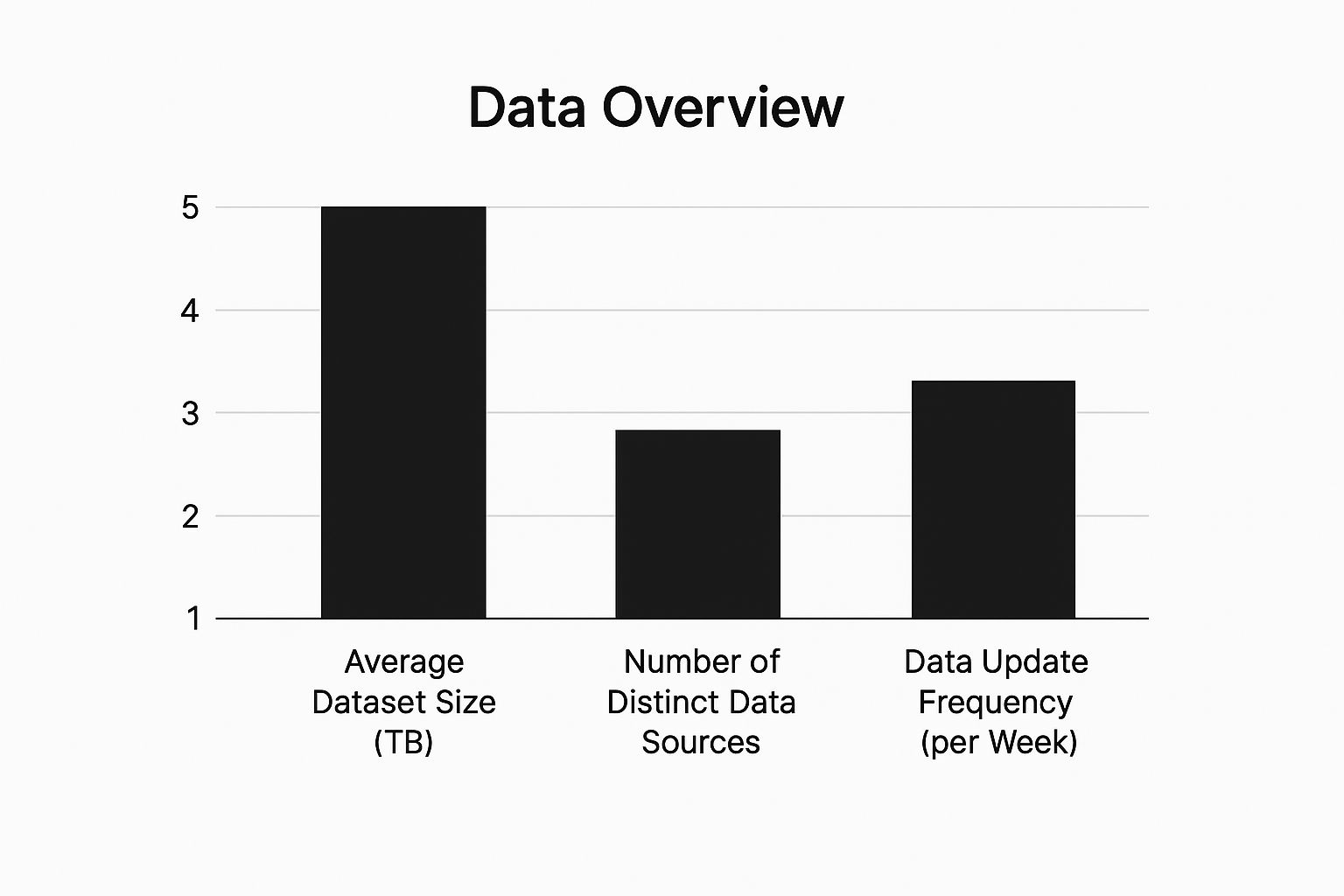
As you can see, it’s not just about having huge datasets. The real value comes from integrating information from many different places, with data that’s constantly being updated. This rich, dynamic foundation is what allows ML models to learn and adapt effectively.
From the Back Office to the Front Lines
So, how is this actually playing out? From finance to HR, machine learning is becoming a go-to tool for making processes better, faster, and more intelligent.
In finance, for instance, algorithms can sift through thousands of transactions a second to spot fraud with pinpoint accuracy, protecting both the company and its customers. Over in supply chain management, ML models forecast demand with a level of precision we could only dream of a decade ago. This helps companies avoid running out of hot-selling items or getting stuck with warehouses full of products nobody wants. It’s all about making smarter, data-backed decisions at every step.
The trend is undeniable. A 2024 global survey revealed that 78% of organizations are now using AI in at least one business function, a massive jump from just 55% the year before. On average, companies are deploying AI across three different departments, which shows this is no longer a niche experiment. You can dig into more of these findings in McKinsey's state of AI report.
To give you a clearer picture, here is a breakdown of how machine learning is being applied across the business.
ML Applications Across Business Departments
This table summarizes some of the most common and impactful machine learning use cases you'll find in a typical company today.
| Business Function | ML Application Example | Primary Benefit |
|---|---|---|
| Marketing & Sales | Personalized product recommendations | Increased customer engagement and sales |
| Operations & Supply Chain | Predictive maintenance for machinery | Reduced downtime and maintenance costs |
| Finance & Accounting | Algorithmic fraud detection | Minimized financial loss and improved security |
| Human Resources | Automated resume screening and analysis | Faster, less-biased hiring processes |
| Customer Service | Intelligent chatbot for instant support | Improved customer satisfaction and efficiency |
These examples are just the tip of the iceberg. Each application is designed to solve a specific, tangible problem, freeing up human teams to focus on more creative and strategic work.
Real-World Examples by Department
Let’s dig a little deeper into how specific teams are putting these tools to use. The common thread is always about automating tedious work, uncovering insights hidden in data, or getting a better sense of what’s coming next.
A few practical examples include:
- Marketing and Sales: A classic example is the "Customers who bought this also bought…" feature on e-commerce sites. ML algorithms analyze purchase data from millions of users to find these connections, driving extra sales without any manual effort.
- Operations and Manufacturing: Predictive maintenance is a game-changer here. A manufacturing plant might put sensors on a critical machine. The ML model learns the normal patterns of vibration and temperature. If it detects a tiny, abnormal change, it can alert the maintenance team to a potential failure weeks before it happens, preventing a costly shutdown.
- Finance and Accounting: Beyond just spotting fraud, machine learning automates the mind-numbing work of processing invoices and approving expense reports. It’s also used for algorithmic trading and for credit scoring, assessing risk far more quickly and consistently than a human ever could.
- Human Resources: Instead of manually sifting through hundreds of resumes, HR teams can use ML tools to surface the most qualified candidates for a role. This not only saves a huge amount of time but can also help reduce unconscious bias in the hiring process.
Expert Opinion: "The most successful machine learning implementations don't start with the technology; they start with a well-defined business problem. Instead of asking 'How can we use AI?', the best leaders ask, 'What is our biggest operational bottleneck, and can data help us solve it?'"
Many of these applications lean on automating structured, repeatable tasks. If you're interested in that side of things, our guide on what is robotic process automation is a great next step. By thoughtfully integrating these smart technologies, every part of a business can become more efficient and forward-thinking.
Using Machine Learning to Elevate Customer Experiences

At the core of any great business, you'll find happy customers. Machine learning is handing companies incredible tools to design hyper-personalized experiences that do more than just satisfy people—they build real, lasting loyalty. It's a fundamental shift away from a one-size-fits-all mindset and toward making every single customer feel seen and understood.
One of the most obvious machine learning business applications is the intelligent chatbot. Forget the clunky, frustrating bots of a few years ago. Today's chatbots offer instant, 24/7 support for common queries, which frees up human agents to handle the more complex and emotionally nuanced problems where their skills are truly needed.
This mix of automated efficiency and human expertise is changing the game for customer service. A recent report revealed that 81% of consumers now consider AI a standard part of modern customer interactions. Even more, generative AI chatbots have been shown to reduce human contact volumes by up to 50%, making support teams far more responsive. You can see more data on this in McKinsey's research on AI's impact.
Understanding Customers at Scale
Beyond just answering questions, machine learning helps companies actually listen to what their customers are saying all over the web. This is where a cool technology called sentiment analysis comes into play.
Imagine being able to tap into thousands of conversations happening right now on social media, review sites, and online forums. Sentiment analysis tools are designed to do just that, sifting through mountains of text to figure out the general feeling—positive, negative, or neutral—people have about your brand, products, or services.
This gives you a real-time pulse on public perception. If a new product feature is driving users crazy, you'll know about it almost immediately, letting you fix the issue before it spirals. It’s like having a superpower to stay ahead of customer needs and proactively manage your reputation. To learn more about putting these insights to work, have a look at our guide on how to use AI for marketing.
"The goal of machine learning in customer experience isn't to replace the human touch; it's to augment it. We use it to handle the routine tasks so our team can focus on creating memorable, empathetic interactions that technology alone can't replicate."
– Customer Experience Strategist
Practical Examples of ML in Customer Experience
So, what does all this look like in the real world? Here are a few ways companies are already improving the customer journey:
- Personalized Recommendations: A streaming service like Spotify doesn't just suggest random songs. Its ML algorithm analyzes everything from the songs you listen to, the ones you skip, and even the time of day you listen to create playlists like "Discover Weekly" that feel like they were made just for you.
- Proactive Support: A telecom company's ML model might spot a network issue in a specific neighborhood and automatically text affected customers before they even notice their internet is down.
- Customized User Interfaces: Some apps and websites use machine learning to dynamically change their layout or content based on your behavior, making the experience feel more intuitive and built just for you.
When you put them all together, these applications create a smoother, more personal, and responsive experience that makes customers feel valued at every turn.
The Global Race for Machine Learning Adoption
Taking a step back from individual departments, you can see that machine learning isn't just a niche trend—it’s a global movement that's redrawing the entire competitive map. This isn't just a game for Silicon Valley titans anymore. It’s become an essential play for companies all over the world that want to stay relevant and grow.
The drive to weave machine learning business applications into company DNA is unfolding at different paces everywhere. Each continent brings its own economic pressures, regulatory quirks, and strategic goals to the table, creating a truly dynamic global race.
Getting a handle on this international picture is critical. It shows that developing ML capabilities has moved from the "nice-to-have" list to the "must-have" list for any business with ambitions of competing on a global scale.
A Look at Regional Adoption Trends
Different corners of the globe are using machine learning to tackle very different problems, shaped by their unique industrial and tech landscapes. The adoption numbers themselves tell a fascinating story about where the action is.
North America, for instance, has a massive head start. With an ML adoption rate of a staggering 85%, the region commands a 44% market share in the AI and ML space, a testament to its deeply-rooted tech ecosystem.
But Europe is hot on its heels. Around 72% of European businesses are already on board, often buoyed by regulations that promote open data, which helps them secure a 44.9% piece of the market. And don't count out the Asia-Pacific region; its rapid digitization has led to a 79% ML adoption rate. For a deeper dive, check out this breakdown of machine learning statistics.
Expert Opinion: "The global adoption of ML is less about a single finish line and more about different races being run simultaneously. North America excels at commercializing AI, Europe is pioneering regulatory and ethical frameworks, and Asia is leapfrogging in mobile-first and manufacturing applications."
Why This Global View Matters for Your Business
Watching how different regions put machine learning to work is like getting a strategic playbook. It shines a light on what’s already working and uncovers new opportunities, helping you make smarter calls on your own path forward.
A few key things to pull from the global picture:
- Competitive Pressure: It's a safe bet your competitors, whether next door or across an ocean, are using ML to get faster, smarter, and more innovative.
- Access to Talent: The worldwide demand for ML skills has created a global talent pool. This opens up huge opportunities for finding the right expertise, no matter where you're based.
- Regulatory Awareness: If you do business internationally, you have to stay on top of global data privacy and AI regulations. It’s not optional.
At the end of the day, the global race for machine learning isn't just about who crosses the finish line first. It's about how businesses everywhere are figuring out how to turn data into real value, making it a truly universal strategy for success.
How to Get Started with ML in Your Business