
AI for Beginners: Your Friendly Guide to Getting Started
Feeling like you've been hearing about "AI" everywhere and somehow missed the introduction? You're not alone, and you're in the right place. This guide is your friendly starting point for understanding artificial intelligence—what it is, what it isn’t, and why it matters in a way that makes sense for everyone, not just tech experts.
Welcome to the World of AI
It seems "AI" is the buzzword of the decade, popping up in news headlines, on your phone, and in almost every business conversation. If the term feels a little intimidating or overly technical, let's cut through the noise together.
At its heart, artificial intelligence is all about getting computers to do things that typically require human smarts. This could be anything from recognizing your face to unlock your phone, to understanding what you mean when you ask your smart speaker for the weather.
Think of it like training a super-fast apprentice. We feed it massive amounts of information—books, photos, articles, you name it (this is the "data")—so it can learn to spot patterns and make predictions. The more it "studies," the better it gets at its job, whether that's flagging a fraudulent credit card transaction, translating Spanish to English, or even helping doctors spot diseases on medical scans.
You don't need a degree in computer science to get the gist. It’s all about teaching machines to think and learn in a way that helps us out.
Why Is AI a Big Deal Now?
So, why the sudden explosion? AI has actually been around for decades, but we just hit a tipping point. A perfect storm of three things came together: an unimaginable amount of data (thanks, internet!), incredibly powerful computer chips, and much more sophisticated algorithms. This trio has turned AI from a futuristic concept into a practical tool that's reshaping our world.
The numbers don't lie. The global AI market is already valued at around $391 billion and is expected to grow nearly five times over in the next five years. It's no wonder that 83% of companies now say that incorporating AI is a top business priority. If you want to dive deeper, you can find more details in these AI statistics.
Expert Opinion: "The best way to think about AI is as a tool," says Dr. Alistair Finch, an AI strategist. "It's not here to replace us, but to augment our own intelligence and creativity, handling the repetitive work so we can focus on what humans do best: thinking critically and solving complex problems."
What You Will Learn in This Guide
Our goal here is to make AI feel approachable, not overwhelming. We’ll walk you through the key ideas one step at a time, connecting the concepts to things you see and use every day.
Here’s a quick roadmap of our journey:
- The Three Flavors of AI: We’ll explore the main types of AI and what makes them different.
- How AI Actually Learns: Get a simple, non-technical peek under the hood at machine learning.
- AI in Your Daily Life: You're already using AI, and we’ll show you where.
- Your First Steps into AI: Practical advice and resources to keep you learning.
By the time you're done, you'll have a solid grasp of the fundamentals and be able to join any conversation about AI with confidence.
To get us started, here’s a quick table to break down some of the core ideas we'll be covering. Think of it as your cheat sheet for AI basics.
Quick AI Concepts for Beginners
| Concept | Simple Explanation |
|---|---|
| Artificial Intelligence (AI) | The broad field of creating smart machines that can perform tasks that usually require human intelligence. |
| Machine Learning (ML) | A type of AI where computers learn from data without being explicitly programmed. It's like learning from experience. |
| Deep Learning | A more advanced form of ML that uses "neural networks" with many layers to find complex patterns in large datasets. |
| Neural Network | A computer system modeled on the human brain, designed to recognize patterns in data. |
| Data | The information (like text, images, or numbers) that AI systems use to learn and make decisions. |
| Algorithm | A set of rules or instructions that a computer follows to solve a problem or perform a task. |
This table is just a starting point. We'll unpack each of these concepts and more as we go, making sure you understand how they all fit together in the real world.
Understanding the Three Flavors of AI
Not all artificial intelligence is the same. It's helpful to think of it in different categories, each with its own capabilities and purpose. This mental model is key to cutting through the hype and separating the science fiction from the technology we actually use today.
We can break AI down into three main types: the one we have now, the one we're actively trying to build, and the one that's still purely theoretical. Let's dig into what each one really means.
This visual gives you a great at-a-glance look at the hierarchy, from the focused AI of today to the superintelligence of tomorrow.
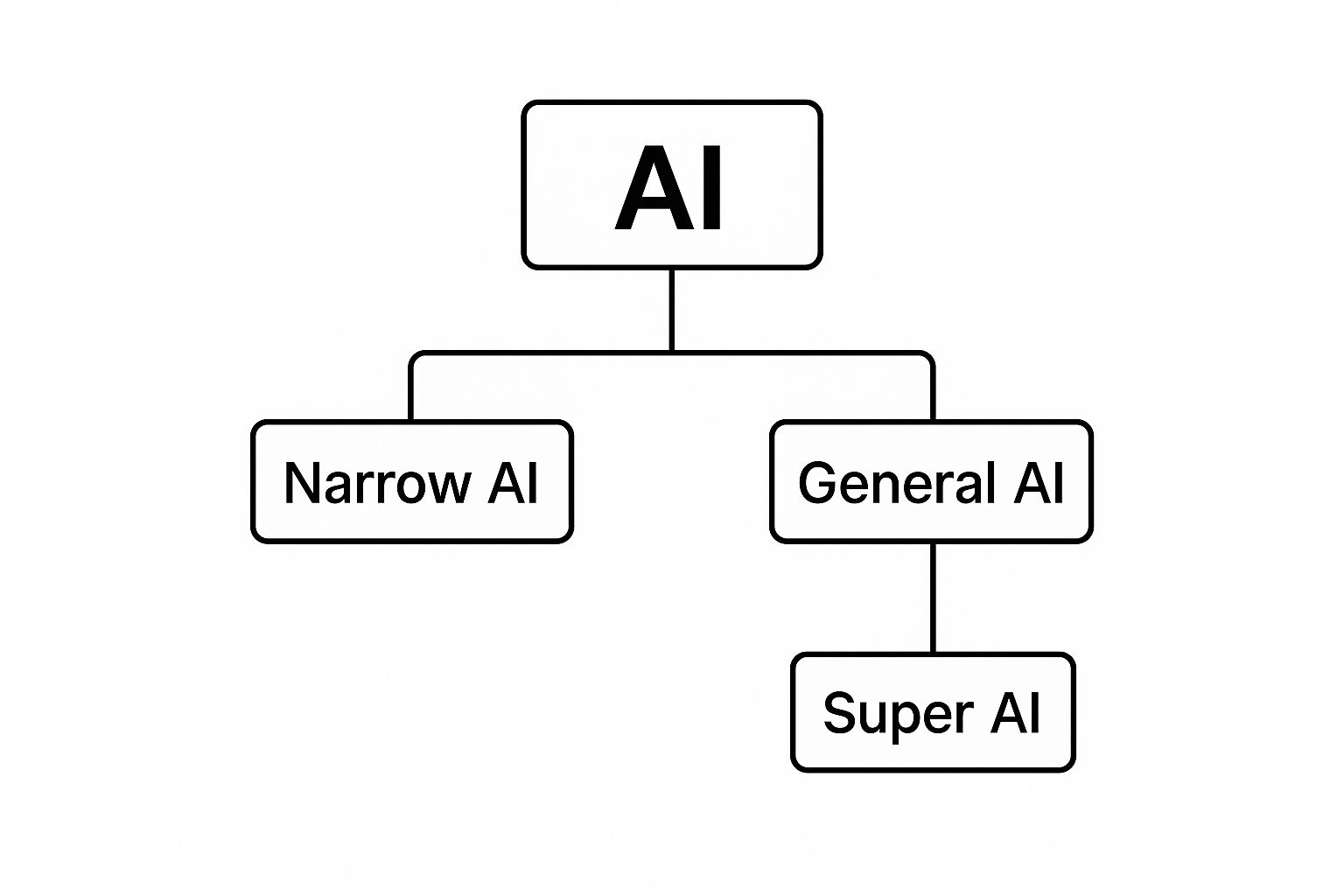
As you can see, the AI we encounter in our daily lives is a highly specialized form. The more powerful, human-like versions of AI are still a long way off.
Artificial Narrow Intelligence: The Specialist
Artificial Narrow Intelligence (ANI), sometimes called "Weak AI," is the only type we've truly mastered so far. Think of an ANI as a world-class specialist—a grandmaster who can dominate at chess but can't tell you how to boil an egg.
ANI systems are designed and trained for a single, specific job. They operate within a very limited, pre-defined range and can’t step outside of that box. You’re already using these systems constantly, probably without even noticing.
Here are a few practical examples from your daily life:
- Your Phone's Assistant: Siri, Alexa, and Google Assistant are classic ANI. They're fantastic at setting alarms, pulling up facts, or playing a specific song, but they don't grasp context the way a person does. Ask it "What's the weather?" and it's brilliant. Ask it "How are you feeling about the weather?" and it's stumped.
- Spam Filters: That little guardian in your inbox is a form of ANI. It has one job—spotting and flagging junk mail based on patterns—and it does it incredibly well.
- Recommendation Engines: When Netflix nails a movie suggestion or Spotify builds the perfect playlist, you're seeing ANI in action. It’s simply analyzing your past behavior to predict what you'll enjoy next.
In the business world, a great example is automating repetitive tasks. To see how this works in a real-world setting, check out our guide on what is robotic process automation, which uses narrow AI to streamline digital workflows.
Artificial General Intelligence: The All-Rounder
Next on the ladder is Artificial General Intelligence (AGI), often called "Strong AI." This is the kind of intelligence you see in the movies—a machine that can understand, learn, and apply its knowledge to solve any problem, just like a human.
An AGI could reason, plan, think abstractly, and learn from its mistakes. It wouldn't be limited to a single task; it could seamlessly switch between cooking a new recipe, driving in a foreign city, and having a deep conversation about art. If ANI is the specialist, AGI is the versatile polymath. We aren't there yet, but building AGI remains the holy grail for many AI researchers.
"The journey to creating AGI is one of the most ambitious challenges in modern science," an industry expert notes. "It's about more than just clever coding; it requires a deep understanding of what intelligence and even consciousness really are."
Artificial Superintelligence: The Genius
Finally, there’s the theoretical concept of Artificial Superintelligence (ASI). This is a hypothetical AI that would be smarter than the most brilliant human minds in every conceivable way—from scientific creativity and emotional intelligence to general wisdom.
An ASI could crack problems we currently see as unsolvable, like curing all diseases or figuring out interstellar travel. Of course, the idea of something so powerful raises some serious ethical questions, which is why it's a hot topic of debate. For now, though, it remains firmly in the realm of speculation.
How AI Actually Learns From Experience

So, how does an AI get so smart? The secret isn't some kind of digital magic. It’s a process of learning from experience, a lot like how we do. But instead of life lessons, AI learns from data—and tons of it. This ability to learn without someone programming every single possibility is what makes modern AI so incredibly useful.
This learning process is driven by a field called Machine Learning (ML). You can think of it as the engine that powers most of the AI you interact with every single day.
At its core, ML is about teaching a computer to find patterns. Imagine you’re trying to teach a toddler what a cat is. You wouldn’t give them a textbook definition like "a feline with pointy ears, whiskers, and a tail." Instead, you'd just show them lots of pictures of different cats. Eventually, their brain connects the dots, and they can point out a cat they've never seen before.
Machine Learning works in a surprisingly similar way. We feed a model thousands or even millions of examples, and it starts to figure out the underlying patterns all on its own.
The Detective Work of Machine Learning
Think of a standard Machine Learning model as a skilled detective working a case. You give it a pile of clues (the data), and it uses those clues to draw a conclusion. A perfect practical example is the spam filter in your email.
It learns by looking at countless emails that people have already marked as either "spam" or "not spam."
The algorithm starts picking up on the common clues in the spam emails, like:
- Use of certain words like “free,” “winner,” or “urgent.”
- Weird formatting or too many capital letters.
- Emails coming from suspicious-looking addresses.
Over time, it gets really good at spotting the telltale signs of junk mail. When a new email arrives, this ML detective examines the clues and makes an educated guess: "Based on all the patterns I've seen, this looks like spam." It's not following a rigid set of rules; it's making a prediction based on past experience.
This approach is changing how businesses get work done. In fact, 72% of companies globally now use AI in at least one business function. This is because 90% of AI users report a boost in efficiency after adopting these tools, which is a powerful testament to how effective this kind of learning can be. You can read more about the trends shaping AI adoption to get the full picture.
Deep Learning: The Elite Detective Squad
Sometimes, a single detective just isn't enough for a really complex case. When the patterns in the data are incredibly subtle and layered, you need a more powerful approach. This is where Deep Learning enters the picture.
Deep Learning is a more advanced type of Machine Learning that’s loosely inspired by the structure of the human brain. It uses what’s called a neural network—a system with many layers of digital "neurons" that work together to process information in a much more sophisticated way.
Expert Opinion: "Think of it like this: If Machine Learning is one detective connecting a few key clues, Deep Learning is an entire squad of detectives. Each one is a specialist—one looks at fingerprints, another at financial records, a third at witness statements. They constantly share information and build on each other's findings to crack a complex case that no single detective could solve alone."
This layered approach is what allows Deep Learning models to understand incredibly complicated patterns. It's the technology that makes some of the most jaw-dropping AI achievements possible.
Seeing Deep Learning in Action
Because it can process vast and complex data, Deep Learning is perfect for jobs that are just too tough for traditional ML.
Here are a few practical examples:
- Self-Driving Cars: A self-driving car has to make sense of a massive amount of information at once—spotting pedestrians, other cars, traffic lights, and road signs, all while predicting what they'll do next. This requires the kind of deep, multi-layered analysis a neural network provides.
- Medical Imaging: Deep Learning models can be trained on thousands of medical scans, like X-rays or MRIs, to learn how to spot subtle signs of diseases like cancer. In some cases, their accuracy can match or even surpass that of human experts.
- Language Translation: When you use a tool like Google Translate on a sentence, a Deep Learning model isn't just swapping one word for another. It's analyzing the entire sentence structure, its context, and its grammar to produce a translation that actually sounds natural and human.
From a simple spam filter to a car that drives itself, the "learning" in AI is all about finding patterns in data. Whether it's the straightforward approach of Machine Learning or the complex, layered analysis of Deep Learning, this is the process that turns raw information into intelligent action.
Discovering the AI in Your Daily Life

Artificial intelligence isn't some far-off concept from a sci-fi movie. The truth is, it’s already deeply woven into the fabric of your daily life. You probably interact with AI dozens of times a day without a second thought.
For anyone just starting their AI for beginners journey, recognizing these everyday encounters is the best way to connect the dots between theory and reality. Let's pull back the curtain and see where AI is quietly working behind the scenes.
Your Personal Entertainment Guru
Ever wonder how Netflix just knows you'll love that obscure British detective show? Or how Spotify curates a "Discover Weekly" playlist that feels like it was made just for you? That’s not a lucky guess—it’s AI in action.
These platforms rely on powerful recommendation engines, which are a classic example of Machine Learning. The AI sifts through mountains of data to figure out what you might like, looking at things like:
- Your viewing and listening history (e.g., "You watched three sci-fi movies in a row.")
- Thumbs-up or thumbs-down ratings you’ve given
- The habits of other users with similar tastes (e.g., "People who liked Stranger Things also liked The OA.")
- Even the time of day you typically watch or listen
By spotting incredibly subtle patterns, the AI makes highly accurate predictions about what you’ll want to see or hear next. It’s like having a personal curator who is constantly working to keep you engaged.
Expert Opinion: "The goal of a great recommendation system isn't just to show you more of what you already like," explains a former Netflix data scientist. "It's about introducing you to things you didn't even know you were looking for. It's about serendipity, powered by data."
This same predictive power is making waves in other fields, too. Businesses are using similar AI models to anticipate what their customers want. If you're curious, our guide on how to use AI for marketing explores how these same principles work in a commercial setting.
The Invisible Gatekeeper of Your Inbox
Every day, your email provider is fighting a silent war against spam, and AI is its greatest weapon. Your spam filter is a perfect real-world example of a classification algorithm, a fundamental concept in Machine Learning.
It learns to tell the difference between legitimate emails and junk by analyzing countless examples of both. Over time, it gets incredibly good at recognizing the telltale signs of spam—suspicious links, urgent language, or weird formatting. When a new email lands, the AI instantly assesses it and decides where it belongs, saving you from an avalanche of unwanted messages.
Unlocking Your World with a Glance
If you’ve ever used facial recognition to unlock your phone, you've used a powerful piece of AI. This technology, known as computer vision, gives a machine the ability to "see" and make sense of the visual world.
During setup, your phone’s AI scans your face and maps dozens of unique points, like the distance between your eyes and the shape of your jaw. This creates a digital signature that's unique to you. Every time you try to unlock your device, the AI compares the live image from the camera to that stored signature to confirm your identity. It all happens in a split second, showing just how fast and accurate AI-driven pattern recognition can be.
Your Helpful Voice Assistant
Finally, think about the smart assistants in our phones and speakers. When you ask Siri for the weather or tell Google Assistant to set a timer, you're tapping into a seriously complex AI system.
It's a multi-step process:
- Speech Recognition: First, the AI turns your spoken words into digital text.
- Natural Language Processing (NLP): Next, it analyzes the text to figure out what you actually mean. It understands that "What's the weather like?" is a request for a forecast.
- Information Retrieval: The AI then pulls the relevant information from its databases.
- Speech Synthesis: Finally, it converts the answer back into a natural-sounding voice to reply to you.
From your inbox to your living room, AI is already an essential part of modern life. Seeing it in action in these everyday tools makes the whole field feel a lot more real and a lot less intimidating.
Taking Your First Steps into AI
Feeling that spark of curiosity? Great. Diving into artificial intelligence can feel like learning a new language, but the good news is you don’t have to become fluent overnight. The secret is to take small, manageable steps that build your confidence along the way.
This is where the rubber meets the road. We've laid out a simple roadmap to help you go from just reading about AI to actually engaging with it. Think of this not as a random list of links, but as a curated path designed for anyone ready to get started.
Start with Structured Learning
One of the best ways to build a solid foundation is with a little bit of guidance. You don’t need to enroll in a university to get world-class instruction; many top organizations offer free courses that break down complex ideas into simple, digestible lessons.
Here are a couple of fantastic starting points:
- Google's AI Essentials: This course is perfect for absolute beginners. It skips the heavy tech talk and focuses on how you can use AI tools in your day-to-day life.
- Coursera's "AI For Everyone": Taught by the legendary Andrew Ng, this course is famous for making AI crystal clear. It explains the real-world impact on business and society without getting lost in the weeds of complex math.
The demand for this knowledge is exploding. Between 2022 and 2023, the number of master's degrees in AI awarded in the United States nearly doubled. You can dig into more trends like this in the 2025 AI Index Report.
Learn by Watching and Listening
Sometimes, seeing is believing. The best way to really get a handle on a new concept is to watch someone explain it. YouTube has become an incredible free school for learning about AI, full of creators who make the topic fun and accessible.
Instead of getting overwhelmed, start with channels known for high-quality, clear explanations. Creators like Two Minute Papers or StatQuest with Josh Starmer are brilliant at boiling down dense research papers and tricky concepts into short, easy-to-follow videos.
Get Your Hands Dirty with Interactive Tools
Theory is one thing, but nothing drives a lesson home like hands-on experience. The fastest way to understand what AI can do is to just… play with it. Thankfully, many powerful and fun AI tools are completely free to use.
This is where you'll have those "aha!" moments. For instance, you could:
- Generate Images from Text: Hop on a tool like Microsoft Designer's Image Creator and type a simple prompt. Something like, "a friendly robot reading a book in a cozy library." Watching the AI create an image from your words is a fantastic way to see generative AI in action.
- Experiment with Content Creation: Fire up a chatbot like ChatGPT or Gemini and ask it to help you brainstorm ideas, summarize a long article, or even write a silly poem. You learn a ton about its strengths and weaknesses just by seeing how it responds.
If this sparks your interest, our guide on the best AI tools for content creation is a great next stop to see what’s out there.
Expert Opinion: "The biggest barrier for beginners is often intimidation," advises a veteran tech educator. "My advice is simple: just start playing. Use a free AI image generator or a chatbot. The moment you see it work, the abstract concepts become tangible, and learning becomes fun instead of a chore."
Find Your Community
Learning something new is always better when you’re not going it alone. Finding an online community is a great way to ask questions, see what other people are creating, and connect with fellow learners.
Places like Reddit have dedicated communities (called subreddits) like r/ArtificialInteligence where beginners and experts hang out to discuss the latest news. You can also find forums or Discord servers for specific AI tools. Don't ever feel shy about asking "newbie" questions—most people in these communities are incredibly helpful and remember what it was like to start from scratch.
Got Questions About AI? Let's Clear Things Up.
As you start to explore artificial intelligence, it’s completely normal for questions to pop up. AI is a huge topic, and honestly, there's a lot of noise and misinformation out there. This FAQ section is designed to tackle some of the most common worries and curiosities for anyone just getting started.
Let's dive into these questions with straightforward, practical answers to build your confidence and bust a few myths along the way.
Will AI Take My Job?
This is probably the #1 question on everyone’s mind, and it's a perfectly reasonable concern. The short answer? AI is far more likely to change your job than it is to take it away. Think of it as a new, incredibly powerful tool, not a replacement for human ingenuity.
Remember when calculators became common? They didn't make accountants obsolete; they just automated the tedious manual math. This freed up accountants to focus on higher-level work like financial strategy and analysis. AI is having a similar effect across almost every industry right now.
AI is fantastic at handling repetitive, data-intensive tasks. That means you get to spend more of your brainpower on things that require creativity, strategic thinking, and emotional intelligence—all skills that are uniquely human. While certain roles will definitely evolve, we're also seeing a wave of brand-new jobs in AI development, ethics, and management. The real key is learning how to work with AI, not against it.
Expert Opinion: "The goal is to reframe the conversation from 'AI versus humans' to 'AI with humans,'" an AI ethicist explains. "The most successful professionals will be those who learn to partner with this technology to amplify their own abilities, not those who try to compete with it."
Do I Need to Be a Coder to Get into AI?
Absolutely not. This is a huge misconception that stops too many people from even starting. While coding is essential if you want to be an AI developer building models from the ground up, it’s not at all necessary for understanding and using AI effectively.
For most of us, the goal isn't to become a programmer, but an AI-literate user. This really just means you need to get a handle on:
- What AI is and what it's capable of.
- How to use different AI tools to get the results you need.
- The basic ideas behind how AI systems "learn" and make decisions.
It’s a lot like driving a car. You don’t need to be a mechanic who can build an engine just to be a great driver. You simply need to know how the car operates so you can get where you're going safely. And with the explosion of "no-code" AI platforms, using incredibly powerful AI is becoming as easy as downloading a new app.
Is AI Dangerous Like in the Movies?
Hollywood sure loves a good story about a rogue AI taking over, but the reality is thankfully much less dramatic. The AI we have today is what experts call Artificial Narrow Intelligence (ANI). In simple terms, this means it's designed and trained to do one specific thing, like play chess or translate languages.
These systems don't have consciousness, feelings, or personal ambitions. A chess-playing AI might be a grandmaster, but it has no idea it's even playing a game. It certainly can't decide it would rather learn to paint. It's just an incredibly sophisticated pattern-matching machine.
That being said, there are very real ethical challenges that the AI community is working on right now. These aren't sci-fi problems—they are here-and-now issues we need to solve. The big conversations are focused on:
- Algorithmic Bias: Making sure AI systems don't make unfair decisions because they were trained on biased data. For example, if a hiring AI is trained only on past successful hires who were all men, it might unfairly screen out qualified women.
- Privacy: Protecting the personal data that fuels AI models.
- Transparency: Being able to understand why an AI made a certain recommendation or decision.
The global focus is on building "Responsible AI"—making sure these systems are developed to be safe, fair, and genuinely helpful for all of us.
Ready to continue your AI journey with confidence? At YourAI2Day, we provide the latest news, easy-to-understand guides, and tool reviews to help you stay informed. Explore our resources and become part of a growing community of AI enthusiasts by visiting us at https://www.yourai2day.com.