What Can Artificial Intelligence Do Today? A Friendly Guide for Beginners
You might be surprised to learn that you probably used artificial intelligence before you even finished your first cup of coffee this morning. No, really! AI isn't some far-off concept from the movies; it's already here, working quietly in the background to make your everyday apps and services smarter, faster, and more intuitive.
It's the invisible helper that suggests the perfect song for your commute, filters spam out of your inbox, and helps your navigation app find a quicker route around that unexpected traffic jam. Think of it less like a robot overlord and more like a super-smart assistant that's already part of your life.
How AI Is Already Part of Your Daily Life
Thinking of AI as a futuristic idea is a common misconception. In reality, it has become a practical tool that millions of us interact with daily, often without even realizing it. The technology has quietly woven itself into the fabric of our digital routines.
This isn't just a small trend, either. The adoption of AI is accelerating at a breathtaking pace. By 2025, an estimated 78% of companies are expected to have integrated AI into at least one part of their business. That's a huge leap from 55% just a year prior. And it’s not just businesses—the number of individual users has skyrocketed to 378 million people globally, a figure that's more than tripled in just five years. For more details on this incredible growth, you can explore these AI adoption statistics.
From Your Inbox to the Highway
So, where exactly is all this AI hiding? Its applications are incredibly diverse, covering everything from simple conveniences to complex problem-solving. It's not one single technology, but rather a whole family of tools designed to perform tasks that once required human intelligence—things like understanding language, spotting patterns, and making sound decisions.
Take a look at this snapshot to see how AI shows up in familiar places.
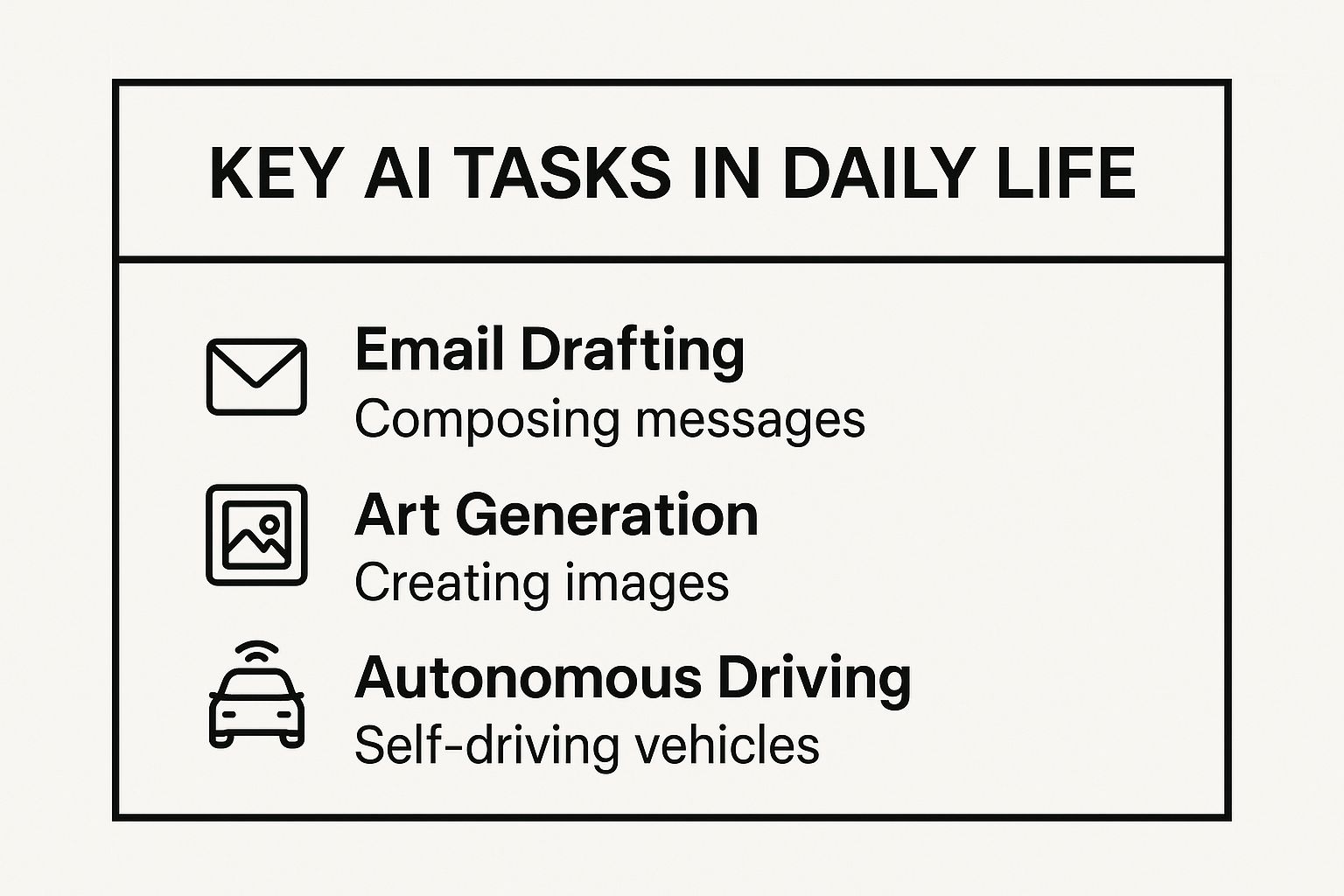
As you can see, AI isn't just for scientists in a lab. It’s a tool for getting more done, expressing your creativity, and simply getting from point A to point B more efficiently.
As tech analyst Sarah Evans puts it, "The real power of AI today is its accessibility. It has moved from research labs into the hands of millions, becoming a collaborator in both our professional and personal lives."
To get a clearer picture, let's break down a few common examples you're likely already using.
A Snapshot of AI in Your Day
This table gives a quick summary of common AI applications in everyday life, connecting the task you're doing with the technology that makes it possible.
| Everyday Task | How AI Makes It Happen | Practical Example |
|---|---|---|
| Getting Driving Directions | AI algorithms analyze real-time traffic data from thousands of other drivers to find the fastest, least congested route. | Google Maps or Waze updating your ETA automatically. |
| Streaming Music or Movies | Recommendation engines learn your preferences and suggest new content based on what you (and people with similar tastes) enjoy. | Spotify's Discover Weekly playlist or Netflix's "Top Picks for You." |
| Using a Voice Assistant | Natural Language Processing (NLP) helps the device understand your spoken commands and find the right information or perform an action. | Asking Siri or Alexa to set a timer while you're cooking. |
| Filtering Spam Emails | Machine learning models identify patterns associated with junk mail (like suspicious links or urgent language) to keep your inbox clean. | Gmail's spam filter automatically catching a phishing attempt. |
These examples just scratch the surface, but they perfectly illustrate how integrated AI has become. It's a fundamental part of the global digital toolkit we all use.
Unlocking Creativity with Generative AI
If you still think artificial intelligence is only good for spreadsheets and data analysis, you’re missing out on its incredibly creative side. The rise of generative AI has completely flipped the script, turning complex technology into a creative partner for just about anyone with an idea.
This isn’t your typical data-crunching AI. Instead of just analyzing existing information, it creates something that has never existed before. You can feed it a simple line of text and watch it produce a stunning image, compose a melody, write a poem, or even build a video clip right from scratch.
Turning Words into Worlds
One of the most mind-blowing things AI can do today is bring our thoughts to life visually. Let's say you need a cool image for a presentation but can't draw a stick figure. With a tool like Midjourney, you just type in a description—"a fluffy orange cat wearing sunglasses, sitting on a beach, cartoon style"—and you get back several unique, high-quality images in seconds. It's like having a personal artist on call 24/7.
And it’s not just for artists. Marketers are spinning up social media graphics on the fly. Writers are using assistants like ChatGPT to beat writer's block, brainstorm blog titles, or get a rough draft down on paper. Suddenly, the barrier to producing great content has all but disappeared. To see just how far this is going, take a look at the progress being made on video models like Sora and its next-generation capabilities.
The best part? These tools aren't just for pros. They're accessible to everyone. Here are just a few practical things you could do right now:
- Brainstorm Ideas: Ask an AI, "Give me 10 fun, cheap ideas for a family weekend activity."
- Design a Logo: Describe your new Etsy shop's vibe, and an image generator can spit out dozens of logo concepts to get you started.
- Write a Story: Give it a fun prompt like, "Write a short story about a detective who is also a penguin," and watch it go!
An Amplifier for Human Skill
Of course, the big question on everyone's mind is whether AI will make human creativity obsolete. But most professionals I talk to don't see it that way at all. They view it as a powerful extension of their own abilities, not a replacement. AI can handle the tedious, time-sucking parts of the creative process, freeing them up to focus on strategy and the big picture.
One digital artist put it perfectly: "AI doesn't replace my skills; it amplifies them. It’s like having an infinitely patient brainstorming partner that never runs out of ideas."
That quote really gets to the heart of what generative AI is today. It’s a tool. A powerful one, yes, but still just a tool. It helps us smash through creative blocks, experiment with new styles, and bring our ideas to life faster than ever before. For hobbyists, it’s a new playground for self-expression. For professionals, it's a way to refine their workflow and find a fresh spark of inspiration.
How AI Is Making Business Smarter

It’s official: AI is no longer a futuristic buzzword whispered in boardrooms. It's now a core part of the modern business toolkit. Companies have stopped asking "what if" and started figuring out how to use AI to work smarter, not just harder.
The speed at which AI is weaving itself into our daily work is astounding. In the United States, 40% of employees say they now use AI on the job—that figure has doubled from just 20% two years ago.
This isn't just a local trend. Advanced economies are jumping in headfirst. When you look at Singapore, its AI usage is 4.5 times higher than its workforce size would suggest, signaling a major global shift. You can dig deeper into this trend in this report on the state of consumer AI.
Boosting Efficiency and Customer Happiness
One of the most immediate benefits we see is AI's ability to take over repetitive, mind-numbing tasks. Think about the hours spent on manual data entry or sifting through a mountain of customer support emails. AI can now handle that grunt work, freeing up your team to focus on the creative problem-solving and strategic thinking that humans do best.
A very practical example is how AI-powered chatbots handle customer service. They can:
- Offer instant, 24/7 answers to common questions like "Where is my order?"
- Walk customers through basic troubleshooting, no human agent needed.
- Intelligently route more complex problems to the right person, so no one’s time is wasted.
The outcome? Customers get faster answers, and the business runs a much tighter ship. It's a practical first step for any company, and you can get a better sense of the process by reading our guide on implementing AI in business.
Sharpening Decisions with Data
Beyond just automating tasks, AI gives businesses a kind of crystal ball. By sifting through vast oceans of data, predictive algorithms can spot future trends with startling accuracy. A retail company, for instance, can use AI to forecast that blue sweaters will be a bestseller next winter, helping them order the right amount and avoid both stock shortages and wasteful over-ordering.
In the financial world, this predictive power is a security game-changer. AI systems can watch millions of transactions in real-time, instantly flagging patterns that hint at fraudulent activity, like your credit card suddenly being used in another country. It’s a huge win for protecting both the company and its customers.
According to business strategist Mark Chen, "Think of AI as a compass for modern business. It uses data to point the way toward better decisions, lower costs, and greater productivity. It's quickly moving from a competitive edge to a basic necessity."
From making daily operations run smoother to uncovering market opportunities you never knew existed, artificial intelligence is reshaping how business gets done—one smart decision at a time.
AI's Growing Role in Healthcare and Personal Wellness

While AI is making a huge difference in business and creative fields, its most meaningful impact might just be in our health. In medicine and personal wellness, artificial intelligence isn't just about efficiency—it's helping save lives and genuinely improve our day-to-day well-being.
Think of it as a new set of high-powered tools for medical professionals. A perfect example is in medical imaging. Specially trained algorithms can now analyze X-rays, MRIs, and CT scans, picking up on tiny anomalies that even a trained human eye might overlook. This is a game-changer for catching conditions like cancer or lung disease earlier and more accurately than ever before.
As Dr. Anya Sharma, a leading radiologist, notes, "AI in medicine isn't about replacing doctors. It’s about giving us a second, incredibly sharp set of eyes. It helps us find the needle in the haystack faster and with more confidence."
This expert view gets to the heart of the matter. AI’s true power in medicine comes from these highly specialized applications, where deep human expertise is amplified by machine learning.
Finding New Cures Faster
Beyond just spotting diseases, AI is also completely overhauling how we find new cures. Traditionally, drug discovery is a long, expensive slog, often taking more than a decade and costing billions.
AI is flipping that script. It can run simulations on how different molecular compounds might behave, essentially letting scientists test millions of potential drug candidates in a virtual lab. This digital proving ground helps researchers zero in on the most promising options almost immediately, shrinking development timelines from years down to months. It's one of the most powerful things artificial intelligence can do today to help us fight complex global diseases.
A Health Companion in Your Pocket
AI's influence isn't just confined to high-tech labs and hospitals. It's already showing up in the wearables we strap to our wrists and the wellness apps on our phones.
Here are a few practical ways AI is already part of your personal health journey:
- Smarter Fitness: Your smartwatch uses AI to learn your activity levels and sleep quality, then gives you personalized advice, like suggesting an earlier bedtime after a stressful day.
- Mental Health Support: AI-driven chatbots and apps offer guided meditations and a non-judgmental space to work through feelings, available 24/7 when you need it most.
- Effortless Nutrition Tracking: Some apps use AI to analyze a photo of your food, giving you an instant nutritional breakdown to help you understand what you're eating without tedious manual entry.
From the front lines of disease detection to the quest for new medicines and the daily habits that keep us well, AI is making healthcare more precise, proactive, and personal for everyone.
How AI Curates Your Entertainment
Ever finish a binge-worthy series, and your streaming app immediately suggests your next obsession? Or maybe your music service builds a playlist so perfect, it feels like it read your mind. That’s not a lucky guess—it’s artificial intelligence working as the invisible director behind your screen.
Entertainment giants like Netflix and Spotify are experts at using AI to decode what you love. They don’t just throw random titles at you; they use powerful algorithms to dig into your habits—what you watch, what you listen to, what you skip, and even the time of day you’re most active.
All this information feeds a sophisticated system that builds a remarkably accurate profile of your tastes. It’s why you aren't suddenly hit with a dozen rom-coms after finishing a gritty sci-fi thriller. The AI learns what you like and curates a feed designed to keep you engaged, making the entire experience feel personal and seamless.
Creating Smarter Virtual Worlds
But AI's role in entertainment doesn't stop at recommendations. It's also the force breathing life into the virtual worlds we explore in video games.
Think about the non-player characters (NPCs) you meet—the town guards, merchants, or enemies. In the old days, they were pretty robotic, stuck on simple, repetitive loops. Now, AI is giving them something like a mind of their own.
Developers are now using advanced AI to make these characters respond to the way you play.
- An enemy might notice you always dodge to the left and will start attacking you on that side.
- An ally might give you different advice based on whether you've been acting heroically or selfishly.
- A crowd in a bustling city might scatter realistically when chaos breaks out, instead of just running in circles.
This kind of responsive behavior is a perfect example of what artificial intelligence can do today to make gaming feel less predictable and far more immersive.
As one game developer explained, "AI acts as the central nervous system for modern digital entertainment. It learns from us to personalize our experiences while simultaneously building the complex, interactive worlds we love to explore."
From the eerily accurate "For You" page to the clever enemy in your favorite game, AI is the silent partner working behind the scenes. It's the secret sauce that ensures your next great find is always just a click away.
What's Next for AI? A Look Over the Horizon
After seeing what artificial intelligence can do today, it’s only natural to wonder what’s coming next. The speed of change is dizzying, and the next wave of AI is poised to weave itself even more deeply into our daily lives, making technology feel less like a tool and more like a friendly collaborator.
We're heading toward a future where AI isn’t something we just direct, but a genuine partner that understands us on a deeper level. Think of a conversational AI that doesn't just process your words but picks up on your tone and the unspoken context. This is the difference between today's digital assistants and a true collaborator that can help you brainstorm more effectively.
Emerging Trends to Watch
One of the biggest areas of development is in autonomous systems. We’re already getting a taste of this with delivery drones and early self-driving cars, but that’s just the tip of the iceberg. Soon enough, we can expect AI to manage complex public transportation networks, optimize entire city power grids for peak efficiency, and orchestrate global supply chains with little to no human oversight.
This isn't just wishful thinking; there’s massive economic momentum behind it. The global AI market is on track to grow at a compound rate of about 36% annually through 2030. Some estimates suggest AI technologies could inject over $15 trillion into the global economy by the end of the decade. If you want to dig into the numbers, you can explore more AI statistics and market projections.
Looking ahead, the biggest shift will be from AI that reacts to our commands to AI that anticipates our needs. It will become a proactive assistant, solving problems before we even know they exist.
Building a Responsible Future
Of course, with all this potential comes a serious need for caution. As AI systems grow more powerful, the conversations around ethics and responsible development are becoming more critical than ever. Building fairness, transparency, and accountability into these systems isn't just a technical problem—it's a societal one we all need to participate in.
The road ahead for AI is incredibly exciting. From smarter personal assistants to self-managing city infrastructure, the possibilities for improving our world are immense. The trick will be to steer its growth with human values at the core, making sure this powerful technology truly benefits everyone.
Common Questions About AI Today
As AI becomes a bigger part of our daily lives, it’s only natural for questions—and maybe a little confusion—to pop up. Let's break down some of the most common ones in simple terms to get a clearer picture of what today's AI is really all about.
The technology might seem incredibly complex from the outside, but you don't need to be a tech genius to understand the basics.
Can AI Think and Feel Like a Human?
In a word, no. At least, not in the way you and I do. Modern AI is a master of pattern recognition. It can sift through enormous datasets and learn to perform specific tasks with stunning accuracy, but it doesn't have consciousness, genuine emotions, or any sense of self.
So, when a chatbot seems empathetic or friendly, what you're seeing is a highly sophisticated mimic. It has learned from billions of examples of human conversation and is simply reflecting the appropriate patterns back to you. It's an impressive feat of engineering, but it's not actually feeling anything.
Is AI Going to Take My Job?
It’s far more likely that AI will change your job, not take it. Think about all the repetitive, manual tasks that eat up your day—data entry, scheduling, sifting through reports. That’s where AI shines. It’s built to handle the boring stuff.
This isn't about replacement; it's about augmentation. AI acts as a powerful assistant, freeing you up to focus on the uniquely human skills: creative thinking, complex problem-solving, and building real relationships with people.
By offloading the tedious tasks, AI lets you concentrate on the parts of your job that you're actually good at and enjoy.
How Can I Start Using AI Tools?
You’re probably already using AI without even thinking about it! Every time you follow a route on Google Maps or get a recommendation on Spotify, that's AI at work. Getting more hands-on is just as easy, and many of the best tools are free to try.
Want to jump right in? Here are a couple of fun ideas:
- For Writing and Brainstorming: Fire up a tool like ChatGPT or Google Gemini. Ask it to help you write a friendly email to your boss, brainstorm taglines for a bake sale, or explain a tough concept like you're five.
- For Creating Images: Head over to a platform like Midjourney or DALL-E 3 (built into ChatGPT Plus). Simply describe a funny or cool image you have in your head, and watch the AI bring it to life in seconds.
Honestly, the best way to grasp what artificial intelligence can do today is to just start playing with it. You'll be amazed at what's possible.
Ready to stay ahead of the curve? YourAI2Day is your go-to source for the latest news, tools, and insights in the world of AI. Explore our articles and resources to continue your learning journey.